
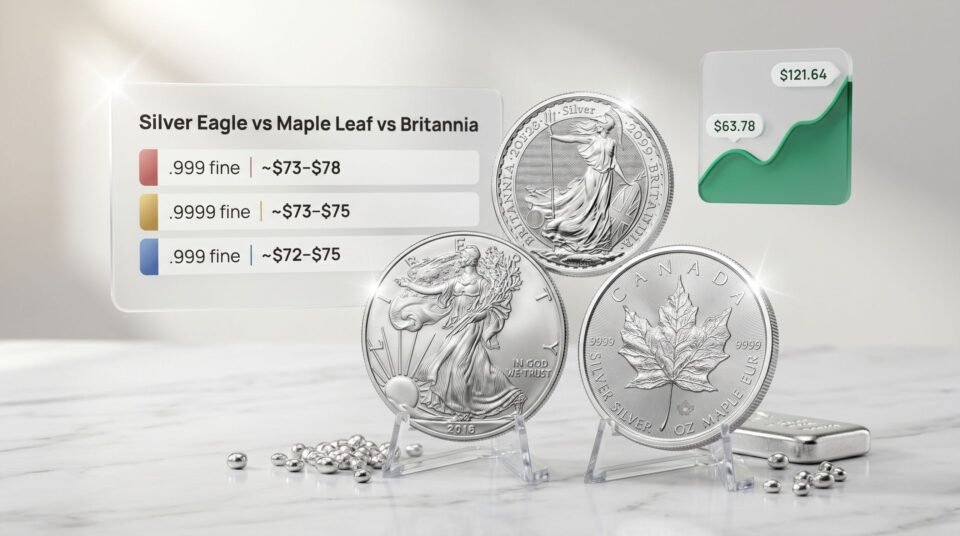
The Silver Coin Decision Most Investors Get Backwards
Most precious metals buyers approach the Silver Eagle vs Maple Leaf vs Britannia decision the same way they might choose a brand of running shoes: by appearance, familiarity, and reputation. This is the wrong analytical frame entirely. The coin that feels best at purchase is not necessarily the coin that performs best at exit. In a physical silver market defined by structural supply deficits, tightening above-ground inventories, and uneven dealer liquidity across jurisdictions, the distinction between those two moments matters more than most buyers ever consider.
The more useful framework treats coin selection as an exit strategy decision made at the point of entry. Before a single ounce of silver changes hands, the serious buyer should already have a clear picture of where they intend to sell, how long they plan to hold, what tax treatment applies in their jurisdiction, and how much of the acquisition premium they expect to recover. Those four variables, not the coin’s design or mint heritage, determine which sovereign silver coin belongs in a portfolio.
When big ASX news breaks, our subscribers know first
Why the Silver Market Backdrop Reshapes This Decision Right Now
Understanding which coin to buy requires first understanding the environment in which that coin will eventually be resold. Silver’s physical market is not behaving like a normal commodity cycle. According to the Silver Institute’s World Silver Survey 2026, the global market is on track to record a 46.3 million ounce supply deficit in 2026, widening from 40.3 million ounces in 2025 and marking the sixth consecutive year in which global silver consumption has exceeded production.
The structural reason for these persistent silver supply deficits is often overlooked by retail buyers. Approximately 70 to 80% of annual global silver output is extracted as a byproduct of copper, zinc, and lead mining operations rather than from dedicated silver mines. This means that even when silver’s price rises sharply, mine supply cannot respond proportionally because production decisions are driven by base metal economics, not silver’s spot price.
Key Insight: When above-ground silver inventories are declining and new supply cannot ramp in response to price signals, the coins that carry the strongest dealer recognition command a measurable premium recovery advantage at resale. In a scarce physical market, liquidity quality is not uniform across coin types.
Silver’s nominal price reached $121.64 on January 29, 2026, representing a significant run before retreating to approximately $63.78 by mid-2026. This pullback has created what practitioners describe as a premium compression window: a period in which sovereign coins trade closer to historical over-spot averages before the next price movement. For accumulators, this is precisely the environment in which coin selection decisions compound in importance. Consulting a precious metals market analysis before committing capital can sharpen these timing decisions considerably.
The Four Variables That Actually Determine Which Coin Wins
Stripping away brand loyalty and aesthetics, the Silver Eagle vs Maple Leaf vs Britannia comparison resolves into four measurable variables. Each coin performs differently across these dimensions, and each investor’s weighting of these variables will differ based on circumstance.
Variable One: Acquisition Premium and the Cost of Entry
The over-spot premium is the true cost of acquiring silver through a government-minted coin. It is not a fee charged by the mint so much as a market-determined liquidity surcharge. The coin with the most recognised resale demand commands the highest premium at purchase because buyers are partially paying for exit certainty.
Mid-2026 premium benchmarks at approximately $63.78 spot:
| Coin | Typical Premium Range | Approximate Single-Coin Price |
|---|---|---|
| American Silver Eagle | 15–22% above spot | ~$73–$78 per coin |
| Canadian Silver Maple Leaf | 13–18% above spot | ~$73–$75 per coin |
| British Silver Britannia | 12–17% above spot | ~$72–$75 per coin |
The compounding effect of this gap becomes significant at volume. On a 20-coin purchase, a $3 to $5 per-coin premium difference represents $60 to $100 in additional cost — roughly the price of one additional ounce of silver. Scale that to 100 coins and the premium gap translates directly into 4 to 8 ounces of physical metal that a lower-premium buyer would own outright. At scale, this is not a rounding error; it is a meaningful position size difference.
Variable Two: Purity and Its Practical Significance
All three coins contain one troy ounce of silver, but their fineness differs. For a deeper understanding of silver’s dual role as both a monetary and industrial metal, purity standards carry implications beyond simple bullion comparisons.
- American Silver Eagle: .999 fine (99.9% silver)
- British Silver Britannia: .999 fine (99.9% silver), upgraded from lower purity in 2013 (The Royal Mint)
- Canadian Silver Maple Leaf: .9999 fine (99.99% silver), the highest purity of any government-issued one-ounce silver bullion coin (Royal Canadian Mint)
The physical silver content difference between a .999 and a .9999 coin is approximately 0.03 grams per coin, which is negligible in isolation. However, where purity becomes genuinely consequential is in three specific contexts:
- IRA compliance: The Maple Leaf’s .9999 fineness exceeds the IRS minimum purity threshold for precious metals IRAs without ambiguity, reducing the likelihood of custodian friction or eligibility questions.
- International and institutional transactions: Higher purity reduces the probability of assay disputes when coins change hands across dealer networks with varying standards.
- Marginal resale pricing: Some dealers in competitive markets apply a small premium to .9999 coins over .999 equivalents, particularly in European and Asian networks where the Maple Leaf’s purity reputation is well established.
Variable Three: Liquidity Geography
Liquidity is not a fixed characteristic of a coin. It is, furthermore, a function of where you intend to sell it. The same coin can be an immediate, frictionless sale in one dealer market and a slow, discounted transaction in another.
| Coin | US Domestic Dealers | European and Asian Dealers | Online and Vault Platforms |
|---|---|---|---|
| American Silver Eagle | Highest recognition, instant liquidity | Moderate recognition | Strong |
| Canadian Silver Maple Leaf | Strong recognition | Highest global recognition | Strong |
| British Silver Britannia | Lower recognition at local shops | Strong in UK and Europe | Strong |
The American Silver Eagle has been produced continuously since 1986, making it the longest-running US sovereign bullion coin program in history. That 40-year track record has embedded it deeply into the domestic dealer ecosystem. Walk-in liquidity at US coin shops, pawn operators, and private buyers is effectively universal.
The Canadian Silver Maple Leaf has been issued annually since 1988 and carries comparable or superior dealer recognition to the Eagle across European and Asian markets. For investors with international resale horizons, this geographic reach is a meaningful advantage. A detailed comparison of American Eagle vs Canadian Maple Leaf coins provides further context on their respective dealer network strengths.
The British Silver Britannia’s key liquidity caveat is specific to walk-in US dealer transactions. Not every local American coin shop will immediately price a Britannia on sight. For vault storage buyers, online sellers, or investors in UK and European markets, however, this friction point is largely irrelevant.
Variable Four: Tax Treatment — The Most Overlooked Structural Advantage
Of all the variables separating these three coins, the tax treatment differential is the least discussed and arguably the most financially significant over multi-year holding periods.
The British Silver Britannia carries legal tender status in the United Kingdom with a face value of £2. Under HMRC rules, profits realised by UK residents from the sale of Britannias are exempt from Capital Gains Tax (The Royal Mint). This structural advantage compounds meaningfully across a five to ten year holding period.
Warning for UK Investors: Dismissing the Britannia’s CGT exemption as a technicality is a costly miscalculation. At a hypothetical silver price appreciation of 50% over seven years on a 100-coin position, the CGT exemption could represent a four-figure after-tax saving for a higher-rate UK taxpayer. That figure dwarfs any per-coin premium differential many times over.
The critical clarification for US investors is that the CGT exemption does not travel with the coin. US capital gains tax applies to silver profits regardless of which coin is held. Tax treatment is determined entirely by the investor’s jurisdiction, not the coin’s country of origin.
IRA Eligibility: What the US Tax Code Actually Requires
Precious metals held inside a self-directed IRA must meet specific IRS fineness standards under Internal Revenue Code Section 408(m). For silver, the minimum purity threshold is .999 fine. All three coins clear this bar, but their standing in IRA administration is not identical.
| Coin | IRA Eligible? | Basis | Custodian Friction |
|---|---|---|---|
| American Silver Eagle | Yes | Explicitly named in IRC §408(m)(3) | None |
| Canadian Silver Maple Leaf | Yes | .9999 purity exceeds IRS minimum | Minimal |
| British Silver Britannia | Broadly accepted | .999 purity plus Royal Mint provenance | Low to moderate |
The Eagle holds a unique statutory position: it is one of the only silver coins granted an explicit named exemption within the US tax code itself. This eliminates any custodian ambiguity at the administrative level. Investors adding Britannias to a retirement account, consequently, should confirm eligibility with their specific custodian before purchasing.
Coin Profiles: Security Architecture and Unique Attributes
American Silver Eagle: Domestic Liquidity Champion
The Eagle’s competitive advantage is straightforward: 40 years of unbroken production history and universal US dealer recognition. The 2026 edition carries additional secondary market significance as both the programme’s 40th anniversary and a year marking the United States’ 250th birthday. Anniversary attention historically firms up resale demand in the secondary market without transforming a bullion coin into a collectible.
Strategic fit: US investors who prioritise same-day domestic resale, airtight IRA eligibility with zero custodian friction, and investors whose exit scenario is overwhelmingly US-domestic.
Strategic limitation: The highest premium of the three coins. Investors paying 20% above spot are partly funding the liquidity premium rather than acquiring additional silver content.
Canadian Silver Maple Leaf: The Value and Purity Benchmark
The Maple Leaf’s 2026 edition is the series’ 39th annual issue, with the obverse now carrying the effigy of King Charles III, introduced in 2024 and replacing Queen Elizabeth II’s portrait, which appeared on the coin from 1988 through 2023 (Royal Canadian Mint).
Four integrated security technologies are built into every Maple Leaf (Royal Canadian Mint, Bullion DNA):
- Radial line machining producing a unique light-diffraction pattern visible to the naked eye
- Micro-engraved privy mark with a “26” designation on 2026 issues, visible only under magnification
- BULLION DNA digital fingerprint registered to each production die
- MINTSHIELD surface protection significantly reducing milk spotting, the most common cause of Maple Leaf surface degradation
At today’s silver prices, a convincing counterfeit is worth serious criminal effort. These technologies are not cosmetic features but functional anti-counterfeiting measures with industrial production standards behind them.
Strategic fit: Value-focused accumulators, investors with international resale horizons, and IRA investors who want unambiguous purity compliance without depending on statutory naming.
British Silver Britannia: Security-First with a Tax Advantage
Issued annually since 1997 and upgraded to .999 fine silver in 2013, the Britannia carries four interlocking anti-counterfeiting features introduced in 2021 (The Royal Mint, press release, September 2020):
- A latent image below Britannia’s gown alternating between a trident and a padlock as the coin is tilted
- Surface animation in the background field creating a rolling wave effect as the viewing angle shifts
- Micro-text engraving of the Latin phrase Decus et Tutamen at the rim, visible only under magnification
- Laser-engraved tincture lines on the Union Jack of Britannia’s shield
The Royal Mint has described the Britannia as the world’s most visually secure bullion coin. For investors accumulating large positions, these features carry material practical value. In addition, a thorough review of Britannias versus Maple Leafs from experienced stacker communities offers useful ground-level perspective on handling and storage characteristics.
Strategic fit: UK investors for whom CGT exemption creates compounding after-tax returns; online and vault-storage buyers for whom local dealer recognition is irrelevant; security-conscious stackers building high-value positions.
Scenario Modelling: Which Coin Wins for Your Investor Profile?
Scenario One: The US-Based IRA Investor
- Stack size: 50 to 200 coins
- Priority: Tax-advantaged retirement account, zero custodian ambiguity, domestic exit
- Optimal coin: American Silver Eagle
- Key trade-off: At a 20% premium on 100 coins at $63.78 spot, Eagles cost approximately $763 more than an equivalent Maple Leaf stack, representing roughly 12 additional ounces of silver foregone
Scenario Two: The Value-Focused Accumulator
- Stack size: 100 to 500 coins
- Priority: Maximum silver per dollar, strong global exit options
- Optimal coin: Canadian Silver Maple Leaf
- Key advantage: The per-coin premium saving on 100 coins translates directly into 4 to 8 additional ounces of physical silver at current prices
Scenario Three: The UK Investor with a Multi-Year Horizon
- Stack size: Any, held 5 to 10 years
- Priority: After-tax return maximisation, CGT-free exit
- Optimal coin: British Silver Britannia
- Key advantage: The CGT exemption under HMRC rules compounds across the holding period. At a 50% silver price appreciation over 7 years, the tax-free exit on a 100-coin position could represent a four-figure after-tax saving for a higher-rate UK taxpayer
Scenario Four: The Internationally Diversified Stacker
- Stack size: Mixed, across multiple jurisdictions
- Optimal approach: A blended allocation across all three coins
- Suggested framework:
- Eagles for US dealer network coverage and IRA eligibility
- Maple Leafs for global liquidity depth and premium efficiency
- Britannias for security-tier holdings and UK CGT optionality where applicable
This blended approach eliminates single-coin concentration risk in any one dealer market and builds a position with layered exit optionality.
The next major ASX story will hit our subscribers first
The Premium Compression Window and What It Means for Timing
Silver’s run to $121.64 on January 29, 2026 drove dealer premiums on sovereign coins significantly above historical norms as physical inventory tightened. The subsequent correction to approximately $63.78 has compressed those premiums back toward historical averages, creating a window in which sovereign coins are available at materially lower over-spot costs than during the January peak.
Historically, premium compression windows close when spot moves again. Investors who accumulate during these periods lock in more silver per dollar and position themselves to recover a greater share of their premium at the eventual exit. Reviewing the current silver market outlook alongside gold-silver ratio analysis can help investors contextualise where sovereign coin premiums sit relative to broader market cycles.
The value argument for Maple Leafs and Britannias strengthens further during these windows because the absolute dollar difference versus Eagles widens, making the lower-premium coins even more attractive for volume buyers. The six consecutive annual supply deficits projected through 2026, combined with the structural inability of mine supply to respond to silver’s price signals, suggest that the fundamental conditions supporting sustained silver demand are not cyclical.
The widening gap from 40.3 million ounces in 2025 to a projected 46.3 million ounces in 2026 (Silver Institute, World Silver Survey 2026) reflects a progressively tightening physical market where the strategic value of holding the right sovereign coin, in the right denomination, for the right exit, becomes increasingly material.
Disclaimer: This article is for informational purposes only and does not constitute financial or investment advice. All figures, premiums, and price data referenced reflect conditions as of mid-2026 and are subject to change. Past performance does not guarantee future results. Investors should consult a qualified financial adviser before making precious metals investment decisions. Tax treatment referenced for UK investors is based on HMRC rules as understood at the time of writing and may vary based on individual circumstances.
Want to Stay Ahead of the Next Major Mineral Discovery on the ASX?
While sovereign silver coins offer a compelling physical metals strategy, investors seeking real-time exposure to high-impact mineral discoveries can gain an immediate edge through Discovery Alert, where the proprietary Discovery IQ model instantly identifies significant ASX announcements across 30+ commodities — explore the historic returns major discoveries have delivered and begin your 14-day free trial to position yourself ahead of the broader market.