


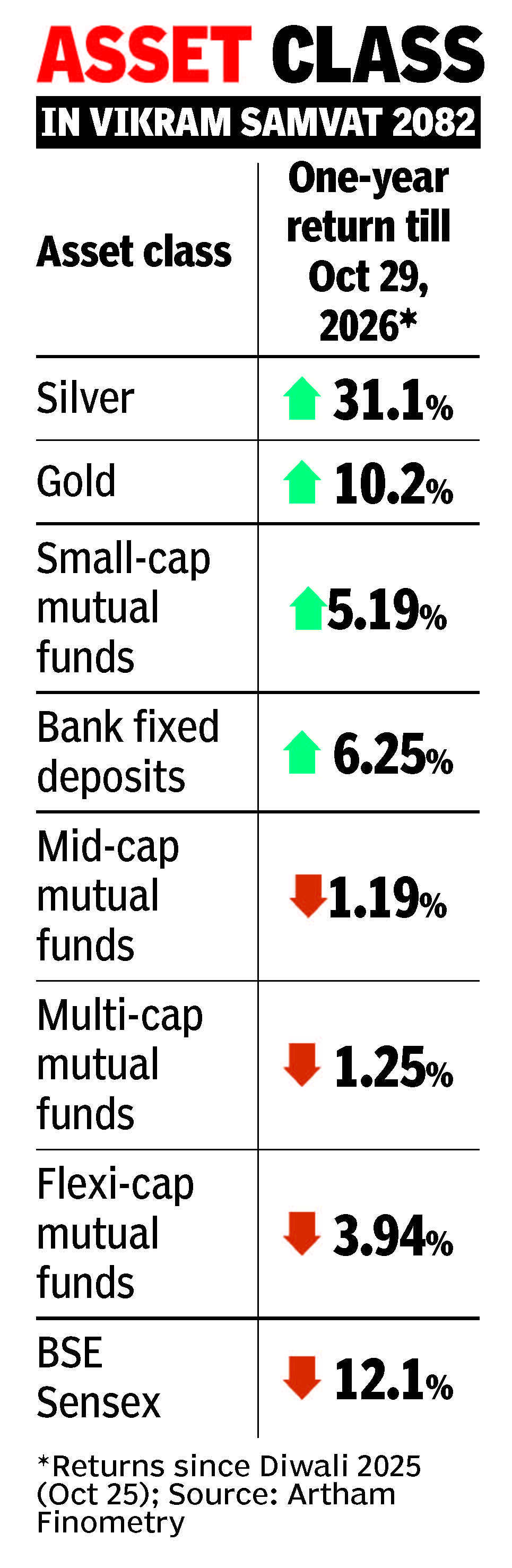
Investors who backed precious metals emerged the biggest winners in Vikram Samvat 2082, while Indian equities endured a difficult year. Silver and gold gained 31.1% and 10.2% respectively since last Diwali. The sensex, meanwhile, declined by 12.1%.Small-cap mutual funds and bank fixed deposits delivered positive returns, while most other equity fund categories recorded marginal losses.The asset class performance clearly shows a year shaped by geopolitical tensions, volatile crude prices and foreign investor selling. Precious metals attracted investors seeking protection against uncertainty. Indian equities faced pressure as foreign institutional investors reduced their exposure to domestic markets.“Samvat 2083 will a shift from momentum-driven investing to selective asset allocation. Frontline indices have corrected amid heavy FII outflows and elevated crude prices, but this is a valuation reset rather than a structural breakdown. Strong domestic liquidity continues to support mid- and small-cap stocks, while gold has emerged as a hedge against uncertainty,” said Jayesh Vithalani, a financial consultant.Despite the market turbulence, India’s economic fundamentals remained resilient. The economy is estimated to grow around 7% in FY2026-27. GST collections stood at approximately Rs 2 lakh crore while several listed companies also reported earnings growth of more than 12%. Monthly systematic investment plan (SIP) contributions touched a record Rs 32,500 crore, indicating continued domestic investor participation. These indicators offered some support amid global uncertainty. Strong domestic consumption, corporate earnings and investment flows could help shape market sentiment in Vikram Samvat 2083.Silver Leads The Asset-class Rally
The maximum returns came from silver
Silver emerged as the best-performing asset class in Samvat 2082, gaining 31.1%. Gold followed with a 10.2% return. Despite silver prices cooling below Rs 2-lakh a kg benchmark levels and gold hovering between Rs 1.4-Rs 1.5 lakh per 10g, the returns have been handsome.Geopolitical uncertainty and demand for safe-haven assets supported the rally in precious metals. Both institutional and retail investors increased their exposure as equity markets turned volatile.“Gold and silver have delivered strong returns as investors increasingly view precious metals as safe-haven assets amid global uncertainty. Heavy buying by central banks, rising inflows into gold ETFs and declining confidence in the US dollar have supported the rally. Silver has also benefited from strong industrial demand. The trend reflects how investors turn to precious metals during uncertain times, as they did during the Covid pandemic,” said Haresh Acharya, director, India Bullion and Jewellers’ Association (IBJA).Small-cap Funds Withstand Market VolatilitySmall-cap mutual funds gained 5.19% during the year, outperforming mid-cap, multi-cap and flexi-cap funds. Mid-cap funds slipped 1.19%, multi-cap funds fell 1.25%, and flexi-cap funds declined 3.94%.The figures point to a divergence within equity mutual funds rather than a uniform decline across the category. Most mutual fund schemes reportedly delivered flat to positive returns, according to the source material.“Despite volatility in equity markets and foreign investor outflows, domestic investors continued to invest through systematic investment plans. Monthly SIP contributions reached a record Rs 32,500 crore, demonstrating the resilience of domestic investment flows. Small-cap funds delivered positive returns, while several other categories remained relatively flat or slipped marginally,” said Mumukshu Desai, director of a city-based financial advisory firm.Fixed Deposits Give Better Returns, Score Over Most MF CategoriesBank fixed deposits delivered 6.25% returns in Vikram Samvat 2082, outperforming the sensex and most mutual fund categories. The returns also exceeded those of mid-cap, multi-cap and flexi-cap funds, which recorded marginal losses. At the end of the June-quarter of FY 2027, Gujarat’s bank deposits stood at Rs 14.79 lakh crore, which grew 10.6% as compared to the corresponding quarter of FY 2026, according to the latest available report by the State Level Banker’s Committee – Gujarat.Banking sector sources told TOI that fixed deposits always play a crucial role in investor portfolios during periods of market uncertainty. “Even though gold and silver attracted investors seeking higher returns and protection against volatility, bank deposits continued to offer predictable and stable returns,” said a source.Realty Sector Stays Steady Despite Challenging March-June StretchWhile weak sentiment and volatility dragged down most asset classes over the past year, real estate in Ahmedabad remained largely steady, delivering moderate returns since last Diwali. The market faced a challenging stretch between March and June as construction input costs rose sharply after the West Asia war started, raising project expenses and slowing some activity, particularly in redevelopment.Taral Shah, chairman of the Indian Green Building Council (IGBC) Ahmedabad, said demand has held up on the back of stronger buyer profiles and longer-term city growth triggers. “Sales have been moderate since last Diwali, but Ahmedabad has seen solid buying from NRIs, and institutional capital is also beginning to flow in. Infrastructure development linked to the 2030 Commonwealth Games and the city’s industrial expansion are supporting end-user demand. Ready-to-move homes are attracting clearer preference from buyers,” Shah said.Kishore Dedhia, chairman of the Organised Real Estate Consultants Association (ORECA), pointed to steady price growth, while cautioning that performance varies by micro-market. “Q3 2026 data places Ahmedabad’s average residential price at Rs 4,837 per sq ft, a 3.7% year-on-year rise. The direction is upward, but the increase is not uniform across segments and localities. Higher steel, cement, fuel, metals and labour costs have pushed up development costs,” Dedhia said. He added that out-of-state buying has increased and that returns depend on entry price and holding costs.“Appreciation is not realised profit until the property is sold,” he said. Redevelopment slowed as cost assumptions changed. Developer Kartik Soni said, “Input costs have risen sharply since the Iran war, upsetting redevelopment feasibility. Many old home owners could not monetise value due to delays, though completed projects benefited them. If societies secure full consent and projects start on time, redevelopment could revive in the new Samvat.”From Global Headwinds to New Opportunities: The Next SamvatThe past Samvat tested Indian equities as global capital increasingly chased the artificial intelligence (AI) boom, say market experts. US, South Korea and Taiwan markets attracted investments in AI infrastructure, semiconductors and data centres, while foreign investors withdrew funds from India amid slower earning growth across large-caps and global capital rotation.Vaibhav Shah, MD, Monarch Networth Capital Ltd said, “The US-Iran conflict pushed crude oil prices higher, widening India’s import bill, fuelling inflation concerns and weakening the rupee against the dollar. The war resulted in a big correction in Indian stock markets, which eventually recovered but at the end of the year again, crude oil prices crossed $100 per barrel bringing the markets down.”These headwinds weighed on several sectors. “Information technology stocks faced concerns over AI-led disruption and cautious global technology spending, while FMCG companies struggled with subdued consumption and modest volume growth. Tourism and hospitality also faced pressure as the West Asia conflict disrupted flights, increased aviation fuel costs which created uncertainty around international travel. This affected airlines and hotels reliant on foreign visitors,” said Vanesh Panchal, director, Aftertrade broking.Dinesh Thakkar, chairman, Tradebulls Securities said, “Sectors which had prominently gained from last Diwali till now were metals (+15.11%) followed by pharma (+14.86%), defence (+6.37%) and PSU banks (+3.0%) while sectors which fell the most were FMCG (-24.38%) followed by realty (-15.38%), IT (-8.56%), auto (-8.15%) and banks (-6.32%). In the new year, defence, capital goods, infrastructure, metals, FMCG, auto and realty sectors may rebound.”Analysts believe the new Samvat could offer selective opportunities in pharmaceuticals and power generation. The 8th Pay Commission could provide more disposable income making consumption-linked sectors worth watching.
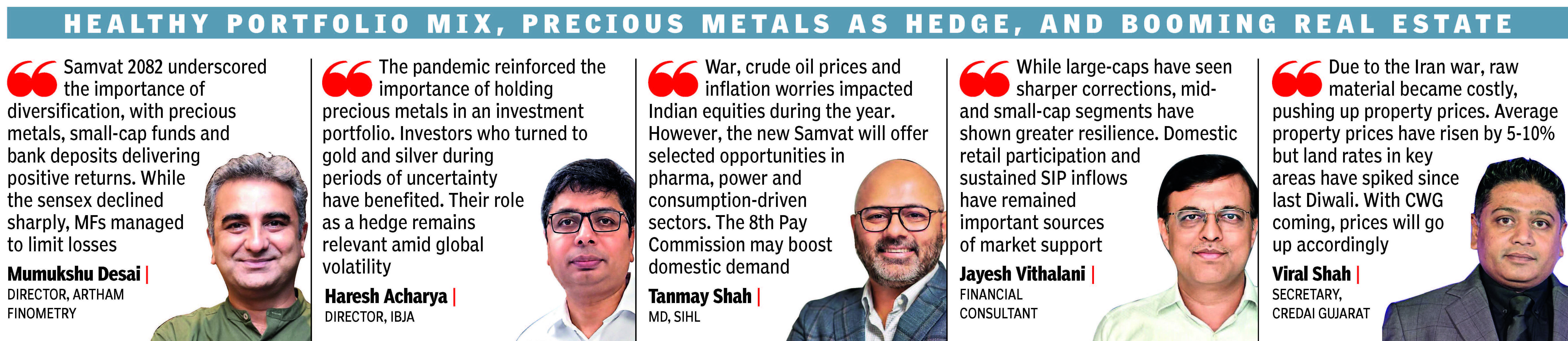
What the industry has to say