
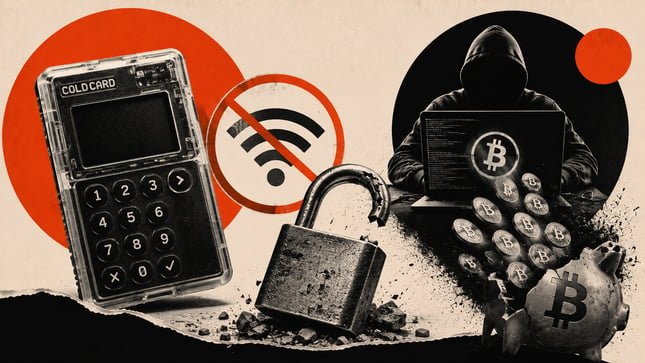
COLDCARD, a Bitcoin-focused hardware wallet by Coinkite powered by air-gapped signing options, was hacked on Thursday, July 30, reportedly resulting in the theft of more than 2,000 BTC and affecting more than 7,300 addresses.
The attackers successfully exploited vulnerable COLDCARD’s air-gapped wallets, which keep private keys offline, through a firmware build error from March 2021 that caused some wallets to generate seed phrases from a much smaller pool of possible values than intended. The reduced randomness pool to create the seed phrase made them vulnerable to guessing, especially in recent times of AI-powered threats, potentially allowing attackers to reconstruct vulnerable seeds without physical access to the devices.
Inside the COLDCARD’s attack method
Typical Bitcoin or crypto wallets use a 12- to 24-word recovery seed, which serves as the digital credential that protects the authority to transact. Still, on Thursday, July 30, multiple COLDCARD wallets were drained of their BTC holdings, raising concerns about non-custodial cold storage wallets.
Block’s Bitcoin Engineering and Security team was the first to report the primary technical root cause of the COLDCARD exploit, highlighting the use of MicroPython’s predictable Yasmarang pseudorandom number generator instead of the device’s hardware random number generator, via the libNgU library.
The shift to MicroPython’s predictable Yasmarang software built the wallet’s starting numbers using predictable data visible to the device itself. These numbers included the device’s Unique ID number, which is printed on the chip, internal system timers that track how many milliseconds the device was turned on, and the order and history of button presses.
This glitch of selecting a seed from a smaller pool of true randomness, rather than a 2²⁵⁶-safe cryptographic combination, allowed the attackers to hack multiple addresses at once. Attackers likely installed the flawed 2021 COLDCARD software on their computers to generate seeds from the same predictable pool and then convert them into public Bitcoin addresses.
Following this, a simple automated script cross-referenced this generated list of vulnerable addresses against the public Bitcoin blockchain to identify those holding BTC.
The impact and the road ahead
The first wave of attack drained 1,082.65 BTC from 1,196 addresses in just 41 minutes, followed by additional waves. Galaxy Research’s latest assessment puts the amount stolen with high confidence at 1,596 BTC across roughly 7,300 addresses, involving three confirmed waves and 14 additional smaller incidents. The firm has also identified a further 448.7 BTC that it believes is likely related to the COLDCARD vulnerability, potentially taking the total above 2,000 BTC, although those funds have not been confirmed by the victims. Galaxy notes that the attack is ongoing and the figures remain subject to further investigation.
Following the hack, CoinKite released multiple firmware upgrades with the help of Rodolfo Novak and a mysterious white hat, Peter D. Gray, also known as Doc-Hex on GitHub.
The initial patch included a hardware-Random Number Generator (RNG) routing correction, along with a build-time test designed to prevent the software fallback from recurring. The company also released corrected Q1, Mk3, Mk4, and Mk5 firmware, followed by a corrected Edge firmware.
These firmware upgrades ensure that future seed phrases for new wallets are generated from a true random pool, but they do not repair the old seed phrase. On Saturday, Doc-Hex added a repository-wide advisory urging users to replace secrets immediately, as versions from 2021 through July 2026 exhibited poor entropy.
Multiple users moved their Bitcoin to new wallets, while many chose multi-signature wallets to avoid such vulnerabilities.
In my opinion, the hack has highlighted that offline wallets work well in most cases, but they are still at risk of built-in firmware, key-generation and zero-day vulnerabilities. Crypto users should add additional security features at their disposal, remain proactive, and avoid keeping all their holdings in a single wallet.
Dean Chen, an analyst at Bitunix, believes that for large Bitcoin holders, the future gold standard would not be a single cold-wallet solution but rather a layered security architecture. Chen added, “The most mature approach will likely combine: Multisignature wallets, Institutional-grade MPC (Multi-Party Computation), Offline key generation, Geographic distribution of key shares, Qualified custodians where appropriate, with the key principle being eliminating single points of failure.”
Can the 2,000 BTC loot ever be cashed out?
Many crypto users believe the stolen BTC will be difficult to liquidate because exchanges and other centralized intermediaries can flag and monitor addresses linked to the stolen funds, and that the hackers will have to use mixers or other black-market methods to cash out their proceeds. Multiple users have also suggested that the hackers take a plea with CoinKite and return the stolen BTC in exchange for an audit fee of 5% of the loot, although this remains an unverified proposal. At the same time, multiple white-hat hackers are working to reclaim the stolen BTC, making it a time-bound challenge for them to monetize their loot.
Kaia Wong, Marketing & Partnership VP at LBank, said in an exclusive chat with FXStreet, “Honestly, I don’t think this ends in a quick payday for them. On-chain forensics firms flagged the address clusters within hours, and every major exchange is now screening deposits against them in real time.”
Wong further added, “ I expect a slow bleed through mixers and OTC channels rather than a clean cash-out. And once any of these coins enter centralized intermediaries, there is still a realistic chance of recovery or freezing.”
On the same question, Oleksandr Filipov, Managing Director at DATAMI, said, “A useful precedent here is the Bitfinex case, in which authorities eventually recovered approximately 95,000 of the 119,754 BTC originally stolen – roughly 80%. In our view, the stolen funds remain partially monetizable, but sustained monitoring meaningfully reduces both their liquidity and their effective value to the attackers.”