
Key Takeaways
- Blockchain technology, which creates secure, transparent and permanent records, is the technology that allows cryptocurrency to exist.
- Tokenizationand smart contracts expand blockchain’s functionality beyond cryptocurrencies.
- Agriculture can benefit from blockchain through dividing assets into digital ownership shares (tokenization), traceability and alternative financing, among other applications.
- Regulation and financial system impacts remain important considerations. While recent legislation aims to provide greater regulatory clarity, questions remain regarding stablecoin oversight, consumer protections, banking sector impacts and the long-term integration of blockchain technologies into the broader financial system.
Blockchain technology is used for securely recording and sharing information. Instead of one company, bank or government maintaining the official ledger of record, debits, credits, etc., blockchain networks distribute control and maintenance across a network of computers that make up a decentralized, digital ledger.
Blockchain is best known as the technology underlying cryptocurrency networks like Bitcoin but can be used in a variety of other applications such as tracking products through a supply chain, automatically carrying out agreements, and digitally representing ownership of physical assets. These uses are creating new opportunities in agricultural, finance and environmental markets while raising questions about regulation, financial risk and data control.
How Blockchain Works
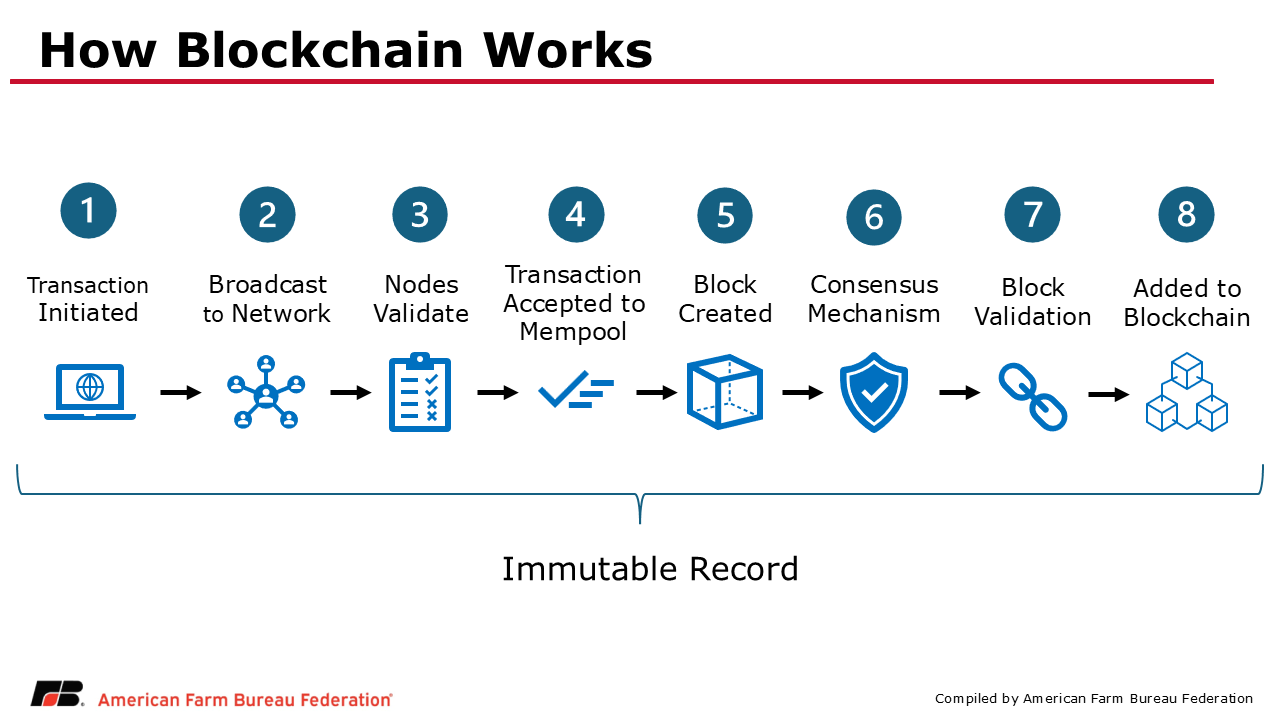
A blockchain transaction begins when a user submits a transaction to the network for review and execution. Upon receipt, a decentralized network of computers, called nodes, checks that the transaction is valid before it can be approved. Because many independent nodes participate, no single party controls the network or its records.
Verified transactions wait briefly in a holding area called a “mempool” before being grouped into blocks. Network participants then agree on the validity of each block through a consensus mechanism that is a set of rules that lets the network settle on a single shared version of the ledger without a bank or other intermediary. Once a block is approved, an algorithm ensures only one accepted version is added to the chain.
Because each block links to the one before it, and because changing the past record would require redoing that work across the entire network, completed transactions become effectively permanent, a characteristic known as immutability. This tamper-resistance is one of blockchain’s defining features.
Many blockchain networks also support smart contracts. Smart contracts are self-executing programs that automatically carry out an agreement’s terms, such as transferring funds, updating records or exchanging assets, once the predetermined conditions are met, without needing a third party. This can reduce transaction costs and increase transparency across many applications.
Three Types of Blockchain Networks
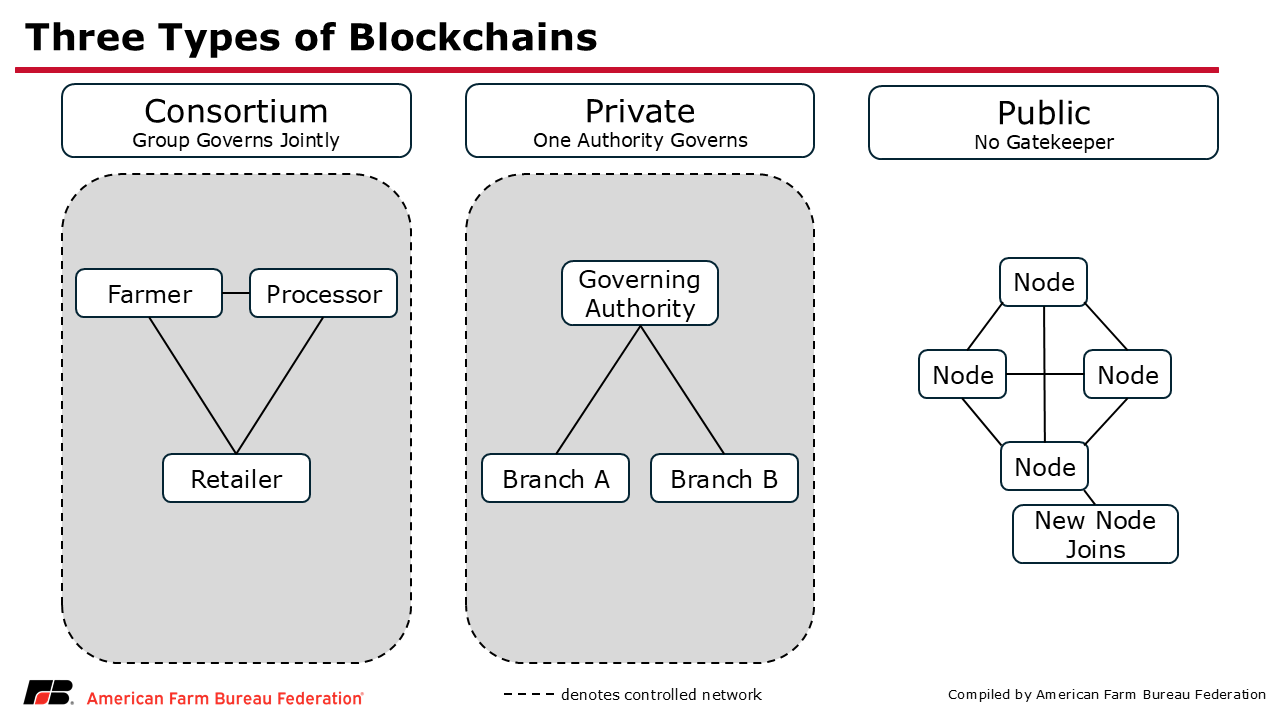
Blockchain networks fall into three broad categories distinguished by who controls them and who can view or add records.
Consortium blockchains are run by a group of organizations that jointly set rules for adding and verifying records and can restrict sensitive data to authorized parties. A system connecting farmers, processors and retailers to improve food-supply traceability is an example.
Private blockchains, usually build for a business or organization, are permissioned and centralized under a single authority. Only approved participants can add or verify records, making this model well suited to sectors like health care and financial services that need to protect sensitive information.
Public (or permissionless) blockchains are fully decentralized where anyone can join, leave, verify or add transactions as long as they follow the network’s rules. Bitcoin is the best-known example.
Crypto Assets
A crypto asset (or digital asset) is any item of value that exists exclusively in a digital form, is recorded on a blockchain or similar network, and has verifiable ownership and usage rights. Virtually any security, good, service, right or interest can be represented this way. It is estimated that there are over 20,000 digital assets currently in existence.
The Commodity Futures Trading Commission (CFTC), alongside the Securities and Exchange Commission, classifies crypto assets into five subcategories:
- Digital securities (tokenized securities) are financial instruments whose ownership is maintained in whole or in part on a blockchain (or crypto) network.
- Digital commodities derive value from the operation of a crypto system as well as supply and demand, rather than managerial efforts of others. Examples of digital commodities include Bitcoin (BTC); Bitcoin Cash (BCH); Dogecoin (DOGE); and Ether (ETH).
- Digital collectibles represent or convey rights to artwork, music, videos, in-game items or internet memes among other things. Like digital commodities, they typically don’t generate passive income. CryptoPunks and meme coins are examples.
- Digital tools are crypto assets that perform a practical function, like a membership, ticket, credential or identity badge. Examples include Ethereum Name Service domains and CoinDesk’s ‘Microcosms’ NFT.
- Stablecoins are designed to maintain a stable or steady value with minimal volatility rather than being designed for investment gains. Stablecoins are frequently tied or “pegged” to a reference asset like the U.S. dollar with the issuer backing that peg by holding reserves such as cash or Treasurys. Stablecoins generally lack certain regulatory protections of a traditional bank deposit, including FDIC insurance.
Blockchain and Crypto Assets in Agriculture
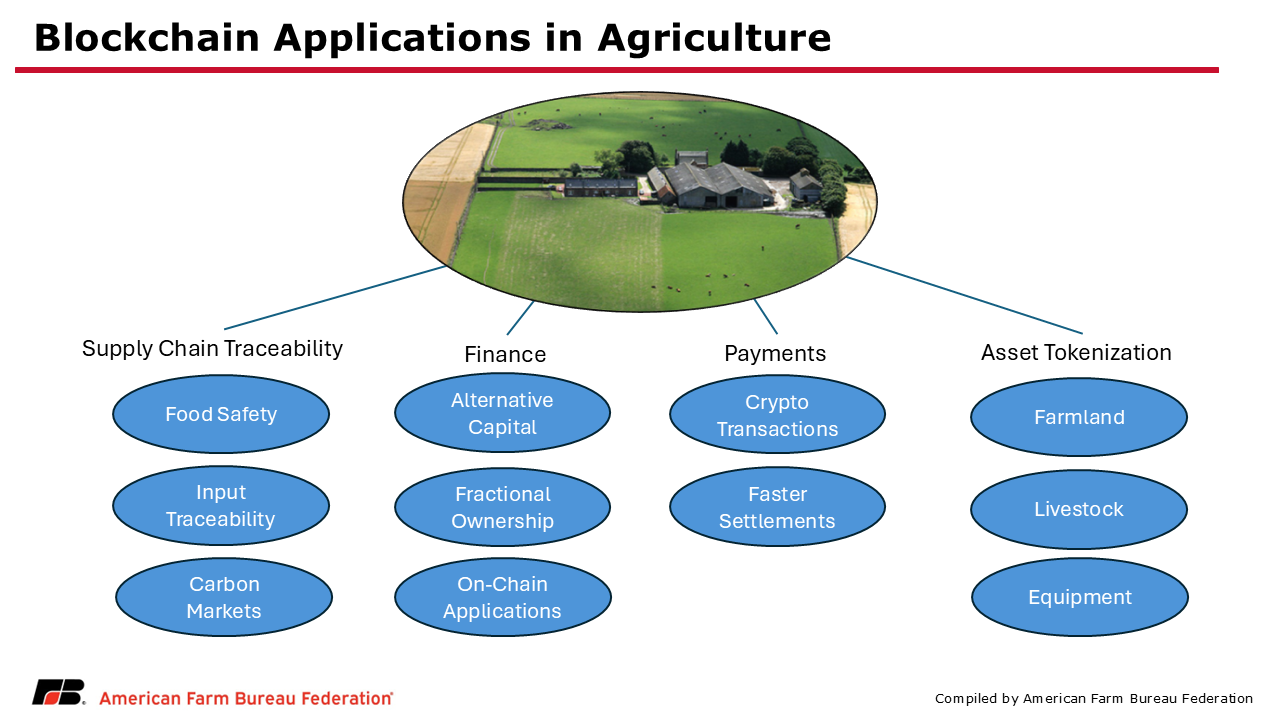
Blockchain technology and crypto assets are increasingly being explored for agricultural applications, particularly in areas related to ownership, supply chain management and financing.
Tokenization
Tokenization is the process of representing ownership rights in a real-world asset as digital tokens recorded on a blockchain allowing those rights to be divided into smaller units and transferred digitally. Agricultural assets such as farmland, livestock, equipment and crops may be tokenized, allowing ownership interests to be divided into smaller units and transferred digitally.
Depending on the structure of the arrangement, tokens may represent ownership interests, a share of revenue or rights to use an asset and can potentially be bought, sold or used as collateral within blockchain-based systems. Smart contracts can automate functions like lease payments and revenue distributions. Proponents argue that tokenization could expand access to capital and improve liquidity in agricultural markets, though adoption and regulatory frameworks are still developing.
Supply Chain Management and Traceability
A blockchain ledger can record activity at each stage of production processing, transportation and distribution, creating a shared timestamped record that participants can access and verify. In agriculture this could support food safety, quality assurance, regulatory compliance and faster identification of the source of contamination or a quality issue.
Input Traceability
Blockchain can also track agricultural inputs such as seed, fertilizer and crop protection products from manufacturer to field. This would create a record to confirm product authenticity and support the documentation needed for certification programs such as organic and regenerative agriculture labeling.
Carbon Credit Verification
Blockchain can record verified data on practices linked to carbon sequestration or conservation practices such as cover cropping or reduced tillage. This creates a transparent, time-stamped record that can support the creation and sale of tokenized carbon credits, addressing longstanding concerns about the verifiability of data underlying carbon markets.
Alternative Financing and Cryptocurrency Transactions
Some agricultural businesses have explored the use of cryptocurrencies as an alternative to traditional payments, citing faster settlement and, in some cases, lower costs. But crypto transactions typically lack deposit insurance and the consumer protections and dispute resolution processes available at insured financial institutions. Losses from errors, fraud or lost access credentials may be difficult or impossible to recover.
Implications for Rural Financial Institutions
The growth of blockchain-based financial services could also have implications for rural banking systems. Community banks provide a significant share of agricultural lending and serve as an important source of financial services in many rural areas. If a larger share of transactions and deposits were to migrate to blockchain-based platforms, traditional financial institutions could experience reductions in transaction-related revenue and deposit funding, potentially affecting their capacity to provide loans and other services.
Onchain Finance
Onchain finance through smart contract protocols provide access to financial service primitives onchain without traditional intermediaries, for example, letting participants contribute assets to a liquidity pool and earn returns based on network activity. These platforms expand access to financial services such as lending, borrowing, trading and liquidity provision, but also carry risks including market volatility, smart-contract vulnerabilities, operational failures and evolving regulation.
Smart contracts can also be used to automate parametric insurance, where payouts are triggered automatically once predetermined conditions are met, such as rainfall falling below a set threshold as measured by a connected weather data feed. This approach can speed claims processing and reduce disputes compared with traditional indemnity-based insurance, though it depends on the accuracy and reliability of the external data source.
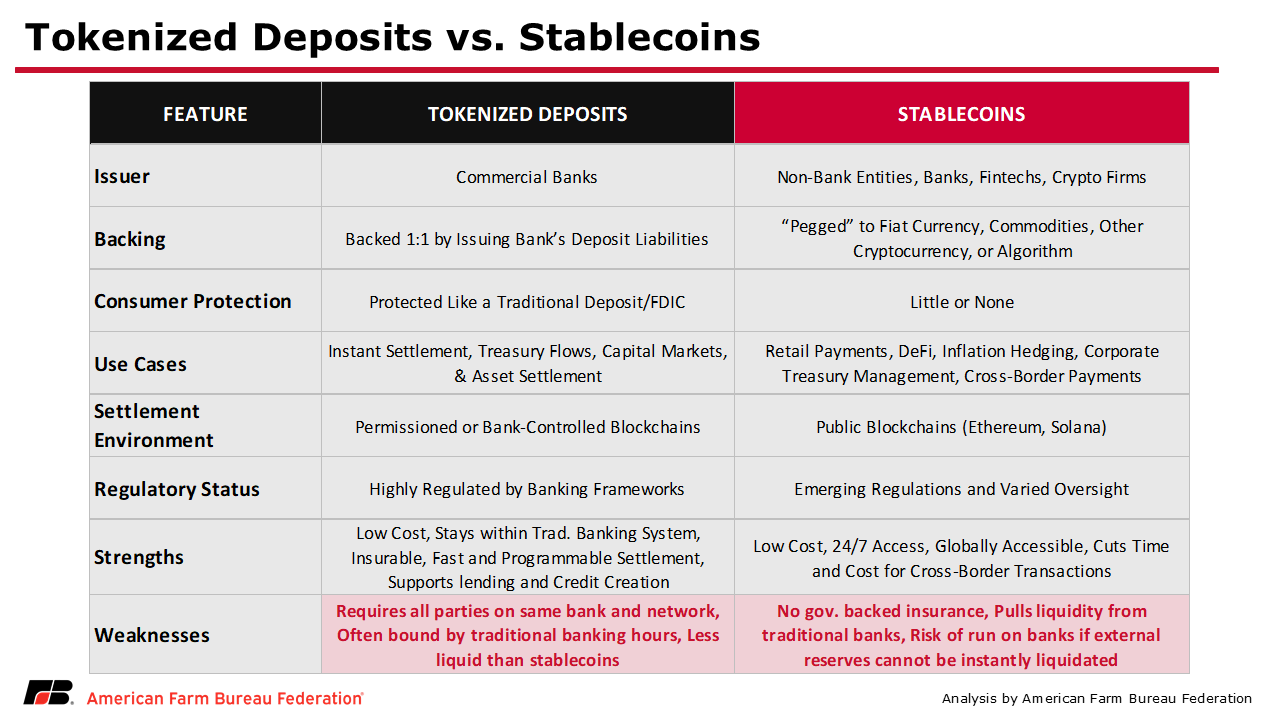
Tokenized Deposits vs. Stablecoins
Tokenized deposits are bank deposits represented digitally on a blockchain. Because they stay on a bank’s balance sheet, they retain standard deposit protections, including FDIC insurance, while adding benefits like 24/7 access, instant settlement and programmable payments.
Stablecoins sit outside the insured banking system. As they gain popularity, they risk pulling funds away from traditional deposits. If a stablecoin’s reserves turnout to be unstable or stable or illiquid, or if the underlying blockchain system fails or misroutes funds, stablecoin holders and issuers could face losses with little recourse, and banks could face sudden, correlated withdrawal pressure.
Regulatory Uncertainty
The absence of a comprehensive regulatory framework has long left blockchain and cryptocurrency regulation fragmented across states, raising compliance costs, the risk of uneven enforcement, and the potential for legal disputes. For agricultural businesses, this uncertainty can complicate decisions about adopting blockchain-based tools for financing, supply chain tracking or asset tokenization, as farmers and lenders weigh potential benefits against unresolved questions. Uneven regulation across states may also add complexity for agricultural operations and lenders working across state lines.
Recent federal legislation has begun to close this gap by establishing clearer regulatory standards for digital assets and stablecoins.
The Guiding and Establishing National Innovation for U.S. Stablecoins (GENIUS) Act, signed into law on July 18, 2025, creates the first federal regulatory framework for payment stablecoins. It defines who may issue payment stablecoins and identifies the regulators responsible for overseeing those issuers. Under the act, bank and credit union subsidiaries, national trust companies, and nonbank entities (excluding non-financial public companies) may apply to become Permitted Payment Stablecoin Issuers (PPSIs). PPSIs are subject to oversight by both federal and state banking regulators. The act also prohibits stablecoin issuers from paying holders interest or yield solely for holding, using or retaining ownership of payment stablecoins.
Congress continues to negotiate broader legislation including the Digital Asset Market Clarity (CLARITY) Act aimed at clarifying oversight responsibilities among federal agencies and strengthening consumer and investor protections across crypto asset markets.
Conclusion
Blockchain and cryptocurrency are often associated with digital currencies, but their potential applications extend far beyond payments and investments. By enabling secure, transparent and decentralized recordkeeping, blockchain has created new opportunities in finance, supply chain management and agricultural asset ownership and traceability.
How far that potential goes will depend on the balance struck between innovation, risk management and regulatory oversight. The GENIUS Act and CLARITY Act represent recent efforts toward a clearer framework, but questions remain about adoption, consumer protection and financial system impact. For farmers and ranchers, lenders and rural communities, staying informed on these developments will be essential as new opportunities and challenges emerge.
AFBF policy supports blockchain technology. AFBF does not currently have policy specifically addressing crypto assets or their markets. As blockchain-based financial products continue to evolve, our farmer and rancher grassroots leaders will need to consider the impacts on farmers, ranchers, lenders and rural communities.