
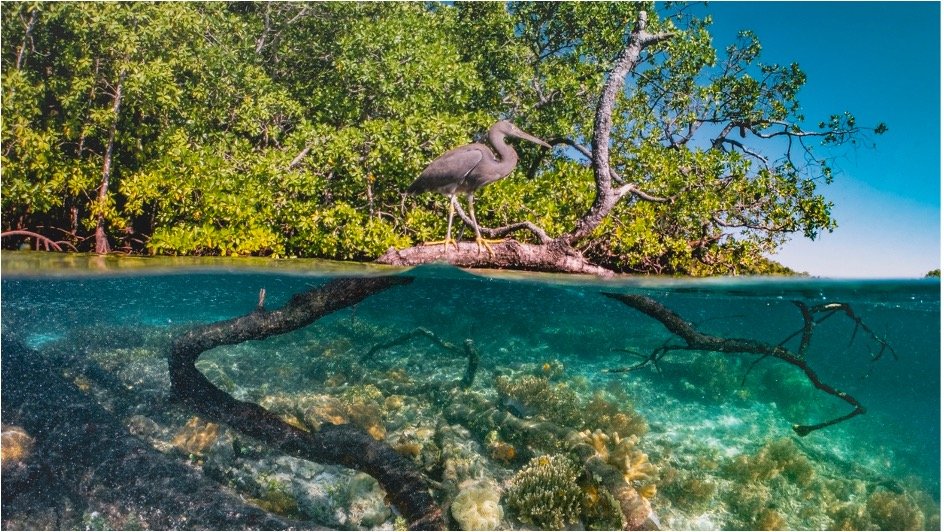
Mangroves are among the most cost-effective, underappreciated and resilient forms of coastal protection.
With roots submerged in seawater, mangroves thrive in hot, muddy, saline environments that would quickly kill most plants. Natural filtration systems remove salt, while intricate root networks anchor them in shifting coastal sediments.
Positioned at the intersection of land and sea, mangroves often fall between funding and regulatory categories — neither fully “green” (terrestrial forests) nor entirely “blue” (marine). Yet this in-between status is also an advantage, allowing mangroves to attract investment and policy attention from both land- and ocean-focused sectors.
Mangroves are gaining prominence within the blue economy, presenting a “triple win” for climate, nature and people. They serve as natural nurseries for fish, prawns, bivalves and crabs, supporting the global food supply while providing income and food security for millions of coastal communities.
Yet their land-based benefits receive less attention. Mangroves play a critical role in shoreline protection, biodiversity conservation, and climate mitigation and adaptation, shielding people and infrastructure along coastlines from flooding, storm surges and sea-level rise.
The financial sector is increasingly recognizing the value of nature, understanding that the health of ecosystems like mangroves directly affects the resilience of its portfolios. Still, key barriers remain, including better integrating mangroves into national and international forest initiatives and providing financial institutions with reliable data on the dependencies between their assets and these critical ecosystems.
The Mangrove Breakthrough, together with its partners in governments, the private sector and civil society, is playing a catalytic role in addressing these barriers and securing the attention and investment mangroves need to help deliver a more resilient future.
Rewiring how mangroves are valued
Investors, NGOs and governments should leverage both “blue” and “green” approaches to mangroves given their immense ecological, social and economic value.
The economic value of mangroves is immense. They protect billions of dollars in coastal infrastructure — airports, ports, factories, railways and cities — while sustaining fisheries, aquaculture and tourism that millions rely on for food and income.
The ecosystem services provided by mangroves can generate up to $50,000 per hectare per year through a valuation of their role in coastal protection, climate regulation, fisheries support, the provision of raw materials and cultural benefits. A 2020 World Bank report estimates that mangroves contribute at least $1.5 billion annually to the economy of Indonesia, a country that is home to nearly a quarter of the world’s mangroves.
The Mangrove Breakthrough is a collective journey aiming to embed the immense value of mangroves into public and private investment decisions. Success will be measured by the mobilization of $4 billion to protect and restore 15 million hectares of mangroves by 2030. Fulfilling this objective could sequester as much as 43.5 million tons of CO2 in mangrove biomass and safeguard an additional 189 million tons of CO2 in the soil, equal to eliminating the annual emissions of 45 coal-burning plants.
Achieving the goals of the Mangrove Breakthrough will restore half of recently lost mangroves, creating habitat for more than 25 billion juvenile fish and other marine species across 37 commercial fisheries each year. At the same time, it would protect coastlines from storms, reduce flood risk for over 15 million people, and safeguard $65 billion in property annually.
Nature risk is financial risk
Financial institutions are beginning to recognize that the health of ecosystems like mangroves directly affects the performance of their portfolios. Despite ongoing headwinds, several global players are making notable progress on nature-related assessments and declarations.
For example, Norges Bank Investment Management’s 2024 report on Climate and Nature Disclosures outlines the bank’s responsible investment strategies and highlights the outcomes of engagements with over 500 companies on climate and nature issues. The global asset manager Mirova states that natural capital is rapidly emerging as a distinct asset class, offering investors a valuable source of diversification. At the end of last year, the Asian Infrastructure Investment Bank released a critical report, advancing the idea that nature should be viewed not only as natural capital to be conserved, but also as essential infrastructure that delivers critical public services.
Nature risk is financial risk, as Julie McCarthy of NatureFinance and Patrick Odier of Building Bridges emphasize. In a recent op-ed, they cited the 2022 floods in Pakistan, which crippled agriculture, drove up food prices and pushed the country to the brink of default. They also point to Indonesia, where palm oil production has driven deforestation and peatland degradation, and to Brazil and Ethiopia, where rising temperatures and erratic rainfall have reduced coffee yields.
Shifting the investment flow
Due to their safeguarding roles, mangroves must be recognized as critical assets for sustaining economies and de-risking financial systems. For this to be realized, three key challenges need to be addressed:
1. Elevating mangroves in deforestation regulations
Mangroves often fall between the cracks of the blue economy and forest-focused efforts. The European Union’s Regulation on Deforestation-free Products does not include mangroves under its definition of “forests.” This is a serious gap to be addressed. However, these regulations offer a promising lever to address certain drivers of mangrove loss, such as cattle grazing and palm oil expansion.
2. Bridging the data gap
Mangrove ecosystems remain underrepresented in global nature-related data platforms, limiting financial institutions’ ability to assess their interdependencies and risks linked to these vital ecosystems. Some tools already exist. For example, the Global Mangrove Watch, developed by the Global Mangrove Alliance, provides near-real-time data on mangrove cover globally.
Building on this, the Mangrove Breakthrough and Restor have just launched the Global Mangrove Project Pipeline, an open-access platform built to anchor capital to high-integrity ecosystem restoration. Currently mapping 316 mangrove project sites across 47 countries and encompassing more than 646,000 hectares, the dashboard brings a direct line of sight to an emerging asset class. Fund managers can filter deals by development stage, geography, and operating model. In doing so, the platform drastically reduces due diligence friction. The result is a transparent marketplace that gives impact investors the key data required to deploy capital into coastal ecosystems with confidence.
Powered by Restor, the platform tracks capital deployment toward the Mangrove Breakthrough’s $4 billion target across public, blended, philanthropic and market-based streams.
3. Broadening the investment thesis
In a few months, we aim to enable the market to map corporate investments and supply chains to areas where mangroves are present. This will allow fund managers to accurately assess the role of mangroves in their portfolios, ensuring the performance of activities such as coastal agriculture, aquaculture, fisheries and real estate, while also enhancing the resilience of communities to extreme weather events.
Activities taking place in or near mangroves should be better mapped and regulated to avoid further loss, support restoration, and strengthen protection. Holding on to the mangrove forests we still have will make financial systems more resilient to climate and nature-related disturbances. That is why it is critical to map mangrove coverage against investors’ portfolios, helping institutions understand where their assets intersect with these vital ecosystems and encouraging better-informed decisions that safeguard them.
The journey is on
The Mangrove Breakthrough, together with its government, private sector and civil society partners, is playing a catalytic role in securing the attention and investment mangroves deserve. As new projects are designed and move through the funding process, it is critical to ensure that mangrove loss is avoided wherever possible. Where impacts cannot be avoided, restoring or replacing mangroves in nearby areas should be a mandatory component of project development — whether for hotels, ports, roads, or other coastal infrastructure.
Mangroves are not just ecosystems to be protected and restored; they are critical natural infrastructure for coastal economies. Recognizing their value and investing in their protection could unlock one of the most cost-effective climate and resilience solutions available today.
Ignace Beguin Billecocq is the executive director of Mangrove Breakthrough.
Monica Medina is an Arnhold Distinguished Fellow at Conservation International.
Guest posts on ImpactAlpha represent the opinions of their authors and do not necessarily reflect the views of ImpactAlpha.