
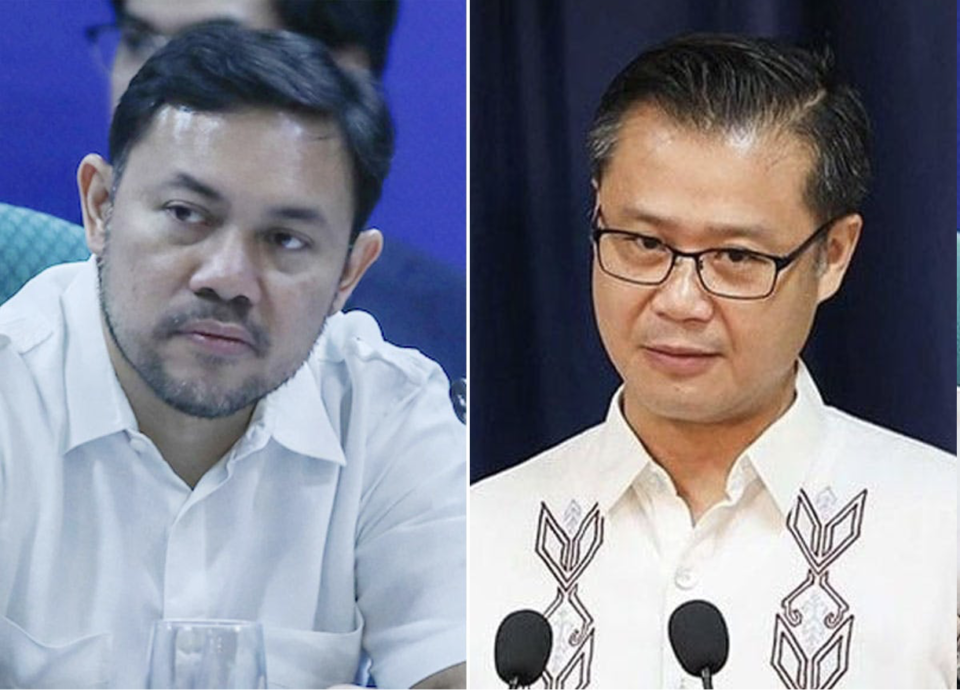
Sen. Mark Villar was named chairman of the Senate committee on finance on Tuesday, May 19, ending the tenure of Sen. Sherwin Gatchalian, who leaves behind sweeping reforms aimed at making the entire budget process transparent.
Villar steps into the committee as he faces allegations from former public works undersecretary Roberto Bernardo of receiving kickbacks from projects during the budget-making process when he was still the agency’s secretary.
Villar has yet to issue a statement on his election as finance chair.
Outgoing chair Gatchalian told reporters that the finance chairmanship “is a position of trust” and stressed that Villar’s diverse experience in different positions in government and his family’s businesses gives him a deep understanding of finance.
“He handled big departments like the DPWH (Department of Public Works and Highways) so he understood public finance. I’m seeing that the finance committee will run smoothly,” he said.
Now that he will effectively be assuming a subtler role in the chamber, Gatchalian reflected on his nearly one year as finance chair.
“For me this is one of the most powerful committees because you hold the country’s wealth in your hands. Every line, if you add one or two zeroes, the budget means something else already,” Gatchalian said.
During his stint, Gatchalian aggressively championed transparency, taking direct aim at the bicameral conference committee of the general appropriations bill.
Historically criticized as a secretive, “smoke-filled room” where lawmakers allegedly horse-trade billions in public funds behind closed doors, the bicam under Gatchalian’s watch was forced into the light, introducing unprecedented oversight to the final stages of the budget’s passage.
On Monday, the newly formed majority consolidated crucial committees, stripping minority lawmakers Bam Aquino and Risa Hontiveros of their vital committee chairmanships during a sweeping reorganization of the chamber.
The realignment formally relegates the minority to the sidelines, with Aquino losing the committee on basic education to Sen. Loren Legarda and Hontiveros losing chairmanship of the health committee to Sen. Bong Go.
The partial reorganization also saw the Tulfo brothers lose control of their respective panels, with Sen. Raffy losing the public service committee to Sen. Rodante Marcoleta and Sen. Erwin losing the games and amusement panel to Sen. Jinggoy Estrada.
Estrada also regained the chairmanship of the committee on national defense, replacing Legarda, while Sen. Joel Villanueva took over the committee on higher education, which Legarda also formerly held.
Despite the shakeup, several key allies of the new leadership retained their turfs, with the Senate President’s sister Sen. Pia Cayetano keeping her hold on the committees on ways and means, energy and sustainable development goals (SDGs).
Sen. Robin Padilla retained the committee on public information and mass media, as well as the committee on cultural communities and Muslim affairs.
Go kept the sports panel and Legarda retained the committee on culture.
Left hanging was the powerful Blue Ribbon committee, vacated by Sen. Panfilo Lacson and reportedly being eyed by Marcoleta. Senate President Alan Peter Cayetano said his sister, Sen. Pia, is being considered to lead the Blue Ribbon.
The chamber also deferred action on the committee on agriculture, currently chaired by Sen. Francis Pangilinan.
The election for a permanent Senate Majority Leader was likewise postponed.
The crucial post was reportedly being dangled to Sen. JV Ejercito, but the prospect vanished after he officially joined the minority bloc earlier in the same session.
In the meantime, Villanueva is serving as the acting Majority Leader.
Grateful
Go welcomed his return as chair of the health committee, which he previously led for six years before being assigned vice chair.
“I am grateful for the trust given to me by my fellow senators. For me, what is important is continuous work for the health of all Filipinos, especially the poor and the disadvantaged,” he said.
The senator said his return to the panel would keep his focus on improving access to public health services, strengthening support for patients and monitoring the proper use of health funds, particularly the funds of state insurer PhilHealth.
“Health funds must go to the patients. Poor Filipinos must not have a hard time seeking check-up, hospitalization and medical help,” he added.
Go’s previous work in the health panel has been tied to several laws, health initiatives and PhilHealth reforms. He is the principal author and sponsor of Republic Act 11463, also known as the Malasakit Centers Act of 2019, which institutionalized Malasakit Centers as one-stop shops for medical assistance. There are now 167 Malasakit Centers operating nationwide that have assisted more than 17 million Filipinos.
He also principally sponsored and is one of the authors of RA 11959, or the Regional Specialty Centers Act, which mandates the establishment of specialty centers within existing Department of Health regional hospitals.
PhilHealth has made significant progress in implementing wide-ranging reforms to make health care more accessible and affordable for Filipinos, especially the poor and marginalized, following numerous appeals from Go.
Notably, PhilHealth lifted the 45-day annual limit on hospitalizations for members and their dependents, allowing continued coverage for prolonged illnesses – especially those involving chronic or life-threatening conditions.