
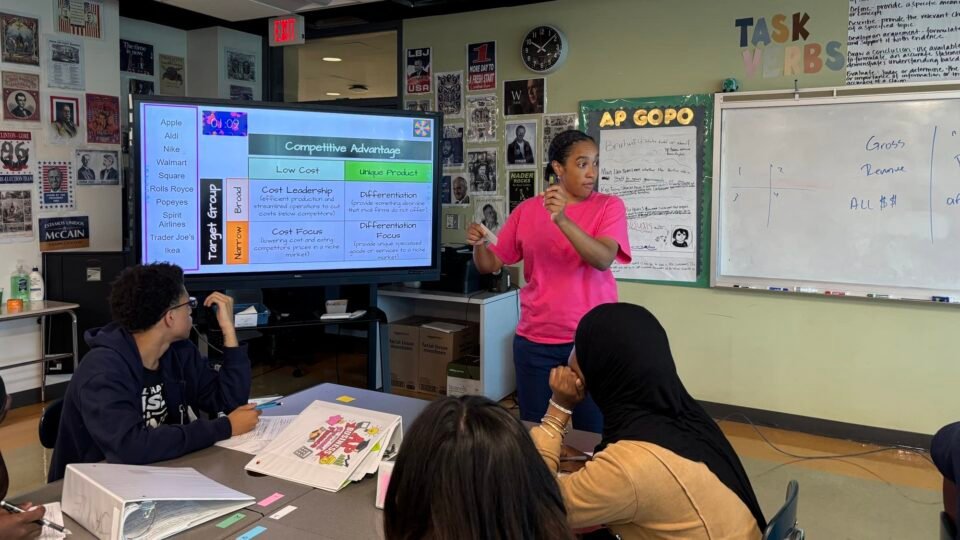
Victoria Beasley is setting up a makeshift commodities market.
“Everybody, grab a golden ticket,” she instructs her students. “If you are a seller, also pick up a bundle of apples. Go, go go!”
Beasley, who is constantly in motion, is in her classroom at Digital Harbor High School, a public school in Baltimore, where she’s teaching AP Business with Personal Finance.
The apples are pictures printed on paper. Each student picks up a ticket that says whether they’re a buyer or seller. It also lists a price: For sellers, that’s the minimum price they can sell their apples. For buyers, it’s the max they’re willing to pay.
“Y’all have to find the person you want to make a deal with,” Beasley instructs.
One seller, Bren Carter, makes his pitch.
“For the apples I have, it’s $16. They’re more flavorful, they’re more juicy,” he said.

Tristan Scott, a Digital Harbor student, listens to a lesson about commodities markets.
Stephanie Hughes/Marketplace
Carter, who’s wearing a shirt that says “rise and grind,” finds a buyer.
“You have me convinced, sir. I would take this deal,” said his classmate, Tristan Scott.
Like future business leaders, they shake hands. But not everyone makes a deal, which Beasley said is to be expected. She asks one student, Nasir Blanding, why he didn’t buy any apples.
“Because they were too expensive, $15 to $20,” he said.
“15 to 20 bucks for apples, and you weren’t about that life,” she responds.
The goal of this activity is to introduce students to different kinds of markets. They’ll also learn about accounting, marketing, how to put together a household budget. It’s all part of a new class from the College Board, the nonprofit behind the SAT test and Advanced Placement courses.
The organization saw that business was the most popular major for college students — over 2.2 million undergraduates were studying it this past spring, according to data from the National Student Clearinghouse. It also noticed the growing popularity of personal finance as a subject. Thirty states now require a stand-alone course in the subject in order to graduate, according to a count by Next Gen Personal Finance. So the College Board combined the two to offer a brand new course: AP Business with Personal Finance.
At Digital Harbor, 12th grader Christopher Borno said he was really excited to take the class.
“My dad really wants me to learn how to start my own business,” said Borno. “He feels like one day, you should learn how to start your own business and not work under people.”

Nasir Blanding, who’s taking the AP business course, also does some day trading.
Stephanie Hughes/Marketplace
Last year, Borno missed a lot of school. But he said this class is motivating him to attend.
“I got into the habit of not showing up. So even on days when I feel like ‘I could just stay home today,’ I’m like, ‘no, I might miss something.’ I want to be there. I want to learn this,” he said.
Students who take this class and do well on the AP exam at the end of the year could receive college credit for an intro-level business course. That’s attractive to 12th grader Wendy Barrios Castaneda.
“I want to make my own law firm at some point, so I hope to take some of this knowledge into consideration,” she said.

Digital Harbor student Wendy Barrios Castaneda is planning to start her own law firm, and hopes the lessons she learns in this class helps with that.
Stephanie Hughes/Marketplace
That interest in business is one reason the College Board is offering this new class, which is expected to be taught in thousands of schools this year.
“We hear so clearly from students that they want to see relevance in their coursework,” said Jennifer Mulhern, vice president of AP program access for the College Board. “They want to understand the connection between what they’re studying and what they could do in the future.”
Mulhern said by teaching business together with personal finance, students will learn about financial concepts from two different angles.
“You think about ‘how does a business invest,’ and then you think about your personal savings, and we thought that would be a rich way for students to learn,” she said.
But some say business and personal finance are two different subjects that don’t necessarily fit together in one high school course.
“Doing both of those at the same exact time is actually a lot, a huge undertaking,” said Carly Urban, an economics professor at Montana State University who studies personal finance education.
Last year, Urban released a working paper that found high schoolers who took a stand-alone course in personal finance saw real benefits.
“They’re just less likely to do things wrong,” said Urban. “They’re 4% less likely to have a subprime credit score, and they also just feel better about keeping up with their day-to-day, month-to-month expenses.”
But when personal finance was embedded in another subject, like math or economics, students didn’t get those benefits.
“There’s something about embedding that makes students not as engaged in it,” Urban said.
The AP business with personal finance course is brand new, so wasn’t part of that research. In response to the criticism, the College Board’s Jennifer Mulhern said the AP exam is a big motivating factor for students. They spend a lot of time studying for it, which she said leads to deeper learning. Also, she points out the new course is built around projects, like acting as a household financial advisor.
“We’ve seen that learning is so strong when students are really asked to apply it,” said Mulhern.

Students who take the AP Business with Personal Finance course could be eligible for college credit if they do well on the end-of-year AP exam.
Stephanie Hughes/Marketplace
At Digital Harbor, Victoria Beasley said about half the kids in her AP business class have already taken her stand-alone personal finance course.
“Our kids need both,” she said. “We focus a lot in the teacher world on math and English. We need to focus on, ‘do you have a bank account?’”
One of her students, Kalel Ross, said he knows adults who don’t understand their finances, and he believes if they’d taken these courses in high school, they would be in better shape now. He also said he’d like more courses about how to make and manage money.
“You know how math has algebra one, algebra two. I feel like it should be like personal finance one, personal finance two, but you learn different things,” he said.
Ross said once you start learning about money, it’s easy to get hooked.