
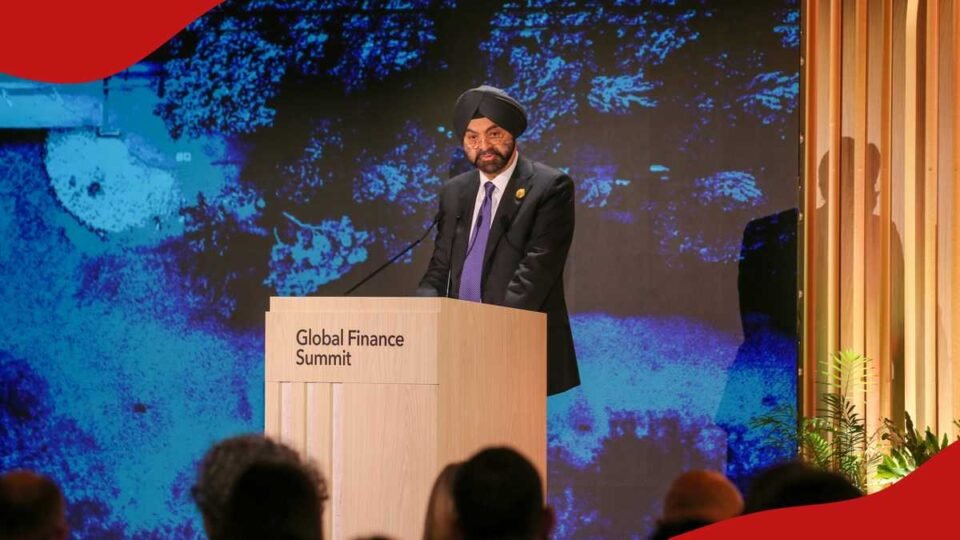
- Senator Okiya Omtatah accused the World Bank of hypocrisy after it published a corruption report focusing on Kenya’s procurement sector in November 2026
- Omtatah argued that billions of shillings in public loans are contracted and spent outside parliamentary oversight under existing Kenyan law
- The senator pointed to specific provisions of the Bretton Woods Agreements Act and the Public Finance Management Act as enabling unaccountable borrowing
Elijah Ntongai is an experienced editor at TUKO.co.ke, with more than four years in financial, business, labour and technology research and reporting. His work provides valuable insights into Kenyan, African, and global trends.
Busia Senator Okiya Omtatah has publicly accused the World Bank of selective focus, arguing that its latest report on corruption in Kenya shields the institution from scrutiny over its own role in the country’s public borrowing arrangements.

Source: Getty Images
In a statement published on November 8, 2026, and amplified on X, Omtatah said the World Bank “cannot condemn corruption while ignoring the accountability gaps within its own lending arrangements,” calling for parliamentary approval, transparent expenditure, and constitutional oversight for every loan contracted on Kenya’s behalf.

What triggered Omtatah’s statement
The senator’s remarks followed the World Bank’s Kenya Economic Update, Edition No. 34, published in November 2026, which identified police stations, land offices, and motor vehicle licensing units as the institutions where Kenyans most frequently pay bribes.
The report estimated that corruption and collusion add 2 percentage points to annual fiscal deficits and recommended electronic procurement and beneficial ownership reforms.
Omtatah does not dispute those findings. His objection is that the report’s exclusive focus on procurement spending allows the World Bank to avoid any examination of how its own lending reaches and moves through the Kenyan public finance system.
He argues that theft on the expenditure side “pales in comparison to the looting of public funds that has happened and continues to happen on the revenue side, where billions of shillings are borrowed without corresponding expenditure lines.”
The legal gaps Omtatah identifies
The senator directed attention to Sections 3, 4, and 5 of the Bretton Woods Agreements Act, Cap. 464, which he says collectively create “a closed loop of unaccountable financial governance.”

He notes that Section 4(1) charges certain payments to the Consolidated Fund without requiring a fresh parliamentary appropriation, while Section 4(3) authorises loans to finance those payments and similarly charges them directly to the Consolidated Fund.
Section 5, he argues, gives specific immunity provisions of the World Bank Agreement the force of law in Kenya, shielding the bank’s assets from seizure and limiting legal action against it.
Omtatah also raised concerns about Section 49 of the Public Finance Management Act, Cap. 412A, which grants the Cabinet Secretary for Finance authority to borrow locally and externally under the guidelines of the most recent Budget Policy Statement.
He argues that the Budget Policy Statement, while approved annually by Parliament, “is not the national legislation the Constitution requires to approve borrowing.”
He further flagged Section 50(7)(b, c & d) of the same Act, which he says allows sizeable portions of foreign loans to be held in offshore accounts and spent abroad without approval from Parliament or the Controller of Budget, an arrangement he considers contrary to Article 206 of the Constitution, which requires all national public revenue to pass through the Consolidated Fund and be spent only with authorisation from both institutions.
Omtatah’s core position is that “public debt is public money” and that Kenya requires accountability across the entire public finance chain, not selective attention to individual corruption cases in procurement.
Source: TUKO.co.ke