
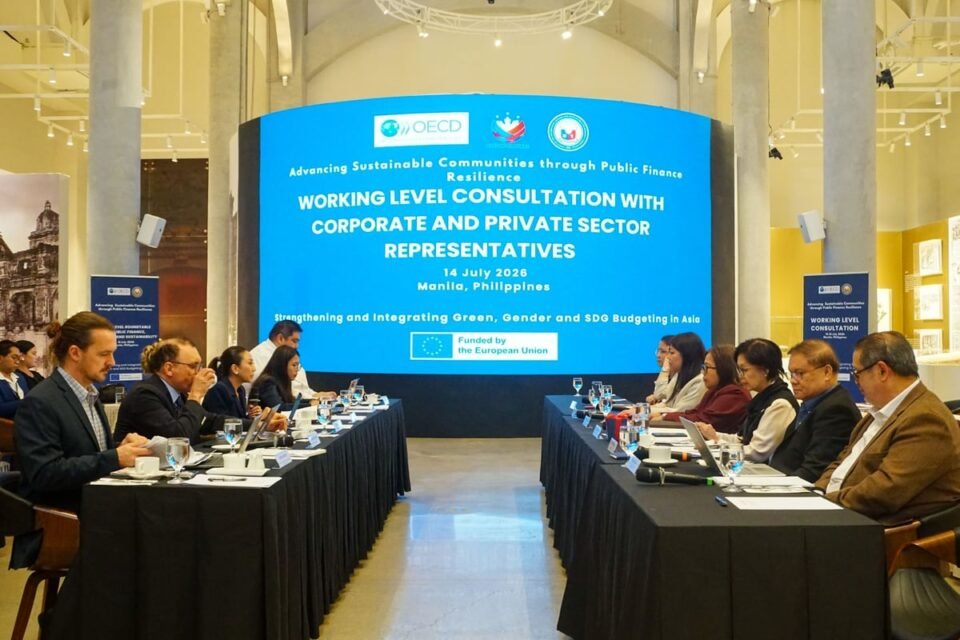
During the discussions, the Department of Finance highlighted the country’s disaster risk financing strategy and ongoing public financial management reforms, including the use of contingency funds, the People’s Survival Fund, and the Local Government Support Fund, to strengthen preparedness, response, recovery, and access to risk-transfer and insurance mechanisms.
Budget Secretary Kim Robert de Leon highlighted the government’s continuing efforts to integrate climate resilience into the national budget, noting that approximately 10 percent of the Fiscal Year 2026 National Budget has been allocated to climate-responsive programs, with the target of increasing this to 12 percent by 2028.
De Leon also cited reforms to institutionalize Climate Change Expenditure Tagging, 2 of 5 integrate Green Public Procurement, strengthen evidence-based investment planning, and expand stakeholder participation through the Open Government Partnership.
“Public finance is one of government’s most powerful tools for building resilience. Through climate-responsive budgeting and strategic investments, we are ensuring that public resources create lasting value for communities and future generations,” De Leon said.
Local representatives shared their community-driven solutions that strengthen resilience while advancing sustainable development.
Governor Jose Enrique Garcia III showcased Bataan’s Green Mobility Program, demonstrating how investments in electric vehicles and supporting infrastructure can improve public service delivery, reduce operating costs, lower carbon emissions, and encourage private sector participation.
Mayor Alfredo Arquillano Jr. of the Municipality of San Francisco, Camotes, Cebu, shared his town’s internationally recognized Purok System, which empowers residents to identify local risks, organize community action, and strengthen disaster preparedness through active citizen participation.
Representatives from Del Carmen, Surigao del Norte highlighted mangrove conservation, Tagbilaran City showcased its ecological solid waste management, Quezon City presented its investments in digital technologies and data-driven disaster risk management.
Presidential Adviser for Sustainable and Resilient Communities Christina Garcia Frasco emphasized that resilience is ultimately measured by its impact on people’s lives.
“It is about protecting lives, safeguarding livelihoods, strengthening local capacities, and ensuring that every Filipino community has the opportunity not only to recover from challenges, but to continue to grow and thrive. Through our partnership with the OECD, we are strengthening public finance, governance, and collaboration so that these priorities translate into meaningful and lasting improvements in the lives of the Filipino people,” Frasco said.
Through the OECD Peer Exchange Mission, OPASRC continues to advance the government’s priority of building sustainable and resilient communities by strengthening policy coordination, promoting evidence-based decision-making, and fostering collaboration across sectors.