
 |
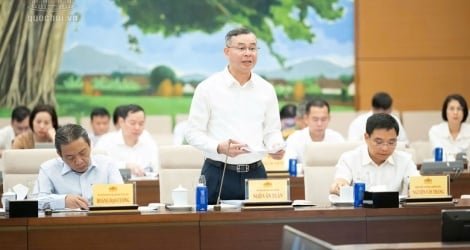
| Minister of Finance Ngo Van Tuan presents the proposal – Photo: National Assembly. |
Continuing its 7th session, on the morning of October 12th, the Standing Committee of the National Assembly gave its opinion on the draft Law on State Budget (consolidated).
In a summary report, Minister of Finance Ngo Van Tuan stated that at the first extraordinary session, the National Assembly gave its opinion on the direction of lawmaking. The Government reported to the Standing Committee of the National Assembly to add the draft law to the 2026 Law and Ordinance Drafting Program for submission to the National Assembly for approval at the second session.
Resource allocation and utilization are linked to the assessment of socio-economic effectiveness.
The draft law comprises 10 chapters and 103 articles (a reduction of 79 articles compared to the two existing laws), essentially inheriting the structure and layout of the current State Budget Law. The contents of the Public Investment Law have been simplified and integrated into the corresponding articles and clauses of the draft law; specific content regarding public investment programs, tasks, and projects is regulated in a separate chapter, Minister Ngo Van Tuan stated.
In terms of basic content, according to the Minister, the Draft inherits the current provisions of the State Budget Law and the Public Investment Law that are still relevant, effective, and have a positive impact; at the same time, it refines them to suit the new situation and the merger of the two laws.
The draft also consolidates the framework for state budget and public investment management, cutting down on overlapping and inconsistent content, linking it with fiscal risk management and promoting digital transformation in state budget management. The public investment plan is comprehensively integrated into the five-year financial plan and the annual state budget estimates.
At the same time, the draft consolidates and harmonizes regulations on the authority of the National Assembly, the Standing Committee of the National Assembly, the Government, the Prime Minister , ministries, and localities regarding the state budget (including public investment expenditure); and on the promulgation of principles, criteria, and norms for the state budget (both public investment and recurrent expenditure).
The Minister also mentioned the need to unify the scope of the state budget and public investment capital, excluding legitimate revenue sources of state agencies and public service units allocated for investment; and to entrust the Government with regulating the use of these revenue sources for investment, avoiding legal loopholes. Furthermore, it called for the institutionalization of regulations on building a national information system and database on the state budget.
According to the Minister, this consolidation aims to promote decentralization and delegation of power while controlling resources. The draft law assigns the Government the authority to specify in detail several provisions currently stipulated in the Law on Public Investment, such as: criteria for classifying projects into groups A, B, and C; procedures, documents, and processes for deciding on investment policies and adjusting investment policies; procedures for preparing, appraising, and deciding on investments… while simplifying procedures, processes, and content to suit the scale of the projects.
The draft also includes provisions for decentralizing the authority to transfer public investment funds from the central government budget from the Provincial People’s Council to the Provincial People’s Committee. It also supplements several principles for decentralizing revenue sources and expenditure responsibilities between provincial and commune budgets, in accordance with Central Committee Conclusion No. 76.
Regarding the allocation and use of resources linked to the assessment of socio-economic effectiveness, the Draft stipulates the principles for assessing socio-economic effectiveness throughout the entire process of implementing public investment projects, the responsibility of the Government to guide the assessment process, the responsibility of ministries, sectors, and localities to issue assessment criteria within their respective fields, and the responsibility of ministries, agencies, localities, and units to assess the investment effectiveness of projects under their management.
This consolidation also adds regulations clarifying the basis and principles for determining and preliminarily calculating the total investment cost during the project proposal process. The regulations ensure priority is given to allocating budget for development investment and breakthrough development in sectors, fields, ethnic policies, and regions with particularly difficult socio-economic conditions… in order to implement the Party and State’s guidelines and policies in each period.
Strengthening discipline and order in state budget management.
Addressing difficulties and obstacles, supplementing management tools, and strengthening discipline and order in state budget management were the next topics discussed by the Minister of Finance.
Accordingly, the draft adds the principle that loans of the state budget are managed in a balanced manner within the state budget fund, expanding the scope of using the state budget reserve, financial reserve fund, increased revenue sources and remaining expenditure estimates to respond to and overcome emergencies related to national and ethnic interests, and stabilize the macroeconomy; and allows for the immediate use of increased state budget revenue generated during the operation process.
The draft regulations specify the categories of development investment expenditures, including public investment expenditures and other development investment expenditures; and reduce three cases where state budget expenditures are allocated from two sources (recurrent expenditures and investment expenditures) compared to current regulations, in order to accurately reflect the nature of the expenditure.
Another point is to unify the authority of the Government to issue regulations, standards, and norms for state budget expenditures nationwide; and the authority of ministries and central agencies to issue standards, regulations, and economic-technical norms within their respective sectors and fields (in cases affecting budget expenditures, the Ministry of Finance must provide its unified opinion on budget balance before issuance).
The consolidated draft also adds the responsibility of the Ministry of Science and Technology to compile and propose a list and level of public investment expenditure for the next five years, including unallocated budget sources, contingency funds, increased revenue, and remaining central government budget expenditure estimates in the fields of science, technology, innovation, and digital transformation, in order to align with current regulations.
In addition, the draft narrows the scope of state budget transfers and the time limit for disbursing transferred funds to strengthen budgetary discipline and order.