
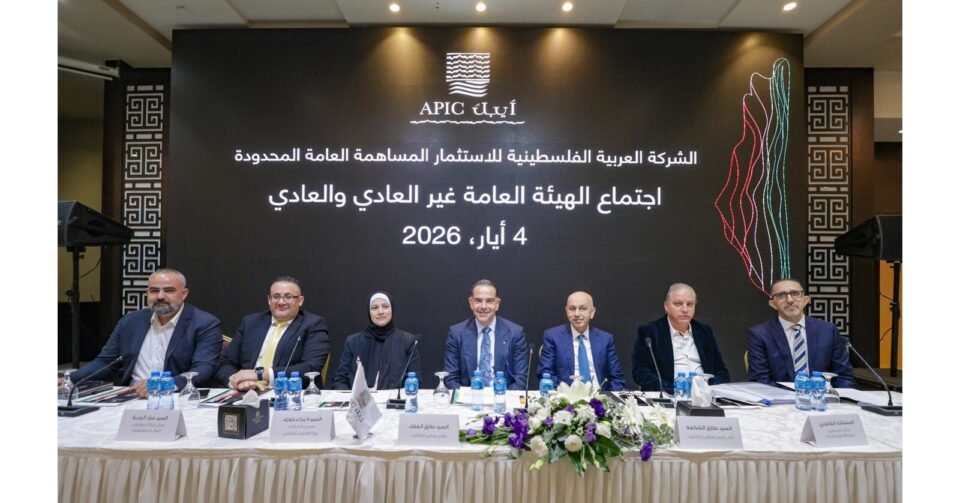
RAMALLAH, Palestine, May 4, 2026 /PRNewswire/ — The general assembly of Arab Palestinian Investment Company (APIC) convened its extraordinary and ordinary meetings on Monday, May 4, 2026, in Ramallah, Palestine. The meetings were chaired by APIC Chairman and CEO Tarek Aggad, and attended by members of APIC’s Board of Directors, representatives of the Ministry of National Economy (companies’ registrar), the Palestine Capital Market Authority, the Palestine Exchange, the company’s external auditors, legal counsel, and many of its shareholders.
During the extraordinary meeting, the general assembly ratified increasing APIC’s authorized capital from USD 160 million to reach USD 180 million.
At the ordinary general assembly meeting, the general assembly approved the distribution of dividends to shareholders of record as of the date of the meeting, totaling 8% of APIC’s paid-in capital of USD 160 million. The distribution includes 5% in cash dividends amounting to USD 8 million, and around 3.1% in stock dividends equivalent to five million shares. Following the distribution of stock dividends, APIC’s paid-in capital will increase to USD 165 million.
The general assembly also elected a new board of directors for a four-year term. The board comprises eleven distinguished business leaders, bringing together a diverse range of expertise across investment, corporate governance, manufacturing, trade, services, finance, and entrepreneurship. The newly elected board members are Tarek Omar Aggad, Tarek Shakaa, Hashim Shawa, Maysa Baransi, Mohammad Abukhaizaran, Riham Hussein (representing National Insurance Company), Raya Sbitany (independent member), Dr. Mazen Hassounah, Nashat Masri, Lana Ghanem, and Ahmad Atwan.
About APIC
APIC is a public shareholding investment company listed on the Palestine Exchange (PEX: APIC). It holds diversified investments across the manufacturing, trade, distribution and service sectors in Palestine, Jordan, Saudi Arabia, the United Arab Emirates, Iraq and Turkey through its group of subsidiaries: Siniora Food Industries Company; Unipal General Trading Company; Palestine Automobile Company; Medical Supplies and Services Company; National Aluminum and Profiles Company (NAPCO); Reema Hygienic Paper Company; Sky Advertising and Promotion Company; Arab Leasing Company and Arab Palestinian Storage and Cooling Company. The company also peruses investment and geographic diversification beyond Palestine and across regional and global markets through its investment arm APIC Capital, which manages a portfolio combining direct stakes in private and publicly listed companies alongside investments in a select group of leading private equity and venture capital funds. APIC employs over 3,400 staff through its group of subsidiaries. For more information, visit https://apic.ps/
Photo: https://mma.prnewswire.com/media/2971851/APIC.jpg
Logo: https://mma.prnewswire.com/media/640722/5951267/APIC_Logo.jpg
