
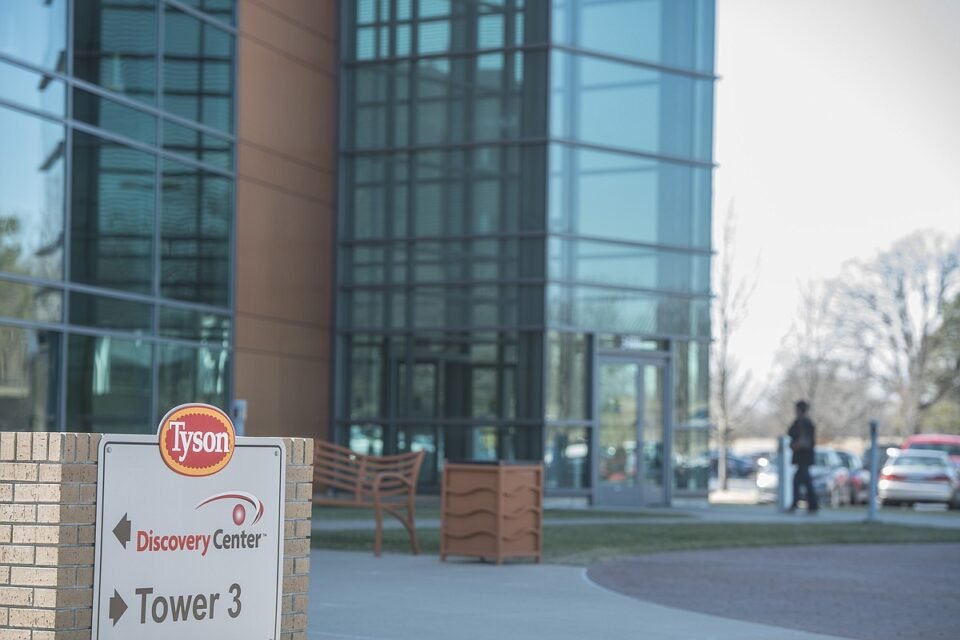
Tyson Foods Inc. on Thursday lowered its revenue growth guidance for 2026 as it faces significant margin pressure from a volatile cattle industry.
The Springdale-based company revised its revenue growth to between 1.5% and 2.0% for 2026, down from between 2.5% and 3.5% when the company reported its third-quarter earnings in August.
In a news release, Donnie King, outgoing president and chief executive officer, said beef pressures that have intensified have required decisive action.
Tyson Foods said it anticipates its beef segment will see an operating loss of between $775 million and $625 million for 2026. This is a greater anticipated loss than its previous outlook that reported a loss between $650 million and $500 million.
“As announced in August, we are restructuring our Beef network around three strategically located facilities in the central United States to create a more efficient and competitive footprint for the long term,” he said. “We expect these actions to begin reducing operating cost pressures as we enter fiscal 2027.”
Beef segment struggles have been plaguing the company’s financial filings after reporting a yearly loss of $1.13 billion in 2025, and quarterly losses totalling $701 million in 2026.
Investors balked Thursday after the announcement. Tyson’s share price fell more than 7% after the markets opened. The shares fell $4.05, or 7.3%, to close Thursday at $51.76.
Tomas Jandik, professor of finance and Dillard’s chair in corporate finance at the Sam M. Walton College of Business at the University of Arkansas, said a 6% change in any stock price is pretty unusual, and Tyson Foods making a revision outside of a typical earnings release is interesting.
“Clearly they see something pretty negative in their future and decided they can’t sit on that negative adjustment any longer,” he said. “It is the right thing to do, if they know those negative things are coming.”
Jandik said that the share price drop comes as the overall market had a positive trading day. Food companies are generally a less risky investment, he said.
“Most one-day returns of companies, like Tyson, should be within 1%, maybe during important announcements (or) earnings it will be a little more than that,” he said.
The increased loss outlook in the beef segment comes after the company announced its decision to close two beef processing plants in Illinois and Utah, while exploring the possibility of a sale of a third plant in Washington.
The plant in Utah employed 723 people, while the Illinois plant employed 2,500, according to state workforce data. Both plants are expected to close in October.
Tyson Foods said volatile cattle prices, one of the most severe cattle shortages in U.S. history and lower cattle prices on value of live cattle inventories were the main driver for the revised outlook.
Analysts with Little Rock-based Stephens Inc. said Tyson Foods’ beef plant closures have cut its slaughter capacity by 50%. The estimated reduction includes a plant closure in Nebraska and shift reduction in a Texas plant announced in November.
Plant closures take a while to be realized on the company’s balance sheet, with the optimizations announced in November only being recognized in the third-quarter earnings report in August.
Chief Operating Officer Wes Morris said during Tyson Foods’ third-quarter earnings call that benefits from the closures were offset by the poor cattle market conditions.
Farm-level cattle prices are forecast to increase by 9.9% in 2026 and wholesale beef prices are forecast to increase by 9.4% this year, according to the USDA’s Food Price Outlook, 2026 report.
Tyson Foods said consumer caution around discretionary spending has created a more challenging food service demand environment.
Opposite to its beef segment, the company said its chicken segment continues to benefit from strategic customer partnerships, which helps it differentiate from its more commoditized competition.
Outlook for the chicken segment tightened Thursday to an operating income between $1.85 billion and $1.95 billion. The outlook had been reported between $1.90 billion and $2.05 billion.
Tyson Foods said as demand stabilizes, it continues to outpace the broader category across its branded and private-label retail and food service portfolio.
The pork segment was also revised to an operation income between $200 million and $250 million, compared to a range of $250 million and $300 million.
The prepared foods segment, which company executives have touted alongside the chicken segment in earnings reports in 2026, has maintained its guidance of an operating income between $1.30 billion and $1.35 billion.
King said the company’s diversified protein portfolio helps the company manage pressure from individual commodity cycles.
“We remain focused on the factors within our control: operational execution, brand investment, innovation and deeper strategic customer relationships,” he said. “We enter fiscal 2027 with a healthy balance sheet, continued momentum in our branded businesses and a clear strategy to drive long-term growth.”

Dylan Sherman is a business reporter for the Arkansas Democrat-Gazette. He is based in Northwest Arkansas and focuses on Tyson Foods Inc. and the transportation industry. A graduate of the University of Missouri, he has been with the newspaper since 2023.