
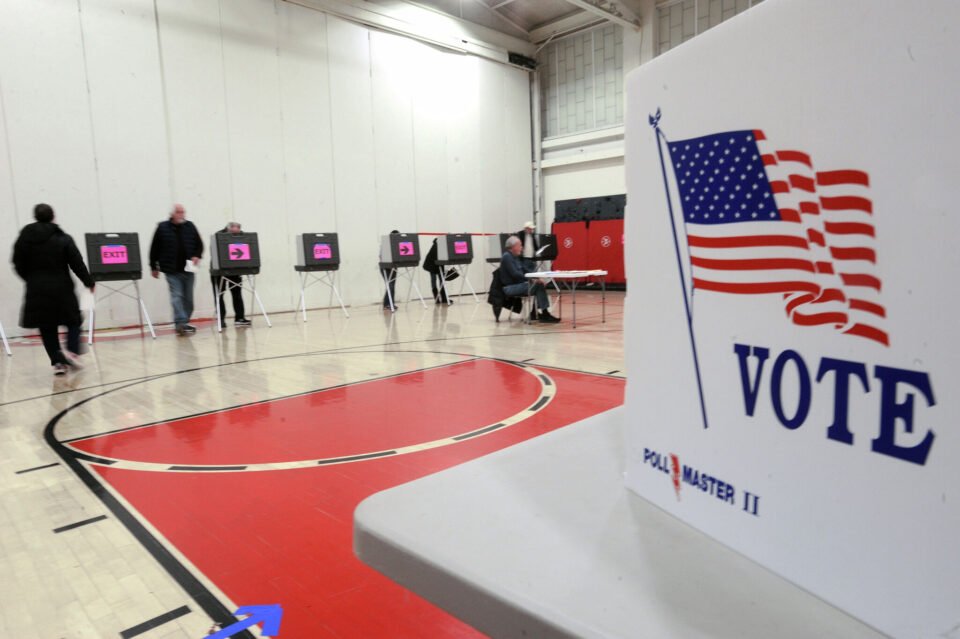

State legislators reroute $1 million from the public financing program to help pay for a voter outreach program. Voters fill out ballots at the Long Lots Elementary School gymnasium in Westport on November 4, 2025.

State legislators recently shifted $1 million out of the public financing fund that bankrolls most General Assembly campaigns

The $1 million is part of a larger transfer
Article continues below this ad
The other $2.25 million will support early voting grants to the state’s 169 cities and towns for the 2026 primary and general elections.
Early in-person voting became an option in Connecticut in the 2024 election cycle, starting with the presidential preference primaries.
Lamont signed legislation May 15 that added an unrestricted mail-in voting option for state voters. The new law removes the previous statutory requirement that a voter cite one of six legally recognized excuses to receive and cast an absentee ballot. Mail-in voting will first become available for primary elections Aug. 11, and then for the general election Nov. 3.
Secretary of the State Stephanie Thomas had requested a $2.5 million appropriation for what she called a “Voter Protection Fund” to support a coordinated statewide public education campaign about voting and elections and rapid response communications in the event of a cyberattack or other disruption to voting and elections.
Article continues below this ad
The Appropriations Committee denied the request and included no funding in its recommended spending plan. Lamont also did not propose any funding in his budget recommendations to the legislature in February. But the governor and Democratic majority leaders later agreed to sweep the $3.25 million from the Citizens’ Election Fund to pay for voter education program and early voting grants.
The election administration team in the secretary of the state’s office is reviewing the revised 2027 budget to work through the particulars of the early voting grant and voter education programs, said Matthew Clyburn, a Thomas spokesman.
Early voting grants
The $2.25 million in early voting funding was an unexpected but welcomed development for the Connecticut Council of Small Towns. Officials from the 142 member towns of COST have lobbied the legislature and Lamont to provide additional state funding to cover the costs of administering early in-person voting, but state leaders were largely unpersuaded.
Article continues below this ad
“They didn’t seem very interested in it, so we were surprised to see that they included a substantial amount for funding for towns,” said Betsy Gara, executive director of COST. “We’re hoping it’s distributed on fair basis, so that our small towns receive some funding to help them meet the requirements of the early voting law.”
State law currently provides for 14 days of early in-person voting for general elections, seven days for primary contests, and four days each for special elections and presidential preference primaries. Referendums are excluded from early voting.
Town leaders and local election officials have been pushing for additional state funding to more fully reimburse local costs of administering the early voting.
“Initially, they had promised towns some funding, and it wasn’t enough, and then the next year they reduced the amount of funding available to towns,” Gara said. “So, we were thrilled to see that the budget includes $2.25 million to help town staff and implement early voting requirements. We are waiting to hear how that is going to be distributed.”
Article continues below this ad
The legislature’s Appropriations Committee proposed $2.25 million for early voting grants in its recommended 2027 spending plan. The committee proposed to provide a $5,000 base grant to each municipality, and any town or city seeking more funding needed to submit early voting expenses to justify the requested increase. The remaining funding was to be distributed based on each town’s proportionate share of the statewide total of early voters for the last election.
SEEC funding
The transfer
That is no longer an immediate concern based on the outcomes of the Democratic and Republican state conventions on May 15 and 16, but funding is a looming issue for the next gubernatorial election cycle in 2030, said Ryan Burns, executive director of the State Elections Enforcement Commission.
Article continues below this ad
Before the state conventions, there was possibility of four major party gubernatorial candidates qualifying for a $3.75 million primary grant, he said. There were also concerns about possible primary contests for lieutenant governor, attorney general, comptroller, secretary of the state and treasurer.
Initially, there were three participating Republican gubernatorial candidates and one participating Democratic candidate who could have sought primary grants. For majority party candidates, the general election grant is $18 million. Potentially, qualifying gubernatorial candidates could have received $51 million among them. The Citizens’ Election Fund has a balance of $62 million, according to Open Connecticut, a centralized database of state financial information.
The fund also has to pay for grants for qualifying candidates for the five other statewide offices and for the 187-seat General Assembly, including possible primary contests.
Burns said concerns about the CEF financial outlook subsided after the Democratic and Republican conventions and the available funds are expected to be sufficient to cover the grant costs for the 2026 election cycle.
Article continues below this ad
Former New Britain Mayor Erin Stewart and Greenwich state Sen. Ryan Fazio both qualified their campaigns for governor for public financing before the Connecticut Republican Convention, and former Lt. Gov. Besty McCaughey, a third candidate, was also a participating CEP candidate. In addition, Hamden state Rep. Josh Elliott was also seeking public financing for his challenge to Lamont for the Democratic Party nomination.
Stewart suspended her campaign the day before the convention, and McCaughey failed to qualify for an automatic primary challenge at the GOP convention and endorsed Fazio. As the now unopposed GOP nominee, Fazio will receive a full $18 million grant.
Elliott received enough votes to challenge Lamont in an Aug. 11 primary. He said he is close to qualifying for public financing and expects to be approved in the coming weeks. Lamont is again largely self-funding his campaign.
The SEEC approved the first two grants for General Assembly candidates on May 28. The maximum grants for major party candidates are $133,155 for Senate races and $38,575 for House races.
Article continues below this ad
The Citizens’ Election Fund finances campaign grants issued to qualifying state candidates through the Citizens’ Election Program. The CEF is funded through unclaimed financial assets that have been transferred to the state government because the rightful owners have not come forward, such as funds left in savings or checking accounts. State law provides for “overdraft protection” if the CEF ever runs short. In that event, revenue from the corporation tax would be used to make up the difference. This alternative funding mechanism has not yet had to be utilized.
Burns said CEF now appears on sound financial footing for 2026 and 2028 election cycles, but there are concerns based on the current four-year deposit cycle and the current grant amounts that there may be insufficient funds for the next gubernatorial election in 2030.
“There is a lot of time between now and then, and I’m already having conversations with legislators so that they’re aware of the problems,” he said. “Hopefully, we’ll be able to address that well in advance of that eventuality. It is something that we are keeping an eye on.”
Article continues below this ad