


The exit is priced in salary. Microsoft pays the people it wants to keep in stock, and that is not an accident.
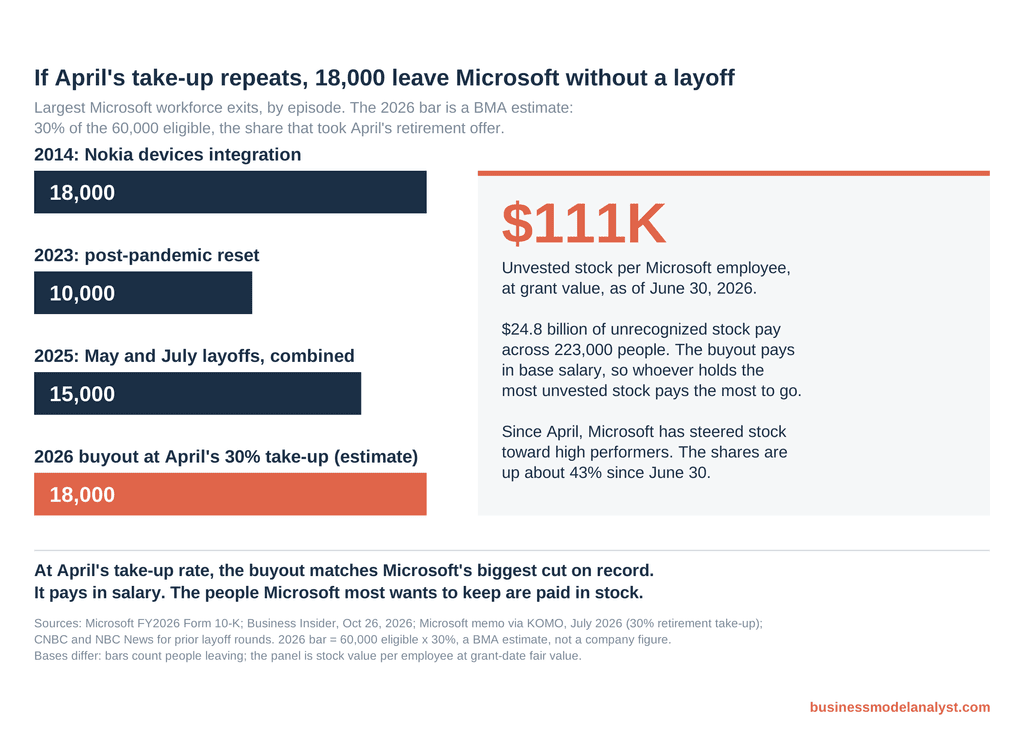
The short version: Microsoft is offering a Voluntary Exit Offer to roughly 60,000 employees, more than a quarter of its workforce, on terms close to its standard severance. That severance is paid in base salary. The average Microsoft employee carries about $111,000 of unvested stock at grant value, and since April the company has been steering stock toward its strongest performers. So the offer is cheap to accept for people with thin stock balances and expensive for the people Microsoft just loaded up. If take-up matches April’s retirement program, about 18,000 people leave, which would tie the largest cut in Microsoft’s history without a single layoff notice.
Everyone will read this as Microsoft trimming payroll to pay for data centers. The arithmetic says otherwise.
Take a generous $250,000 fully loaded cost per head (our assumption, not a Microsoft figure). If 18,000 people walk, Microsoft saves about $4.5 billion a year. Microsoft has guided to roughly $175 billion of capital spending in fiscal 2027. The buyout funds about nine days of it.
So the money is not the point. The point is who walks out the door, and Microsoft has spent six months quietly deciding that before anyone signs anything.
What Happened
On Monday, Chief People Officer Amy Coleman told employees that Microsoft is introducing a Voluntary Exit Offer, according to the memo published by Business Insider. Eligible staff in the US, Canada, India and the UK, at internal level 70 and below, received their terms by email the same day.
Not every team is in. Sales organizations, certain engineering teams and some corporate functions were left out, and each business decided for itself whether to participate. A spokesperson put the eligible pool at around 60,000 people and said the terms would resemble Microsoft’s standard severance. Employees have until early December to decide, with exits at year end. Coleman’s own line on the experiment was disarmingly short: “We’ll learn from it.”
The US severance Microsoft paid in its layoffs earlier this year, per offers Business Insider reviewed, looks like this:
- A minimum of 60 days of base pay, during which the employee stays on payroll
- For most employees, up to 39 weeks of base pay on top, set by level and tenure
- Levels 64 and below: one week of base pay per six months of service
- Levels 65 to 67: two weeks of base pay per six months of service
Run that formula and the cap tells you who it was built for. A level-64 engineer needs 19.5 years of service to reach 39 weeks. A level-65 principal gets there in 9.75 years. The cash scales with seniority and tenure, and it is denominated entirely in salary.
The timing is not subtle either. Microsoft reports fiscal first-quarter results on Wednesday, October 28.
The Backstory
This is Microsoft’s second buyout in six months, and the first one is the template.
In April, Microsoft launched the first voluntary retirement program in its 51-year history, open to US employees at senior director level and below whose age plus years of service reached 70. About 8,750 people qualified. The package paid 8 to 39 weeks of base salary, extended health coverage, and added six months of vesting on unvested stock (12 months for anyone with 24 or more years of service). In July, Coleman said 30% of those eligible chose to retire.
The same April memo did something that got far less attention. Microsoft overhauled its annual rewards: pay points cut from nine to five, the old performance curve removed, and stock awards decoupled from cash bonuses so managers could give meaningfully more equity to high performers. Hold that thought.
Around those two programs, Microsoft kept cutting the old way:
- 2025: about 6,000 roles in May and roughly 9,000 in July, more than 15,000 for the year
- July 2026: 4,800 roles, about 2.1% of the company, concentrated in sales and Xbox
- Fiscal 2026 headcount: about 223,000 at June 30, down from 228,000, the first annual decline in a decade
CFO Amy Hood has said headcount will keep falling in fiscal 2027 while operating expenses grow in the mid-to-high single digits. Meanwhile the business is booming: fiscal 2026 revenue topped $331 billion and Azure passed $100 billion. This is not a company in trouble. It is a company reshaping its workforce while the stock recovers, which matters more than it sounds.
The Plan
A buyout and a layoff can cost exactly the same. The difference is who picks the names.
In a layoff, a manager chooses, the company files notices, and lawyers review the list for patterns. In a buyout, the employee chooses. Microsoft gets departures without a selection process to defend, and voluntary exits generally do not count as the kind of job losses that trigger federal layoff notices. Its July cut came with a WARN filing. This one, by design, should not.
The textbook problem with buyouts is adverse selection. The people most willing to leave are the ones with the best outside offers, which usually means your best people. Pay everyone the same check and you risk losing stars while keeping the folks nobody else is calling.
Microsoft has two answers to that, and neither is in the memo.
The first is the door list. Sales is excluded because a strong seller’s outside option is the customer relationships they carry. Certain engineering teams are excluded for the obvious reason. Microsoft did not try to stop the best person on each team from leaving. It decided which teams get a door at all.
The second is the stock. Microsoft’s fiscal 2026 10-K reports $24.8 billion of unrecognized compensation cost for unvested stock awards, to be recognized over a weighted average of three years. Spread across 223,000 employees, that is about $111,000 per person at grant-date value. Annual stock-based compensation was $12.4 billion, or about $55,600 per head. The average employee is sitting on two full years of stock pay that has not vested yet.
Now put the pieces together:
- The exit check is base salary. Stock is not in the formula.
- Since April, stock has been steered toward high performers by design.
- Microsoft shares closed at $373.02 on June 30 and at $532.95 on October 21, a gain of about 43%, so unvested balances are worth more in the market today than when the 10-K was written.
That combination turns the unvested balance into a performance-weighted exit fee. Someone with small recent refreshers gives up little by leaving and collects weeks of salary. Someone Microsoft just rewarded with a big equity grant walks away from far more than the severance pays. Business Insider’s reporting does not say whether this offer adds the six months of extra vesting April’s did. Even if it does, six months on a four-year grant releases one-eighth of it.
The Business Model Angle
Compensation design is a selection device. The April rewards overhaul and the October exit offer are one mechanism, not two announcements. Steer equity toward the people you want, then price the exit in cash. The offer filters itself, and no manager has to name anyone.
The gate is the org chart, not the individual. Excluding sales and specific engineering teams solves adverse selection at the team level, where Microsoft has information, instead of at the person level, where it would need to rank people. We made a related point in our breakdown of why Uber’s 20% manager cut buys only half a layer: companies announce the unit that sounds big and manage the variable that actually moves.
The savings are small. The shape is the product. Nine days of capex will not change Microsoft’s business model, which runs on Azure, Microsoft 365 and enterprise contracts. What the buyout buys is a smaller, more senior-weighted workforce without the friction of a layoff list, at a moment when Hood has promised falling headcount alongside tight operating-expense growth.
Big Tech is borrowing the old-economy playbook. Voluntary separation was the tool of telecoms, automakers and manufacturers. Google has run voluntary exit programs in search, ads and commerce. Microsoft has now run two in one year, and each became a test case for the next.
The Risk
The stock screen has real holes, and the best counterarguments are worth stating plainly.
Rivals buy out the forfeited stock. The people with the best outside offers are exactly the people a competitor will make whole with a sign-on grant. In the AI talent war, that is not hypothetical: an internal spreadsheet reported by Benzinga showed self-reported stock awards in Microsoft’s Cloud + AI group as high as $1.4 million. For the most poachable engineers, the unvested balance is a speed bump, not a wall. That is likely why some engineering teams are excluded outright.
$111,000 is an average, not a person. Unvested stock is concentrated at senior levels and among recent hires with fresh grants. Many lower-level employees hold far less, and for them the offer is close to free money. Microsoft may lose more early-career and mid-level people than it intends.
Some of the money goes to people who would have left anyway. Every buyout pays a bonus to employees already halfway out the door. That is deadweight cost, and no screen removes it.
Our 18,000 figure assumes April repeats, and it probably will not. April’s pool was retirement-eligible by construction. This pool has no age gate, so it skews younger, with more unvested stock and more career left to fund. That argues for lower take-up than 30%, which would make the stock screen stronger, not weaker. It also means our chart’s bar is a ceiling scenario, not a forecast.
Voluntary only works if it stays voluntary. Critics called April’s program a layoff with better manners. Microsoft’s spokesperson said there are no plans for another buyout at this time. If take-up disappoints, the next tool is the old one, and the people who stayed will have learned what the first offer was worth.
Quick Questions
Who can take Microsoft’s Voluntary Exit Offer? Employees at level 70 and below in participating teams in the US, Canada, India and the UK. Sales organizations, certain engineering teams and some corporate functions are excluded. Microsoft puts the eligible pool at around 60,000.
How much does it pay? Microsoft says terms are similar to its standard severance. In this year’s US layoffs that meant at least 60 days on payroll plus, for most, up to 39 weeks of base pay, scaled by level and tenure.
Does it include stock? The terms reported so far describe base pay. April’s retirement program added six months of extra vesting; whether this offer does the same has not been reported. Either way, most unvested stock stays behind.
Why are salespeople excluded? A seller’s outside option is the customer book. Letting quota carriers self-select out is the clearest version of the adverse-selection risk, so Microsoft closed that door.
Will it show up in this week’s earnings? Probably not in the numbers. Wednesday’s report covers July through September, and exits happen at year end, so any charge would most likely land in the quarter ending December 31. Expect the question on the call.
The Business Model Analyst Take
Microsoft built a door and priced it in the currency it is spending less of.
Base salary is the part of Microsoft pay that every employee gets. Stock is the part Microsoft now aims, by its own April memo, at the people it most wants to keep. An exit priced in the first and blocked by the second does the sorting no manager wants to do on paper. Combine that with a list of teams that never got the offer, and you have a workforce reduction designed to lose the people least anchored by equity while keeping the ones most anchored by it.
It is cleverer than a layoff and cheaper than a reorg. It is also exactly as reliable as the stock price and the competition’s checkbook. The coordination costs it leaves behind are their own story, one we covered when the chief of staff boom showed up as the bill for the Great Flattening, and the restocking risk is the one Booz Allen ran into after cutting head count for AI. For the org chart this all reshapes, see our Microsoft organizational structure analysis.
The real tell will come in January, when Microsoft reports how many took the door. A low number would not mean the offer failed. It would mean the stock did its job.