
European technology is in its strongest run in years. Startups across the continent raised €68.4 billion in the first nine months of 2026, already more than in all of 2025, with the full year on course to finish about 31% higher. AI companies drew €44.1 billion of that total, nearly two-thirds of all European deal value.
The fastest-rising part of the market is deeptech, the category of companies built on scientific or engineering breakthroughs such as fusion energy, robotics and AI-designed drugs. It drew a record $20.3 billion in 2025, or 32% of all European venture capital, while VC-backed European deeptech companies are now valued at about $690 billion. Capital is flowing back into the funds that back these companies from day one, as European VC funds raised $14.9 billion in the first nine months of 2026, close to the total for all of 2025.
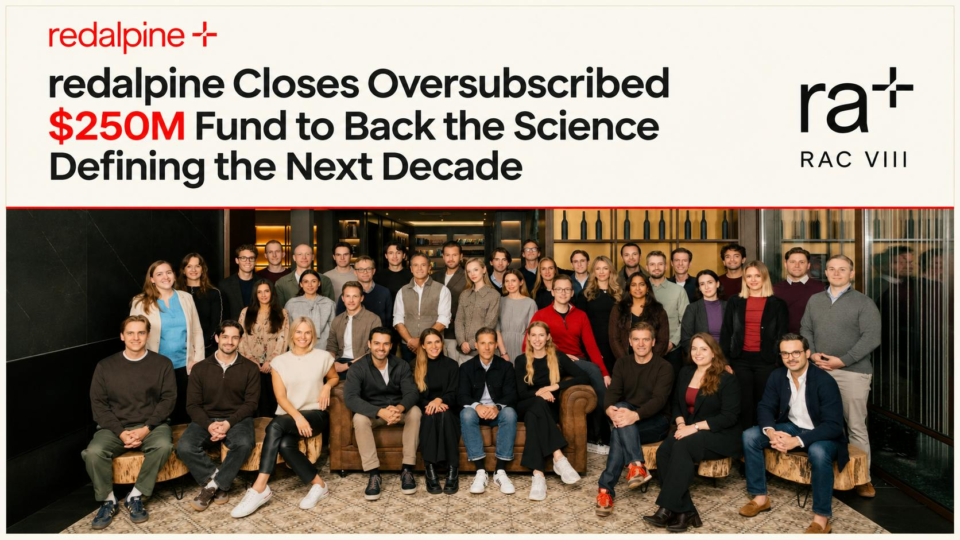
redalpine, a pan-European venture capital firm founded in Zurich in 2006, closed its early-stage fund redalpine capital VIII, or RAC VIII, at $250 million on 10 November 2026. The fund closed oversubscribed, is the largest early-stage fund in the firm’s history and arrives as redalpine marks 20 years of backing companies where software and science meet. It takes the firm’s assets under management above $1.4 billion.
Deeptech Takes Centre Stage
AI’s share of European VC deal value has nearly quadrupled in a decade, rising from 9.3% in 2015 to 35.5% in 2025. Deeptech has grown alongside it, taking a record 32% of European venture capital in 2025, more than double its share a decade earlier. Dealroom’s 2026 report found the fastest growth in compute infrastructure, with strong gains in defence, computational biology and chemistry, space, robotics and energy.
 AI’s share of European VC deal value rose from 9.3% in 2015 to 35.5% in 2025, while deeptech took a record 32% of venture capital.
Europe’s research base is the engine behind that growth. The continent is home to 30% of the world’s leading deeptech universities and produces twice as many science and engineering graduates as the United States, while Paris, Cambridge, London, Munich, Stockholm and Zurich rank among the world’s top deeptech hubs. That talent gives early-stage investors a deep pipeline of scientist founders, which is the pipeline redalpine has drawn on since 2006.
Record Momentum in 2026
European tech funding reached €27.8 billion in the third quarter of 2026 across 732 deals, up 32.4% on a year earlier and more than two and a half times the €11 billion raised in the same quarter of 2024. Five rounds passed €1 billion in the quarter, led by Mistral AI’s €3 billion raise along with large rounds for Nscale, Helsing and Quantum Systems, while more than 2,630 investors took part in deals.
Crunchbase data points the same way, with European startup funding up 77% year on year to about $25 billion in the third quarter, while AI companies took a record 75% share at $18.8 billion. Deal value for the first nine months of 2026 has already passed the €66.2 billion invested in all of 2025, a year in which later-stage rounds of Series D and beyond grew 45.2% as European companies scaled further at home.
 European startups raised €68.4 billion in the first nine months of 2026, more than in all of 2025.
The money is also returning to new funds. European venture funds raised $14.9 billion in the first nine months of 2026, close to the $15.5 billion raised across all of 2025, with large closes such as EQT’s €5 billion Scaleup Europe Fund. Limited partners, the pension funds, insurers, development banks and family offices that commit money to venture funds, are backing specialists with a record in AI and science, which is the group redalpine belongs to.
Capital Flows to Frontier Sectors
Beyond AI, PitchBook data shows billions moving into the hardest technology categories in the first nine months of 2026, with €10 billion for cleantech, €9.1 billion for advanced manufacturing, €8.7 billion for robotics and drones and €3.5 billion for space technology. These categories can overlap, since a robotics company may also be an AI company. Each one is growing as industry, governments and investors look for European suppliers of critical technology.
Those are the fields where redalpine already invests, from fusion energy at Proxima Fusion to robotics at Enact Intelligence, AI biology at Helical and Basecamp Research and AI for critical systems at Arlequin AI. Every one of the large late-stage rounds in these sectors started with a Seed investor able to judge the science, which is the stage RAC VIII is built to lead.
 AI companies drew €44.1 billion of European venture funding in the first nine months of 2026.
The Fund: RAC VIII at $250 Million
RAC VIII closed at $250 million, 25% larger than RAC VII, which closed in August 2024 at $200 million, or about €179 million, and was itself the firm’s largest fund at the time (our arithmetic). Both funds closed oversubscribed, meaning investors asked to commit more money than the fund was set to accept. redalpine’s assets under management have grown from over $1 billion in 2024 to over $1.4 billion today, an increase of about 40% in roughly two years (our arithmetic).
The fund’s limited partners include returning and new investors such as Aviva Investors, the asset management arm of the UK insurer Aviva, the private markets firm Flexstone Partners and KfW, Germany’s state-owned development bank. Entrepreneurs, executives with deep domain expertise and business owners also invested, giving redalpine a network of operators who can support portfolio companies directly.
That mix of investors reflects a broader push to keep more of the value created by European technology companies with European savers, including pension funds. Aviva Investors has said it sees the partnership as a way to gain access to high-growth UK and European start-ups for the long-term benefit of pension investors.
 RAC VIII closed at $250 million, 25% above the $200 million RAC VII.
Science at Seed and Series A
RAC VIII will invest in about 20 early-stage companies across Europe, primarily leading or co-leading Seed and Series A rounds with initial tickets of $1 million to $15 million. A Seed round is usually a company’s first institutional funding, raised to build a product and prove the technology works, while a Series A funds the move from early traction to a scalable business. Spread across about 20 companies, the fund has roughly $12.5 million of capital per company before fees, which leaves room for follow-on investment.
 RAC VIII will back about 20 companies with initial tickets of $1 million to $15 million.
Selection is strict. redalpine screens more than 5,000 companies each year, while its early-stage funds make five to ten new investments a year, so only about 0.1% to 0.2% of the companies it reviews receive a first cheque (our arithmetic). Half of redalpine’s investment team are trained scientists, including biologists, physicists and engineers, who can assess complex technology before there is a product or customer data to judge.
Robotics, Drug Discovery and Secure AI
The first three RAC VIII companies show where the fund is headed. Enact Intelligence, a Swiss startup led by co-founder and chief executive Manuel Yves Galliker, formerly of Physical Intelligence, is building force intelligence for robotics, which lets robots sense force and touch through their own actuators so they can handle objects more precisely than with cameras alone. Enact raised a $30 million pre-seed round in October 2026 with redalpine, Notion Capital and Firstminute Capital, along with angel investors Arthur Mensch of Mistral, Yann LeCun and Thomas Wolf of Hugging Face.
Helical, founded in Luxembourg and based in London, is building a virtual AI lab that turns the outputs of biological foundation models into reproducible drug discovery decisions. redalpine led its $10 million Seed round in April 2026. Helical says it already works in production with several of the world’s top 20 pharmaceutical companies, with public collaborations that include Pfizer and Tanabe Pharma America.
Arlequin AI, a Paris company founded in 2024, is developing a new AI architecture called topological neural networks that learns from both data points and the relationships between them, with uses in security, defence, fraud detection and critical systems. redalpine co-led its €28 million Series A in September 2026 alongside OTB Ventures, with the Defence Innovation Fund of Bpifrance also taking part.
Portfolio Track Record
redalpine’s portfolio includes some of Europe’s most valuable technology companies. Mistral AI, the Paris AI model developer, closed a €3 billion Series D at a post-money valuation above €21 billion in September 2026, led by Samsung Electronics. N26, the Berlin digital bank, is one of the firm’s best-known fintech investments, while Basecamp Research, a London company designing medicines with its EDEN biological foundation model, raised a $140 million Series C in September 2026 with NVIDIA and Anthropic’s Anthology Fund taking part.
Proxima Fusion shows redalpine’s early-stage model at work. The Munich company, spun out of the Max Planck Institute for Plasma Physics in 2023 to build stellarator fusion power plants, raised its Seed round with redalpine as lead before closing a €130 million Series A in June 2025, the largest private fusion round in Europe at the time, taking its total funding to more than €185 million.
Across the portfolio, companies backed by RAC VII have raised over $1.1 billion in total funding since that fund closed in 2024, about 5.5 times the size of the fund itself (our arithmetic). Twelve portfolio companies have exited since 2023, giving redalpine’s investors realized returns alongside a growing set of private companies valued in the billions.
 Companies backed by RAC VII have raised more than $1.1 billion in total funding.
Two Decades of Science-Led Investing
redalpine was founded in Zurich in 2006 by software entrepreneur Peter Niederhauser and molecular biologist Michael Sidler, who started the firm on the view that the most important companies would emerge where software and science meet. It invested in fusion energy, AI, robotics and biotechnology before those fields became established venture themes. The firm has since opened offices in Zug, Berlin and London and built a presence in Silicon Valley.

Over two decades redalpine has backed more than 100 companies, which have gone on to create over 10,000 jobs and raise more than $3 billion. It began as a single early-stage fund and has grown into a multi-stage platform that can back founders from Seed to IPO, including the Summit Fund, an evergreen vehicle that invests in redalpine’s early-stage funds, follows on in their strongest companies and buys into later-stage category leaders.
Europe’s Science Advantage
General Partner Sebastian Becker argues that AI is levelling the playing field between regions, which shifts the advantage to whoever understands the underlying science and the hardest problems best. In redalpine’s view that has always been Europe’s strength. The firm says it is seeing a new generation of ambitious founders determined to build world-leading technology companies from Europe.
The firm also sees a change in European confidence among the institutions that fund venture. Partner Rafael Hubatschek has described institutional investors as putting real conviction behind European technology, which fits the mix of returning and new limited partners in RAC VIII. A platform that can back a company from its first round to later growth stages lets redalpine keep supporting founders as they grow into global category leaders.
Outlook
RAC VIII starts investing with three companies already in the portfolio and room for about 17 more over the coming years, in a market where AI and deeptech take a growing share of European venture capital. The fund’s focus on force intelligence for robotics, AI for drug discovery and new AI architectures for critical systems places it in the categories that drew the largest rounds of 2026.
European venture investment is on course for its best year since 2022, while the share flowing to AI and deeptech keeps rising. A specialist with two decades of history, a scientist-led team and a growing base of European institutional investors is well placed to lead those rounds. The firm’s past funds backed Mistral AI, Proxima Fusion and N26, while RAC VIII gives redalpine $250 million to find the next generation of European technology leaders.
This article is for information only and does not constitute investment advice or an offer of interests in any fund. RAC VIII is closed to new subscriptions. Past performance is not a reliable indicator of future results.