
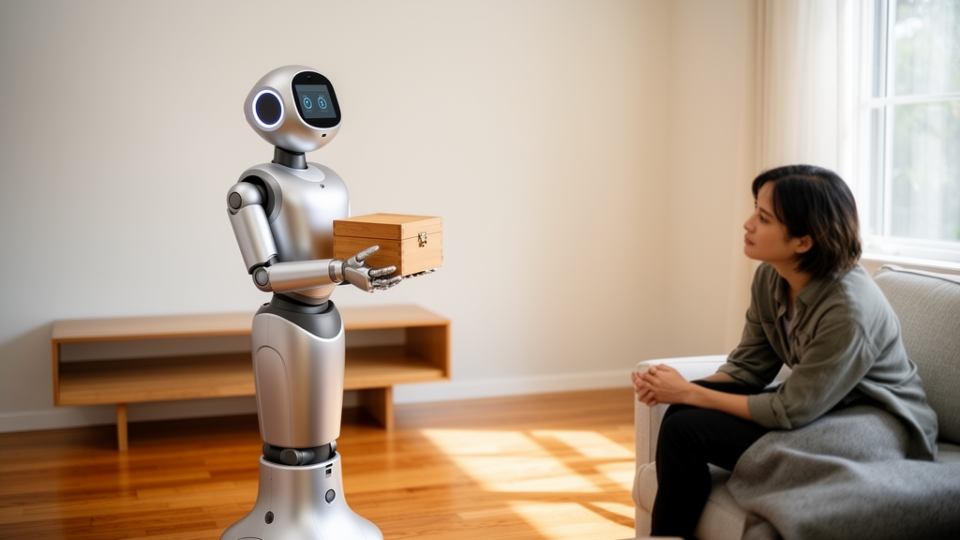
To execute everyday domestic commands such as fetching a specific coffee cup, autonomous service robots must reliably determine who owns what in shared human environments. However, visual appearance and spatial position alone rarely reveal property boundaries, because multiple visually identical items frequently belong to different individuals, and personal belongings are often moved across desks, counters, and shelves. In a study published in Artificial Life and Robotics, roboticists Saki Hashimoto, Shoichi Hasegawa, Tomochika Ishikawa, Akira Taniguchi, Yoshinobu Hagiwara, Lotfi El Hafi, and Tadahiro Taniguchi introduce Active Ownership Learning, or ActOwL. The framework enables robots to actively deduce object ownership by strategically generating clarifying questions directed at users. Rather than passively observing cluttered environments or exhausting human patience with endless inquiries, ActOwL pairs a multimodal probabilistic generative model with commonsense reasoning from large language models, allowing machines to acquire structured, persistent ownership knowledge through a minimal number of targeted conversational interactions.
The fundamental challenge of ownership recognition stems from its reliance on invisible social conventions rather than obvious physical traits. A single coffee mug sitting on an office table might look indistinguishable from dozens of others, yet social rules dictate that only one person possesses it. Asking users about every item in an environment quickly becomes intolerable, significantly degrading human-robot collaboration. To circumvent this cognitive bottleneck, Hashimoto and colleagues designed ActOwL to first distinguish between communal and personal property before selecting dialogue targets. Using contextual prompts, an integrated large language model inspects object labels alongside room descriptions to classify candidates as either shared items or owned belongings. Everyday communal fixtures like tissue boxes or soap dispensers are designated as shared and filtered out of questioning routines, immediately shielding occupants from redundant queries while allowing the robot to concentrate exclusively on privately owned items.
At the mathematical core of the framework lies a probabilistic generative model formulated to integrate multimodal sensory inputs with conversational evidence. The architecture represents an environment with latent ownership concepts, spatial coordinates, and physical attributes structured under hierarchical Bayesian priors. Categorical ownership concepts are governed by Dirichlet distributions, while spatial arrangements are captured through a Gaussian mixture model governed by conjugate normal and inverse-Wishart priors. This spatial formulation accounts for the empirical observation that an individual’s personal belongings typically cluster within designated work zones, such as private desks, while accommodating realistic spatial dispersion across adjacent counters. Simultaneously, object characteristics—encompassing visual attributes, category identities, shapes, sizes, and colors—are modeled through multinomial distributions conditioned on categorical ownership variables, enabling the system to learn personalized user preferences, such as an individual’s tendency to possess objects of a distinct hue or specific geometric form.
Because service robots operating in dynamic households must update their internal beliefs incrementally as interactions unfold, ActOwL implements an online estimation scheme based on a Rao-Blackwellized Particle Filter. Rather than recalculating the entire joint posterior distribution from scratch following every observation, the system factorizes the parameter space into analytical components and sampled particles. Each particle maintains a plausible ownership hypothesis, tracking discrete cluster assignments while updating continuous spatial and attribute distributions analytically through Bayes’ theorem. During the initial environmental exploration phase before dialogue takes place, the conversational observation modality is treated as uninformative. Once the robot begins querying users, each verbal reply is incorporated as an informative evidence vector that shifts particle weight distributions. Particles whose underlying ownership hypotheses align with the user’s feedback receive higher weights, enabling the machine to discard implausible ownership configurations and sequentially converge upon accurate social representations.
To select which item to query next, ActOwL applies active exploration principles rooted in information gain maximization. For every object identified as an individually owned candidate, the robot calculates the expected reduction in ownership uncertainty that would result from receiving an answer about that specific item. This expected information gain is computed across the weighted particle ensemble by generating hypothetical pseudo-observations of possible user responses. The robot then selects the candidate item that yields the highest expected information gain, ensuring that every dialogue turn maximally sharpens its internal ownership model. Once an item is chosen, GPT-4 transforms its coordinates, categorical name, visual characteristics, and the known ownership states of adjacent items into a natural, conversational question. Furthermore, the language model interprets user responses, translating ambiguous colloquial statements, possessive pronouns like ‘mine,’ and relational references such as ‘my father’s’ into explicit ownership indices tied to concrete individuals.
The authors evaluated ActOwL across three experimental setups, beginning with a simplified simulation built within the Gazebo robotics platform using the aws-robomaker-small-house-world environment. In this initial trial, the simulated household contained three distinct human users and twelve labeled objects spanning nine categorical classes. The robot was supplied with pre-mapped two-dimensional coordinates and twenty-one-dimensional attribute vectors encoding object categories, six primary colors, three discrete sizes, and three basic shapes. The tracking system operated with one hundred particles and evaluated ten pseudo-observation samples per candidate question. Hyperparameters were tuned to establish robust baseline distributions, setting the ownership concept count and spatial distribution count both to four. Crucially, in the multimodal integration stage, user answers were designated as the most reliable information source, receiving a heavy weighting coefficient of five, while spatial positions and physical attributes shared standard unit weighting coefficients.
In this baseline simulation, ActOwL’s performance was compared against four alternative approaches: selecting objects with minimal information gain, random questioning, a model lacking language model guidance, and an approach relying solely on language model prompts without probabilistic modeling. Performance was measured using the Adjusted Rand Index alongside Kaplan-Meier survival curves tracking the questions needed to reach an index score of 0.7. ActOwL achieved superior ownership clustering accuracy in fewer interaction steps than all baselines, converging within nine questions due to the exclusion of shared objects. In ablation tests isolating individual modalities, relying exclusively on color produced high simulation scores because users possessed color-coded belongings, but the authors noted that single-attribute reliance fails in real-world settings where individuals own diverse items. Settings relying solely on position or attributes underperformed, confirming the necessity of multimodal integration.
To examine system resilience under less orderly domestic conditions, the researchers conducted a second simulation involving three users, twenty objects, and ten categorical classes, introducing deliberate sensory contradictions. While most objects belonging to a specific individual retained uniform color attributes, a designated subset was assigned conflicting colors to mimic inconsistent real-world aesthetics. In this complex environment, ActOwL demonstrated an operational vulnerability: an individually owned item belonging to the category ‘Box’ was erroneously classified as shared by the initial language model filter and excluded from questioning. Consequently, the probabilistic model lacked necessary evidence, causing ActOwL’s overall clustering accuracy to plateau below that of the baseline without language model filtering. Nevertheless, ActOwL still outperformed random querying and minimal information gain strategies, illustrating that information-gain-directed exploration remains advantageous even when contextual commonsense heuristics introduce initial classification errors.
Moving beyond computer simulations, the team deployed the architecture onto a physical Toyota Human Support Robot operating inside an active research laboratory at Ritsumeikan University. The physical testing grounds presented substantial complexity, encompassing seven human users and forty-eight physical objects distributed across eighteen distinct categories. Prior to question generation, the robot generated a spatial floor plan using the ROS-based gmapping package and detected objects alongside category labels using the Detic vision model. Unlike domestic residences where personal items often exhibit vivid stylistic differences, the laboratory workspace featured visually homogeneous office supplies, electronics, and stationery shared across adjacent desks. Because physical attributes possessed minimal discriminative power in this setting, the researchers deliberately adapted the multimodal fusion weights, down-weighting the attribute modality coefficient to 0.1 while maintaining the user answer weighting coefficient at 5.0 and expanding both spatial and concept counts to eight.
During the physical trial, ActOwL demonstrated high clustering consistency across ten experimental repetitions, reaching stable convergence around forty questions and matching or exceeding baselines while curbing unnecessary dialogue. Incorporating specific laboratory prompts allowed GPT-4 to correctly identify shared communal assets, including centralized trash bins, desktop printers, and wall clocks, even when those items were physically positioned close to private workstations. Qualitative inspections of generated dialogue revealed that while the robot formulated fluent and context-aware questions referencing surrounding reference points, the language model occasionally hallucinated proximity relations, describing distant objects as adjacent. Quantitatively, the Adjusted Rand Index confirmed that strategic questioning combined with down-weighted visual attributes allowed the robot to effectively isolate individual ownership clusters despite overlapping desk spaces, demonstrating the framework’s adaptability across contrasting physical environments where visual cues cannot be trusted alone.
Despite these promising empirical results, the research team highlighted several limitations that currently restrict ActOwL’s immediate commercial deployment. The current implementation relies on binary ownership labels, categorizing items strictly as privately owned or universally shared, which fails to accommodate joint custody, departmental borrowing, or temporary possession common in human households. Furthermore, the system presumes that human respondents provide consistently truthful and unambiguous answers, leaving it vulnerable to misdirection or conflicting human testimony. The researchers also noted that environmental layouts and object features were largely pre-annotated, meaning autonomous operation will require integrating end-to-end active visual SLAM and autonomous feature-weight adaptation. Looking forward, the authors plan to incorporate user role profiles and track dynamic behavioral patterns, leveraging physical touch and usage frequency cues documented in psychological ownership literature to help domestic robots manage personal belongings with minimal human supervision.
Subject of Research: Robotic learning of object ownership through active exploration and language models
Article Title: Toward ownership understanding of objects: active question generation with large language model and probabilistic generative model
Article References: Hashimoto, S., Hasegawa, S., Ishikawa, T., Taniguchi, A., Hagiwara, Y., El Hafi, L., & Taniguchi, T. (2026). Toward ownership understanding of objects: active question generation with large language model and probabilistic generative model. Artificial Life and Robotics, 31(2), 389-404. https://doi.org/10.1007/s10015-026-01116-7
Image Credits: AI Generated
DOI: 10.1007/s10015-026-01116-7
Keywords: Active Ownership Learning, human-robot interaction, probabilistic generative model, large language models, information gain, Rao-Blackwellized particle filter, object ownership, domestic robotics, Human Support Robot, service robots, semantic mapping, Gaussian mixture model, multimodal learning, active inference, Adjusted Rand Index, commonsense reasoning