
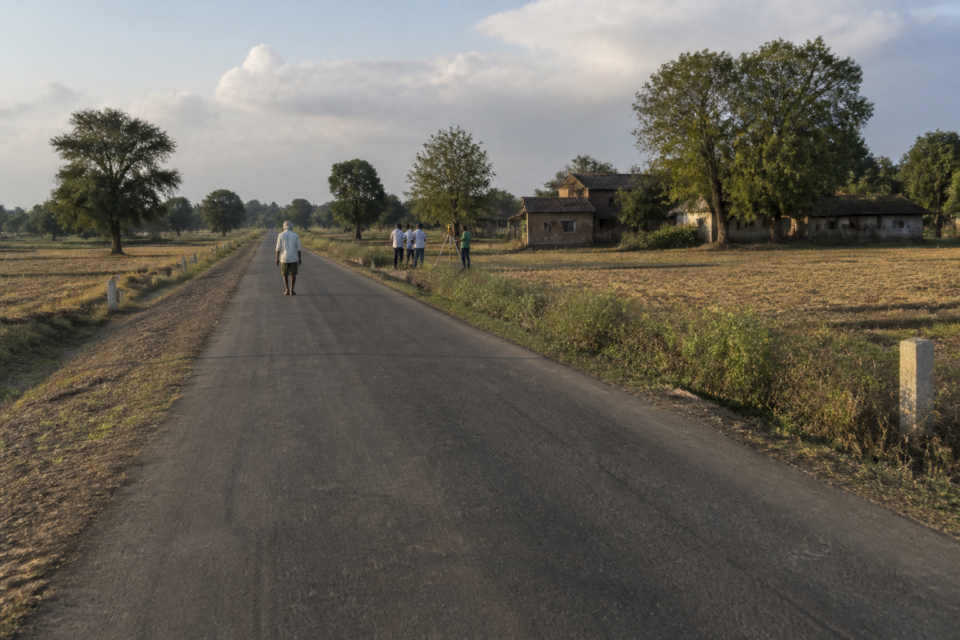
The Bombay High Court’s Nagpur bench has rejected a long-used assumption in public works: that a road built on private land becomes legally secure simply because the owner did not object at the time. In directing Maharashtra to begin fresh acquisition proceedings for land used to construct a road in Chandrapur in 1979, the court placed the question of compensation and lawful authority at the centre of infrastructure development.
The case concerns private land at Mouza Kolara (Rith) in Chimur taluka. According to the report by the Times of India, the land belonging to Shekhar Janbandhu’s father was used for road construction but was never formally acquired, and no compensation was paid. The state did not produce a document showing that the landowner or his predecessor had voluntarily surrendered, donated or otherwise permitted permanent use of the property.
That finding turns a decades-old local dispute into a wider governance question. Roads are among the most visible forms of public infrastructure, but their legal foundation is often established through processes that are less visible: land records, consent documents, acquisition notifications, compensation awards and possession proceedings. When those steps are missing, the physical completion of a road does not resolve the state’s obligation to establish how it obtained the land.
The court’s core principle was that silence cannot substitute for lawful transfer. A division bench comprising Justices Anil Kilor and Rajnish Vyas observed that the law recognises either compulsory acquisition or acquisition by agreement. The court made clear that an agreement in this context would mean a written agreement, rather than an assumed verbal arrangement inferred from the absence of an objection.
This distinction matters because infrastructure projects can create an imbalance between administrative power and individual property owners. A government agency may be able to build a road, occupy land and operate the facility for years, while the affected owner faces the burden of proving that the state had no lawful basis to retain the property. The passage of time can make that task harder: records may be unavailable, officials may change, land may pass to heirs and the original circumstances may become difficult to reconstruct.
The state’s principal objection in the case was delay. It argued that the road had been completed in 1979 without objection from the petitioner’s father and relied on the Supreme Court’s 1995 decision in State of Maharashtra vs Digambar. The High Court, however, held that the principle of delay and laches could not be treated as an automatic reason to dismiss every claim involving long-standing deprivation of property without lawful authority.
The ruling therefore separates two issues that are often merged in public administration. One is whether a claimant approached the court after a long period. The other is whether the state had lawful authority to take or permanently use the land in the first place. The High Court’s reasoning, as reported, indicates that delay cannot by itself cure an absence of acquisition, written consent or another legally recognised transfer.
The case also invokes Article 300-A of the Constitution, which protects a person from being deprived of property except by authority of law. The protection does not make every land dispute a constitutional case, but it establishes that public purpose alone is not a complete legal answer. A road may serve a public function, yet the state must still follow the process through which private property can be acquired or transferred.
The court referred to seven rights identified by the Supreme Court when the state seeks to acquire private property: notice, an opportunity to object, a reasoned decision, acquisition for a public purpose, fair compensation or restitution, an efficient process and conclusion of the acquisition proceedings. Taken together, these rights describe acquisition as a chain of administrative duties rather than a single notification or construction activity.
That chain is especially important for roads. Unlike a temporary worksite, a road generally represents permanent or continuing occupation of land. Its alignment may determine access to fields, homes and other plots, while the road itself becomes part of the public network. If the underlying land transaction is incomplete, the dispute remains embedded in the infrastructure even after the road has been used for decades.
The High Court has directed the authorities to initiate fresh proceedings under the Right to Fair Compensation and Transparency in Land Acquisition, Rehabilitation and Resettlement Act, 2013. The process is to include a preliminary notification under Section 11 and must be completed according to law. The direction does not simply ask the state to make an administrative payment; it requires the authorities to undertake the statutory acquisition route that was absent when the road was constructed.
The compensation question is also significant. The competent authority has been directed to consider applicable statutory benefits and specifically examine the prolonged deprivation and extraordinary delay attributable to the authorities, subject to the 2013 Act and Supreme Court law. This places the duration of unlawful or undocumented occupation within the compensation conversation, rather than treating the land as if it had been acquired at the time of the original road construction.
For public agencies, the ruling highlights the cost of treating land documentation as a procedural detail that can be regularised later. A project may be completed quickly when acquisition is bypassed, but the unresolved liability can survive for generations. The eventual cost may include fresh proceedings, compensation, legal expenses and the administrative effort required to reconstruct records from a much earlier period.
For landowners, the case indicates that continued public use does not automatically establish that property was lawfully surrendered. The absence of an immediate objection may reflect many circumstances, but the court’s reported reasoning says that silence alone cannot prove permanent consent or transfer. The state must show the legal basis on which it took possession or obtained permission to use the land.
The ruling also raises a records-management issue. A lawful acquisition system depends on documents that can be located and produced: notices, objections, decisions, agreements, awards and possession records. In the Chandrapur case, the reported absence of a written consent or surrender document became central to the dispute. For infrastructure agencies, maintaining those records is not merely an archival function; it is part of demonstrating that public assets rest on lawful foundations.
The 2013 land acquisition law provides the framework the authorities must now use in this case. The High Court’s direction means that the road’s public utility will continue, but the legal status of the land must be addressed through the prescribed process. The ruling does not suggest that an existing public road will automatically be removed. Its immediate consequence, as reported, is that Maharashtra must begin acquisition proceedings and determine compensation in accordance with the applicable law.
The broader urban and regional planning lesson is that infrastructure delivery and land governance cannot be separated. Roads, transit corridors, utilities and public facilities all depend on land assembled through credible procedures. When that institutional foundation is weak, the physical network may appear complete while the state’s obligations remain unfinished.
The Chandrapur matter does not establish that every old land claim must succeed, nor does it eliminate the relevance of delay in litigation. It does, however, show that delay cannot automatically replace proof of lawful acquisition or written consent. The immediate developments to monitor are the preliminary notification, the completion of the acquisition process and the authority’s determination of compensation, including the statutory benefits and prolonged deprivation identified by the court.