
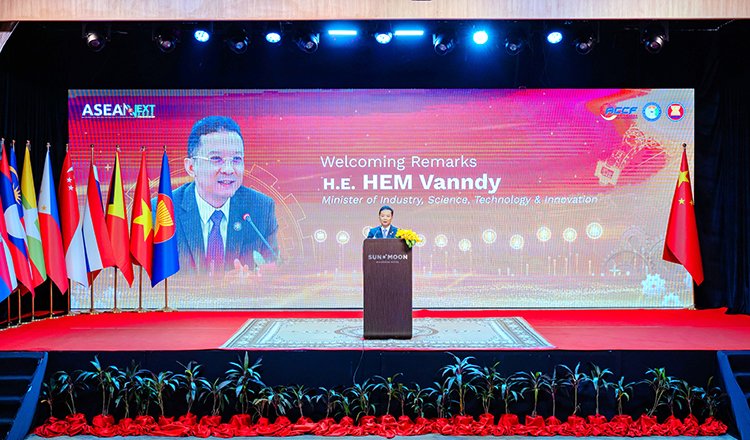
The Southeast Asia’s manufacturing sector faces a critical turning point as regional leaders convened at the ASEAN NEXT 2025 Forum in Phnom Penh, placing the spotlight on “soft infrastructure”—the integration of technology, innovation, and skilled human capital—as the central driver of competitiveness.
The two-day forum, hosted by Cambodia’s Ministry of Industry, Science, Technology & Innovation (MISTI), brought together policymakers, industry leaders, and investors to discuss strategies for propelling ASEAN to the forefront of global manufacturing.
In his keynote address, Hem Vanndy, Cambodia’s Minister of Industry, Science, Technology & Innovation, called for a shift in the region’s approach to infrastructure development. “While roads, ports, and reliable energy remain indispensable to commerce, our future competitiveness will be equally shaped by soft infrastructure—the dynamic frameworks of technology, innovation, and human capital,” Vanndy said.

The minister detailed Cambodia’s ongoing efforts, including finalizing a university-industry collaboration framework, establishing a National R&D Fund, and developing technology transfer legislation. He stressed that digital networks, research hubs, and robust intellectual property protections are essential for advancing smart manufacturing and technological upgrades across ASEAN.
The forum’s priorities were echoed by ASEAN Secretary-General Kao Kim Hourn, who, in pre-recorded remarks, linked the gathering’s focus to the ASEAN Plan of Action on Science, Technology and Innovation (APASTI) 2026-2035, describing APASTI as the “shared compass” for integrating science and technology in the region.
“Modern infrastructure—particularly in logistics, transport, digital connectivity, and energy—forms the backbone of competitive and resilient manufacturing,” Kao said.

He underscored the need to close the workforce skills gap, noting that only 48.8% of large firms, 36.1% of medium-sized firms, and 16.8% of small firms in ASEAN currently offer employee training. Kao urged participants to use the forum as a catalyst for turning strategic plans into tangible results.
Song Jianyuan, Deputy Director of the China-ASEAN Technology Transfer Center, highlighted the importance of science and technology collaboration between China and ASEAN. He noted the expansion of bilateral technology transfer mechanisms with nine ASEAN nations and a collaboration network exceeding 2,900 members.”
“This forum’s theme—Role of Infrastructure Technology and Innovation in Successful Manufacturing—directly addresses ASEAN countries’ needs for industrial upgrading and digital transformation,” Song said.

Song emphasised the importance of continued collaboration, expressing confidence that through the combined efforts of China and ASEAN countries, scientific and technological innovation will drive high-quality regional economic growth and help build a more united China-ASEAN Community with a Shared Future.
Representatives from ASEAN and China have established a collaborative roadmap that emphasises the rapid adoption of advanced technologies—including artificial intelligence, the Internet of Things, and robotics—alongside initiatives to enhance workforce competencies for contemporary manufacturing. The agreement also prioritises policy harmonisation and regional cooperation with strategic partners such as China.
The ASEAN NEXT 2025 Forum served as a platform for advancing ASEAN’s vision of innovation-driven, inclusive, and resilient economic growth.