
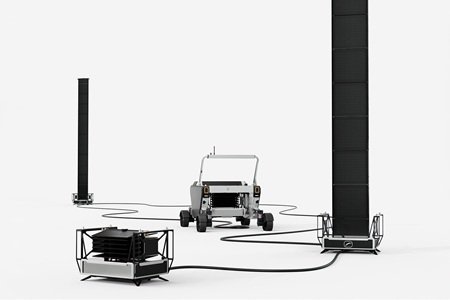

Astrolab has unveiled the Lunar Utility Module for Industrial Services (LUMIS), a lunar infrastructure system designed to provide power, communications and data services to customers operating on the Moon. The launch expands the company’s business beyond rover development and supports its new positioning as “The Lunar Operations Company”, bringing together surface mobility, energy and connectivity for long-term lunar activities.
Alongside LUMIS, Astrolab introduced its Lunar Operating System (LUNAR OS), an integrated platform of products and services aimed at transforming individual lunar missions into sustained operations. The system combines the company’s FLEX family of rovers, which transport cargo and deploy infrastructure, with LUMIS nodes that supply power, communications and data services.
By integrating mobility and infrastructure into a coordinated utility network, Astrolab aims to simplify lunar logistics, lower operational costs and help customers establish and expand their presence on the lunar surface as exploration moves towards longer-term human and robotic operations.
Astrolab Founder and CEO Jaret Matthews is presenting the company’s expanded strategy at UP.SUMMIT, held as part of the MAX POWER activities at Kennedy Space Center. Full-scale models of the company’s lunar rovers and the newly introduced LUMIS node are also scheduled to be displayed during the public showcase.
A key feature of Astrolab’s approach is the ability to transport and position infrastructure at locations that offer optimal sunlight and communications coverage after delivery to the Moon. Its FLEX rover can carry payloads across distances of tens of kilometres, allowing LUMIS nodes to be deployed where conditions are most favourable rather than limiting their placement to the immediate surroundings of a lander.
Using a shared rover to transport multiple nodes, instead of equipping each infrastructure unit with its own mobility system, could reduce redundant mass and increase the amount of infrastructure delivered through fewer lunar missions.
Initial LUMIS demonstration units are expected to generate 2kW of power, with future versions designed to provide up to 20kW each as lunar infrastructure expands. Multiple nodes could be delivered on a single cargo lander and subsequently transported, positioned and connected by one FLEX rover.
Astrolab estimates that an interconnected network of LUMIS nodes could provide more than 100kW of power before anticipated nuclear power systems become available, without the regulatory and safety requirements associated with nuclear technologies. The company expects this approach to reduce deployment complexity and costs for customers.
Astrolab’s infrastructure strategy also addresses the challenges of establishing reliable communications networks on the Moon, particularly around the lunar south pole, where small differences in terrain can significantly affect solar exposure and visibility of Earth.
Much like terrestrial wireless networks, lunar communications systems require equipment to be positioned at locations with suitable lines of sight. Near the south pole, even a 50-metre difference in positioning can result in hundreds of additional hours of darkness or reduce near-continuous visibility of Earth to approximately half the time.
However, landing sites must be selected primarily for safe slopes, suitable terrain and hazard avoidance. Astrolab’s rover-based deployment model allows landing locations and infrastructure placement to be determined independently.
The Shackletonde Gerlache connecting ridge, near the lunar south pole, is one area of interest for future human and robotic exploration, although its limited visibility of Earth creates communications challenges.
Astrolab believes a network of LUMIS nodes could address this limitation. Units positioned by FLEX rovers at elevated locations on Malapert Massif or Mons Mouton could maintain near-continuous communications with Earth while retaining a line of sight to the connecting ridge, more than 100 kilometres away.
Additional LUMIS nodes deployed along the ridge could connect to Earth through links between installations, while providing local Wi-Fi and 5G connectivity for surface operations. The network would extend communications to areas with limited or no direct access to Earth and complement planned orbital communications systems as they become operational.
Each LUMIS unit is being developed with a vertical solar array tower, batteries, transceivers, wireless power-transfer capabilities and onboard edge computing. The system is designed to support high-bandwidth direct-to-Earth communications, local Wi-Fi and 5G connectivity for surface equipment, and long-range backhaul connections between nodes deployed across different operating areas.
LUMIS is intended to support a range of activities, including recharging visiting rovers while collecting and uploading scientific data for storage and transmission to Earth. It could also supply power to energy-intensive in-situ resource utilisation equipment, with FLEX rovers transporting the necessary raw materials, or feedstock, to these installations.
The communications network would further enable coordinated operations between different lunar assets through a reliable local wireless infrastructure.
According to Astrolab, each node will have sufficient internal power reserves to operate for more than 400 hours while continuing to supply external payloads.
Through LUNAR OS, the company plans to offer mobility, power and connectivity as integrated services, allowing customers to pay for access and usage rather than developing and maintaining their own infrastructure. Smaller customers could share existing infrastructure, while larger operations could be supported through dedicated equipment.
Astrolab is targeting 2028 for its first LUMIS deployment as part of its previously announced commercial FLEX mission aboard SpaceX’s Starship.
Astrolab also plans to relocate its headquarters from Hawthorne, California, to a purpose-built facility in Torrance in 2027. The new site will be approximately four times larger than its current premises and will accommodate manufacturing, engineering, testing, research and development, and mission control operations.
The company will additionally use its facility at the Texas Space Institute in Houston to advance LUMIS testing in a lunar analogue environment.
The expansion follows Astrolab’s selection to develop a crewed lunar rover for NASA’s Artemis programme. Separately, the company is preparing its first lunar rover, the FLEX Lunar Innovation Platform (FLIP), for launch aboard Voyager Technologies’ Griffin-1 lander later this year. The mission is part of NASA’s Moon Base initiative targeting the lunar south pole region.
Visitors attending the UP.SUMMIT public showcase during MAX POWER on November 78 will be able to view full-scale models of Astrolab’s lunar rovers and the LUMIS node inside the NASA hangar at the Kennedy Space Center Visitor Complex.