
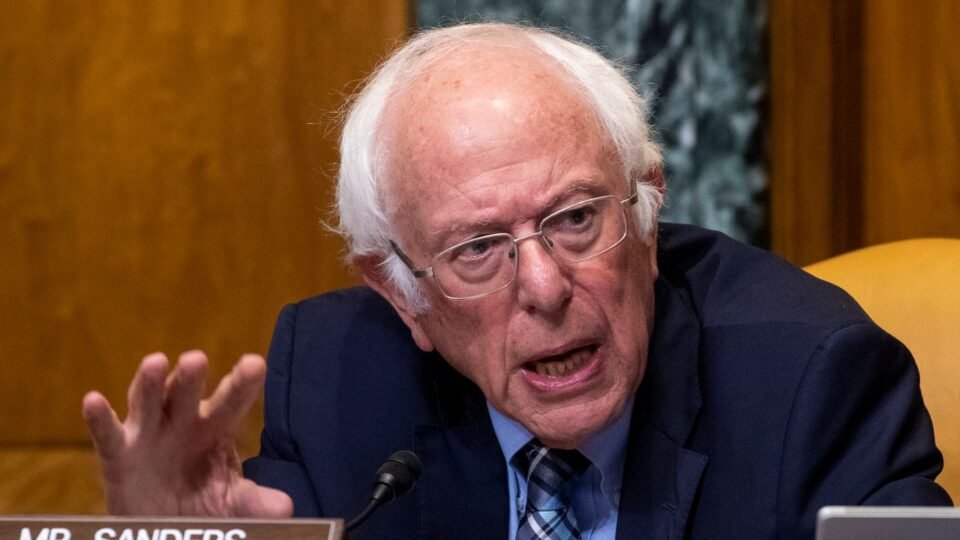
As Bernie Sanders endorsed former primary rival Joe Biden in April of last year, he promised to work to “move Joe and his campaign in a more progressive direction.” In many ways, he has succeeded: Biden ran his general election campaign against Donald Trump not only on a call for national unity, but on a legitimately ambitious agenda. The new administration quickly began to carry it out, including with the passage of its bold COVID-19 relief package, which it got through without any GOP support.
More recently, however, the progressive push has hit some speed bumps. Republicans—virtually all of whom are pulling in the same illiberal direction—have often forced their counterparts to focus on defending the central tenets of democracy rather than on advancing specific policies. And the centrist and conservative flanks of the Democratic party have used their influence to hold up or alter big-ticket items. As Axios reported over the weekend, a growing number of Democrats are “raising the alarm” that the party’s focus on progressive tenants is alienating much of America. This is embodied by Eric Adams, who won the Democratic primary and will likely be New York City’s next mayor, and who ran on a message of promoting public safety rather than defunding the NYPD. Adams will reportedly meet with Biden and Attorney General Merrick Garland at the White House on Monday.
All this has frustrated many on the left, who want to see more concrete action from the White House, and who have turned up the pressure on Sanders, now helping to lead a party where he was once an outsider. “It’s absolutely imperative if democracy is to survive that we do everything that we can to say, ‘Yes, we hear your pain and we are going to respond to your needs,’” Sanders told the New York Times’ Maureen Dowd over eggs and toast at a Vermont diner. “That’s really what this is about.”
Sanders was discussing intra-party negotiations over Democrats’ “soft infrastructure” plan, the latest frontline in the battle between progressives and moderates. Sanders, the chair of the Senate Budget Committee, wants $6 trillion for programs aimed at helping families, social services, and the climate. But centrists like Mark Warner are pushing for a plan with a lower price tag, uneasy about progressives’ more ambitious proposals that would raise taxes on corporations. As Axios reported Sunday, that will likely put the starting point for negotiations somewhere in the $3.5 trillion range—a number that could be pulled lower by conservative and moderate Democrats like Joe Manchin and Jon Tester as the party works to advance the legislation before lawmakers recess in August.
That $3.5 trillion wouldn’t be anything to sneeze at; while it’s far lower than the $6 trillion Sanders has identified as his preferred starting point, it would still check every box on the White House priority list and could go a long way toward delivering real gains for everyday Americans. But it won’t have the sweep of Sanders’s original proposal, and may prove unsatisfactory to both him and the rest of the progressive caucus. “A lot of work has gone into the effort and much more work needs to be done,” a Sanders spokesperson told Axios. “Senator Sanders wrote a $6 trillion proposal to address the desperate needs of working people and the existential threat of climate change, and he’s confident that Democrats will come together around a reconciliation bill that does just that.”