

Institutional Intelligence Dossier | Financial Security | Critical Infrastructure | Cyber Resilience | European Strategic Autonomy
Scope: Assessment of European banking infrastructure, using Italy as the principal analytical entry point and comparing France, Germany, the United Kingdom, Spain and the Netherlands within the wider European financial ecosystem, examining technological dependencies, operational resilience, regulatory effectiveness, geopolitical exposure and systemic financial stability over the 2026–2031 horizon.
Executive Summary — Bottom Line Up Front
- European banking faces a structural cybersecurity challenge in which common technological dependencies can transform individual operational failures into cross-border financial disruptions.
- The ECB’s revised November 2026 supervisory assessment identifies cybersecurity, third-party and ICT control deficiencies affecting 96% of significant supervised institutions.
- European financial entities reported 3,383 major ICT incidents in 2025, of which 29% originated from third-party providers, approximately 31% had cross-border consequences and 10% were cybersecurity-related.
- Italy retains 19,140 operational bank branches, including 4,099 belonging to cooperative credit banks, alongside increasingly centralised digital infrastructure.
- Intesa Sanpaolo announced the completion of a major core IT cloud migration in July 2026, involving more than 800 applications.
- The European Systemic Risk Board elevated its systemic cyber risk assessment from elevated to severe in June 2026.
- DORA and the corresponding British regulatory framework strengthen institutional oversight but cannot, independently, eliminate correlated operational failures.
- Through 2031, the decisive variable will be whether verified recovery capabilities, technological substitutability and cross-sector crisis coordination develop faster than technological concentration and AI-enabled threats.
Sources: ECB supervisory assessment, November 2026; Joint ESAs Report on Major ICT-related Incidents, June 2026; Banca d’Italia, March 2026; Intesa Sanpaolo, July 2026; ESRB systemic cyber risk warning, July 2026.
Europe has strengthened the capital, liquidity and regulatory foundations of its banking system without securing equivalent control over the technological infrastructure on which financial stability increasingly depends. The European Central Bank’s November 2026 supervisory assessment assigned medium-high operational and ICT risk scores to 96% of significant institutions, while European financial entities reported 3,383 major ICT incidents in 2025. The contradiction is becoming economically consequential: banks must finance cybersecurity remediation, artificial intelligence adoption, cloud modernisation and post-quantum migration while governments attempt to reduce strategic technological dependence. Italy’s extensive cooperative banking network illustrates the difficulty of reconciling territorial accessibility with centralised digital infrastructure. Through 2031, European financial sovereignty will depend less on the nationality of technology providers than on the demonstrated capacity to maintain essential financial services when common technological dependencies fail.
A solvent banking system can still become operationally paralysed
The economic importance of Europe’s financial infrastructure is measured by the scale of the transactions it supports. In 2025, the Eurosystem’s T2 platform processed an average of 431,067 euro-denominated transactions daily, worth €1,932.8 billion. TARGET2-Securities processed 922,533 daily transactions worth €1,101.4 billion equivalent, while TARGET Instant Payment Settlement handled approximately 2.472 billion transactions throughout the year. The Eurosystem Collateral Management System, launched on 16 June 2025, supported an average mobilised collateral stock of €1,579.4 billion.
These figures describe settlement flows and collateral stocks, not potential cyber losses. Their significance is institutional: capital buffers cannot restore unavailable payment systems, liquidity reserves cannot fulfil their economic purpose if transactions cannot be executed, and deposit protection does not guarantee uninterrupted access to banking services.
The TARGET disruption of 27 February 2025 demonstrated that malicious activity is not a prerequisite for substantial financial interruption. A hardware malfunction affected T2 for approximately ten hours, T2S for eight hours and partially disrupted TIPS for approximately one hour. Contingency settlement was activated. Two months later, the Iberian electricity blackout of 28 April exposed a different dependency: principal financial infrastructures remained resilient, while electricity and telecommunications disruption impaired practical access to retail payment services.
The first annual report under the Digital Operational Resilience Act (DORA), published by the European Supervisory Authorities on 3 June 2026, confirms that technological reliability deserves as much attention as malicious cyber activity. Of 3,383 major ICT incidents reported across covered European financial sectors in 2025, 51% were associated with system failures, 27% with external events, 18% with payment-related problems and 10% with cybersecurity. These classifications overlap. Approximately 31% had cross-border consequences, 29% originated from third-party providers and 30 incidents affected more than one million transactions.
By September 2026, the European Banking Authority had received nearly 5,500 major ICT incident reports since DORA reporting began in January 2025, including more than 4,000 originating from banks. The cumulative figures overlap with the first annual dataset and cannot establish a comparable increase in successful attacks. They nevertheless demonstrate the scale of the supervisory challenge.
Italy’s banking geography conceals a increasingly centralised technological economy
Italy retained 19,140 operational bank branches and 414 banking institutions at the end of 2025. Its branch network contracted by 2.62% during the year, but cooperative credit banks still operated 4,099 branches. BCC Iccrea and Cassa Centrale alone maintained 3,910 branches, 177 operating affiliated institutions and approximately €261.65 billion in combined reported assets, with €148.8 billion in net customer lending.
The contradiction is that geographical decentralisation no longer guarantees technological independence. Shared processing services allow smaller institutions to access capabilities that would be prohibitively expensive to maintain individually, but the continuity of thousands of geographically distributed banking facilities may depend on common digital services.
On 2 July 2026, Intesa Sanpaolo announced the completion of a major core IT migration involving more than 800 applications transferred to Google Cloud infrastructure hosted in Italy through cooperation with TIM. Domestic hosting strengthens certain data-residency and jurisdictional safeguards. It does not independently establish technological substitutability or operational independence.
Banca d’Italia’s July 2026 horizontal incident assessment identified 23 distinct cybersecurity events generating 31 notifications during 2025. Within the national reporting analysis, external providers were involved in 56% of notifications, service interruptions occurred in approximately 70%, and economic losses were reported in approximately 35%. Five episodes generated losses exceeding €1 million; two subsequently achieved full financial recovery and three partial recovery. The Italian provider-involvement measure is not directly comparable with the European 29% third-party-origin statistic, but both demonstrate the importance of external service governance.
Italy’s challenge is therefore to preserve the economic benefits of cooperative banking and technological consolidation without mistaking institutional diversity for independent recovery capacity.
The cost of digital security is becoming a structural banking expense
The 2024 CIPA-ABI economic survey, covering 23 banking groups representing approximately 92% of Italian banking-group assets, recorded €6.334 billion in total IT ownership costs, €6.618 billion in IT cash expenditure and €2.140 billion in investment. Security expenditure amounted to €366 million, public cloud expenditure to €245 million, and IT compliance expenditure reached €780.9 million across a separate population of 21 groups.
Security represented approximately 5.53% of aggregate IT cash expenditure, while the published mean institutional security share was 4.9%. Total ownership costs and cash expenditure overlap, as may security, cloud and compliance categories. Their economic significance lies not in their aggregation but in the competing demands they impose on investment budgets.
The proportionality problem is particularly visible among smaller institutions. Average public cloud expenditure represented 3.3% of IT cash out among the largest surveyed Italian banking groups, compared with 3.8% among medium-sized groups and 4.9% among smaller groups. Regulatory requirements that disregard these differences risk imposing disproportionate fixed costs and encouraging further dependence on shared providers.
Insurance offers only a partial financial response. According to EIOPA, earned cyber insurance premiums across the European Economic Area reached approximately €6 billion in 2024, comprising €3.6 billion in direct insurance and approximately €2.4 billion in inward reinsurance. Standalone cyber coverage represented 79% of premiums, up from 73% in 2023.
The 40% inward reinsurance share demonstrates the importance of distributing cyber underwriting exposure. Yet correlated losses arising from common technological dependencies challenge the diversification assumptions underlying insurance. Compensation can absorb eligible financial damage; it cannot restore essential banking services.
Artificial intelligence accelerates the threat while quantum migration consumes the investment budget
On 7 July 2026, the European Systemic Risk Board warned that frontier AI models could strain financial-sector cybersecurity. Its systemic cyber risk assessment had risen from elevated in March to severe in June. The ECB simultaneously intensified supervisory attention towards AI-enabled threats.
The November 2026 EBA assessment found that approximately 70% of surveyed banks identified cybersecurity and data protection among their leading operational risks, followed by fraud at 58% and conduct and legal risks at 48%. Nearly two-thirds reported using AI to identify or remediate software weaknesses, demonstrating that defensive adaptation is already underway.
The financial fraud evidence is less reassuring. Reported fraudulent payment transaction values across the European Economic Area increased from approximately €3.4 billion in 2022 to €4.2 billion in 2024. The official 2024 annual increase was 17%, or €602 million, despite an overall value-based fraud rate of approximately 0.002%. Credit transfers accounted for €2.5 billion in fraudulent transactions and card payments for €1.3 billion. These amounts are not equivalent to unrecovered bank losses, and the available evidence does not establish their AI-related share.
The Bank of England and Financial Conduct Authority’s October 2026 survey found that 86% of respondents used AI, compared with 58% in 2022. Some 80% reported deploying AI agents, although only 2% reported broad autonomy. More consequentially, 77% reported deep knowledge of internally developed high-materiality systems, compared with just 24% for externally supplied equivalents. Technological adoption is advancing faster than institutional understanding of certain externally supplied capabilities.
Post-quantum migration imposes a further investment requirement. The EBA’s November 2026 survey found that 66% of responding European banks targeted completion of high-risk migration by 2030, yet only 8% possessed operational migration roadmaps and 9% approved roadmaps. Comprehensive cryptographic inventories existed at 34% of respondents, while 73% reported limited or undocumented knowledge of suppliers’ migration preparedness.
The European post-quantum roadmap targets priority critical infrastructure migration by the end of 2030; the British framework identifies 2031 for high-priority migration and 2035 for broader completion. These objectives require expenditure before the emergence of a demonstrated cryptographically relevant quantum threat, placing additional pressure on institutions already financing DORA implementation and AI transformation.
Europe is financing technological alternatives without yet securing operational independence
The European Commission’s sovereign cloud procurement award of 17 April 2026 provides a concrete departure from sovereignty declarations unsupported by industrial capability. Four contracting arrangements, worth up to €180 million over six years, were assessed under the Commission’s Sovereignty Effectiveness Assurance Level framework. Three achieved SEAL-3 and one SEAL-2.
The successful arrangements involve POST Telecom, OVHcloud, Clever Cloud, STACKIT, Scaleway, Proximus, S3NS, Clarence and Mistral. Their assessments concern specified services procured for Union entities, not comprehensive banking-sector cybersecurity certification.
The industrial ambition is considerably larger. The Important Project of Common European Interest on Next Generation Cloud Infrastructure and Services, approved in December 2023, provides for up to €1.2 billion in public support and an expected €1.4 billion in private investment. France, Germany, Italy, Spain and the Netherlands participate alongside Hungary and Poland.
The EuroHPC and AI Factories programme envisages approximately €10 billion in investment over 2021–2027. On 30 July 2026, the Commission announced its call for up to seven AI Gigafactories, supported by up to €10 billion in public funding and intended to mobilise at least €20 billion in private investment. These programme amounts cannot be aggregated indiscriminately or treated as completed expenditure.
Industrial expansion faces physical constraints. The International Energy Agency’s 2026 outlook projects global data centre electricity demand rising from approximately 485 TWh in 2025 to 950 TWh in 2030. Meanwhile, the Commission announced €347 million for strategic submarine cable projects in February 2026, including €20 million for emergency repair capabilities. Computing sovereignty is inseparable from electricity supply, communications infrastructure and industrial execution.
The Cloud and AI Development Act, proposed on 3 June 2026, could strengthen European computing capacity, but remains a legislative proposal in the assessed record. The Data Act’s elimination of applicable switching charges from 12 January 2027 addresses a narrower commercial barrier. It cannot eliminate application redesign, interoperability requirements or the costs of validating financial-service transitions.
The next 24 months will expose whether regulation delivers recovery or paperwork
DORA has applied since 17 January 2025. Yet the ECB’s November 2026 assessment of 108 banks recorded an average operational and ICT risk score of 2.99, with an ICT component score of 3.02. Only 16% registered improvements in operational and ICT assessments, while 13% experienced downgrades. Business continuity controls accounted for 23% of relevant supervisory measures.
The United Kingdom offers a complementary institutional approach. Its October 2026 SIMEX26 exercise involved 38 major banks and financial infrastructure operators, examining collective resilience during prolonged disruption affecting a global cloud provider. Updated British operational incident and third-party reporting requirements are scheduled to apply from 18 March 2027.
National priorities nevertheless differ. France must connect its technology industry with the requirements of internationally active banking groups. Germany must establish the continuity of shared services supporting its savings banks and cooperative institutions. Spain must address electricity and telecommunications dependencies. The Netherlands has already recommended household preparedness for 72 hours of electronic payment disruption, including approximately €70 in cash per adult and €30 per child.
Between November 2026 and November 2028, European authorities must convert these differentiated requirements into measurable collective recovery capabilities. The planned digital euro pilot, involving 36 selected payment service providers and scheduled to operate for 12 months from the second half of 2027, may support additional payment functionality, although issuance remains conditional.
The central planning case through 2031 is uneven improvement: stronger regulation and defensive capabilities alongside persistent technological concentration, substantial investment requirements and incomplete substitutability. Accelerated mandatory localisation could impose additional migration risks without resolving these constraints.
The cost of inaction will fall first on banks through remediation expenditure, operational losses and reduced investment flexibility; on enterprises through interrupted transactions and working-capital pressures; on households through impaired financial accessibility; and potentially on governments through wider economic stabilisation requirements.
With 96% of significant institutions receiving medium-high operational and ICT risk assessments in 2026, Europe’s next financial security test is not the publication of another regulatory framework. It is whether the banking system can demonstrate collective continuity before technological acceleration, geopolitical fragmentation or common-provider disruption makes that capability economically indispensable.
Navigational Index
PILLAR I — Structural Exposure, Banking Infrastructure and Systemic Technological Dependencies
Purpose: Establish the institutional, economic, physical and technological architecture of European banking infrastructure and identify the structural factors determining its operational resilience.
Chapter 1 — European Banking Infrastructure as a Systemically Critical Economic and National Security Asset
The architecture of European banking, monetary transmission, financial intermediation, payment systems, settlement infrastructure and the distinction between institutional solvency and operational continuity.
Chapter 2 — Italy’s Banking Infrastructure: Territorial Distribution, Cooperative Credit, Digital Transformation and Structural Exposure
Italian banking groups, branch consolidation, cooperative banking, national payment infrastructure, technological investment, physical service availability and the resilience implications of digital centralisation.
Chapter 3 — Cloud Computing, Technology Concentration and the External Dependencies of European Banking
Hyperscale cloud adoption, outsourcing, data governance, contractual substitutability, technological sovereignty, vendor concentration and the distinction between geographic data residency and operational independence.
Chapter 4 — European Banking Infrastructure in Comparative Perspective: Italy, France, Germany, the United Kingdom, Spain and the Netherlands
National banking structures, regulatory jurisdictions, digital maturity, technological dependencies, financial infrastructure, service continuity and comparative institutional resilience.
PILLAR II — Cyber Risk, Emerging Technologies, Regulatory Architecture and Financial Contagion
Purpose: Assess documented cyber and operational risks, their financial consequences, technological evolution and the effectiveness of European regulatory and supervisory responses.
Chapter 5 — European Banking Cyber Incidents: Official Evidence, Operational Losses and Threat Evolution
DORA incident statistics, incident classification, historical developments, documented financial losses, recovery outcomes, third-party failures and limitations of cross-country incident comparisons.
Chapter 6 — Systemic Financial Contagion and Correlated Operational Disruption
The transmission of operational disruption into payment delays, liquidity pressures, economic interruption, confidence deterioration and cross-sector financial instability, including systemic recovery requirements.
Chapter 7 — Artificial Intelligence, Cybercrime and the Transformation of Financial Security
Frontier artificial intelligence, financial fraud, defensive automation, supervisory warnings, institutional preparedness and the changing economics of cybersecurity.
Chapter 8 — Quantum Computing, Cryptographic Modernisation and Long-Term Financial Infrastructure Security
Post-quantum cryptography, migration governance, cryptographic inventories, implementation costs, interoperability and long-term protection of financial information.
Chapter 9 — DORA, ECB Supervision and the European Legal Architecture of Digital Operational Resilience
Regulation (EU) 2022/2554, supervisory responsibilities, mandatory incident reporting, resilience testing, critical third-party oversight, national implementation and the British regulatory comparison.
PILLAR III — Strategic Autonomy, Economic Resilience and European Financial Security Through 2031
Purpose: Integrate the structural and regulatory findings into a forward-looking assessment of financial sovereignty, strategic risk management and government decision priorities.
Chapter 10 — Financial Infrastructure, Geopolitical Risk and Cross-Sector Resilience
International technological dependencies, geopolitical uncertainty, telecommunications and energy continuity, public-private crisis coordination and national economic security.
Chapter 11 — The Economics of Banking Cybersecurity: Investment, Operational Costs, Insurance and Financial Exposure
Cybersecurity expenditure, technological modernisation, financial loss measurement, insurance limitations, investment efficiency and proportionality between large and smaller banking institutions.
Chapter 12 — European Strategic Autonomy and the Future of Financial Infrastructure Governance
European technological capabilities, cloud sovereignty, procurement policy, diversification, regulatory coordination, cross-border cooperation and the implications of European dependence on global technology suppliers.
Chapter 13 — European Banking Cyber Risk Scenarios and Strategic Outlook, 2026–2031
Alternative five-year trajectories, technological and regulatory developments, observable indicators, residual uncertainties and plausible financial stability outcomes.
Chapter 14 — Final Net Assessment: Government Decision Priorities and a European Financial Resilience Roadmap
Integrated cross-pillar assessment, institutional responsibilities, policy alternatives, implementation constraints, measurable resilience objectives and strategic priorities through 2031.
Master Abstract
From bank-specific cybersecurity to system-wide financial resilience
The security of European banking infrastructure can no longer be assessed exclusively through conventional measures of institutional solvency, capital adequacy, liquidity or exposure to credit and market risks. The continuity of essential financial services increasingly depends on technological infrastructures shared across institutions, economic sectors and national jurisdictions. Operational resilience has consequently acquired a macroprudential dimension: an otherwise solvent and adequately capitalised banking institution may experience severe operational impairment without an initial deterioration of its balance sheet. The November 2026 ECB supervisory assessment illustrates this distinction. Although the aggregate capital and liquidity positions of supervised banks remain robust, operational and ICT risk continues to represent one of the weakest areas of supervisory evaluation. Overall Common Equity Tier 1 capital requirements and guidance for 2027 stand at 11.3% of risk-weighted assets, compared with 11.2% for 2026, while deficiencies associated with cybersecurity, technology providers and ICT controls remain widespread. The resulting strategic challenge is therefore not simply to prevent individual cyber incidents, but to preserve the availability, integrity and recoverability of essential financial functions when technological disruption affects multiple institutions simultaneously. ECB — 2026 Supervisory Review and Evaluation Process — November 2026. bankingsupervision.europa.eu+1
Italy as a representative case of hybrid banking infrastructure
Italy provides a particularly relevant analytical case because its financial infrastructure combines an extensive territorial distribution of banking services with substantial technological modernisation. According to Banca d’Italia, the national banking system retained 19,140 operational branches at the end of 2025, compared with 19,655 at the end of 2024, representing a calculated annual contraction of approximately 2.62%. Cooperative credit institutions accounted for 4,099 branches, while cooperative popular banks operated a further 633. This distribution preserves an important territorial dimension of financial accessibility, particularly for households, small enterprises and communities dependent on local banking relationships. Nevertheless, physical distribution does not necessarily correspond to technological decentralisation. Intesa Sanpaolo announced in July 2026 that it had completed a major migration of core IT systems using Italian Google Cloud regions and infrastructure supplied by TIM, involving more than 800 applications. The combination of territorial banking networks and centralised technological services creates a dual resilience requirement: maintaining local service accessibility while ensuring that the underlying digital infrastructure remains recoverable and operationally sustainable. Cloud modernisation may improve resilience against institution-specific failures, but its systemic benefits depend on the independence and effectiveness of contingency arrangements. Banche e istituzioni finanziarie: articolazione territoriale — Banca d’Italia — March 2026; Core IT Cloud Migration — Intesa Sanpaolo — July 2026.
Third-party dependencies and the internationalisation of operational risk
The most consequential structural concern is the possibility that common technological dependencies produce correlated operational disruption. The first joint European supervisory report under DORA documents a financial ecosystem in which operational incidents are frequently associated with system malfunctions, external events and outsourced services rather than exclusively malicious activity. Of the 3,383 major ICT incidents reported across EU financial sectors during 2025, 1,056 had cross-border consequences, and 29% originated from failures attributable to third-party providers. Cybersecurity-related incidents accounted for 10% of the total. These distinctions are essential because the statistics neither establish that every major ICT incident constitutes a cyberattack nor demonstrate that third-party failures are predominantly malicious. Instead, they establish that financial infrastructure is exposed to operational interdependence irrespective of the initiating cause. The European policy response must therefore address both malicious cybersecurity threats and broader technological reliability, while evaluating whether contractual diversification genuinely provides independent operational alternatives. 2025 Report on Major ICT-related Incidents — Joint European Supervisory Authorities — June 2026.
The emerging macroprudential dimension of artificial intelligence
Artificial intelligence introduces a further transformation in the relationship between technological progress and financial stability. On 7 July 2026, the European Systemic Risk Board published its warning concerning systemic cyber risks associated with frontier AI models, following an elevation of its risk assessment from elevated in March to severe in June. The institution anticipates that advanced AI could eventually strengthen defensive capabilities but considers its near- and medium-term effects particularly challenging for cybersecurity. The concentration of leading AI technology providers outside the European Union also introduces questions concerning strategic autonomy, regulatory jurisdiction and continuity of access to essential technological capabilities. These developments do not establish that AI has already caused systemic banking disruption, nor do they justify a numerical forecast of future cyber losses. They nevertheless support the assessment that the speed of technological change may exceed the implementation capacity of traditional supervisory and corporate governance frameworks. The ECB’s supervisory priorities for 2027–2029 consequently include AI-enabled cybersecurity risks, cloud dependencies and readiness for post-quantum cryptographic migration. Frontier AI Models Could Strain Cyber Resilience in the Financial System — ESRB — July 2026; Supervisory Priorities 2027–29 — ECB — November 2026.
DORA and the transition towards infrastructure-level supervision
Regulation (EU) 2022/2554, the Digital Operational Resilience Act, establishes a common European framework covering ICT risk governance, incident reporting, resilience testing, contractual arrangements and oversight of critical external technology providers. Applicable since 17 January 2025, DORA represents an institutional recognition that the resilience of financial entities cannot be separated from the reliability of the services on which they depend. Its significance extends beyond regulatory harmonisation: it establishes a mechanism through which designated critical technology providers become subject to European financial-sector oversight.
The United Kingdom has pursued a comparable, although legally distinct, policy direction. Its first four critical third-party designations occurred in July 2026, followed by five additional designations on 17 November. The Bank of England’s Financial Stability Report of 26 November 2026 emphasises that common dependencies can generate risks exceeding those manageable by individual financial institutions. The convergence of European and British policy responses supports the analytical judgment that operational resilience is increasingly becoming a system-level responsibility requiring coordination between financial institutions, technology suppliers and public authorities. Regulation (EU) 2022/2554 — European Parliament and Council — December 2022; Financial Stability Report — Bank of England — November 2026. EUR-Lex+1
Financial sovereignty and the European strategic outlook
European financial sovereignty should not be equated with the exclusive use of domestically owned technology. A more substantive definition concerns the ability of European institutions to govern essential financial services, retain effective control over financial information, enforce regulatory requirements and sustain operational continuity under severe disruption. Domestic data residency, contractual rights and technological ownership are relevant but individually insufficient indicators of this capability.
Through 2031, European policymakers will confront a fundamental trade-off between the economies of scale offered by internationally integrated technology platforms and the systemic resilience benefits of credible technological diversification. Excessive fragmentation may increase costs and operational complexity; excessive concentration may reduce substitutability and institutional freedom of action. The appropriate strategic objective is consequently not technological isolation, but demonstrable operational independence where required, enforceable accountability, coordinated recovery arrangements and investment proportionate to the systemic importance of the functions concerned.
Key Evidence Table
European banking infrastructure and digital operational resilience
| Indicator | Verified value or status | Reference period | Definition and scope | Issuing authority | Exact source |
|---|---|---|---|---|---|
| Operational and ICT risk deficiencies | 96% | November 2026 | Significant ECB-supervised institutions | ECB | 2026 SREP |
| Original supervisory figure | 92%, subsequently revised | 19–20 November 2026 | Superseded publication figure | ECB | Official correction |
| CET1 requirements and guidance | 11.3% | 2027 | Percentage of risk-weighted assets | ECB | 2026 SREP |
| Major ICT incidents | 3,383 | 2025 | All covered EU financial sectors | Joint ESAs | DORA incident report |
| Third-party incident origin | 29% | 2025 | Share of major ICT incidents | Joint ESAs | DORA incident report, Figure 8 |
| Cross-border incidents | 1,056 | 2025 | Major ICT incidents affecting other jurisdictions | Joint ESAs | DORA incident report, Figure 4 |
| Cybersecurity-related incidents | 10% | 2025 | Share of all major ICT incidents | Joint ESAs | DORA incident report, Figure 5 |
| Italian operational bank branches | 19,140 | December 2025 | National banking network | Banca d’Italia | Territorial banking statistics |
| Italian cooperative credit branches | 4,099 | December 2025 | Banche di credito cooperativo | Banca d’Italia | Territorial banking statistics, Figure 2 |
| Italian branch network contraction | −2.62% | 2024–2025 | Calculated from 19,655 and 19,140 branches | Banca d’Italia | Territorial banking statistics |
| Core IT application migration | More than 800 | July 2026 | Company-reported cloud migration | Intesa Sanpaolo | Official announcement |
| Banks subject to cyber resilience stress testing | 109 | 2024 | ECB-supervised banks | ECB | Cyber resilience stress test |
| Banks undergoing enhanced testing | 28 | 2024 | Subset of stress-tested institutions | ECB | Cyber resilience stress test |
| UK critical third-party designations | 9 | November 2026 | Four July and five November designations | Bank of England / HM Treasury | Financial Stability Report |
| Systemic cyber risk assessment | Severe | June 2026 | EU macroprudential risk assessment | ESRB | Frontier AI warning |
| DORA application | In force and applicable | Since 17 January 2025 | Covered EU financial entities and relevant ICT providers | European Union | Regulation 2022/2554 |
Statistical interpretation and documentary corrections
The 92% and 96% figures contained in the supplied preliminary assessment do not represent an uncertainty interval. The ECB expressly corrected its original 92% figure to 96% on 20 November 2026. The corrected value will therefore constitute the authoritative baseline throughout this dossier.
Similarly, the 3,383 incidents concern the covered EU financial sector collectively, not exclusively banking institutions and not exclusively cyberattacks. These denominators will remain distinct throughout the subsequent chapters.
The national branch figures have been established using Banca d’Italia’s harmonised territorial statistics. Individual banking-group rankings contained in the supplied preliminary assessment require verification against company disclosures and comparable reporting dates before incorporation into Chapter 2.
Competing Explanations and Strategic Pathways
The four principal hypotheses originating in the supplied assessment concern different mechanisms and may coexist. They are therefore treated as overlapping, testable propositions rather than mutually exclusive scenarios with artificially assigned probabilities.
| Hypothesis | Supporting evidence | Countervailing factors | Observable indicators | Current assessment |
|---|---|---|---|---|
| H1 — Common technology dependencies constitute the principal structural systemic vulnerability | Third-party incident share; cross-border effects; ECB and British supervisory priorities | Provider oversight, diversification and improved recovery arrangements | Sector-wide recovery performance; concentration trends; independent continuity testing | Strongly supported as a material systemic risk |
| H2 — Italy’s territorial banking structure materially affects operational exposure | 19,140 branches; extensive cooperative credit network | Branch consolidation; potential resilience benefits of maintaining physical access | Service continuity outcomes; comparative operational losses; accessibility during disruption | Plausible; magnitude not established |
| H3 — AI development increases cyber risk faster than defensive adaptation | ESRB warning; increased supervisory attention | Defensive AI, improved detection and accelerated remediation | AI-related incident trends; defensive performance; verified remediation progress | Strong institutional support for increased risk; future losses uncertain |
| H4 — DORA and supervisory intervention progressively reduce residual systemic risk | Mandatory reporting, testing and external-provider oversight | Persistent control deficiencies, implementation costs and technological change | Closure of supervisory findings; recovery exercise results; incident severity | Conditional; effectiveness not yet demonstrated over a full economic cycle |
The principal judgment emerging from these propositions is that regulatory progress and technological risk growth are occurring simultaneously. Improved supervisory visibility must not be confused with demonstrated reductions in residual operational risk.
Principal Gaps and Watch Indicators
| Intelligence gap | Required evidence | Decision relevance |
|---|---|---|
| Actual system-wide technological concentration | Aggregated supervisory concentration assessments | Determines the scale of common-dependency risk |
| Effective technological substitutability | Independently assessed continuity and migration outcomes | Distinguishes contractual safeguards from practical resilience |
| Cross-sector operational resilience | Aggregated financial, energy and telecommunications crisis-exercise findings | Establishes whether continuity arrangements remain effective during compound disruption |
| AI-related financial losses | Consistent supervisory incident classification and loss statistics | Determines the measurable financial consequences of emerging threats |
| National banking-group infrastructure statistics | Comparable audited annual reports and regulatory disclosures | Enables accurate Italian and European structural comparisons |
| Post-quantum migration maturity | Aggregated supervisory reviews and programme completion records | Evaluates long-term information security preparedness |
| Cyber insurance exposure | Aggregated claims, coverage and exclusion data from competent authorities | Measures residual financial exposure and risk-transfer effectiveness |
| DORA implementation effectiveness | Supervisory remediation outcomes and oversight assessments | Establishes whether regulation produces substantive resilience improvements |
| EU–UK regulatory coordination | Formal cooperation instruments and published implementation outcomes | Measures the effectiveness of cross-border governance |
| Systemic operational loss modelling | Harmonised loss distributions and validated macrofinancial models | Establishes whether quantitative stress modelling is supportable |
19,140
−2.62%
74.67%
National Branch Footprint by Institutional Category (N = 19,140)
Click any category card to inspect share & branch ratio
Joint-stock banks
14,292
74.67%
Dominant commercial banking backbone (~3 in every 4 physical branches nationwide).
Cooperative credit banks
4,099
21.42%
Second-largest physical pillar, anchoring regional and local territorial proximity.
Cooperative popular banks
633
3.31%
Mid-tier mutual banking presence representing roughly 1 in every 30 Italian branches.
Foreign-bank branches
116
0.61%
Specialized cross-border institutional footprint concentrated in major financial hubs.
Selected Category Telemetry
Joint-stock banks — 14,292 branches (74.67% of national total)
14,292 / 19,140 = 74.6708% | Remaining network: 4,848 branches (25.33%)
Official Branch Count Reconciliation (31 December 2025)
| Institutional Category | Operational Branches | Reported Share (%) | Exact Calculated Ratio | Branches per 1,000 Total |
|---|---|---|---|---|
| Joint-stock banks | 14,292 | 74.67% | 14,292 / 19,140 (74.6708%) | 746.7 |
| Cooperative credit banks | 4,099 | 21.42% | 4,099 / 19,140 (21.4159%) | 214.2 |
| Cooperative popular banks | 633 | 3.31% | 633 / 19,140 (3.3072%) | 33.1 |
| Foreign-bank branches | 116 | 0.61% | 116 / 19,140 (0.6061%) | 6.1 |
| Total Italian Banking Infrastructure | 19,140 | 100.00% (100.01% rounded) | 19,140 / 19,140 (100.0000%) | 1,000.0 |
Note: Individual category percentages (74.67% + 21.42% + 3.31% + 0.61% = 100.01%) reflect standard two-decimal rounding from official Banca d’Italia branch counts.
Illustrative Contraction Sensitivity & Strategic Resilience Analysis
Using the verified 31 December 2025 baseline of 19,140 operational branches and the observed 2024–2025 annual contraction rate of −2.62%, explore an illustrative multi-year projection under constant annual contraction rates (for analytical illustration only; not an official Banca d’Italia forecast):
Implied 2024 Baseline (Derived)
~19,655
19,140 ÷ (1 − 0.0262) ≈ −515 net closures in 2025
Illustrative 2026 Footprint (1-Yr)
18,639
−501 branches vs. Dec 2025
Illustrative 2030 Footprint (5-Yr)
16,760
−2,380 branches (−12.4%) vs. Dec 2025
Physical-Digital Resilience Interdependence: While retail payments and banking interfaces migrate toward digital channels, physical branches remain critical fallback nodes during telecom outages, power disruptions, and cyber incidents—particularly outside metropolitan cores where cooperative credit banks (4,099 branches; 21.42%) provide essential territorial redundancy alongside joint-stock banks (14,292 branches; 74.67%).
WordPress-ready analytical component
The following self-contained HTML component presents the institutional distribution of Italian banking infrastructure, distinguishing physical service accessibility from demonstrated digital resilience. It requires no external libraries or JavaScript.
EUROPEAN BANKING INFRASTRUCTURE | OSINT 2026
Italy’s Banking Infrastructure
Territorial distribution and institutional structure.
Reference date: 31 December 2025.
19,140
Operational bank branches
−2.62%
Annual branch network change
4,099
Cooperative credit bank branches
Institutional distribution
Joint-stock banks — 14,292 | 74.67%
Cooperative credit banks — 4,099 | 21.42%
Cooperative popular banks — 633 | 3.31%
Foreign-bank branches — 116 | 0.61%
Percentages calculated from official branch counts.
Minor differences in totals reflect rounding.
Strategic interpretation
Physical distribution remains relevant to financial
accessibility and continuity planning. Branch counts
alone do not establish cybersecurity maturity,
technological independence or operational resilience.
Official source:
Banca d’Italia — Banche e istituzioni finanziarie:
articolazione territoriale — 27 March 2026
, Figure 2.
Initial Evidence Validation and Dossier Boundaries
The opening assessment incorporates the supplied preliminary research under the open-research protocol, subject to independent documentary corroboration wherever available.
Several elements require further verification before they can be treated as established facts:
- The individual branch rankings and technology investment amounts of Italian banking groups.
- The reported November 2026 Crédit Mutuel Arkéa incident, including its financial magnitude and third-party involvement.
- The preliminary estimate attributing approximately one-fifth of recent banking cyber incidents to third parties.
- Comparative national cyberattack frequencies, which require harmonised reporting definitions.
- The extent of post-quantum readiness and compound-disruption testing across individual European economies.
- The assertion that no systemic cyber event has materialised to date, which requires a precise definition of systemic impact and an adequate historical evidence base.
The joint ESAs report was accessible in extracted documentary form, but its rendered-page retrieval was blocked. Banca d’Italia’s statistical figures were additionally checked against the rendered original publication. The WordPress component has been reviewed for structural consistency but has not been tested within a live WordPress installation.
These limitations do not invalidate the central assessment. They define the boundaries within which the subsequent fourteen chapters will develop a defensible, evidence-based understanding of European banking cybersecurity, financial infrastructure resilience and strategic autonomy through 2031.
European Banking Cyber Resilience 2026–2031
Open-source analytical assessment — 28 November 2026.
European banking resilience depends on operational continuity,
technological substitutability, third-party governance and effective
recovery arrangements.
| Indicator | Value |
|---|---|
| ECB-supervised institutions with reported deficiencies | 96% |
| Major EU financial-sector ICT incidents, 2025 | 3,383 |
| Third-party incident origin | 29% |
| Cross-border incidents | 1,056 |
| Cybersecurity-related incidents | 10% |
| Italian bank branches, 2025 | 19,140 |
| Italian cooperative credit branches | 4,099 |
| Joint-stock bank branches | 14,292 |
| Cooperative popular bank branches | 633 |
| Foreign-bank branches | 116 |
| Annual Italian branch contraction | −2.62% |
| Intesa Sanpaolo migrated applications | >800 |
| ECB cyber resilience stress-tested banks | 109 |
| Enhanced testing subset | 28 |
| UK critical third-party designations | 9 |
Regulation (EU) 2022/2554 — DORA
Interactive features require JavaScript. This static summary
remains available when scripts are disabled.
OPEN-SOURCE ANALYTICAL ASSESSMENT
Assessment cut-off: 28 November 2026 Strategic horizon: 2026–2031 Geographical coverage: Italy, France, Germany, United Kingdom, Spain, Netherlands and the European Union.
Purpose: Establish the institutional, economic, physical and technological architecture of European banking infrastructure and identify the structural factors determining its operational resilience, strategic autonomy and exposure to correlated technological disruption.
The transformation of banking infrastructure into a strategic national security dependency
The principal structural transformation of European banking is the progressive convergence of financial intermediation, monetary infrastructure, telecommunications, data processing and internationally distributed technological services into a single interconnected operational ecosystem. The security of that ecosystem can no longer be evaluated solely through the financial soundness of individual banking institutions, because the capacity of banks to perform their economic functions increasingly depends on infrastructures that are not necessarily owned, directly controlled or independently replaceable by those institutions. A banking group may maintain adequate capital, liquidity reserves, profitable commercial activities and a sustainable balance sheet while simultaneously experiencing an operational disruption that prevents customers from accessing deposits, enterprises from executing payments, financial institutions from transferring liquidity or market participants from completing securities settlement. This distinction between financial capacity and operational capacity constitutes one of the most consequential changes in the contemporary relationship between banking regulation, economic security and national resilience. The integration of European financial markets has significantly increased transactional efficiency and reduced institutional fragmentation, but it has also expanded the strategic significance of common operational platforms, making their continuity a public-interest objective that extends beyond conventional commercial risk management. Aggregated Results of the 2026 SREP — European Central Bank — November 2026. bankingsupervision.europa.eu
The institutional importance of this transformation derives from the fact that banking infrastructure supports multiple economic functions simultaneously: household access to income and savings, corporate working capital, government disbursements and tax collection, domestic and international trade, collateral mobilisation, monetary policy implementation and financial market settlement. The operational impairment of these functions cannot necessarily be addressed through conventional financial stabilisation measures alone. Central bank liquidity may alleviate financial pressure but cannot independently restore unavailable transaction-processing systems or establish the integrity of compromised financial records. Similarly, deposit insurance protects eligible claims under its applicable legal framework but does not substitute for the uninterrupted availability of transactional infrastructure. Financial stability policy must therefore consider technological continuity as a distinct condition for the effective exercise of existing monetary and supervisory powers. The strategic objective is not merely the protection of individual institutions from financial loss, but the preservation of the financial system’s capacity to perform essential economic functions under adverse conditions.
The institutional architecture of European financial infrastructure
European banking infrastructure consists of overlapping layers of institutional responsibility, economic activity and technical service provision. Commercial banks maintain customer relationships and intermediate financial resources; central banks provide monetary settlement facilities and liquidity-management mechanisms; payment institutions facilitate transactional services; central counterparties and securities settlement systems support financial market activity; and external technology providers supply the computing, communications and data-processing capabilities upon which these functions increasingly depend.
The resulting architecture should not be interpreted as a collection of autonomous financial institutions operating independently of one another. It is more accurately understood as a distributed financial network in which separate organisations share institutional rules, settlement arrangements and technological dependencies. The systemic implications arise where independently managed institutions depend upon common services whose disruption could produce correlated consequences. The international standards developed by the Committee on Payments and Market Infrastructures and the International Organization of Securities Commissions recognise this interdependence by requiring financial market infrastructures to manage risks associated with participants, connected infrastructures and external service providers. Principles for Financial Market Infrastructures — CPMI-IOSCO — Bank for International Settlements. Bank for International Settlements
Institutional and functional architecture
| Infrastructure layer | Principal function | Economic relevance | Operational resilience requirement |
|---|---|---|---|
| Central banks | Monetary operations and settlement in central bank money | Monetary transmission and financial stability | Continuity of critical monetary functions |
| Commercial banks | Deposits, credit and payment services | Household and enterprise financial activity | Availability and integrity of essential banking services |
| Cooperative banks | Local credit and territorial financial intermediation | SMEs and local economic communities | Proportionate resilience and continuity of accessibility |
| Payment service providers | Transaction initiation and processing | Retail commerce and digital economic activity | Reliable transaction execution |
| Central counterparties | Clearing and management of counterparty exposures | Financial market stability | Operational continuity and reliable risk management |
| Central securities depositories | Securities recording and settlement | Capital markets and ownership integrity | Accurate, recoverable securities records |
| Financial messaging services | Exchange of financial instructions | Domestic and international transactions | Authenticity, integrity and availability |
| Cloud and computing providers | Hosting, processing and digital services | Banking system modernisation | Effective oversight and substitutability |
| Telecommunications providers | Connectivity between financial participants | Remote access and transactional communication | Continuity and dependable recovery |
| Energy infrastructure | Electricity supply | Physical and digital operational continuity | Cross-sector resilience arrangements |
| Public authorities | Regulation and crisis coordination | Protection of essential economic functions | Institutional cooperation and decision readiness |
Analytical classification based on the financial infrastructure functions and operational resilience principles described in the CPMI-IOSCO Principles for Financial Market Infrastructures.
The Eurosystem’s TARGET architecture and the scale of European financial interdependence
The Eurosystem’s TARGET Services provide the clearest measurable demonstration of the economic significance of European financial infrastructure. Their architecture integrates large-value payments, securities settlement, instant payments and collateral management within a harmonised institutional environment. T2 performs real-time gross settlement and supports monetary policy operations and interbank payments; TARGET2-Securities, or T2S, facilitates securities settlement; TARGET Instant Payment Settlement, or TIPS, provides continuous settlement of instant payments; and the Eurosystem Collateral Management System, or ECMS, harmonises the management of assets used as collateral in Eurosystem credit operations.
The launch of ECMS on 16 June 2025 completed a major phase of European financial infrastructure integration. The institutional significance extends beyond the replacement of national technological arrangements: it establishes a common collateral-management framework that supports the movement of eligible collateral and interacts with the Eurosystem’s liquidity and settlement services. Integration improves standardisation, institutional interoperability and the efficiency of monetary operations, although the associated resilience requirements must account for the possibility of common disruptions affecting more than one financial function.
The economic scale of these services is extraordinary. The ECB’s TARGET Services Annual Report for 2025 records daily euro-denominated T2 settlement activity exceeding €1.9 trillion, while T2S processed an average of more than 922,000 securities settlement transactions per day. The architecture consequently supports financial flows whose gross transactional value is substantially larger than the annual output of individual national economies. These values represent settlement activity rather than wealth creation, capital at risk or potential cyber losses and must not be interpreted as equivalent measures. TARGET Services Annual Report 2025 — European Central Bank — June 2026. European Central Bank
TARGET Services — Daily operational scale in 2025
| Infrastructure | Average daily transactions | Average daily value | Currency or scope |
|---|---|---|---|
| T2 | 431,067 | €1,932.8 billion | EUR |
| T2 | 11,425 | DKK 1,641.9 billion | Danish krone |
| T2S | 922,533 | €1,101.4 billion equivalent | EUR and DKK |
| TIPS | 2,735,053 | €2.2 billion | EUR |
| TIPS | 2,884,723 | SEK 1.6 billion | Swedish krona |
| TIPS | 1,632,664 | DKK 1.4 billion | Danish krone |
| ECMS | 6,087 | €1,579.4 billion | Average stock of mobilised collateral |
Source: TARGET Services Annual Report 2025, Table 1 — ECB — June 2026.
Statistical distinction: ECMS reports an average collateral stock, whereas the settlement services report transactional flows. These values must not be aggregated into a single financial exposure figure. Values denominated in different currencies must likewise remain separate unless converted using an expressly defined exchange-rate convention.
The accelerating operational significance of instant financial transactions
The expansion of instant payments introduces a further structural transformation because continuous financial service availability increasingly becomes an economic expectation rather than a supplementary commercial feature. The ECB reports substantial growth in TIPS activity between 2024 and 2025, accompanied by the expansion of its currency coverage and the continued integration of European payment services. The resulting environment compresses the traditional operational distinction between banking hours and non-banking hours, requiring institutions to consider continuous service delivery, liquidity availability and technological support.
The growth of instant payment infrastructure also illustrates why transaction counts, monetary values and criticality cannot be treated as interchangeable. Retail payment systems may process exceptionally large volumes of relatively low-value transactions whose interruption produces immediate consequences for households and commerce, whereas wholesale settlement infrastructure may process fewer transactions with significantly greater implications for financial institutions and liquidity management. A meaningful resilience framework must therefore distinguish economic function, time sensitivity, settlement integrity and the availability of alternative services instead of assigning a uniform security requirement based solely on transactional value. TARGET Services Annual Report 2025 — ECB — June 2026.
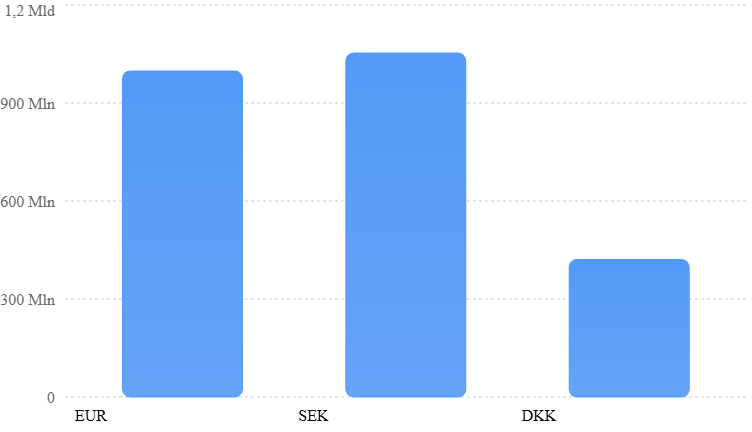
TIPS annual transaction distribution — 2025
| Currency | Annual transactions | Share of total volume |
|---|---|---|
| Euro | 998,294,509 | 40.4% |
| Swedish krona | 1,052,924,004 | 42.6% |
| Danish krone | 421,227,239 | 17.0% |
| Total | 2,472,445,752 | 100% |
Source: TARGET Services Annual Report 2025, Section 2.1 — European Central Bank — June 2026.
Operational availability and the limits of conventional resilience indicators
Operational availability remains an indispensable measure of infrastructure performance, but its interpretation requires considerable methodological caution. A high annual availability percentage establishes that a system remained technically available during the overwhelming majority of its defined measurement period; it does not establish immunity from consequential disruption, guarantee the successful completion of every transaction or measure the full economic effect of partial service degradation. This distinction is explicitly recognised in the ECB’s methodology for TARGET reporting, which notes that technical availability metrics do not capture every category of partial interruption. Consequently, annual uptime should be assessed alongside business-function availability, transaction completion, reconciliation integrity, recovery effectiveness and the consequences experienced by dependent institutions. TARGET Services Annual Report 2025, Section 3 — ECB — June 2026.
| Infrastructure | Reported technical availability, 2025 | Measurement qualification |
|---|---|---|
| T2 | 99.8% | Defined technical availability indicator |
| T2S | 99.8% | Weighted platform service availability |
| TIPS | 99.99% | Continuous instant payment platform |
| ECMS | 99.96% | Critical operational hours following launch |
Source: TARGET Services Annual Report 2025, Section 3 — ECB — June 2026.
These percentages should not be converted mechanically into comparable outage durations because their measurement periods and operational definitions differ. Nor should the residual percentages be interpreted as probabilities of successful cyberattacks. The appropriate strategic interpretation is that European financial infrastructure demonstrates high routine operational reliability while retaining a requirement for resilience against exceptional disruption.
Solvency, liquidity and operational continuity as separate dimensions of financial stability
A comprehensive financial security assessment requires the separation of solvency risk, liquidity risk and operational continuity risk. Solvency concerns the institution’s capacity to absorb losses and maintain an economically sustainable financial position; liquidity concerns its ability to meet obligations when they become due; operational continuity concerns its practical ability to execute the activities necessary to fulfil those obligations. The three categories interact but are not substitutes for one another. An operational disruption may initially leave an institution’s accounting position unchanged while progressively generating liquidity-management complications, additional costs or customer confidence deterioration. Conversely, a financially distressed institution may retain functioning technological systems while experiencing an inability to meet its financial obligations. This distinction has direct implications for supervisory decision-making because capital requirements address only part of the broader resilience problem.
The international infrastructure standards provide an additional benchmark. Principle 17 of the CPMI-IOSCO framework calls for arrangements designed to restore critical IT functions within two hours following disruptive events and complete settlement by the end of the affected day, including under extreme conditions. This is a financial market infrastructure continuity objective, not a universal recovery guarantee applicable to every commercial banking application. Principle 17: Operational Risk — CPMI-IOSCO — Bank for International Settlements. Bank for International Settlements
| Risk dimension | Central question | Principal assessment method |
|---|---|---|
| Solvency | Can the institution absorb financial losses? | Capital and balance-sheet assessment |
| Liquidity | Can obligations be met when due? | Liquidity stress testing |
| Operational availability | Can essential functions continue? | Business service continuity assessment |
| Data integrity | Can financial records be trusted? | Reconciliation and integrity assurance |
| Recovery capability | Can affected services be restored safely? | Validated recovery exercises |
| Third-party dependence | Can external services be sustained or replaced? | Supplier governance and substitutability assessment |
| Systemic resilience | Can the wider financial system continue functioning? | Coordinated sector-wide exercises and macroprudential assessment |
Chapter 1 — Key judgments and decision implications
European banking infrastructure must be evaluated as an interconnected economic utility whose reliability has implications extending beyond the commercial interests of individual banking institutions. Integrated settlement arrangements generate substantial economic and institutional benefits, but their effectiveness depends on the continuity of financial, technological and cross-sector services. For European governments and central banks, the central decision implication is that operational resilience must complement rather than replace existing capital, liquidity and macroprudential frameworks.
The assessment would materially change if comprehensive sector-wide exercises established consistently effective recovery across independent institutions, shared providers and interconnected financial services under severe disruption. The principal unresolved official evidence concerns aggregate financial losses attributable to operational interruptions, harmonised cross-infrastructure recovery results and the practical effectiveness of independent continuity arrangements.
The Italian banking model: territorial distribution and technological centralisation
Italy’s banking infrastructure presents a distinctive combination of territorial financial intermediation, large consolidated banking groups, cooperative institutions and accelerating technological transformation. Its strategic relevance derives not simply from the number of banking facilities operating throughout the country, but from the coexistence of institutional structures serving markedly different economic functions and customer populations while increasingly relying on integrated technological services. The distribution of banking branches reflects historical relationships between financial institutions, manufacturing districts, agricultural communities, family-owned enterprises and local economic development. Digitalisation is progressively changing these relationships by reducing the necessity of physical proximity for routine transactions, but the importance of territorial access remains differentiated according to demographic characteristics, enterprise size, financial literacy and the availability of alternative services.
The strategic vulnerability is therefore not inherent in the continued existence of a large branch network. Rather, it arises from a potential divergence between the geographical distribution of customer-facing services and the concentration of the underlying computing, telecommunications, processing and institutional capabilities required to sustain those services. Thousands of geographically distributed facilities may provide considerable accessibility without representing thousands of technologically independent operational units. Conversely, the consolidation of technological functions can improve security governance, standardisation and investment efficiency without necessarily improving resilience against every category of common disruption. Italy’s banking structure must consequently be analysed through two complementary dimensions: the territorial distribution of financial services and the organisational distribution of the technological capabilities supporting them.
Structural consolidation of the Italian banking network
The statistical publication issued by Banca d’Italia on 27 March 2026 establishes the authoritative national baseline for the territorial configuration of the Italian banking sector at the end of 2025. The number of operating branches declined from 19,655 to 19,140, while the number of banking institutions decreased from 420 to 414. The contraction occurred disproportionately within the joint-stock banking segment, whose branch network declined from 14,813 to 14,292, compared with relative stability among cooperative popular banks.
The significance of these developments extends beyond conventional banking consolidation. A reduction in physical infrastructure changes the distribution of financial accessibility and increases the economic importance of the remaining physical and digital channels. Where customers substitute electronic banking for branch-based services, the continuity of digital infrastructure becomes increasingly relevant to the effective availability of banking services. Where physical branches retain an essential territorial role, resilience planning must preserve the practical capacity of those branches to support customers during operational disruption. The relevant policy question is not whether physical or digital banking represents the superior model, but whether the combination of channels provides genuinely complementary continuity capabilities. Banche e istituzioni finanziarie: articolazione territoriale — Banca d’Italia — 27 March 2026. Banca d’Italia
Structural evolution of the Italian banking sector
| Indicator | December 2024 | December 2025 | Absolute change | Calculated change |
|---|---|---|---|---|
| Banking institutions | 420 | 414 | −6 | −1.43% |
| Operational branches | 19,655 | 19,140 | −515 | −2.62% |
| Joint-stock banking institutions | 110 | 105 | −5 | −4.55% |
| Joint-stock bank branches | 14,813 | 14,292 | −521 | −3.52% |
| Cooperative popular banks | 16 | 16 | 0 | 0.00% |
| Cooperative popular bank branches | 631 | 633 | +2 | +0.32% |
Source: Banche e istituzioni finanziarie: articolazione territoriale, 2025 — Banca d’Italia — March 2026. Percentage changes calculated from published year-end observations.
Distribution by institutional category
| Institutional category | Branches, 2025 | Share of national network |
|---|---|---|
| Joint-stock banks | 14,292 | 74.67% |
| Cooperative credit banks | 4,099 | 21.42% |
| Cooperative popular banks | 633 | 3.31% |
| Branches of foreign banks | 116 | 0.61% |
| Total | 19,140 | 100% |
Source: Banca d’Italia — Territorial Banking Statistics, Figure 2 — March 2026. Minor differences in percentage totals reflect rounding.
Distribution according to institutional size
| Bank size classification | Operational branches | Calculated national share |
|---|---|---|
| Largest banks — banche maggiori | 9,784 | 51.12% |
| Large banks — banche grandi | 1,344 | 7.02% |
| Medium-sized banks — banche medie | 2,334 | 12.19% |
| Small banks — banche piccole | 3,902 | 20.39% |
| Minor banks — banche minori | 1,776 | 9.28% |
| Total | 19,140 | 100% |
Source: Banca d’Italia — Territorial Banking Statistics, Figure 1 — March 2026.
These two classifications measure different structural characteristics. The institutional classification describes legal and organisational categories, whereas the dimensional classification describes the relative size of banking institutions. They must not be combined as though they constituted separate populations.
Cooperative banking as an essential component of Italian economic resilience
The cooperative credit sector occupies a strategically important position within Italy’s banking architecture because its territorial presence connects national financial intermediation with local economic communities. The organisation of cooperative banking groups creates a model in which local institutions operate within wider systems of consolidated governance, financial coordination and shared services. This structure potentially reconciles the benefits of local financial knowledge with the investment capacity and supervisory organisation of larger banking groups. However, its operational resilience depends on whether consolidated technological arrangements preserve sufficient independence and continuity across local institutions.
The official consolidated financial statements of Gruppo BCC Iccrea establish that the group operated 2,409 branches at 31 December 2025, with consolidated assets of approximately €167.65 billion. This figure supersedes the preliminary branch count of 2,464 supplied in the initial research material for purposes of the adopted year-end comparison. The group reported 112 operating affiliated cooperative banks, distinguishing them from the wider accounting population that includes an affiliated institution undergoing liquidation. The same report establishes consolidated customer lending and direct funding figures that illustrate the group’s material importance within Italian financial intermediation. Relazione e bilancio consolidato e individuale 2025 — Gruppo BCC Iccrea. gruppobcciccrea.it
Gruppo Cassa Centrale reported 65 affiliated banks, 1,501 branches, more than 502,000 cooperative members and over 2.4 million customers at the end of 2025. The branch figure likewise replaces the preliminary estimate of 1,549 because the official annual financial report provides a clearly identified reference date and reporting perimeter. These two cooperative groups demonstrate that Italy’s territorial banking architecture cannot be understood exclusively through the activities of the largest conventional universal banks. Their institutional organisation has substantial implications for financial accessibility, SME financing and the proportionality of operational resilience requirements. Relazione Finanziaria Annuale 2025 — Il Gruppo Cassa Centrale. Relazione Finanziaria Annuale 2025
Principal Italian cooperative banking groups — Official 2025 disclosures
| Indicator | Gruppo BCC Iccrea | Gruppo Cassa Centrale |
|---|---|---|
| Operational branches | 2,409 | 1,501 |
| Operating affiliated cooperative banks | 112 | 65 |
| Employees or collaborators, as reported | 22,470 | 12,580 |
| Consolidated assets | €167.65 billion | Approximately €94 billion |
| Net customer loans | €97.9 billion | €50.9 billion |
| Direct funding | €143.2 billion | €75.2 billion |
| Consolidated equity | €17.7 billion | €10.4 billion |
| Net profit, approximately | €1.9 billion | €1.162 billion |
| CET1 ratio | 26.0% | 29.1% |
| Liquidity Coverage Ratio | 276% | 299% |
| Net Stable Funding Ratio | 162% | 180% |
Sources: Gruppo BCC Iccrea — 2025 Consolidated Financial Statements; Gruppo Cassa Centrale — Annual Financial Report 2025; Gruppo Cassa Centrale — Results for the 2025 Financial Year.
The accounting definitions of customer funding, consolidated perimeter and personnel classifications must be considered before treating these figures as perfectly harmonised measures.
Combined institutional footprint
| Combined indicator | Value |
|---|---|
| Operational branches | 3,910 |
| Operating affiliated cooperative banks | 177 |
| Reported personnel and collaborators | 35,050 |
| Consolidated assets | Approximately €261.65 billion |
| Net customer lending | Approximately €148.8 billion |
| Direct funding | Approximately €218.4 billion |
| Consolidated equity | Approximately €28.1 billion |
| Branches relative to Italy’s national network | 20.43% |
Calculated from the preceding group disclosures. The aggregated financial figures are arithmetic sums, not a consolidated balance sheet or an assessment of exposures net of transactions between institutions.
The two groups’ scale introduces an important strategic distinction between institutional decentralisation and operational independence. Local banking institutions retain differentiated legal identities, customer relationships and territorial responsibilities while participating in wider consolidated organisations. Shared services can reduce duplicated expenditure, improve security consistency and enable access to specialised technological capabilities that smaller institutions might struggle to maintain independently. Nevertheless, the existence of multiple legal entities cannot establish that their critical technological services are independently recoverable. The appropriate unit of systemic resilience assessment is therefore the essential business function and its dependencies, rather than the number of separately incorporated institutions.
Digital transformation and the Italian banking sector’s technological transition
The most significant documented Italian example of large-scale technological transformation is the Intesa Sanpaolo cloud migration programme completed, according to the group’s announcement, on 2 July 2026. The programme transferred a substantial portion of the bank’s core IT environment to Google Cloud infrastructure hosted in Italy through cooperation with TIM. The company reported that more than 800 applications had been migrated and that corresponding applications within its physical infrastructure had been decommissioned. Intesa Sanpaolo Brings Its Digital Infrastructure to Google Cloud Regions in Italy Hosted in TIM’s Data Centers — Intesa Sanpaolo — July 2026. Intesa Sanpaolo Group
The programme is strategically significant because it demonstrates the increasing integration of financial infrastructure with global technology ecosystems while preserving an important national infrastructure dimension. Hosting services within Italy can support data residency, latency management, regulatory engagement and domestic investment. Nevertheless, the physical location of data processing is only one component of technological sovereignty. Operational governance, contractual responsibilities, software dependencies, intellectual property rights, access to specialist personnel and the practical capacity to maintain or restore services remain separate assessment dimensions.
It would therefore be incorrect to interpret the programme either as automatic evidence of technological dependence incompatible with financial sovereignty or as conclusive evidence that domestic hosting establishes full operational independence. Its actual resilience contribution must be evaluated through the effectiveness of governance and recovery arrangements, not through the number of migrated applications alone.
National evidence on IT and cybersecurity governance
On 16 November 2026, Banca d’Italia announced the publication of the 2026 technological and security edition of the Italian banking IT survey, prepared through CIPA in cooperation with ABI and referring to 2025. The survey covered 20 banking groups representing 93.1% of Italian banking-sector assets, together with three individual banks. Its analytical focus includes cybersecurity governance, organisational arrangements, technological maturity and the implications of artificial intelligence and quantum computing for the financial sector. Rilevazione sull’IT nel settore bancario italiano — Profili tecnologici e di sicurezza, Edizione 2026 — Banca d’Italia — November 2026. Rapporto sul 2025
The breadth of the survey provides an important institutional foundation for evaluating the technological evolution of the Italian banking sector. However, the 93.1% figure represents asset coverage, not the percentage of banks possessing a particular cybersecurity capability, the proportion of banking infrastructure tested or a measured cybersecurity maturity rate. A separate economic and organisational edition referring to the 2024 financial year covered 23 banking groups representing approximately 92% of banking-group assets and 32 individual banks. These surveys demonstrate the availability of broad institutional observation while preserving differences in sample population and analytical purpose. Rilevazione sull’IT nel settore bancario italiano — Profili economici e organizzativi, esercizio 2024 — Banca d’Italia — November 2025.
Italian banking IT surveys
| Survey dimension | Economic and organisational edition | Technology and security edition |
|---|---|---|
| Reference year | 2024 | 2025 |
| Publication year | 2025 | 2026 |
| Participating banking groups | 23 | 20 |
| Reported asset coverage | Approximately 92% | 93.1% |
| Participating individual banks | 32 | 3 |
| Principal focus | Expenditure, organisation and technology sourcing | Cybersecurity, technological maturity and emerging risks |
| Coverage limitation | Not a uniform security audit | Not a complete inventory of independently validated capabilities |
Italian payment infrastructure and the redistribution of transaction processing
Italy’s payment infrastructure is undergoing structural change alongside the banking sector’s consolidation. Banca d’Italia’s October 2026 financial infrastructure statistics provide a detailed illustration through the evolution of BI-COMP, the national clearing system for relevant domestic payment instruments.
The system processed approximately 2.15 billion operations in 2025, compared with approximately 3.19 billion in 2023. However, these figures cannot be interpreted as evidence of a comparable contraction in Italian payment activity because the system’s functional perimeter changed following the removal of SEPA credit-transfer and direct-debit processing from BI-COMP. The structural redistribution of transaction processing is more important than the apparent decline itself: the disappearance of activity from one infrastructure may reflect migration to another processing arrangement rather than the elimination of the underlying economic demand. Financial Market Infrastructures — Banca d’Italia — 27 October 2026. Banca d’Italia
BI-COMP — Annual transaction volumes
Millions of operations, converted from official figures expressed in thousands.
| Payment category | 2023 | 2024 | 2025 | January–September 2026 |
|---|---|---|---|---|
| Credit transfers | 591.896 | 126.054 | Not reported | Not reported |
| BANCOMAT withdrawals and card payments | 2,294.649 | 2,092.108 | 1,969.979 | 1,505.940 |
| Cheque truncation | 54.715 | 46.984 | 39.717 | 25.116 |
| Collection orders | 246.730 | 172.521 | 140.193 | 104.675 |
| Total operations | 3,187.989 | 2,437.669 | 2,149.890 | 1,635.732 |
BI-COMP — Annual transaction values
Nominal billions of euros.
| Payment category | 2023 | 2024 | 2025 | January–September 2026 |
|---|---|---|---|---|
| Credit transfers | 1,578.3 | 333.8 | Not reported | Not reported |
| BANCOMAT withdrawals and card payments | 126.1 | 106.9 | 93.2 | 68.1 |
| Cheque truncation | 235.8 | 218.9 | 196.2 | 126.3 |
| Collection orders | 500.9 | 463.0 | 447.9 | 347.7 |
| Total value | 2,441.5 | 1,122.9 | 737.3 | 542.0 |
Source for both tables: Financial Market Infrastructures, BI-COMP Tables — Banca d’Italia — October 2026.
The 2026 observations cover nine months and must not be compared directly with complete calendar-year totals without adjustment. No annual projection has been introduced.
The broader resilience implication is that supervisory authorities must continuously update their understanding of where critical economic functions are performed as payment activity migrates between infrastructures. Historical transaction statistics attached to a particular system may lose their relevance as a measure of national dependence when its operational perimeter changes. Effective oversight therefore requires functional classification and consistent reconciliation across successor infrastructures, rather than simple extrapolation of legacy system statistics.
Chapter 2 — Key judgments and decision implications
Italy possesses a geographically extensive banking infrastructure in which cooperative institutions continue to perform materially important economic functions, while large banking groups are transforming their technology architecture through extensive modernisation. The resulting structural configuration requires differentiated resilience requirements for territorial accessibility, centralised technological services, financial data integrity and shared operational arrangements.
The cooperative banking sector’s financial strength should not be used as a substitute for evidence of independent operational recovery. Likewise, the declining number of bank branches cannot independently establish either an increase or a decrease in systemic cybersecurity risk. The decisive evidence would consist of comparable recovery results, verified continuity of essential services and sufficiently detailed institutional assessments of common technology dependencies.
The remaining official-record requirements include harmonised branch disclosures for the largest conventional Italian banking groups, detailed IT expenditure classifications, audited technological transformation outcomes and comparable operational resilience results. The preliminary rankings for Intesa Sanpaolo, UniCredit and BPER are not incorporated as verified year-end statistics because their reporting perimeters and reference dates have not yet been reconciled.
Cloud computing as a structural transformation of financial infrastructure
Cloud computing has become an important element in the transformation of European banking because it changes not only the location and management of technological infrastructure but also the institutional distribution of responsibility for essential financial functions. Under traditional infrastructure arrangements, banks typically exercised comparatively direct control over computing assets, operational environments and internal technology personnel, although dependence on external software and equipment suppliers already existed. Cloud-based arrangements extend the scope of externally provided capabilities and introduce contractual, organisational and technical relationships that must be assessed across the full lifecycle of financial services.
The potential advantages include scalable computing capacity, reduced duplication of infrastructure investment, access to specialised security capabilities, accelerated deployment of new applications and improved technological standardisation. These advantages are particularly important where banks must manage growing transactional volumes, respond to changing regulatory requirements and replace ageing systems without impairing continuity. However, the economic benefits of shared technology platforms can produce an aggregate concentration of dependencies even when each individual banking institution has made an independently rational outsourcing decision. The resulting tension between institution-level efficiency and system-level resilience is the central analytical issue of cloud adoption within European finance.
The ECB’s supervisory response to cloud outsourcing
On 16 July 2025, ECB Banking Supervision published its final guide concerning the outsourcing of cloud services to cloud service providers. The document clarifies supervisory expectations relating to the implementation of existing DORA obligations and provides guidance concerning appropriate outsourcing governance. Its legal status is important: the ECB expressly distinguishes supervisory guidance from binding legislative obligations, meaning that the guide does not independently create additional regulatory requirements beyond those established by applicable law.
The publication establishes cloud outsourcing as a subject requiring systematic supervisory consideration rather than exclusively commercial procurement assessment. Its underlying institutional significance concerns the retention of accountability by supervised banks even where essential technological activities are performed externally. Outsourcing redistributes operational responsibilities but does not eliminate the responsibility of a financial institution’s governing bodies to ensure that services remain appropriately controlled, monitored and recoverable. ECB Finalises Guide on Outsourcing Cloud Services — European Central Bank — July 2025. bankingsupervision.europa.eu
Principal dimensions of financial-sector cloud governance
| Governance dimension | Institutional requirement | Strategic relevance |
|---|---|---|
| Management accountability | Clear responsibility for outsourced functions | Prevents diffusion of institutional responsibility |
| Service criticality | Identification of essential business services | Supports proportionate oversight |
| Contractual governance | Defined obligations and enforceable responsibilities | Establishes the legal basis for service continuity |
| Data governance | Integrity, availability and lawful handling of information | Protects financial information and trust |
| Concentration assessment | Evaluation of material common dependencies | Identifies system-level exposure |
| Subcontracting governance | Visibility of relevant external relationships | Supports effective institutional oversight |
| Business continuity | Credible restoration arrangements | Preserves essential economic functions |
| Exit governance | Feasible service transition arrangements | Reduces dependence on a particular commercial relationship |
| Supervisory access | Effective access to relevant records and assurance evidence | Supports public accountability |
| Independent validation | Appropriate testing and assurance | Distinguishes documented arrangements from demonstrated capability |
Analytical synthesis of the ECB cloud outsourcing supervisory guidance and the international operational resilience principles for financial infrastructure.
European designation of critical external technology providers
The European Supervisory Authorities published their initial list of critical ICT third-party service providers on 18 November 2025. The designation framework establishes a direct institutional recognition of the systemic relevance of certain external technology services to the European financial sector. Importantly, designation concerns the criticality of the services provided and the associated oversight requirements; it does not establish that a designated provider is insecure, nor does it establish that all European banks depend on every designated organisation.
The initial official list comprises 19 providers covering multiple segments of the technological services ecosystem. Its composition illustrates that financial-sector technological dependence extends beyond hyperscale cloud computing to encompass enterprise software, financial information services, communications, computing infrastructure and professional technology services. List of Designated Critical ICT Third-party Service Providers — Joint European Supervisory Authorities — November 2025. EBA
Initial EU critical ICT third-party provider register
| No. | Designated legal entity | Broad service domain |
|---|---|---|
| 1 | Accenture plc | Technology and consulting services |
| 2 | Amazon Web Services EMEA Sarl | Cloud computing |
| 3 | Bloomberg L.P. | Financial data and analytical services |
| 4 | Capgemini SE | Technology and consulting services |
| 5 | Colt Technology Services | Communications and connectivity |
| 6 | Deutsche Telekom AG | Telecommunications and technology services |
| 7 | Equinix (EMEA) B.V. | Data centre and interconnection services |
| 8 | Fidelity National Information Services, Inc. | Financial technology and processing |
| 9 | Google Cloud EMEA Limited | Cloud computing |
| 10 | International Business Machine Corporation | Enterprise technology and computing |
| 11 | InterXion HeadQuarters B.V. | Data centre services |
| 12 | Kyndryl Inc. | Technology infrastructure services |
| 13 | LSEG Data and Risk Limited | Financial data and risk services |
| 14 | Microsoft Ireland Operations Limited | Cloud and enterprise software |
| 15 | NTT DATA Inc. | Technology infrastructure and services |
| 16 | Oracle Nederland B.V. | Enterprise software and cloud services |
| 17 | Orange SA | Telecommunications and technology services |
| 18 | SAP SE | Enterprise software |
| 19 | Tata Consultancy Services Limited | Technology and consulting services |
Source: Official List of Designated CTPPs — EBA, EIOPA and ESMA — November 2025.
The legal entity names are drawn from the official designation list. The service-domain column is an analytical classification of broad business activities, not an official classification of specific designated contracts.
The register is presented as the verified November 2025 designation vintage. It should not be treated as a certified, exhaustive November 2026 list without verification of any subsequent amendments or designations.
The distinction between banking concentration and technological concentration
Banking concentration and technological concentration represent different economic phenomena. Banking concentration measures the distribution of financial assets, deposits, lending or market activity among financial institutions. Technological concentration measures the distribution of dependencies on providers, infrastructure and services supporting those institutions. The two may develop independently: a national financial system containing many competing banks may rely on a comparatively concentrated technology market, while a banking sector dominated by a small number of institutions may maintain differentiated technological arrangements.
This distinction has substantial implications for competition policy, financial supervision and national economic security. Traditional banking concentration indicators cannot establish the degree of common technological dependence without additional evidence concerning contractual relationships and service criticality. Conversely, the designation of a technology provider as systemically important does not provide a quantitative measure of its banking market share or establish the consequences of its hypothetical unavailability.
A credible assessment therefore requires multiple complementary concentration measures.
| Concentration dimension | Unit of measurement | Evidence required |
|---|---|---|
| Banking market concentration | Share of banking assets or deposits | Harmonised banking statistics |
| Contractual concentration | Distribution of material provider relationships | Regulatory outsourcing registers |
| Functional concentration | Share of essential services dependent on a provider | Aggregated service-dependency assessments |
| Technology concentration | Dependence on common technological platforms | Supervisory technology inventories |
| Geographic concentration | Distribution of relevant processing environments | Aggregated infrastructure governance evidence |
| Jurisdictional concentration | Distribution of applicable legal jurisdictions | Contractual and legal assessments |
| Operational substitutability | Demonstrated feasibility of service replacement | Validated transition and continuity evidence |
The public register of designated providers establishes their recognised relevance to the European financial sector. It does not supply the underlying market shares or confidential service-dependency information necessary to calculate the Herfindahl-Hirschman Index, concentration ratios or institution-level systemic technology exposure. No numerical technology-concentration index is therefore supportable from the register alone.
Data residency, jurisdiction and technological sovereignty
The concept of digital sovereignty is frequently reduced to the geographical location of information, but the resilience of financial infrastructure requires a more comprehensive institutional definition. Data residency concerns where information is stored or processed; legal sovereignty concerns the capacity to exercise effective jurisdiction and enforce applicable obligations; operational sovereignty concerns the practical ability to sustain essential services under adverse conditions; technological autonomy concerns the availability of competencies, intellectual property, software and infrastructure required to maintain institutional freedom of action.
These dimensions are interrelated but not equivalent. A financial institution may maintain domestic data residency while relying on internationally supplied technological services. It may possess contractual rights to retrieve information while facing material costs or complexity in transitioning essential applications. It may also operate infrastructure under domestic corporate ownership while depending on externally sourced software, computing equipment or specialist expertise. A rigorous financial security assessment must therefore avoid equating national ownership, geographical hosting or legal incorporation with complete technological independence.
Digital sovereignty assessment framework
| Dimension | Central assessment question | Insufficient evidence when considered alone |
|---|---|---|
| Data residency | Where is financial information processed and retained? | Location of a data centre |
| Data governance | Who controls lawful access and information management? | Corporate statements on privacy |
| Legal jurisdiction | Which authorities can enforce relevant obligations? | Country of corporate registration |
| Operational sovereignty | Can essential financial services continue during disruption? | Contractual availability commitments |
| Technological autonomy | Can essential capabilities be maintained or replaced? | Domestic infrastructure ownership |
| Commercial independence | Are credible alternatives economically and operationally feasible? | Number of contracted providers |
| Institutional accountability | Can the bank and supervisors obtain adequate assurance? | General compliance certification |
The preferred European strategic objective should be defined as effective control over the continuity and integrity of essential financial functions rather than an indiscriminate requirement for exclusive domestic technology procurement. The latter could create substantial implementation costs, constrain innovation and introduce new technological concentration without guaranteeing improved resilience.
Contractual portability versus demonstrated operational substitutability
One of the most important distinctions in cloud governance concerns the difference between the contractual right to terminate a service and the practical ability to replace that service without unacceptable operational consequences. Financial contracts may contain exit provisions, transition obligations and data portability arrangements, but these provisions are meaningful only insofar as they can be exercised within the operational constraints of essential banking activities.
Technological substitutability must therefore be treated as a demonstrated capability rather than a purely legal attribute. It requires institutional confidence that financial information can remain accurate and accessible, essential applications can remain available or be restored, relevant personnel can sustain the transition, and the organisation can continue fulfilling its regulatory and economic obligations. The existence of more than one technology supplier does not independently establish these conditions, since apparently differentiated providers may share other important technological dependencies.
The financial implications are equally material. Maintaining alternative capabilities introduces expenditure that may appear inefficient under normal operating conditions. Nevertheless, the appropriate economic comparison concerns the cost of maintaining credible continuity arrangements against the potential consequences of prolonged interruption of critical financial functions. This comparison cannot be completed quantitatively without reliable cost, loss and recovery distributions, but it establishes a defensible conceptual basis for assessing resilience investments.
Assessment of outsourcing architectures
| Architecture | Potential economic benefit | Principal resilience consideration |
|---|---|---|
| Institution-managed infrastructure | Direct organisational control | Capital expenditure and specialist staffing |
| Private cloud | Greater control over dedicated environments | Maintenance burden and scalability |
| Public cloud | Flexible capacity and access to advanced services | External dependency and contractual governance |
| Hybrid infrastructure | Flexibility across technological environments | Integration and governance complexity |
| Multiple cloud providers | Potential service diversification | Actual independence and interoperability |
| Shared banking technology services | Economies of scale and standardisation | Common-dependency oversight |
No architecture is inherently superior across all resilience dimensions. The appropriate configuration depends on the essential functions concerned and the demonstrated effectiveness of the associated governance and recovery arrangements.
Chapter 3 — Key judgments and decision implications
European financial institutions are increasingly dependent on technological services whose economic importance extends beyond individual outsourcing relationships. The European supervisory designation framework provides an institutional mechanism for recognising and overseeing critical external providers, while ECB guidance establishes expectations for effective bank-level governance.
The strategic challenge is to preserve the substantial economic and security advantages of modern technology platforms while ensuring that contractual arrangements, institutional oversight and continuity capabilities remain effective under exceptional conditions. Neither mandatory technological localisation nor indiscriminate diversification can independently achieve this objective.
The most consequential unresolved evidence concerns aggregated provider concentration, demonstrated portability, independent continuity assurance and the economic cost of maintaining credible alternatives. Publication of sufficiently harmonised sector-wide assessments could materially improve the understanding of European technological dependence without requiring disclosure of sensitive institution-specific configurations.
National differentiation within an increasingly integrated European financial ecosystem
The development of common European supervisory standards and integrated financial infrastructure has not eliminated the structural differences between national banking systems. Italy, France, Germany, Spain and the Netherlands participate in the Eurosystem’s monetary and settlement architecture, while the United Kingdom operates within a separate monetary, regulatory and institutional framework. Nevertheless, all six economies participate in international financial markets and depend to varying degrees on globally integrated technological services. The convergence of technological dependencies therefore coexists with substantial differences in banking organisation, customer behaviour, institutional concentration, financial accessibility and the national distribution of regulatory responsibilities.
The principal comparative judgment is that European banking cybersecurity cannot be evaluated through a single national ranking without introducing considerable methodological distortion. A country with a highly digitalised banking system may possess sophisticated technological capabilities while remaining dependent on uninterrupted electronic services; a country with an extensive physical banking network may preserve alternative customer-access arrangements while facing higher operational complexity. Similarly, a concentrated banking market may support efficient investment and consolidated governance but increase the economic consequences of disruption at major institutions. A more fragmented market may distribute commercial activity across multiple institutions while retaining concentrated technological dependencies. These distinctions require a comparative framework that separates the structure of financial markets from the operational architecture supporting them.
Italy — Cooperative banking, industrial interdependence and hybrid financial accessibility
Italy’s principal distinguishing characteristic is the continuing importance of territorial banking within an economy supported by manufacturing networks, family-owned enterprises and small and medium-sized businesses. As established in Chapter 2, the cooperative banking system retains considerable institutional and economic significance, even as conventional banking groups consolidate their physical infrastructure and modernise technological services.
The latest ECB study on consumer payment behaviour, published in November 2026, provides an additional dimension to this assessment. Cash accounted for 49% of Italian point-of-sale transactions by number, compared with 43% for physical cards and 7% for mobile payments. By transaction value, cash accounted for 42%, physical cards for 48% and mobile payments for 8%. These figures establish that Italy continues to operate a hybrid payment environment in which digital services are increasingly important but physical currency retains a substantial economic role. Study on the Payment Attitudes of Consumers in the Euro Area — SPACE 2026, Chart 7 — ECB — November 2026. 2026
The policy significance concerns the potential contribution of differentiated payment channels to economic continuity. Cash provides a degree of transactional independence from electronic payment authorisation at the point of sale, but the availability and distribution of cash remain dependent on wider banking, logistical and security arrangements. Consequently, Italy’s continued use of cash should not be interpreted as automatic resilience against prolonged financial infrastructure disruption. Its practical value depends on maintaining accessible cash services, merchant acceptance and effective arrangements for the continuity of financial services.
Italy’s strategic priorities should therefore include preservation of proportionate territorial accessibility, effective governance of shared banking services, verification of large-scale technology transformation programmes and coordinated continuity planning between financial institutions and public authorities.
France — Internationally integrated universal banking and consolidated financial exposure
France’s banking system combines extensive domestic financial intermediation with internationally active universal banking groups and significant participation in global capital markets. This structure creates a particularly important relationship between national financial resilience and the continuity of cross-border banking operations. The disruption of essential financial services may have consequences extending beyond domestic customer activity because French banking groups participate in international lending, securities markets, financial intermediation and payment services.
According to the Autorité de contrôle prudentiel et de résolution, the consolidated assets of the French banking sector reached €9.685 trillion at the end of 2025, representing annual growth of 1.6%. Outstanding lending to households and enterprises exceeded €4 trillion, while the average CET1 ratio stood at 16.2% and the Liquidity Coverage Ratio reached 144%. The supervisory authority nevertheless identified cybersecurity among the structural risks requiring specific institutional attention. Chiffres du marché français de la banque et de l’assurance pour l’année 2025 — ACPR — October 2026. ACPR
French banking-sector baseline
| Indicator | Official value | Reference period |
|---|---|---|
| Consolidated banking-sector assets | €9,685 billion | December 2025 |
| Annual asset growth | +1.6% | 2025 |
| Outstanding lending to households and enterprises | More than €4,000 billion | December 2025 |
| Average CET1 ratio | 16.2% | December 2025 |
| Liquidity Coverage Ratio | 144% | December 2025 |
| Cash share of POS transactions | 36% | 2026 |
| Physical card share of POS transactions | 55% | 2026 |
| Mobile payment share of POS transactions | 6% | 2026 |
Sources: ACPR — French Banking and Insurance Market Statistics 2025; ECB — SPACE 2026, Chart 7.
France’s comparatively extensive international banking activities increase the relevance of cross-border coordination, harmonised service governance and regulatory cooperation. A French banking group may provide financial services across jurisdictions whose technological, contractual and operational arrangements differ substantially. Its resilience must therefore be evaluated at consolidated group level while maintaining sufficient visibility into the continuity of essential services within individual jurisdictions.
France also demonstrates the increasing importance of electronic payments: physical cards accounted for 55% of point-of-sale transactions in the 2026 ECB survey, compared with 36% for cash. Nevertheless, payment behaviour establishes exposure to particular service channels rather than the cybersecurity maturity of those channels. It cannot independently support a conclusion that France is more or less vulnerable than Italy or Germany.
The strategic priority for French authorities is the preservation of continuity across internationally integrated banking functions while ensuring that consolidated operational governance remains effective across differentiated legal and commercial environments.
Germany — Institutional diversity, regional banking and technological consolidation
Germany provides an important comparison with Italy because its banking architecture retains a substantial decentralised institutional dimension through savings banks, cooperative credit institutions and regional financial organisations. This structure creates a differentiated environment in which numerous institutions participate in shared financial and technological arrangements. Institutional diversity may support competition, local economic relationships and geographical accessibility, but it does not independently establish technological diversity or operational independence.
The Bundesbank’s October 2026 report on the structure of the banking network establishes that the number of German credit institutions, including legally non-independent building societies within its stated reporting perimeter, declined to 1,327 at the end of 2025. This compares with 1,368 in 2024, 1,679 in 2020 and 1,960 in 2015. The Bundesbank identifies mergers, particularly within cooperative and savings-bank structures, together with digitalisation and branch consolidation, as important contributors to this long-term institutional transformation. Bankstellenbericht 2025 — Deutsche Bundesbank — October 2026. Deutsche Bundesbank
German banking-sector institutional consolidation
| Reference year | Credit institutions |
|---|---|
| 2015 | 1,960 |
| 2020 | 1,679 |
| 2024 | 1,368 |
| 2025 | 1,327 |
| Absolute change, 2015–2025 | −633 |
| Calculated percentage change, 2015–2025 | −32.30% |
Source: Bankstellenbericht 2025 — Deutsche Bundesbank — October 2026.
The Bundesbank’s earlier June 2026 release reported 1,329 institutions and a domestic branch network of 16,799 facilities, compared with 17,870 in 2024. The subsequent October institutional count of 1,327 is used as the later reported figure, rather than averaging the two observations. The earlier branch figures are retained as a separately dated statistical vintage.
German territorial banking distribution — June 2026 publication vintage
| Indicator | Value |
|---|---|
| Domestic bank branches, 2024 | 17,870 |
| Domestic bank branches, 2025 | 16,799 |
| Absolute annual reduction | −1,071 |
| Calculated annual reduction | −5.99% |
| Cooperative-sector branches | 6,241 |
| Cooperative-sector share of domestic branches | 37.2% |
| Savings-bank sector share of domestic branches | 40.5% |
| Combined savings and cooperative sector share | 77.7% |
Source: Bankstellenentwicklung im Jahr 2025 — Deutsche Bundesbank — June 2026. Deutsche Bundesbank
Germany’s institutional architecture demonstrates why the number of credit institutions is an inadequate proxy for operational independence. Shared technological services may generate substantial economic efficiencies within otherwise decentralised banking structures. The economic relevance of such arrangements depends on the continuity of common financial functions and the ability of the participating organisations to maintain services under severe disruption.
The 2026 ECB consumer payments survey additionally identifies Germany as a country in which cash retains a significant transactional role. Cash represented 51% of point-of-sale transactions by number, compared with 34% for physical cards and 12% for mobile payments. Germany therefore retains a comparatively balanced relationship between physical and electronic payment channels, although national differences in payment survey methodology must remain visible in comparative interpretation. SPACE 2026, Chart 7 — ECB — November 2026.
The principal German strategic requirement is to reconcile the institutional benefits of decentralised financial intermediation with the resilience obligations arising from shared technological and financial services.
United Kingdom — Autonomous regulatory architecture and global financial connectivity
The United Kingdom occupies a distinct position within the European financial security environment because it maintains an autonomous monetary system, national regulatory arrangements and a globally integrated financial services sector. Its operational resilience policies are consequently relevant not only to domestic banking continuity but also to the wider European and international financial ecosystem.
The Bank of England’s Financial Stability Report, published on 26 November 2026, provides particularly recent evidence concerning the British institutional assessment of operational vulnerabilities. The report identifies the possibility that weaknesses in services supplied by common critical providers can produce simultaneous disruption across multiple financial institutions and market infrastructures. Its analytical approach explicitly distinguishes firm-level resilience from the additional measures required to manage system-wide operational risk. Financial Stability Report — Bank of England — November 2026. the UK’s central bank
This distinction is important for European comparative analysis because the British framework demonstrates that the supervision of critical external technology services is not exclusively a consequence of EU legislation. Comparable institutional concerns have emerged within a separate regulatory jurisdiction, supporting the conclusion that common technological dependencies constitute a broader structural issue for advanced financial systems.
British institutional framework for operational resilience
| Authority | Principal responsibility |
|---|---|
| Bank of England | Financial stability and relevant financial infrastructure oversight |
| Financial Policy Committee | System-wide financial stability risks |
| Prudential Regulation Authority | Prudential supervision of regulated institutions |
| Financial Conduct Authority | Conduct regulation and applicable operational resilience obligations |
| HM Treasury | Designation of critical third parties under the applicable framework |
| Regulated financial institutions | Governance and continuity of essential services |
| Designated critical third parties | Compliance with relevant oversight requirements |
The British authorities have also announced aligned third-party reporting requirements taking effect on 18 March 2027, intended to improve regulatory visibility into material dependencies across financial institutions and infrastructures. This development is strategically important because a harmonised reporting framework can improve the identification of system-wide dependencies that might not be visible through institution-specific assessments alone.
The Bank of England’s November 2026 assessment additionally describes recent disruption involving major technology providers and confirms that established coordination arrangements were activated to evaluate the consequences for the financial sector. The institution did not assess those events as having produced severe financial-system effects. The significance of the evidence lies in the demonstrated relevance of cross-institutional monitoring and coordination, rather than in an assertion that the United Kingdom has experienced systemic financial collapse. Financial Stability Report, Chapter 5 — Bank of England — November 2026.
British critical third-party oversight milestones
| Date | Institutional development |
|---|---|
| July 2026 | First four critical third-party designations |
| 17 November 2026 | Five additional designations |
| November 2026 | Nine designated critical third parties in total |
| 18 March 2027 | Scheduled introduction of aligned material third-party reporting requirements |
Source: Financial Stability Report — Bank of England — November 2026.
The strategic requirement for the United Kingdom is to maintain the continuity of its globally interconnected financial functions while developing practical mechanisms for regulatory coordination with European and international counterparts. Its separate legal framework provides regulatory flexibility but also increases the importance of cooperation where internationally active providers serve multiple jurisdictions.
Spain — Accelerating electronic payment adoption and continuity requirements
Spain’s banking infrastructure must be assessed in the context of increasing electronic payment activity and the changing relationship between traditional banking access and digital financial services. The Banco de España’s payment statistics for the second half of 2025 provide significant quantitative evidence of this transition.
The number of non-cash payment operations increased by 10.8% compared with the corresponding period in 2024, while their aggregate monetary value increased by 1.9% to approximately €6.5 trillion. Card payments represented 65.9% of reported non-cash transactions, with credit transfers accounting for 15.8% and direct debits for 11.2%. The number of payment cards reached 126 million, approximately 2.5 cards per inhabitant. Estadísticas sobre pagos en España — Banco de España — July 2026. Banco de España
Spanish non-cash payment infrastructure
| Indicator | Official value |
|---|---|
| Annual growth in transaction count | +10.8% |
| Annual growth in transaction value | +1.9% |
| Total transaction value | €6.5 trillion |
| Card payments as share of non-cash operations | 65.9% |
| Credit transfers | 15.8% |
| Direct debits | 11.2% |
| Electronic money operations | 1.7% |
| Payment cards | 126 million |
| Annual growth in payment cards | +10.2% |
| Payment cards per inhabitant | Approximately 2.5 |
| Reported average card payment value | €32.10 |
Reference period: second half of 2025, with annual changes measured against the corresponding period of 2024.
Source: Banco de España — Payment Statistics in Spain — 23 July 2026.
The growing volume of electronic transactions increases the economic relevance of digital service continuity. However, the expansion of digital payments can also improve financial efficiency and facilitate more sophisticated fraud prevention. These opposing mechanisms must be assessed together rather than assuming that digitalisation produces a proportional increase in cybersecurity risk.
The ECB’s November 2026 survey establishes that cash still accounts for 47% of Spanish point-of-sale payments by number. Physical cards represent 41%, while mobile payments account for 10%. This combination indicates that Spain continues to operate within a transitional payment environment, with both physical and digital channels retaining substantial economic relevance. SPACE 2026 — ECB — November 2026.
Spain’s strategic objective should therefore be to accommodate increasing demand for electronic payment services while maintaining sufficient continuity across financial accessibility, transaction integrity and the wider infrastructure supporting retail economic activity.
Netherlands — Advanced digitalisation and the resilience implications of electronic payment dependence
The Netherlands provides a contrasting European model because electronic payment channels occupy a substantially greater share of routine economic activity than in Italy, Germany or Spain. The resulting environment can deliver considerable transactional efficiency and technological sophistication, but it also increases the importance of ensuring that digital payments remain practically available under adverse conditions.
De Nederlandsche Bank reported that Dutch consumers completed approximately 7.1 billion point-of-sale transactions during 2025, representing aggregate expenditure of €185 billion. Cash accounted for 17% of transactions, while card payments represented 83% under the national study’s classification. Over-75s More and More Likely to Pay by Debit Card — De Nederlandsche Bank — May 2026. De Nederlandsche Bank
The subsequent 2026 ECB SPACE study uses a classification that separately identifies physical card and mobile payments. Its Dutch observations attribute 18% of point-of-sale transactions to cash, 54% to physical cards and 27% to mobile payments. These figures should not be interpreted as directly contradicting the preceding national study, because the reference periods and instrument classifications differ.
Dutch retail payment environment
| Indicator | Value | Reference year |
|---|---|---|
| Point-of-sale transactions | Approximately 7.1 billion | 2025 |
| Total point-of-sale expenditure | €185 billion | 2025 |
| Cash transaction share, national study | 17% | 2025 |
| Card transaction share, national study | 83% | 2025 |
| Cash transaction share, SPACE | 18% | 2026 |
| Physical card transaction share, SPACE | 54% | 2026 |
| Mobile transaction share, SPACE | 27% | 2026 |
| Cash share by transaction value, SPACE | 15% | 2026 |
Sources: De Nederlandsche Bank — National Payment Behaviour Study — May 2026; ECB — SPACE 2026, Chart 7.
The Netherlands’ structural relevance derives from the distinction between technological maturity and the economic consequences of technological unavailability. Advanced electronic payment adoption can coexist with robust resilience capabilities, and the available payment statistics do not establish weakness in Dutch banking cybersecurity. They do, however, demonstrate that the continuity of electronic financial services has substantial implications for everyday commercial activity.
The appropriate policy emphasis concerns the verification of electronic payment continuity, financial accessibility for customers unable to use particular digital channels and the continued practicality of alternative payment arrangements during disruption.
Comparative European payment architecture — The latest November 2026 evidence
The ECB’s SPACE 2026 study provides a comparatively consistent basis for assessing consumer payment behaviour across the five euro-area economies covered by this dossier. Its observations are particularly relevant because they distinguish transaction volume from transaction value, allowing a more precise assessment of the economic role occupied by physical currency, cards and mobile payment services.
Point-of-sale payment instruments — Percentage of transaction count
| Country | Cash | Physical cards | Mobile payments |
|---|---|---|---|
| Italy | 49% | 43% | 7% |
| France | 36% | 55% | 6% |
| Germany | 51% | 34% | 12% |
| Spain | 47% | 41% | 10% |
| Netherlands | 18% | 54% | 27% |
| Euro area | 44% | 45% | 9% |
Point-of-sale payment instruments — Percentage of transaction value
| Country | Cash | Physical cards | Mobile payments |
|---|---|---|---|
| Italy | 42% | 48% | 8% |
| France | 31% | 58% | 6% |
| Germany | 35% | 50% | 12% |
| Spain | 40% | 47% | 11% |
| Netherlands | 15% | 54% | 28% |
| Euro area | 37% | 51% | 9% |
Source for both tables: Study on the Payment Attitudes of Consumers in the Euro Area — SPACE 2026, Chart 7, page 20 — European Central Bank — November 2026.
The residual share consists of other payment methods and rounding differences. The Dutch observations incorporate national payment-survey evidence, while the German comparison is affected by differences in the coverage of retail payment locations.
The United Kingdom is excluded from these tables because it is outside the SPACE euro-area survey population. Substituting a differently defined British payment statistic would create an artificial comparison.
The comparative results identify a 33-percentage-point difference between Germany and the Netherlands in the share of cash payments by transaction count. Italy and Spain retain comparatively substantial cash usage, whereas France and particularly the Netherlands demonstrate greater reliance on electronic instruments. These differences establish differentiated payment-channel exposure, not comparative cybersecurity effectiveness. The strategic significance concerns the types of economic activity requiring continuity during disruption and the availability of alternative channels appropriate to each national environment.
The long-term transformation of European payment behaviour
The latest official survey also provides a historical perspective on the structural transformation of European retail payments. Between 2016 and 2026, the share of cash in point-of-sale transaction counts declined from 79% to 44%, while the share of physical card payments increased from 19% to 45%. Mobile payments, reported at approximately zero percent in the rounded 2016 observations, accounted for 9% in 2026.
Euro-area point-of-sale payment evolution
| Year | Cash | Physical cards | Mobile | Other |
|---|---|---|---|---|
| 2016 | 79% | 19% | 0% | 2% |
| 2019 | 72% | 25% | 1% | 2% |
| 2022 | 59% | 34% | 3% | 3% |
| 2024 | 52% | 39% | 6% | 4% |
| 2026 | 44% | 45% | 9% | 2% |
| Change, 2016–2026 | −35 pp | +26 pp | +9 pp | 0 pp |
Source: SPACE 2026, Chart 5 — European Central Bank — November 2026. Percentage-point changes calculated from the published rounded observations.
The observed transformation represents more than a change in consumer preferences. It increases the economic relevance of the continuous availability of payment authorisation, financial communications and associated processing services. Nevertheless, cash should not be treated as an infrastructure-independent alternative in every circumstance. Its contribution to resilience depends on effective distribution, merchant acceptance and the ability of consumers and businesses to maintain physical payment arrangements. European policy should consequently preserve meaningful channel diversity while recognising the economic advantages of digitalisation.
European Union — Banking consolidation and the limits of market concentration statistics
The ECB’s June 2026 publication of structural financial indicators provides the aggregate European baseline for the evolution of banking infrastructure. At the end of 2025, the European Union retained 122,889 bank offices, of which 86.13% were situated within the euro area. The number of offices declined by 2.62% during the year, with reductions recorded in 23 of the 27 Member States. Banking-sector employment declined by 0.80%.
The ECB additionally reports substantial variation in national banking concentration, measured through the share of banking assets held by the five largest credit institutions. National observations ranged from 34.37% to 95.2%, while the reported EU average stood at 69.33%. EU Structural Financial Indicators: End of 2025 — European Central Bank — June 2026. European Central Bank
European Union banking structure — End of 2025
| Structural indicator | Official value |
|---|---|
| EU bank offices | 122,889 |
| Share situated within the euro area | 86.13% |
| Annual change in EU bank offices | −2.62% |
| Member States recording office reductions | 23 of 27 |
| Annual change in banking-sector employment | −0.80% |
| Lowest national five-bank concentration ratio | 34.37% |
| Highest national five-bank concentration ratio | 95.20% |
| Reported EU average concentration ratio | 69.33% |
| Calculated difference between national extremes | 60.83 percentage points |
The considerable variation in national banking concentration establishes the need for differentiated structural assessments. A common European regulatory framework operates across banking markets whose institutional configurations differ materially. Supervisory proportionality is consequently important, particularly where smaller institutions rely upon shared services and larger institutions maintain substantial cross-border operations.
However, the five-bank asset concentration ratio cannot be used to estimate dependence on cloud providers, telecommunications operators or financial technology services. These are separate variables requiring dedicated statistical evidence. A country with a relatively low banking-sector concentration ratio may still possess concentrated technological dependencies.
Comparative strategic architecture of the six European economies
| Country | Principal structural characteristic | Material resilience consideration | National institutional priority |
|---|---|---|---|
| Italy | Hybrid territorial and digital banking architecture | Continuity of cooperative and centralised services | Territorial accessibility and shared-service governance |
| France | Internationally integrated universal banking | Cross-border continuity of large banking groups | Consolidated operational governance |
| Germany | Savings-bank and cooperative institutional diversity | Independence of shared technological arrangements | Resilience across decentralised institutions |
| United Kingdom | Independent regulatory and monetary architecture | International and cross-sector financial continuity | System-wide oversight and international coordination |
| Spain | Expanding electronic payment activity | Continuity during digital transformation | Reliable payment services and alternative access |
| Netherlands | Extensive electronic payment adoption | Availability of digital transactional services | Channel diversity and verified continuity |
| European Union | Integrated supervision across differentiated markets | Common technological dependencies | Coordinated oversight and proportional implementation |
This matrix represents a qualitative analytical synthesis of the official records discussed in the preceding national sections. It does not assign numerical risk ratings or rank countries according to cybersecurity effectiveness.
Comparative regulatory and institutional governance
| Governance dimension | European Union and euro-area economies | United Kingdom |
|---|---|---|
| Monetary architecture | Eurosystem for participating economies | Bank of England and sterling |
| Common settlement infrastructure | TARGET Services | British settlement infrastructure |
| Financial-sector digital resilience | DORA and applicable supervisory frameworks | Domestic operational resilience framework |
| Critical technology-provider oversight | Joint European Supervisory Authorities | Bank of England, PRA and FCA |
| Critical provider designation | European supervisory framework | HM Treasury |
| Banking supervision | ECB and competent national authorities, according to jurisdiction | PRA and applicable domestic authorities |
| System-wide financial risk | European and national macroprudential authorities | Financial Policy Committee |
| Principal coordination requirement | Cross-border implementation within the EU | Cooperation between UK and international authorities |
Sources: ECB Cloud Outsourcing Supervisory Guide Announcement; Joint ESAs Critical ICT Third-party Provider Register; Bank of England Financial Stability Report — November 2026.
Chapter 4 — Key judgments and decision implications
The six European economies examined in this chapter display substantially different institutional banking structures and payment behaviours, yet increasingly converge in their reliance on advanced technological services and the need for effective operational governance. The distinction between national banking structure and common external technological dependencies is therefore essential to the comparative assessment.
Italy and Germany demonstrate the continued relevance of territorially distributed financial institutions; France and the United Kingdom illustrate the strategic importance of internationally integrated financial activities; Spain provides evidence of accelerating digital transaction growth; and the Netherlands demonstrates the economic significance of extensive electronic payment adoption.
None of these structural characteristics independently establishes superior or inferior cybersecurity effectiveness. Such conclusions would require harmonised incident severity data, validated recovery assessments, comparable financial loss statistics and consistent measures of critical technology concentration.
Financial infrastructure as an interconnected strategic system
The evidence developed across the four chapters establishes that European banking infrastructure is undergoing a transformation characterised by increasing functional integration, continued institutional consolidation and the growing strategic importance of externally supplied technological capabilities. These processes are mutually reinforcing but do not develop uniformly across the European financial ecosystem. The institutional architecture supporting monetary settlement, customer payments, credit intermediation and securities markets generates substantial economic benefits through standardisation and integration. Nevertheless, its resilience must be evaluated at the level of interconnected financial functions rather than exclusively through the financial strength or cybersecurity governance of individual organisations.
The most consequential structural judgment is that the economic benefits of technology concentration can coexist with increasing requirements for collective resilience. The centralisation of technological services may support stronger investment, improved governance and access to advanced security capabilities, while also creating common dependencies that individual financial institutions cannot fully evaluate in isolation. This tension provides the analytical foundation for Pillar II, which will examine documented incidents, financial consequences, emerging technologies and the effectiveness of the regulatory response.
Structural evidence consolidated from Pillar I
| Strategic domain | Decision-critical evidence | Analytical implication |
|---|---|---|
| European banking infrastructure | 122,889 EU bank offices at end-2025 | Substantial physical infrastructure remains economically relevant |
| Banking consolidation | EU office network declined by 2.62% in 2025 | Financial accessibility is progressively changing |
| Monetary infrastructure | T2 processes €1,932.8 billion in average daily euro settlement | Operational continuity supports monetary and financial stability |
| Securities infrastructure | T2S processes 922,533 average daily transactions | Financial market continuity requires reliable settlement |
| Instant payments | 2.472 billion TIPS transactions in 2025 | Continuous payment availability is increasingly significant |
| Collateral infrastructure | €1,579.4 billion average mobilised collateral stock | Monetary operations depend on technological continuity |
| Italian banking network | 19,140 branches and 414 banking institutions | Hybrid physical and digital infrastructure |
| Italian cooperative banking | 3,910 branches across two principal groups | Significant territorial and economic relevance |
| Cooperative financial scale | Approximately €261.65 billion combined reported assets | Cooperative institutions require proportionate systemic assessment |
| Italian cloud transformation | More than 800 Intesa Sanpaolo applications migrated | Large-scale restructuring of core technological services |
| Italian cybersecurity observation | 20 groups representing 93.1% of sector assets | Broad institutional coverage, not a uniform maturity assessment |
| Italian domestic clearing | 2.15 billion BI-COMP operations in 2025 | Payment infrastructure remains materially important despite scope changes |
| French banking assets | €9.685 trillion at end-2025 | Significant consolidated and international financial exposure |
| German institutional consolidation | −32.30% in institution count between 2015 and 2025 | Long-term structural transformation |
| Spanish digital payments | +10.8% annual non-cash transaction growth in H2 2025 | Increasing significance of electronic service continuity |
| Dutch retail transactions | 7.1 billion POS transactions worth €185 billion in 2025 | Extensive economic reliance on payment infrastructure |
| European payment transformation | Cash transaction share fell from 79% to 44% between 2016 and 2026 | Increasing electronic payment dependence |
| EU technology-provider oversight | 19 providers in the initial November 2025 designation register | Formal recognition of external technological criticality |
| UK technology-provider oversight | Nine designations by November 2026 | Convergence towards system-wide resilience supervision |
Strategic implications for European governments and supervisory authorities
| Policy objective | Competent institutional actors | Expected strategic benefit | Principal implementation constraint |
|---|---|---|---|
| Harmonise critical-service classifications | European and national supervisory authorities | Comparable resilience assessments | Differences in institutional and reporting structures |
| Strengthen independent recovery assurance | Supervisors and financial institutions | Improved confidence in operational continuity | Cost and technical complexity |
| Assess common technological dependencies | ESAs, national authorities and UK regulators | Improved system-wide visibility | Confidentiality and comparability constraints |
| Preserve financial accessibility | National authorities and financial institutions | Continuity across differentiated customer populations | Commercial cost and geographical distribution |
| Improve cross-border institutional coordination | Central banks and competent authorities | More coherent management of interconnected financial risks | Jurisdictional and regulatory differences |
| Evaluate operational substitutability | Financial institutions and supervisors | Reduced dependence on untested contractual assurances | Transition cost and technological complexity |
| Maintain proportionate requirements | Supervisory authorities | Resilience appropriate to institutional criticality | Balancing cost, competition and systemic importance |
| Integrate financial and technological risk assessment | Macroprudential and prudential authorities | More comprehensive financial stability analysis | Limited harmonised recovery and loss data |
Final documentary validation and remaining intelligence requirements
The documentary assessment has established a substantially stronger structural baseline than the preliminary supplied research. In particular, the official year-end figures for the two principal Italian cooperative banking groups require correction in the underlying dossier.
| Indicator | Preliminary supplied figure | Official 2025 baseline adopted |
|---|---|---|
| BCC Iccrea branches | 2,464 | 2,409 |
| Cassa Centrale branches | 1,549 | 1,501 |
| Combined branch network | 4,013 | 3,910 |
Sources: BCC Iccrea Consolidated Financial Statements 2025; Cassa Centrale Annual Financial Report 2025.
The following limitations remain material:
| Outstanding evidence | Reason for exclusion or qualification |
|---|---|
| Complete harmonised national branch comparison | Individual ECB statistical-series pages were temporarily unavailable |
| Current individual Italian major-bank branch rankings | Reporting perimeters and dates were not fully reconciled |
| November 2026 EU critical-provider register | Only the initial November 2025 list was conclusively retrieved and visually inspected |
| Provider-specific market shares | Designation records do not disclose the required concentration data |
| Full cloud migration resilience outcomes | Corporate announcements do not establish independently validated recovery performance |
| National cybersecurity maturity rankings | Comparable official evidence is insufficient |
| Numerical systemic cyber-loss probabilities | No defensible calibrated loss model or probability distribution was established |
| Complete statutory article-level verification | EUR-Lex retrieval encountered an automated-access restriction |
| Iccrea rendered annual-report page | Text was retrieved, but the rendered-page request did not return the original PDF image |
These limitations are preserved rather than resolved through assumptions, fabricated estimates or unsupported institutional rankings.
European Banking Infrastructure — Pillar I
Institutional Intelligence Dashboard | 2026–2031
Assessment date: 28 November 2026
| Structural indicator | Value |
|---|---|
| EU bank offices | 122,889 |
| Daily T2 euro settlement | €1,932.8 billion |
| Daily T2S transactions | 922,533 |
| Annual TIPS transactions | 2.472 billion |
| Italian bank branches | 19,140 |
| Italian banking institutions | 414 |
| Iccrea and Cassa Centrale branches | 3,910 |
| French banking assets | €9.685 trillion |
| German credit institutions | 1,327 |
| Initial EU critical ICT providers | 19 |
| UK critical third parties | 9 |
Interactive features require JavaScript.
OPEN-SOURCE ANALYTICAL ASSESSMENT
Assessment cut-off: 28 November 2026
Strategic horizon: 2026–2031
Institutional coverage: European Union, Eurosystem, Italy, France, Germany, United Kingdom, Spain and Netherlands.
Purpose: Assess the documented evolution of cybersecurity and operational risks affecting European banking, distinguish institution-specific incidents from systemic financial disruption, evaluate emerging artificial intelligence and quantum computing threats, and establish the effectiveness and limitations of the European regulatory architecture governing digital operational resilience.
Principal strategic judgment: The most consequential threat to European financial stability is not necessarily the most sophisticated cyberattack against an individual banking institution, but the possibility that an operational disruption propagates through interconnected financial services, exceeds collective recovery capacity and progressively produces economic, liquidity and confidence effects. The regulatory architecture is becoming substantially more sophisticated, but the available evidence does not yet establish that improvements in collective resilience are keeping pace with technological change.
The transition from fragmented cyber incident reporting to harmonised European operational intelligence
The introduction of the Digital Operational Resilience Act has fundamentally changed the institutional capacity of European supervisory authorities to observe operational disruption across the financial sector. Before the implementation of DORA, incident reporting was distributed across sector-specific legislation, national supervisory practices and different institutional reporting arrangements, limiting the comparability of operational events across jurisdictions and categories of financial institutions. The new framework provides a substantially broader evidentiary foundation by establishing common reporting obligations, classification criteria and information-sharing arrangements. Its significance derives not simply from the increasing volume of information available to supervisors, but from the possibility of identifying operational events that affect several institutions through shared technological services or interconnected financial infrastructure. A disruption that previously appeared within national reporting systems as a series of unrelated institutional incidents may now become more intelligible as a common operational event requiring coordinated supervisory attention.
On 3 June 2026, the European Banking Authority, the European Insurance and Occupational Pensions Authority and the European Securities and Markets Authority published their first joint annual assessment of major ICT incidents under Article 22 of DORA. The report covers incidents occurring in 2025 for which final reports were submitted by 5 February 2026. This methodological qualification is important because the publication does not necessarily represent every incident occurring during the calendar year, particularly where reporting remained incomplete at the adopted cut-off. The resulting dataset nevertheless constitutes the most important harmonised official baseline presently available for analysing the distribution, classification and observed consequences of major operational incidents across European financial sectors. 2025 Report on Major ICT-related Incidents — Joint European Supervisory Authorities — 3 June 2026. eba.europa.eu
European financial-sector incident statistics: the first DORA evidence baseline
The first annual joint supervisory report establishes that European financial entities reported 3,383 major ICT incidents during 2025, with substantial differences in reporting intensity between financial sectors. Credit institutions accounted for more than 60% of reported incidents, while payment institutions and related payment-sector entities accounted for a further 16%. These observations demonstrate the operational importance of banking and payment infrastructure but cannot independently establish that these sectors possess inferior cybersecurity controls compared with insurance companies, asset managers or other financial institutions.
The relative concentration of incidents within banking and payments is influenced by the high frequency of interactions with customers, the extensive use of electronic processing and the pre-existing incident-reporting obligations applicable to these institutions under European payment services legislation. Furthermore, common infrastructure failures may result in separate notifications by several affected institutions. The distinction between the number of reported institutional incidents and the number of unique underlying events is therefore essential: 3,383 reports must not be interpreted as 3,383 separate successful cyberattacks.
DORA incident reporting intensity — 2025
| Indicator | Official observation | Analytical interpretation |
|---|---|---|
| Major ICT incidents | 3,383 | Reported institutional incidents |
| Average monthly incidents | 282 | Rounded annual average |
| Average annual incidents per covered financial entity | 0.18 | Includes entities reporting no incidents |
| Average monthly incidents per covered entity | 0.015 | Aggregate reporting intensity |
| Credit-sector incident share | More than 60% | Banking sector dominates reported incidents |
| Payment-sector incident share | 16% | Includes relevant payment and electronic money institutions |
| Credit-sector incidents per entity | 0.57 | Sector-specific average |
| Payment-sector incidents per entity | 0.23 | Sector-specific average |
| Credit-sector reporting intensity relative to overall average | Approximately 3.17 times | Calculated from 0.57 ÷ 0.18 |
| Final-report cut-off | 5 February 2026 | Defines the analytical dataset |
Source: 2025 Report on Major ICT-related Incidents, Sections 2–3.1 — Joint ESAs — June 2026.
The calculated credit-sector reporting intensity is not a relative cybersecurity risk ratio. It reflects reported incidents under the applicable definitions and sector population, without adjustment for institution size, transaction volume, technological complexity or reporting maturity.
The nature of operational disruption: malicious activity versus technological failure
One of the most important findings of the first DORA reporting year is that major operational disruption cannot be understood principally through the conventional taxonomy of malicious cybersecurity threats. System failures, external events and failures affecting payment processes account for a substantial share of reported incidents. The financial stability implications of technological malfunction may be comparable to those of deliberate disruption where essential services become unavailable, even though the institutional response, attribution requirements and investigative procedures differ materially. From a resilience perspective, the critical issue is the effect on financial functions; from a cybersecurity perspective, the initiating cause remains essential for selecting appropriate corrective measures and assessing potential criminal or state-sponsored activity.
Reported major ICT incident classifications
| Incident classification | Share of reported major incidents |
|---|---|
| System failures | 51% |
| External events | 27% |
| Payment-related incidents | 18% |
| Cybersecurity-related incidents | 10% |
Source: 2025 Report on Major ICT-related Incidents, Section 3.2 and Figure 5 — Joint ESAs — June 2026.
These classifications may overlap and must not be added together or represented as mutually exclusive sectors of a pie chart. Their principal analytical value is to establish the relative importance of different reported characteristics.
The distinction has substantial consequences for financial-sector investment. Expenditure concentrated exclusively on protection against external malicious activity may leave material operational risks associated with technological complexity, defective system changes, organisational errors and external infrastructure disruptions insufficiently addressed. Conversely, investments directed exclusively towards reliability and technological modernisation may underestimate risks arising from malicious activity, fraudulent manipulation and compromises of financial information. Effective resilience governance therefore requires coordinated treatment of security, reliability, data integrity and business continuity.
Geographic propagation and cross-border operational exposure
The harmonised incident evidence confirms that operational disruptions are increasingly capable of producing consequences beyond the jurisdiction in which they originate. This reflects the interaction of internationally active financial institutions, common payment arrangements and cross-border technology services. Geographic propagation does not necessarily indicate malicious coordination or systemic financial contagion; it establishes that the operational consequences of an incident extend beyond a single national market.
Geographic distribution of major ICT incidents
| Geographic classification | Share of all major incidents |
|---|---|
| Domestic impact | 69% |
| Cross-border impact | 31% |
| Cross-border impact involving more than 10 Member States | 8% |
Source: 2025 Report on Major ICT-related Incidents, Figure 4 — Joint ESAs — June 2026.
The approximately 31% cross-border share establishes the material relevance of international institutional coordination. The 8% of incidents affecting more than ten Member States provides an additional indication that certain operational events possess substantial geographic reach. However, geographic reach alone does not establish economic severity: a widespread service interruption with limited customer consequences may generate less financial damage than a geographically contained incident involving significant financial losses.
Evolution of documented cybersecurity threats
The first annual DORA assessment identifies denial-of-service incidents and compromises involving financial data or identity information as prominent categories within the reported cybersecurity incident population. Their economic significance differs because interruptions to availability may prevent financial services from operating, whereas compromises of information integrity or confidentiality may generate fraud, legal liabilities, remediation expenditure and longer-lasting consequences for institutional confidence.
| Reported cyber threat category | Share of reported cyber threat classifications |
|---|---|
| Distributed denial-of-service | 33% |
| Data exfiltration, manipulation and identity theft | 31% |
| Other reported categories | Not separately quantified here |
Source: 2025 Report on Major ICT-related Incidents, Figure 6 — Joint ESAs — June 2026.
These percentages describe reported cybersecurity threat classifications rather than the entire population of 3,383 major ICT incidents. They also do not establish the relative effectiveness of individual threat categories or the probability that a particular technique will succeed.
For European banking authorities, the strategically relevant distinction concerns the nature of the economic harm requiring mitigation. An availability incident requires effective service continuity and recovery arrangements; an integrity incident requires confidence that restored records are accurate; and a confidentiality incident may create persistent exposure even after operational services have been restored. Financial security governance should consequently avoid treating successful system restoration as equivalent to the complete resolution of every category of cybersecurity incident.
Operational consequences for customers, transactions and financial counterparties
The first European incident dataset also contains substantial counterevidence against an interpretation of continuously deteriorating financial resilience. The supervisory authorities found that most reported operational incidents produced relatively contained consequences for customers and transactions. Approximately 60% resulted in either no customer impact or disruption affecting fewer than 1,000 customers. The report records that only 30 major incidents affected more than one million transactions, with the most substantial transaction effects concentrated principally within banking and payment services.
Observed economic and operational impact
| Impact indicator | Reported observation |
|---|---|
| Incidents with no or limited customer impact below 1,000 clients | Approximately 60% |
| Incidents without reported transaction impact | 32% |
| Incidents affecting fewer than 1,000 transactions | 26% |
| Incidents affecting more than one million transactions | 30 |
| Incidents affecting financial counterparties | Less than 18% |
| Incidents affecting more than one million transactions relative to total reports | Approximately 0.89% |
Source: 2025 Report on Major ICT-related Incidents, Section 3.3 — Joint ESAs — June 2026.
The supervisory report identifies data-quality limitations affecting particular impact fields. Consequently, the percentages describing customers, transactions and counterparties must retain their published definitions rather than being treated as perfectly reconciled subdivisions of the entire incident population.
The appropriate interpretation is that European financial institutions demonstrated meaningful capacity to contain the consequences of many operational disruptions during the first reporting year. Nevertheless, the historical concentration of incidents within relatively limited impact categories cannot establish that the financial system would respond equally effectively to severe correlated disruptions. Observed incident experience provides evidence about the distribution of realised outcomes, not a comprehensive estimate of the financial system’s exposure to exceptional events.
Direct costs, indirect losses and the measurement of financial damage
The economic consequences of operational and cybersecurity incidents remain substantially more difficult to establish than incident frequencies. Financial entities are expected to account for relevant direct and indirect costs, including restoration expenditure, personnel costs, lost revenue, compensation, contractual liabilities and applicable financial recoveries. These categories describe different economic mechanisms and may arise over different periods.
The first DORA annual assessment identifies important limitations in the implementation of these reporting requirements. Approximately 40% of reported incidents indicated no direct or indirect monetary costs, while approximately 10% reported costs below €1,000. A further 15% did not provide the relevant cost information. The authorities also questioned whether reporting institutions consistently included personnel resources devoted to incident management, demonstrating that apparently negligible monetary impact may partly reflect incomplete cost recognition rather than the absence of economic consequences.
Reported incident cost and recovery observations
| Indicator | Reported share |
|---|---|
| Incidents reporting no direct or indirect costs | Approximately 40% |
| Incidents reporting costs below €1,000 | Approximately 10% |
| Incidents with missing cost information | Approximately 15% |
| Incidents reporting positive financial recoveries | Approximately 3% |
Source: 2025 Report on Major ICT-related Incidents, Section 3.5 — Joint ESAs — June 2026.
The available evidence is insufficient to establish a reliable aggregate European banking cyber-loss distribution. Missing monetary information cannot be treated as zero losses, while gross costs, financial recoveries and net losses must remain separate accounting categories.
Financial loss measurement framework
| Loss category | Economic mechanism | Measurement requirement |
|---|---|---|
| Direct financial theft | Unauthorised diversion of financial assets | Confirmed losses and subsequent recoveries |
| Service interruption | Lost fees, revenue or business activity | Counterfactual revenue assessment |
| Technical remediation | Restoration and replacement expenditure | Attributable expenditure |
| Personnel expenditure | Internal and external incident-management resources | Time and labour-cost attribution |
| Customer compensation | Refunds or damages paid to customers | Actual compensation obligations |
| Contractual liabilities | Failure to meet contractual responsibilities | Established contractual claims |
| Regulatory and legal costs | Investigations, litigation and sanctions | Realised and appropriately recognised costs |
| Reputational consequences | Potential deterioration of customer relationships | Evidence-based economic attribution |
| Insurance recoveries | Transfer of eligible financial losses | Actual payments and applicable exclusions |
| System-wide economic effects | Disruption extending beyond the affected institution | Validated macrofinancial assessment |
This analytical framework distinguishes measurable financial losses from broader economic effects. It does not assign monetary values where the necessary evidence is absent.
International evidence concerning extreme cyber losses
The International Monetary Fund’s April 2024 financial stability assessment supplies a broader international perspective on the evolution of cyber-related financial risks. The IMF reported that financial institutions accounted for approximately one-fifth of cyberattacks in its underlying dataset, while the magnitude of extreme cyber losses had more than quadrupled since 2017, reaching approximately $2.5 billion. These observations are relevant because financial stability is influenced by the severity of exceptional outcomes rather than exclusively by the frequency of typical incidents.
The $2.5 billion figure concerns the IMF’s international assessment of extreme losses. It is neither the annual cost of European banking cybersecurity incidents nor a forecast of future losses under DORA. Its incorporation into this dossier therefore establishes the international relevance of extreme-loss risk without substituting a global historical estimate for missing European banking-specific financial information. Rising Cyber Threats Pose Serious Concerns for Financial Stability — International Monetary Fund — April 2024. FMI
Chapter 5 — Key judgments and decision implications
The European incident baseline establishes that operational failures, external events and cybersecurity threats must be assessed within a common financial resilience framework while preserving their different causes and consequences. The evidence supports a judgment of substantial operational interdependence and generally contained realised incident impacts during 2025, accompanied by material uncertainty concerning exceptional losses and correlated disruption.
The assessment would change materially if subsequent harmonised reporting demonstrated increasing severe financial losses, widespread failures to restore essential services or sustained deterioration in the proportion of incidents affecting counterparties.
The principal outstanding intelligence requirements concern reliable monetary-loss reporting, harmonised severity measures, consistent identification of common underlying events, comparable recovery outcomes and independently corroborated information concerning major institution-specific financial losses.
The transformation of operational disruption into macrofinancial instability
The systemic consequences of a cybersecurity or technological incident depend less on its initiating technical characteristics than on the interaction between the affected financial functions, the duration of their impairment, the availability of alternative arrangements and the ability of financial institutions and public authorities to contain secondary consequences. A technically sophisticated intrusion may remain economically insignificant if detected and contained rapidly, while a non-malicious infrastructure malfunction can disrupt economically essential activities across several jurisdictions. The transition from an operational incident to a financial stability event occurs when disruption exceeds the capacity of individual institutions and existing collective arrangements to preserve essential economic functions. This distinction is particularly important in European banking because operational disruption may propagate through contractual, technological, financial and confidence-related relationships without immediately appearing in traditional measures of balance-sheet deterioration.
The November 2026 Financial Stability Report of the Bank of England provides particularly recent institutional support for this interpretation. Its analysis recognises that common services and interconnections can amplify operational disruption beyond the resilience capacity of individual institutions, requiring a macroprudential approach capable of addressing collective vulnerabilities. The strategic objective is consequently not the elimination of every operational interruption, which would be economically and technically unrealistic, but the preservation of the minimum financial activities necessary to prevent disruption from developing into broader financial instability. Financial Stability Report, Section 5 — Bank of England — 26 November 2026. the UK’s central bank
The principal transmission channels of systemic financial disruption
The propagation of an operational shock into the wider economy can occur through several mutually reinforcing mechanisms. The first concerns transaction execution: unavailable payment and settlement services may delay the completion of obligations, affect commercial cash flows and create administrative backlogs. The second concerns financial liquidity: delays in receiving expected funds or mobilising eligible collateral may alter the timing of liquidity requirements, even where the underlying financial position of the affected institution remains sound. The third concerns economic activity: households and enterprises may be unable to complete purchases, access working capital or receive expected payments, generating temporary economic losses that are not necessarily captured by banking-sector incident-cost reports.
A fourth mechanism concerns confidence. Uncertainty about whether essential services remain available, whether balances are accurate or whether an institution can reliably fulfil its obligations may affect customer and counterparty behaviour. A fifth mechanism concerns institutional interdependence: an operational problem affecting one essential service may impair other activities whose continuity depends on that service. These mechanisms are conditional rather than automatic. Their materialisation depends on disruption duration, financial buffers, alternative arrangements, effective communication and coordinated institutional intervention.
Systemic financial contagion channels
| Transmission channel | Immediate operational effect | Potential macrofinancial consequence | Principal mitigating capability |
|---|---|---|---|
| Retail payments | Delayed or unavailable transactions | Interrupted commercial activity | Alternative payment arrangements |
| Wholesale payments | Delayed interbank settlement | Increased liquidity uncertainty | Contingency settlement |
| Securities settlement | Delayed completion of transactions | Market liquidity and settlement complications | Coordinated settlement management |
| Collateral management | Delayed mobilisation of assets | Reduced flexibility in liquidity management | Verified contingency arrangements |
| Corporate banking | Delayed access to transaction services | Working-capital pressures | Alternative service continuity |
| Household banking | Restricted financial access | Consumer hardship and confidence deterioration | Accessible alternative channels |
| Data integrity | Uncertainty regarding financial records | Reconciliation and legal uncertainty | Independently verified restoration |
| Common external services | Simultaneous operational impairment | Correlated institutional consequences | Collective resilience arrangements |
| Public communications | Uncertain or inconsistent information | Behavioural amplification of financial stress | Coordinated authoritative communications |
This framework represents an analytical synthesis of the mechanisms identified by the IMF’s Global Financial Stability Assessment — April 2024 and the Bank of England Financial Stability Report — November 2026.
The TARGET disruption of 27 February 2025: a documented European operational stress event
The major TARGET Services incident of 27 February 2025 constitutes an important empirical case for understanding the transmission of technological disruption across European financial infrastructure. Unlike a hypothetical cybersecurity scenario, the incident provides a documented example of an operational malfunction affecting interconnected wholesale payments and securities settlement services. The ECB’s subsequent assessment attributed the event to hardware failure rather than malicious cyber activity. The event temporarily impaired the execution of financial transactions and the mobilisation of liquidity across relevant services, requiring contingency arrangements and comprehensive assurance before the restoration of normal operations.
The analytical importance of this incident concerns the distinction between infrastructure redundancy and demonstrated functional resilience. The existence of alternative operational arrangements did not eliminate the need to establish that restoration could proceed safely and that the integrity of essential financial information would be preserved. This requirement illustrates a fundamental principle of financial infrastructure recovery: restoration speed must be assessed together with restoration integrity. An accelerated return to service cannot be considered successful if uncertainty remains regarding the accuracy of financial records or the completion of legally significant transactions.
Documented operational impact of the TARGET incident
| Financial infrastructure | Reported disruption | Economic function affected |
|---|---|---|
| T2 | Approximately 10 hours | Wholesale payments and liquidity transfers |
| T2S | Approximately 8 hours | Securities settlement |
| TIPS | Approximately 1 hour of partial disruption | Instant payment services |
| Contingency settlement | Activated | Processing of critical payments |
| Restoration | Services subsequently restored | Resumption of essential financial functions |
| Initiating cause | Non-malicious hardware malfunction | Operational rather than attributed cyber incident |
Sources: TARGET Services Annual Report 2025, Box 3 — European Central Bank — June 2026; 2025 Report on Major ICT-related Incidents — Joint ESAs — June 2026. European Central Bank
The reported disruption periods must not be added together as though they represented 19 hours of cumulative European financial infrastructure unavailability. They describe effects across different services during the same operational event.
Furthermore, the daily settlement values established in Chapter 1 must not be multiplied by the outage duration to produce an estimate of financial losses. A delayed transaction does not necessarily represent a lost transaction, and the gross nominal value of payment instructions is fundamentally different from realised economic damage. Such calculations would substantially overstate financial exposure unless supported by an independently validated methodology that distinguishes delayed, cancelled, subsequently settled and economically impaired transactions.
The Iberian electricity blackout: cross-sector resilience and end-user availability
The electricity interruption affecting Spain and Portugal on 28 April 2025 provides a second documented case, illustrating how the continuity of financial infrastructure can diverge from the practical availability of financial services to customers. The Spanish central bank reported that major financial market infrastructures demonstrated effective continuity arrangements, while retail commercial activity and customer-facing services experienced significant disruption associated with electricity and telecommunications availability. The episode therefore demonstrates that the operational availability of a banking platform does not independently establish the availability of the economic service delivered through that platform.
The following morning, Banco de España reported that TARGET, Iberpay, securities infrastructures and the central bank’s cash-distribution operations were functioning normally. Card-payment activity had largely recovered, and remaining banking-sector disruptions were generally isolated. This evidence provides meaningful support for the effectiveness of existing continuity arrangements during the observed event, while also identifying the importance of dependencies outside the direct institutional control of banks. Monitorización del impacto del apagón en el sistema financiero — Banco de España — 29 April 2025. Banco de España
Comparative interpretation of the two documented operational events
| Assessment dimension | TARGET incident, February 2025 | Iberian blackout, April 2025 |
|---|---|---|
| Initiating cause | Technological malfunction | Electricity supply interruption |
| Malicious cyber attribution | Not established; hardware failure identified | Not treated here as a cyberattack |
| Main financial consequence | Settlement and transaction delays | Reduced practical access to payment services |
| Institutional continuity | Required contingency and restoration measures | Principal financial infrastructures remained resilient |
| Customer implications | Certain payments and services delayed | Retail transactions and banking access disrupted |
| Principal policy lesson | Recovery integrity and collective financial continuity | Cross-sector and end-user service continuity |
Together, these events demonstrate that severe financial operational disruption may arise without malicious cyber activity. They also demonstrate why national resilience policies must extend beyond bank-managed information systems to consider the broader economic infrastructure required for customers and counterparties to receive financial services.
Liquidity transmission and the limitations of conventional financial buffers
An operational disruption may generate liquidity pressures without initially producing insolvency because financial institutions’ cash-flow requirements depend on the timing and completion of transactions. Delayed incoming payments can create temporary funding requirements, while uncertainty regarding settlement may complicate the management of financial obligations. The magnitude of these consequences depends on available liquidity buffers, contractual arrangements, financial market conditions and the effectiveness of contingency procedures.
The fundamental policy distinction concerns the difference between financial liquidity and the operational ability to mobilise liquidity. An institution may possess eligible assets and sufficient financial resources while experiencing a temporary operational inability to execute transactions necessary to use those resources. Central bank arrangements can mitigate financial pressures, but their effectiveness depends on the continued availability of the institutional and technological mechanisms through which support is delivered.
Financial and operational crisis management
| Instrument or capability | Primary purpose | Limitation |
|---|---|---|
| Capital buffers | Absorb financial losses | Cannot restore unavailable services |
| Liquidity reserves | Meet payment obligations | Require operational access and execution |
| Central bank liquidity arrangements | Support eligible liquidity needs | Depend on functioning institutional arrangements |
| Deposit protection | Protect eligible deposit claims | Does not ensure immediate transactional availability |
| Business continuity arrangements | Maintain essential services | Require regular validation |
| Operational recovery | Restore affected functions | Must preserve information integrity |
| Coordinated crisis management | Reduce broader systemic consequences | Depends on effective institutional cooperation |
The conclusion is not that traditional prudential buffers have become less important. Rather, financial buffers and operational resilience are complementary requirements whose effectiveness may depend on one another during severe disruption.
Collective recovery capability and the emerging British systemic resilience framework
A significant development in macroprudential operational resilience occurred in October 2026 when the Bank of England, working with industry through the Cross Market Operational Resilience Group, conducted its biennial SIMEX26 exercise. The exercise involved 38 major banks and financial market infrastructure operators and examined collective responses to prolonged disruption affecting a global cloud service provider.
The exercise represents an important transition from institution-specific continuity assessments towards collective operational resilience evaluation. It does not establish that the participating institutions successfully met every recovery objective, since detailed and independently comparable exercise outcomes have not been established within the retrieved public record. Its importance instead concerns the institutional recognition that coordinated testing is required where financial organisations depend on common technological services.
| SIMEX26 indicator | Documented observation |
|---|---|
| Exercise date | October 2026 |
| Institutional coordination | Bank of England and CMORG |
| Participating organisations | 38 major banks and financial infrastructure operators |
| Analytical focus | Prolonged common-provider disruption |
| Strategic dimension | Collective and cross-border operational resilience |
| Published quantitative recovery success rate | Not established |
Source: Financial Stability Report, Section 5.4 — Bank of England — November 2026.
Systemic resilience performance indicators
A European macroprudential operational resilience framework should assess the economic consequences of disruption through performance indicators that distinguish routine technical reliability from the preservation of essential financial functions. Such indicators should measure actual outcomes and avoid relying exclusively on compliance documentation or institutional declarations.
| Proposed assessment indicator | Required measurement |
|---|---|
| Essential-service continuity | Proportion of defined essential functions maintained |
| Recovery objective compliance | Actual recovery performance relative to approved objectives |
| Financial information integrity | Successful verification and reconciliation |
| Transaction backlog | Number and value of transactions awaiting completion |
| Settlement recovery | Timely completion of outstanding obligations |
| Customer accessibility | Practical availability of alternative financial services |
| Cross-sector coordination | Demonstrated effectiveness of collective arrangements |
| Common-provider assurance | Validated continuity of material outsourced functions |
| Financial loss containment | Gross and net realised economic costs |
| Supervisory remediation | Verified closure of material findings |
These are proposed analytical measurement requirements, not currently observed European sector-wide performance scores.
Chapter 6 — Key judgments and decision implications
The principal finding is that operational disruption becomes systemically consequential when it impairs the economic functions connecting financial institutions, markets and the real economy. Documented European events demonstrate that malicious intent is not a necessary condition for substantial financial disruption. The appropriate policy response must consequently combine cybersecurity governance with operational continuity, financial liquidity management and cross-sector institutional cooperation.
The decisive unresolved question is whether European financial institutions can collectively maintain minimum essential financial functions under prolonged correlated disruption. Publicly available incident histories and individual institutional tests provide relevant evidence but do not establish a comprehensive system-wide recovery capability.
Artificial intelligence as a structural accelerator of financial cybersecurity risk
Artificial intelligence introduces a fundamental change in financial cybersecurity because it can alter the speed, scale and economic efficiency of both malicious activity and defensive operations. Its importance should not be reduced to the proposition that AI creates entirely new categories of cybercrime. Many underlying risks—including financial fraud, unauthorised access, manipulation of information and weaknesses in software governance—predate contemporary AI systems. The more consequential transformation concerns the possibility that increasingly capable systems accelerate existing processes, broaden their applicability and reduce the time available for financial institutions to detect and contain harmful activity.
This introduces a dynamic institutional problem: cybersecurity effectiveness depends not only on the absolute capability of defensive systems but also on the relationship between the evolution of threats and the capacity of institutions to adapt. Where financial organisations require lengthy governance, testing and implementation processes before introducing security changes, rapid technological advances may create periods in which previously manageable weaknesses become increasingly material. Conversely, the effective use of AI for defensive analysis, fraud detection and operational assurance may improve institutional resilience substantially.
The European Systemic Risk Board’s July 2026 warning identifies this potential asymmetry as a macroprudential concern. The ESRB considers that advanced AI could ultimately strengthen defensive capabilities while presenting significant near- and medium-term challenges and increasing the strategic relevance of externally supplied AI technology. Frontier AI Models Could Strain Cyber Resilience in the Financial System, ESRB Warns — European Systemic Risk Board — 7 July 2026. European Central Bank
European supervisory escalation during 2026
The significance of the ESRB’s warning lies partly in the chronology of the institutional risk assessment. In March 2026, systemic cyber risk was assessed as elevated; by June, the assessment had been raised to severe. On 7 July, the ESRB published its specific warning concerning frontier AI and its implications for financial stability.
On the same date, Claudia Buch, Chair of the ECB Supervisory Board, issued a letter to chief executives of significant supervised banking institutions addressing AI-enabled cybersecurity threats. The communication identified the acceleration of the threat environment as a reason for revisiting governance, investment decisions, resource allocation and unresolved supervisory findings.
European AI-related financial cybersecurity milestones
| Date | Institutional development | Analytical significance |
|---|---|---|
| March 2026 | ESRB systemic cyber risk assessed as elevated | Existing macroprudential concern |
| June 2026 | ESRB assessment increased to severe | Increased institutional concern |
| 7 July 2026 | ESRB frontier AI cybersecurity warning | Explicit recognition of AI-related systemic implications |
| 7 July 2026 | ECB letter to significant banking institutions | Supervisory expectations for governance and remediation |
| 15 October 2026 | FSB finalises responsible AI adoption practices | International governance convergence |
| 26 October 2026 | Bank of England and FCA publish AI adoption survey | Updated evidence of deployment and governance |
| 26 November 2026 | Bank of England updates financial stability assessment | Integration of emerging technology into systemic resilience analysis |
Sources: ESRB Frontier AI Warning — July 2026; Addressing AI-enabled Cybersecurity Threats — ECB Banking Supervision — July 2026; FSB Responsible AI Adoption — October 2026; Bank of England and FCA AI Survey — October 2026.
The ESRB’s qualitative risk categories are institutional assessments, not numerical probabilities of systemic financial disruption. They should not be converted into percentage risk scores.
Payment fraud: documented European financial losses and changing criminal behaviour
The joint EBA-ECB report published on 15 December 2025 provides an authoritative harmonised baseline concerning payment fraud across the European Economic Area. The total value of reported fraudulent payment transactions increased from approximately €3.4 billion in 2022 to €3.5 billion in 2023 and €4.2 billion in 2024. The official report calculates the 2024 year-on-year increase at approximately €602 million, or 17%, using its underlying unrounded observations.
This distinction matters because calculations derived from the headline figures rounded to one decimal place would produce an apparent increase of 20% between 2023 and 2024. The official 17% growth rate is therefore preferable to an independently calculated rate based on rounded headline values.
The increase in fraudulent transaction value occurred while the overall fraud rate remained approximately 0.002% of aggregate annual payment value. These observations demonstrate that absolute fraud losses and relative fraud rates can evolve differently when aggregate transactional activity changes. A stable relative fraud rate does not necessarily imply stable absolute financial exposure.
European Economic Area — Reported payment fraud
| Reference year | Fraudulent transaction value |
|---|---|
| 2022 | Approximately €3.4 billion |
| 2023 | Approximately €3.5 billion |
| 2024 | Approximately €4.2 billion |
| Official annual increase, 2024 | €602 million |
| Official annual growth rate, 2024 | 17% |
| Overall fraud rate, 2024 | Approximately 0.002% by transaction value |
Source: 2025 Report on Payment Fraud, Section 2 — EBA and ECB — December 2025. European Central Bank
Distribution of fraudulent payment value by instrument
| Payment instrument | Fraudulent value, 2024 | Fraud rate by transaction value |
|---|---|---|
| Credit transfers | €2.5 billion | 0.001% |
| Card payments | €1.3 billion | 0.033% |
| Direct debits, cash withdrawals and e-money combined | €349 million | Different instrument-specific rates |
| Direct debits, separately | €112 million | 0.001% |
| Cash withdrawals | Included in combined figure | 0.010% |
| E-money | Included in combined figure | 0.018% |
Source: 2025 Report on Payment Fraud, Section 2 and Chart 1a — EBA and ECB — December 2025.
The values are rounded and the direct-debit figure is a component of the €349 million combined category; it must not be counted twice. Furthermore, fraudulent transaction value is not synonymous with unrecovered bank losses. Losses may ultimately be borne by payment service providers, customers or other parties and may be partially recovered.
Strong customer authentication and the limitations of identity-centred financial security
The European payment fraud assessment finds that strong customer authentication remains an effective component of financial security, particularly against fraud categories for which it was originally designed. However, changes in fraudulent behaviour demonstrate that establishing the identity of a person authorising a transaction does not necessarily establish that the transaction reflects an informed and legitimate economic decision. A customer may authenticate a payment while acting under deceptive influence, meaning that a technically successful authentication procedure can coexist with a fraudulent economic outcome.
Artificial intelligence potentially reinforces this distinction by increasing the scale and sophistication of deceptive communications and synthetic content. The appropriate institutional response must therefore extend beyond authentication towards transaction-context assessment, customer protection, verification of payment information and effective mechanisms for identifying anomalous financial behaviour. These measures must remain proportionate to avoid creating unnecessary financial exclusion, excessive false positives or delays in legitimate commercial activity.
Importantly, the available payment fraud statistics do not establish what percentage of the reported €4.2 billion in fraudulent transactions involved artificial intelligence. Attributing the entire observed increase to AI would constitute an unsupported causal inference.
Artificial intelligence adoption within British financial institutions
The joint Bank of England and Financial Conduct Authority survey published on 26 October 2026 provides one of the most important recent institutional datasets concerning AI adoption and governance within financial services. Its findings establish both the rapid diffusion of AI and the need to distinguish technological deployment from autonomous control of financial decisions.
AI adoption among survey respondents
| Reference year | Respondents reporting AI use |
|---|---|
| 2022 | 58% |
| 2024 | 75% |
| 2026 | 86% |
| Change, 2022–2026 | +28 percentage points |
| Change, 2024–2026 | +11 percentage points |
Source: Artificial Intelligence in UK Financial Services — Bank of England and FCA — October 2026.
The surveys do not constitute a balanced longitudinal panel. Changes in respondent composition and question scope require caution when interpreting the evolution of adoption rates.
Technological deployment and concentration — 2026
| Indicator | Reported observation |
|---|---|
| Respondents using AI | 86% |
| Generative AI share of reported systems | 56% |
| Operations and IT share of reported systems | Approximately 31% |
| Systems classified as highly material | Approximately 7% |
| Share of reported systems concentrated among ten respondents | 43% |
| Respondents with AI agents deployed | 80% |
| Additional respondents planning agent deployment within 12 months | 14% |
| Current and planned agent deployment combined | 94% |
Source: Artificial Intelligence in UK Financial Services, Sections 2–3 — Bank of England and FCA — October 2026. the UK’s central bank
The concentration of reported AI systems among ten respondents describes the distribution of deployment across surveyed financial institutions. It does not measure concentration among external AI model providers.
Autonomous financial agents and the changing governance requirements
The growing adoption of AI agents introduces a more complex institutional question than the adoption of conventional analytical systems. A model providing recommendations can be evaluated primarily through the quality of its information, the reliability of its outputs and the effectiveness of human oversight. An agent capable of initiating or executing actions introduces additional questions concerning delegated authority, accountability, transaction integrity and the capacity to prevent unintended consequences.
The British survey identifies a substantial difference between the prevalence of AI agents and the prevalence of broadly autonomous deployment. While decision-support applications are widespread, only 2% of respondents reported agents operating with broad autonomy. This constitutes important counterevidence against an interpretation that European financial institutions have already transferred extensive autonomous control of critical financial decisions to artificial intelligence.
Reported agent autonomy among UK survey respondents
| Autonomy classification | Share of respondents |
|---|---|
| Decision support | 80% |
| Constrained execution | 46% |
| Conditional autonomy | 22% |
| Broad autonomy | 2% |
Source: Artificial Intelligence in UK Financial Services, Table B — Bank of England and FCA — October 2026.
Respondents may deploy agents across more than one autonomy category. These observations are therefore overlapping and do not constitute a percentage distribution totalling 100%.
AI governance and institutional assurance
| Governance indicator | Share of respondents |
|---|---|
| Organisation-wide AI policies or standards | 94% |
| Centralised AI or model-risk governance arrangements | 84% |
| Formal AI materiality classification in place | 62% |
| Central AI-system inventory | 68% |
| AI systems reviewed at least annually | 61% |
| Deep knowledge of internally developed high-materiality systems | 77% |
| Deep knowledge of externally supplied high-materiality systems | 24% |
| Reliance on vendor assurance and contracts for third-party systems | 81% |
Source: Artificial Intelligence in UK Financial Services — Bank of England and FCA — October 2026.
The difference between the reported depth of institutional knowledge concerning internal and externally supplied AI systems is particularly consequential for accountability. Financial institutions may depend on externally provided systems whose operation they cannot independently evaluate to the same degree as internally developed applications. Vendor assurance can support governance, but it cannot automatically substitute for effective institutional understanding, testing and accountability.
Defensive artificial intelligence and the economics of financial cybersecurity
AI deployment also provides financial institutions with substantial defensive opportunities. Its potential value concerns the analysis of high-volume operational information, identification of anomalous activity, prioritisation of security findings, detection of suspicious financial transactions and support for administrative and compliance functions. The potential economic benefits arise through improved productivity, more efficient allocation of specialist personnel and reduced response times.
However, a defensible economic assessment must account for implementation costs, external service expenditure, model governance, monitoring, false-positive effects and the consequences of incorrect automated decisions. A defensive system that reduces one operational cost may introduce additional dependencies or compliance requirements elsewhere.
Financial-sector AI assessment framework
| Application domain | Potential benefit | Principal governance requirement |
|---|---|---|
| Fraud detection | Improved recognition of anomalous transactions | Validation and consumer protection |
| Security monitoring | More efficient analysis of operational information | Reliability and human supervision |
| Compliance operations | Reduced administrative workload | Legal accuracy and accountability |
| Customer support | Improved service responsiveness | Data protection and output reliability |
| Software development | Increased development productivity | Secure change governance |
| Operational recovery support | Faster analysis and coordination | Verified recommendations and oversight |
| Financial decision support | Improved processing of complex information | Model-risk management |
| Autonomous execution | Potential operational efficiency | Explicit authority, limits and accountability |
The Financial Stability Board’s final October 2026 report establishes 12 recommended practices for responsible AI adoption, addressing organisation-wide governance and risks arising across the AI lifecycle. These practices provide an international reference framework rather than a standalone binding European banking regulation. FSB Finalises Sound Practices for the Responsible Adoption of Artificial Intelligence — Financial Stability Board — 15 October 2026. Financial Stability Board
Chapter 7 — Key judgments and decision implications
The available official evidence supports the assessment that AI is increasing the importance of adaptive cybersecurity governance and creating additional financial-sector dependencies. However, neither the growth in payment fraud nor the expansion of financial AI adoption independently establishes that AI has already generated systemic European banking disruption.
Through 2031, the decisive indicators will concern actual incident severity, the effectiveness of defensive applications, the adoption of increasingly autonomous financial systems and the ability of institutions to maintain effective governance over externally supplied technologies. The principal outstanding evidence concerns AI-specific realised financial losses, independent assessments of defensive effectiveness and harmonised measures of critical AI-provider concentration.
Quantum computing as a long-duration strategic risk to European finance
Quantum computing presents a fundamentally different category of technological risk from contemporary cybersecurity threats because its most consequential implications concern the future validity of mathematical assumptions underlying widely deployed cryptographic systems. Whereas conventional cybersecurity incidents generally involve failures in implementation, configuration, governance or operational controls, sufficiently capable quantum computers could undermine certain public-key cryptographic methods even where those methods have been implemented correctly according to contemporary technical standards. This distinction transforms post-quantum preparedness from a conventional cybersecurity maintenance activity into a long-duration programme of technological modernisation affecting financial information, electronic signatures, identity verification, communications, payment infrastructure and the legal reliability of digitally authenticated transactions.
The strategic concern does not depend on establishing that a cryptographically relevant quantum computer already exists. No such capability is established by the official records examined for this dossier. Rather, the concern arises from the potentially substantial interval required to identify, procure, validate and deploy replacement cryptographic capabilities throughout complex financial systems. Waiting until the emergence of a demonstrated cryptographic threat could leave institutions insufficient time to complete the required transformation without introducing material operational disruption.
The Bank of England’s November 2026 Financial Stability Report explicitly recognises that quantum computing could affect financial stability through compromises of confidential information, authentication mechanisms and digitally authenticated financial processes. It consequently identifies orderly migration towards quantum-resistant cryptography as an immediate strategic planning requirement. Financial Stability Report, Section 5.3 — Bank of England — November 2026.
The mathematical and institutional dimensions of quantum-related exposure
The potential cryptographic implications of quantum computing must be differentiated according to the algorithms and financial functions concerned. Widely used public-key mechanisms based on integer factorisation and discrete logarithms face a fundamentally different theoretical exposure from symmetric encryption and cryptographic hashing. Shor’s algorithm establishes that a sufficiently capable fault-tolerant quantum computer could solve mathematical problems underpinning widely deployed RSA and elliptic-curve cryptographic methods. Symmetric cryptographic systems face different theoretical considerations associated with quantum search algorithms and appropriate security parameter selection.
It would therefore be incorrect to state that quantum computing will invalidate all existing encryption simultaneously. The relevant institutional challenge concerns identifying which cryptographic mechanisms support particular financial functions, establishing their protection requirements and implementing suitable replacement standards without compromising operational continuity.
Cryptographic exposure and financial functions
| Cryptographic domain | Financial application | Quantum-related consideration |
|---|---|---|
| Public-key encryption and key establishment | Secure financial communications | Certain existing mathematical foundations become vulnerable to sufficiently capable quantum computation |
| Digital signatures | Transaction authorisation and document authenticity | Potential future compromise of signature security |
| Digital certificates | Institutional identity and trusted communications | Requires migration of relevant authentication ecosystems |
| Symmetric encryption | Protection of stored and transmitted information | Different quantum security implications from public-key systems |
| Cryptographic hashing | Integrity verification and related security functions | Security requirements depend on algorithm and application |
| Hardware security technologies | Institutional cryptographic operations | Compatibility and lifecycle considerations |
| Financial archives | Long-term confidential information | Exposure associated with extended confidentiality requirements |
| Financial messaging | Authenticated institutional communications | Requires coordinated interoperability |
| Electronic identity | Verification of customers and institutions | Migration must preserve identity assurance |
| Payment and settlement services | Authenticity and integrity of financial instructions | Requires coordinated implementation across participants |
The framework is consistent with the NIST Post-Quantum Cryptography Standardisation Programme and the financial-sector quantum risk assessment contained in the Bank of England Financial Stability Report — November 2026.
Long-term confidentiality and the harvest-now-decrypt-later problem
An important distinction between quantum-related confidentiality risk and conventional information security risk concerns the duration for which financial information must remain protected. Information encrypted using currently accepted cryptographic methods may retain economic, commercial, legal or personal significance for many years. Consequently, future improvements in quantum computation could affect information collected before such capabilities became operational.
This possibility is commonly described as harvest now, decrypt later. Its institutional implications concern the confidentiality lifetime of financial information rather than an independently established date of quantum capability emergence. Financial records relating to commercially sensitive transactions, strategic corporate activity, identity information and long-duration contractual relationships may require protection extending well beyond the lifecycle of the technological systems currently processing them.
The appropriate planning approach must therefore consider three distinct variables: the required confidentiality lifetime of the information, the expected duration of the cryptographic migration programme and the uncertain future evolution of quantum capabilities. No reliable date for the emergence of a cryptographically relevant quantum computer has been established in the reviewed financial supervisory evidence, making deterministic predictions inappropriate.
Cryptographic risk assessment dimensions
| Assessment variable | Meaning | Strategic implication |
|---|---|---|
| Confidentiality lifetime | Period for which information must remain protected | Longer-lived information requires earlier assessment |
| Migration lead time | Time required to modernise cryptographic capabilities | Delayed planning reduces implementation flexibility |
| Cryptographic inventory completeness | Institutional visibility into relevant cryptographic use | Determines the reliability of migration planning |
| Supplier preparedness | Readiness of external technology providers | Determines dependencies outside institutional control |
| Interoperability | Compatibility across financial participants | Prevents migration-related service disruption |
| Quantum capability uncertainty | Unknown timing of relevant future computational capability | Supports precautionary rather than deterministic planning |
The emergence of internationally standardised post-quantum cryptography
On 13 August 2024, the United States National Institute of Standards and Technology announced the approval of three Federal Information Processing Standards establishing post-quantum cryptographic mechanisms for key establishment and digital signatures. Their publication constitutes an important technological milestone because it provides standardised foundations around which software developers, financial institutions, infrastructure operators and technology suppliers can organise migration programmes.
NIST post-quantum cryptographic standards
| Standard | Algorithm | Principal function | Mathematical foundation |
|---|---|---|---|
| FIPS 203 | ML-KEM | Key encapsulation and shared-key establishment | Module lattices |
| FIPS 204 | ML-DSA | Digital signatures | Module lattices |
| FIPS 205 | SLH-DSA | Digital signatures | Hash-based cryptography |
Source: Announcing Approval of Three Federal Information Processing Standards for Post-Quantum Cryptography — NIST — 13 August 2024. NIST
The publication of cryptographic standards does not establish that every banking application, software library, hardware platform or financial messaging environment is already capable of implementing them. Standardisation is a prerequisite for coordinated adoption, not evidence of completed technological migration. Financial-sector preparedness therefore requires a distinction between the availability of approved algorithms, the availability of compatible commercial products, validated institutional implementation and demonstrated interoperability across financial infrastructures.
European post-quantum migration policy
On 11 April 2024, the European Commission initiated a coordinated approach to post-quantum migration through its recommendation concerning the development of a European implementation roadmap. The subsequent roadmap, developed through the NIS Cooperation Group and published on 23 June 2025, established strategic milestones for European Member States and critical infrastructures.
The Commission identifies the end of 2026 as the point by which Member States should have initiated the transition, while protection of critical infrastructure should migrate towards post-quantum cryptography as early as possible and no later than the end of 2030. These milestones are strategically relevant to banking because financial services depend on interconnected technologies and suppliers whose implementation schedules may differ across jurisdictions.
The roadmap’s milestones must nevertheless be distinguished from directly applicable statutory deadlines imposed uniformly on every banking application. They establish coordinated policy direction and implementation objectives, while the precise obligations applicable to particular institutions depend on relevant legal requirements, supervisory expectations and institutional criticality. EU Reinforces Its Cybersecurity with Post-Quantum Cryptography — European Commission — 23 June 2025. Shaping Europe’s digital future
European Union and United Kingdom migration milestones
| Milestone | European Union | United Kingdom |
|---|---|---|
| Initial coordinated policy | April 2024 Commission recommendation | March 2025 NCSC migration guidance |
| Strategic roadmap | June 2025 | March 2025 |
| Initial transition activities | By end-2026 | Discovery and migration planning by 2028 |
| High-priority migration | By end-2030 for relevant critical infrastructure objectives | By end-2031 |
| Broader implementation horizon | Progressive implementation under coordinated roadmap | Completion target of 2035 |
Sources: A Coordinated Implementation Roadmap for the Transition to Post-Quantum Cryptography — European Commission — June 2025; Timelines for Migration to Post-Quantum Cryptography — UK National Cyber Security Centre; Financial Stability Report — Bank of England — November 2026.
The divergence between the European 2030 objective and the British 2031 high-priority target does not independently establish that one jurisdiction is more advanced than the other. Their respective milestones must be interpreted according to their scope, institutional responsibilities and implementation definitions.
European banking preparedness: the latest EBA evidence of November 2026
The European Banking Authority’s November 2026 Risk Assessment Report provides significant new quantitative evidence concerning the preparedness of EU and EEA banks for post-quantum cryptographic migration. Its Risk Assessment Questionnaire received responses from 85 European banks during August and September 2026, although individual questions may have different response counts. The results reveal a substantial distinction between institutional awareness of quantum risk and the operational maturity of migration programmes.
The EBA reports that 66% of responding banks aim to complete migration of high-risk use cases by 2030. However, only approximately 8% reported operational migration roadmaps, while a further 9% reported approved roadmaps. The majority remained within conceptual or draft development stages.
Status of internal post-quantum migration roadmaps
| Roadmap status | Responding banks |
|---|---|
| No roadmap | Approximately 5% |
| Conceptual stage | 45% |
| Draft roadmap | 33% |
| Approved roadmap | 9% |
| Operational roadmap | 8% |
| Approved or operational | Approximately 17% |
| Conceptual or draft stage | Approximately 78% |
Source: Risk Assessment Report of the European Banking Authority — November 2026, Figure 37, page 41. NOVEMBER 2026
The calculated combined percentages use rounded published observations. An operational roadmap also does not establish that the underlying migration programme has been completed.
External technology suppliers and quantum migration coordination
The same EBA assessment identifies a further concern relating to banks’ understanding of their external technology suppliers’ migration plans. Approximately 73% of respondents lacked documented knowledge of relevant vendor roadmaps or possessed only informal visibility. By comparison, approximately 5% reported good visibility concerning the preparedness of critical external providers, while 22% reported documented but incomplete information.
Visibility into third-party post-quantum preparedness
| Supplier governance indicator | Responding banks |
|---|---|
| No documented knowledge or only limited informal understanding | Approximately 73% |
| Documented but incomplete knowledge | 22% |
| Good visibility regarding critical providers | 5% |
Source: EBA Risk Assessment Report — November 2026, Figure 38, page 42.
This information provides direct empirical support for the assessment that quantum migration is an ecosystem-level governance challenge rather than a programme that individual banks can necessarily complete independently. Where financial institutions depend on common suppliers, implementation delays or incompatibilities may create correlated technological consequences. Conversely, coordinated investment and common technical standards can reduce duplication and improve the economic efficiency of migration.
Cryptographic asset inventories as a prerequisite for strategic preparedness
The EBA additionally reports that only 34% of responding EU and EEA banks possessed comprehensive and regularly maintained cryptographic asset inventories, while 35% maintained basic inventories with limited scope and 26% relied on partial or ad hoc inventories. The resulting preparedness gap is strategically important because institutions cannot reliably establish the scope, cost or completion status of a migration programme without adequate visibility into the technologies requiring modernisation.
Cryptographic inventory maturity
| Inventory maturity | Responding banks |
|---|---|
| Comprehensive, regularly maintained inventory | 34% |
| Basic inventory with limited scope | 35% |
| Partial or ad hoc inventory | 26% |
| Remaining share | Approximately 5% |
Source: EBA Risk Assessment Report — November 2026, Figure 39, page 42.
The inventory requirement extends beyond cryptographic algorithms themselves. Financial institutions must account for the applications, external services, certificates, institutional responsibilities and technological lifecycles associated with cryptographic functions. An inventory that identifies an algorithm without establishing the business services depending on it provides insufficient information for prioritising migration expenditure or evaluating operational consequences.
Project Leap: practical evidence from European payment infrastructure
On 11 December 2025, the Bank for International Settlements published the results of the second phase of Project Leap, an initiative examining post-quantum cryptographic implementation in payment systems. The project brought together the BIS Innovation Hub’s Eurosystem Centre, Banca d’Italia, Banque de France, Deutsche Bundesbank, Nexi-Colt and Swift.
The experiment assessed the use of post-quantum digital signatures in an operational payment-system environment while executing liquidity-transfer functions. The results established practical implementation considerations involving interoperability, cryptographic agility and performance differences between existing and post-quantum mechanisms.
The significance of this project derives from its transition beyond abstract algorithmic standardisation towards financial infrastructure experimentation. Nevertheless, experimental validation must not be conflated with completed production deployment across European payment systems. Project Leap Phase 2: Quantum-Proofing Payment Systems — Bank for International Settlements — 11 December 2025. Bank for International Settlements
Project Leap — Institutional participation
| Participating institution | Jurisdiction or institutional role |
|---|---|
| BIS Innovation Hub — Eurosystem Centre | International innovation and central banking cooperation |
| Banca d’Italia | Italy |
| Banque de France | France |
| Deutsche Bundesbank | Germany |
| Nexi-Colt | Financial and technological services |
| Swift | International financial messaging |
The participation of Italian, French and German central banks establishes direct institutional engagement in evaluating post-quantum implementation within financial infrastructure. It does not establish that their respective national banking sectors have completed migration.
The economics of cryptographic modernisation
Post-quantum migration will require expenditure extending beyond the acquisition of cryptographic software. Financial institutions may need to modernise legacy applications, update contractual arrangements, modify technological infrastructure, invest in specialist capabilities and conduct extensive interoperability and operational testing. The associated expenditure may compete with other strategic investment priorities, including AI deployment, core banking modernisation and the remediation of existing cybersecurity deficiencies.
The economic consequences must therefore be evaluated through lifecycle expenditure rather than exclusively through software procurement costs. A programme that initially appears inexpensive may impose substantial additional obligations associated with integration, validation, maintenance and supplier coordination. Conversely, incorporating cryptographic modernisation into existing technology replacement programmes could reduce duplicated expenditure and limit operational disruption.
Post-quantum migration expenditure framework
| Expenditure category | Principal cost driver | Financial planning implication |
|---|---|---|
| Cryptographic discovery | Identification of existing dependencies | Upfront institutional assessment expenditure |
| Legacy modernisation | Replacement or modification of ageing applications | Potential capital and operating expenditure |
| Supplier upgrades | External service and licensing arrangements | Contractual and procurement commitments |
| Hardware lifecycle | Compatibility of relevant hardware and security products | Multi-year replacement planning |
| Interoperability assurance | Coordination with financial counterparties | Cross-institutional testing expenditure |
| Specialist expertise | Scarcity of relevant technical personnel | Recruitment and professional-service expenditure |
| Operational validation | Demonstrating service continuity during migration | Programme assurance costs |
| Governance and compliance | Oversight, documentation and reporting | Continuing organisational expenditure |
No harmonised, sufficiently documented European banking-sector estimate of total post-quantum migration expenditure has been established. Assigning an aggregate monetary value would therefore introduce unsupported precision.
Chapter 8 — Key judgments and decision implications
Quantum preparedness constitutes a material long-term strategic challenge requiring action before the emergence of a demonstrated cryptographic threat. The latest EBA evidence reveals that European banks have broadly recognised the requirement for migration but remain unevenly prepared in relation to operational roadmaps, supplier visibility and cryptographic asset inventories.
The 2030 European high-priority horizon and the 2031 British milestone fall within the strategic period of this dossier. Their practical achievement will depend on coordinated implementation across financial institutions, technology suppliers, payment infrastructures and supervisory authorities.
The assessment would improve materially if subsequent official evidence demonstrated widespread operational migration programmes, comprehensive cryptographic inventories, improved supplier readiness and independently validated interoperability. The principal outstanding intelligence requirement is a sufficiently harmonised measurement of migration completion rather than announced planning intentions.
The transformation of operational resilience into a binding European regulatory responsibility
Regulation (EU) 2022/2554 of 14 December 2022, commonly known as the Digital Operational Resilience Act — DORA, represents a structural transformation of European financial regulation because it establishes digital operational resilience as a distinct and enforceable component of financial-sector governance. Rather than treating cybersecurity as a purely technical matter delegated to information technology departments, DORA integrates ICT risk into institutional responsibility, business continuity, supervisory reporting, contractual governance and the oversight of external technology providers. Its application from 17 January 2025 establishes a common legal baseline across a broad range of European financial institutions, including credit institutions, payment institutions, electronic money institutions, investment firms, insurance undertakings and financial market infrastructures, subject to the regulation’s specific scope and exemptions.
The legislation addresses an institutional problem that conventional prudential supervision could only partially resolve. Financial institutions increasingly depend on technological services supplied by organisations outside the traditional perimeter of financial regulation. Although financial supervisors can impose requirements on regulated banks, their ability to address risks originating within external technology providers historically depended heavily on contractual arrangements and institution-specific outsourcing governance. DORA creates a more integrated architecture by combining financial-entity obligations with a European oversight framework applicable to designated critical ICT third-party providers. Its effectiveness must nevertheless be assessed through actual supervisory implementation, remediation and operational performance rather than through the existence of legislation alone. Regulation (EU) 2022/2554 on Digital Operational Resilience for the Financial Sector — European Parliament and Council — December 2022. EUR-Lex
The five principal regulatory domains established by DORA
DORA establishes interconnected requirements governing ICT risk management, incident reporting, digital operational resilience testing, third-party risk management and information sharing. These domains should not be interpreted as independent compliance activities because their effectiveness depends on the consistency of underlying institutional governance. Incident reporting requires adequate information concerning affected services; resilience testing requires knowledge of the systems supporting those services; third-party governance requires an understanding of external dependencies; and effective supervisory remediation requires institutional accountability for corrective action.
Legal and institutional architecture of DORA
| Regulatory domain | Principal legal provisions | Institutional objective |
|---|---|---|
| Governance and management accountability | Article 5 | Establish management responsibility for ICT risk |
| ICT risk management framework | Articles 6–16 | Protect essential technological functions and information |
| Incident management and classification | Articles 17–18 | Identify and assess material operational incidents |
| Mandatory incident reporting | Articles 19–23 | Improve supervisory visibility and coordination |
| Digital operational resilience testing | Articles 24–25 | Evaluate institutional operational preparedness |
| Threat-led penetration testing | Articles 26–27 | Assess selected institutions’ resilience through advanced testing |
| ICT third-party risk management | Articles 28–30 | Maintain control over outsourced technological services |
| Critical ICT provider designation | Article 31 | Identify providers requiring European oversight |
| Critical provider oversight | Articles 32–44 | Assess and address systemically material provider risks |
| Information-sharing arrangements | Article 45 | Support collective cybersecurity awareness |
| Competent authorities and supervisory powers | Articles 46–54 | Establish institutional supervision and enforcement |
Source: Regulation (EU) 2022/2554 — Official Journal of the European Union — December 2022.
Management responsibility and the legal limits of outsourcing
Article 5 establishes the central governance responsibilities of financial institutions’ management bodies. Its significance extends beyond the approval of cybersecurity policies because management must assume responsibility for institutional arrangements governing ICT risk, technological investment, operational continuity and the oversight of material external services. This transforms technological resilience into a corporate governance responsibility that cannot be discharged simply by transferring operational activities to an external supplier.
Article 28 reinforces this principle by establishing that financial institutions remain responsible for fulfilling their obligations even where they use external ICT services to conduct business operations. Consequently, outsourcing can transfer responsibility for performing contractual services without transferring the financial institution’s ultimate regulatory accountability. This distinction is particularly important in relation to cloud computing, financial processing services and increasingly integrated AI applications because their operational complexity may create information asymmetries between regulated institutions and external suppliers.
An institution’s governing body must therefore possess sufficient assurance concerning the continuity of essential functions even where it does not directly manage every technological component involved in delivering them. The supervisory issue concerns the effectiveness of that assurance, including whether contractual commitments correspond to demonstrable operational outcomes.
Institutional accountability matrix
| Institutional actor | Principal responsibility |
|---|---|
| Management body | Overall ICT risk governance and strategic accountability |
| Executive management | Implementation of approved policies and operational arrangements |
| Technology management | Effective administration of ICT services and technological risks |
| Risk management function | Independent assessment and monitoring of material risks |
| Compliance function | Assessment of applicable regulatory obligations |
| Internal audit | Independent examination of governance and control effectiveness |
| External ICT providers | Fulfilment of contractual and applicable regulatory responsibilities |
| Competent financial supervisors | Assessment and enforcement of financial-entity obligations |
| European critical-provider overseers | Oversight of designated critical ICT third-party providers |
Source: Regulation (EU) 2022/2554, Articles 5, 6 and 28 — European Union.
Mandatory major incident classification and reporting
The operational effectiveness of DORA depends substantially on whether financial institutions classify and report incidents consistently. The regulation is supplemented by technical standards that define incident classification criteria, materiality thresholds, reporting content, deadlines and standardised reporting arrangements.
Commission Delegated Regulation (EU) 2024/1772 establishes the relevant classification criteria and materiality thresholds, including considerations relating to the criticality of affected services, customers, financial counterparties, transactions, duration, geographical consequences, information losses and economic impact. Commission Delegated Regulation (EU) 2025/301 establishes notification deadlines and reporting content, while Commission Implementing Regulation (EU) 2025/302 specifies the relevant reporting forms and procedures.
The regulatory architecture is designed to provide supervisory authorities with information at different stages of incident management. Initial notification supports early institutional awareness; intermediate reporting provides information concerning the evolution and consequences of the disruption; final reporting supports analysis of causes, remediation, costs and financial recoveries.
Mandatory incident notification sequence
| Reporting stage | Principal deadline | Regulatory purpose |
|---|---|---|
| Initial notification | Within four hours of classification as major and ordinarily no later than 24 hours after awareness | Early supervisory notification |
| Intermediate report | Within 72 hours after initial notification | Assessment of incident development and consequences |
| Updated intermediate report | Without undue delay when required, including upon recovery of regular activities | Continued supervisory visibility |
| Final report | Within one month after the intermediate or latest updated intermediate report | Root-cause assessment, remediation and financial consequences |
| Significant cyber threat notification | Voluntary under Article 19(2), subject to applicable conditions | Preventive information sharing |
Source: Commission Delegated Regulation (EU) 2025/301, Articles 4–6 — European Commission. EUR-Lex
Important legal qualifications
The reporting framework contains qualifications that must be preserved in operational interpretation. Where an incident is classified as major more than 24 hours after the institution originally became aware of it, the initial notification must be submitted within four hours of that subsequent classification. Where an institution cannot meet a reporting deadline, it must inform the competent authority within the applicable reporting period and explain the reason for the delay.
The regulation also provides certain weekend and public-holiday accommodations, but these do not apply to initial notifications and intermediate reports submitted by credit institutions, central counterparties, trading venue operators and specified other entities. Banks must therefore not interpret the reporting regime as suspending relevant initial or intermediate obligations outside normal business hours. Commission Delegated Regulation (EU) 2025/301, Article 5(2)–(6).
Digital operational resilience testing and supervisory assurance
DORA establishes testing requirements intended to move institutions beyond documentary declarations of preparedness. Article 24 requires applicable financial entities, other than microenterprises, to conduct appropriate testing at least annually on ICT systems and applications supporting critical or important functions. Article 11 establishes recurring testing requirements for business continuity and response and recovery plans.
The strategic importance of these requirements concerns the distinction between planned resilience and demonstrated resilience. A documented continuity programme may establish that institutional responsibilities and recovery arrangements have been defined, but it cannot independently establish that those arrangements will function effectively under severe disruption. Testing provides evidence concerning actual institutional capabilities, although its conclusions remain dependent on the scope, severity and representativeness of the scenarios examined.
Threat-led penetration testing under DORA
Articles 26 and 27 establish advanced testing requirements for specifically identified financial entities. The applicable baseline frequency is at least once every three years, subject to adjustment by competent authorities according to the institution’s risk profile and operational circumstances.
ECB Banking Supervision has adopted the TIBER-EU framework for implementing these requirements among relevant significant institutions. Its November 2025 implementation guide expressly distinguishes the supervisory methodology from the binding legal requirements established by DORA and the associated technical standards.
| Testing framework | Applicable population | Baseline frequency or status |
|---|---|---|
| ICT resilience testing | Applicable financial entities, excluding relevant exemptions | At least annually for systems supporting critical or important functions |
| Business continuity and recovery-plan testing | Applicable financial entities | At least annually and following relevant substantive changes |
| Threat-led penetration testing | Specifically identified financial entities | At least every three years, subject to supervisory adjustment |
| TIBER-EU implementation | Relevant significant institutions under ECB supervision | Supervisory implementation framework |
| External testers where internal testers are used for TLPT | Applicable institutions | External testers required every three tests |
| Remediation | Institutions with identified deficiencies | According to applicable findings and supervisory requirements |
Sources: Regulation (EU) 2022/2554, Articles 11 and 24–27; TIBER-EU SSM Implementation Guide — ECB Banking Supervision — November 2025. EUR-Lex+1
The associated regulatory technical standards are established by Commission Delegated Regulation (EU) 2025/1190. Their purpose includes defining the criteria used to identify relevant institutions, requirements for conducting advanced testing and the associated supervisory cooperation and remediation arrangements.
The ECB’s 2024 cyber resilience stress test and its continuing supervisory significance
The ECB’s 2024 cyber resilience stress test provides an important pre-DORA supervisory baseline against which subsequent operational resilience developments can be assessed. The exercise involved 109 supervised banks, of which 28 underwent more extensive evaluation including an IT recovery test and on-site assessment. Unlike a conventional prudential stress test focused primarily on capital adequacy, the exercise assessed institutional response and recovery capabilities following a hypothetical severe cybersecurity incident.
The ECB concluded that participating institutions generally possessed response and recovery frameworks, while identifying areas requiring further improvement. The results contributed to the 2024 Supervisory Review and Evaluation Process and subsequent supervisory engagement.
ECB cyber resilience stress test — Institutional coverage
| Indicator | Official observation |
|---|---|
| Participating banks | 109 |
| Banks undergoing enhanced assessment | 28 |
| Remaining participating banks | 81 |
| Enhanced assessment share | 25.69% |
| Standard assessment share | 74.31% |
| Exercise year | 2024 |
Source: ECB Annual Report on Supervisory Activities 2024, Section 1.2.4.3. Calculated participation shares use the official population counts.
The exercise does not provide a comprehensive national cybersecurity ranking or establish that the entire European banking system can withstand every category of prolonged correlated disruption. Its value lies in the supervisory evidence generated concerning institutional preparedness and the subsequent identification of deficiencies requiring remediation.
ECB supervisory findings — November 2026: the persistence of operational and ICT risk
The 2026 Supervisory Review and Evaluation Process provides the latest comprehensive ECB assessment available within the adopted cut-off date. Its findings are particularly significant because they establish that operational and ICT risks remain among the weakest assessed dimensions despite the substantial financial resilience of the supervised banking sector.
The ECB reports that 96% of significant institutions received medium-high operational and ICT risk scores, with an average score of 2.99 for the combined operational and ICT category and an average of 3.02 for the ICT component specifically. Within the category, 16% of banks experienced improvements, while 13% experienced downgrades. The ECB identifies persistent control deficiencies, operational losses, DORA implementation shortcomings and third-party risks among the factors contributing to weaker assessments.
These findings provide a more precise basis for interpreting the previously established 96% supervisory figure. It is a supervisory risk assessment measure, not evidence that 96% of European banks have suffered successful cyberattacks or possess identical control deficiencies.
ECB SREP — Operational and ICT risk indicators
| Indicator | Official 2026 observation |
|---|---|
| Banks included in relevant SREP assessment | 108 |
| Institutions receiving medium-high operational and ICT risk scores | 96% |
| Average operational and ICT risk score | 2.99 |
| Average ICT component score | 3.02 |
| Institutions with improved operational and ICT scores | 16% |
| Institutions with deteriorating operational and ICT scores | 13% |
| Remaining share without a reported score change | Approximately 71% |
Source: Aggregated Results of the 2026 SREP, Sections 5.4–5.4.1 — European Central Bank — November 2026. bankingsupervision.europa.eu
The SREP score scale must not be converted mechanically into a percentage measure of cybersecurity vulnerability. It represents a supervisory classification based on institutional risk assessments and applicable supervisory methodologies.
Distribution of operational and ICT supervisory measures
| Supervisory concern | Share of relevant measures |
|---|---|
| Business continuity risk controls | 23% |
| ICT governance | 16% |
| Risk management and internal control framework | 16% |
| Governance and organisational framework | Approximately 13% |
| Remaining measures | Approximately 32% |
Source: Aggregated Results of the 2026 SREP, Section 5.4.2 and Chart 31 — ECB — November 2026.
The distribution demonstrates that supervisory concerns extend beyond technical cybersecurity measures. Business continuity, management accountability and internal governance collectively occupy a substantial position within the remedial agenda, supporting the assessment that European operational resilience remains fundamentally dependent on institutional implementation.
Updated European incident evidence through September 2026
The EBA’s November 2026 Risk Assessment Report extends the initial DORA incident baseline by providing information through the end of September 2026. According to the report, nearly 5,500 major ICT incidents had been reported to the EBA since reporting commenced in January 2025, excluding incidents subsequently reclassified as non-major. Banking institutions accounted for more than 4,000 of these reports.
These cumulative observations should not be combined with the first joint ESAs annual report as though the two publications represented mutually exclusive datasets. Their institutional scope, reporting populations and cut-off arrangements differ, and part of the information necessarily overlaps.
| Indicator | Updated official observation |
|---|---|
| Cumulative major ICT incidents reported to the EBA | Nearly 5,500 |
| Reports originating from banks | More than 4,000 |
| Reference period | January 2025–September 2026 |
| Principal reported 2026 causes | System failures and external events |
| Subsequently reclassified non-major incidents | Excluded |
Source: Risk Assessment Report of the European Banking Authority — November 2026, Section on Operational Risk, pages 39–40. NOVEMBER 2026
The updated evidence reinforces the importance of technological reliability and external operational dependencies. It does not independently establish a deterioration in the rate of successful malicious cyberattacks because cumulative reporting counts are affected by the population of reporting institutions and the progressive implementation of the new framework.
Italy — National supervisory evidence and the implementation of DORA
Italy’s national implementation provides particularly important evidence because Banca d’Italia published a dedicated horizontal assessment of major ICT incidents on 9 July 2026. Unlike the aggregate European report, this national assessment provides a more detailed examination of reported events, external-provider involvement, detection intervals, service interruption and economic consequences within its own supervisory population.
The findings reinforce the strategic importance of distinguishing unique underlying events from notifications submitted by affected institutions. During 2025, Banca d’Italia identified 23 separate cybersecurity events generating 31 notifications. The national assessment additionally reports that external service providers were involved in 56% of notifications, while service interruption occurred in approximately 70%. Economic losses were reported in approximately 35% of notifications, although their overall magnitude was generally contained and concentrated within a limited number of more severe episodes.
Italian major ICT incident indicators — 2025
| Indicator | Official observation |
|---|---|
| Separate cybersecurity events | 23 |
| Cybersecurity incident notifications | 31 |
| Notifications involving service providers | 56% |
| Notifications involving service interruption | Approximately 70% |
| Notifications reporting economic losses | Approximately 35% |
| Incidents with losses exceeding €1 million | 5 |
| Million-euro loss incidents with full recovery | 2 |
| Million-euro loss incidents with partial recovery | 3 |
| Significant cyber threats voluntarily reported without materialising into major incidents | 3 |
Source: Quadro Segnaletico di Vigilanza dei Gravi Incidenti ICT — Analisi Orizzontale 2025 — Banca d’Italia — 9 July 2026. Analisi orizzontale 2025+1
Detection and service interruption findings
| Operational indicator | Banca d’Italia observation |
|---|---|
| Immediate detection | Approximately half of notifications |
| Detection within eight hours | Approximately 20% |
| Detection between eight and 24 hours | Approximately 3% |
| Detection after 24 hours | Approximately 28% |
| Most reported service interruptions | No longer than eight hours |
| Longer interruptions | A limited number exceeded 24 hours |
Source: Banca d’Italia — Analisi Orizzontale 2025, Section 3, page 10.
The published detection percentages are approximate and may not sum precisely to 100%.
The Italian third-party involvement figure of 56% must not be compared directly with the European figure of 29% as though they measured identical phenomena. The Italian assessment examines provider involvement, whereas the European aggregate figure describes incidents originating from third-party failures under its own reporting methodology. Differences in definitions, institutional populations and aggregation practices prevent the construction of a valid national risk multiplier.
The Italian report also identifies an important reporting discontinuity. When restricting the comparison to financial entities covered by both the earlier and the DORA reporting frameworks, the number of notifications declined during 2025, while the number of separate underlying events increased. This observation demonstrates how changes in incident classification and aggregation can produce different trends depending on the unit of analysis.
France — Regulatory implementation and supervisory reporting quality
France’s implementation of DORA is organised through the competent supervisory authorities, with the Autorité de contrôle prudentiel et de résolution providing detailed guidance for institutions subject to its jurisdiction. The ACPR’s official DORA frequently asked questions distinguish mandatory reporting of major ICT incidents from voluntary notifications of significant cyber threats and establish the relevant national reporting arrangements.
The French framework illustrates the operational complexity of harmonised European regulation. Although the substantive reporting obligations derive from common European legislation, their implementation depends on national reporting channels, institutional authorisations, technical validation procedures and the capacity of financial institutions to apply common classifications consistently.
The strategic implication for France concerns the effectiveness of reporting quality and supervisory coordination within an internationally integrated banking system. Institutions with significant cross-border activities must ensure that information generated through national reporting arrangements remains consistent with group-level operational risk governance and relevant European supervisory responsibilities. FAQ sur la Directive et le Règlement DORA — ACPR, Banque de France. ACPR
Germany — Supervisory harmonisation across a differentiated banking population
Germany’s implementation of DORA must accommodate the institutional characteristics established in Pillar I, particularly the coexistence of large internationally active banks, savings banks and cooperative credit institutions. The principal regulatory challenge is not the creation of different cybersecurity objectives for these categories, but the proportionate implementation of common resilience requirements across organisations with materially different operational resources and technological dependencies.
Shared technology arrangements are particularly relevant because smaller institutions may rely on consolidated infrastructure and externally supplied services while retaining individual supervisory responsibilities. Effective national supervision therefore requires the assessment of common operational dependencies in addition to institution-specific compliance.
The German implementation of the wider DORA legislative package must also be distinguished from the directly applicable European regulation itself. As of the European Commission’s 19 November 2026 monitoring assessment, Germany had communicated full transposition measures for the accompanying Directive (EU) 2022/2556. This establishes the reported status of legislative transposition, not independently verified compliance by every German financial institution. Transposition Status — Directive on Digital Operational Resilience for the Financial Sector — European Commission — 19 November 2026.
Spain — Integration of operational and payment-related incident reporting
Banco de España has implemented specific reporting procedures covering major ICT incidents, serious payment-related operational or security incidents and voluntary notifications of significant cyber threats under DORA. Its published guidance establishes the relevant reporting obligations and deadlines, providing a concrete example of how the new European framework consolidates previously separate categories of supervisory information.
Spain’s experience is particularly relevant when considered alongside the Iberian electricity interruption examined in Chapter 6. National operational resilience governance must address both the continuity of financial institutions’ technological services and the consequences of external infrastructure disruptions affecting customers, merchants and counterparties.
The Spanish example therefore reinforces the need for regulatory information that distinguishes initiating causes, institutional service availability and the broader economic effects of disruption. Notificación de Incidentes Graves y Ciberamenazas Importantes Bajo Normativa DORA — Banco de España. Sede Electrónica BdE
Netherlands — Regulatory reporting, information registers and digital resilience
De Nederlandsche Bank provides a dedicated institutional framework for implementing DORA, including reporting arrangements for major ICT incidents, supervisory information requirements and references to the relevant technical standards. The Dutch approach illustrates the importance of structured supervisory data, particularly concerning external ICT service relationships and operational incident information.
For a financial system characterised by substantial electronic payment adoption, the effectiveness of supervisory reporting has particular importance for identifying correlated consequences and assessing whether financial institutions possess adequate continuity arrangements. However, the availability of structured reporting mechanisms does not independently establish the quality of the submitted information or the demonstrated effectiveness of operational resilience controls. DORA — De Nederlandsche Bank, Open Book Supervision. De Nederlandsche Bank
The distinction between DORA regulation and national directive transposition
A fundamental legal distinction concerns the relationship between Regulation (EU) 2022/2554 and Directive (EU) 2022/2556. The regulation is directly applicable within the European Union, whereas the accompanying directive requires national transposition to amend the relevant domestic legislative frameworks.
The European Commission’s assessment dated 19 November 2026 reports full transposition measures communicated by 25 Member States. France had communicated partial measures, while Spain had not communicated transposition measures according to that monitoring record.
National transposition status of Directive (EU) 2022/2556
| Jurisdiction | Commission-reported status, 19 November 2026 |
|---|---|
| Italy | Full measures communicated |
| France | Partial measures communicated |
| Germany | Full measures communicated |
| Spain | No measures communicated |
| Netherlands | Full measures communicated |
| European Union | 25 Member States reporting full transposition measures |
| United Kingdom | Outside the EU directive transposition framework |
Source: Transposition Status — Directive on Digital Operational Resilience for the Financial Sector — European Commission — 19 November 2026. Finance
The incomplete communication of directive transposition measures must not be interpreted as meaning that DORA’s directly applicable regulation is absent from French or Spanish financial supervision. Nor does communication of full transposition measures establish that every national legal provision has been independently assessed as substantively compliant.
United Kingdom — Operational resilience based on important business services and impact tolerances
The British regulatory architecture establishes a complementary but legally distinct approach to financial operational resilience. Its principal emphasis concerns the identification of important business services and the establishment of impact tolerances defining the maximum disruption that can be accepted before specified regulatory objectives are threatened.
This service-centred approach has particular strategic value because it requires institutions to evaluate operational resilience in relation to economic outcomes rather than exclusively the technical availability of individual systems. A financial institution may meet an internal technical recovery objective while failing to maintain an important business service within its applicable impact tolerance. Conversely, effective alternative arrangements may permit continuity of the economically important service while individual technological components remain unavailable.
The Bank of England’s supervisory statement published on 12 June 2026 concerning recognised payment system operators and specified service providers further establishes the importance of operational resilience in protecting British financial stability. Its associated requirements distinguish binding obligations under the relevant statutory Code of Practice from supervisory expectations explaining their implementation. Operational Resilience: Recognised Payment System Operators and Specified Service Providers — Bank of England — 12 June 2026. the UK’s central bank
On 18 March 2026, the Prudential Regulation Authority published its final policy statement on operational incident and third-party reporting. The new requirements are scheduled to take effect on 18 March 2027, strengthening regulatory visibility into operational incidents and material external-service arrangements. PS7/26 — Operational Resilience: Operational Incident and Third-Party Reporting — PRA — March 2026.
European Union and United Kingdom regulatory comparison
| Regulatory dimension | European Union | United Kingdom |
|---|---|---|
| Principal framework | DORA and associated technical standards | Domestic operational resilience rules and supervisory expectations |
| Governing objective | Digital operational resilience of financial entities | Continuity of important business services |
| Management responsibility | Explicit ICT governance obligations | Institutional accountability for operational resilience |
| Incident classification | Harmonised European materiality criteria | Applicable domestic reporting requirements |
| Incident reporting | Standardised multistage framework | Updated reporting framework scheduled from March 2027 |
| Recovery assessment | ICT continuity and testing obligations | Service-centred assessment against impact tolerances |
| Advanced resilience testing | DORA TLPT and TIBER-EU implementation | Applicable British supervisory testing arrangements |
| Critical provider designation | European Supervisory Authorities | HM Treasury |
| Critical provider oversight | European Lead Overseers | Bank of England, PRA and FCA |
| Systemic coordination | European and national competent authorities | Financial Policy Committee and relevant authorities |
| Regulatory implementation | Common regulation with national supervisory execution | Domestic statutory and regulatory architecture |
Sources: DORA — Regulation (EU) 2022/2554; Financial Stability Report — Bank of England — November 2026; PRA Operational Incident and Third-Party Reporting Policy Statement.
ECB supervisory priorities for 2027–2029
The ECB’s supervisory priorities published in November 2026 establish the institutional direction for the next three years. Alongside conventional financial resilience requirements associated with geopolitical and macroeconomic risks, the priorities explicitly address technological change, cybersecurity, ICT risk management and operational resilience.
The central supervisory challenge concerns the simultaneous implementation of several technologically intensive programmes. Banks must remediate existing ICT control deficiencies while adapting to AI-related threats, managing increasingly sophisticated external dependencies and preparing for post-quantum migration. These requirements compete for specialist expertise, management capacity and investment resources. Moreover, programmes intended to improve resilience may themselves introduce implementation risks if several major technological transformations occur simultaneously without adequate governance.
Supervisory agenda through 2029
| Strategic priority | Principal institutional requirement |
|---|---|
| ICT risk remediation | Effective closure of identified supervisory deficiencies |
| Cybersecurity governance | Adaptation to the evolving threat environment |
| Third-party risk management | Stronger assurance concerning outsourced services |
| Artificial intelligence | Appropriate strategy, governance and risk management |
| Quantum-related preparedness | Proportionate migration planning and technological assessment |
| Data aggregation and reporting | Improved reliability of institutional risk information |
| Technology transformation | Coordination of modernisation and operational continuity |
| Supervisory enforcement | Escalation where material deficiencies persist |
Source: Supervisory Priorities 2027–29, Priority 2 — ECB Banking Supervision — November 2026. bankingsupervision.europa.eu
Chapter 9 — Key judgments and decision implications
DORA establishes a substantially more comprehensive legal architecture for financial operational resilience, integrating management accountability, incident intelligence, testing, external-provider governance and supervisory oversight. Nevertheless, the November 2026 ECB findings demonstrate that the existence of common regulatory requirements has not eliminated persistent institutional control deficiencies.
The effectiveness of the regulatory framework will depend on the quality of supervision, the enforcement of corrective measures, the availability of specialist capabilities and the extent to which resilience requirements produce measurable improvements in essential financial-service continuity.
The principal unresolved evidence concerns harmonised remediation outcomes, independently evaluated resilience improvements and collective recovery performance across institutions and critical external providers.
A financial security environment characterised by simultaneous regulatory progress and technological acceleration
The five chapters of Pillar II establish that European financial cybersecurity is evolving through the simultaneous interaction of operational risk, technological innovation, financial crime, regulatory transformation and system-wide economic interdependence. The observed historical evidence does not support an indiscriminate conclusion that European banking infrastructure is approaching imminent systemic failure. Many reported incidents have produced comparatively contained consequences, while documented recovery outcomes and regulatory developments demonstrate meaningful institutional resilience. Nevertheless, the persistence of supervisory weaknesses, the growing importance of common external technologies and the acceleration of AI-related threats support a judgment of substantial residual systemic vulnerability.
The most significant strategic issue concerns the difference between preventing individual incidents and sustaining financial functions during correlated disruption. Institutional security measures may successfully reduce the frequency or impact of conventional incidents without fully addressing exceptional events that affect several financial institutions simultaneously. The emergence of advanced AI and the requirement for post-quantum cryptographic modernisation further complicate this relationship because defensive adaptation requires sustained investment, technological coordination and institutional implementation capacity.
Consolidated quantitative intelligence — Pillar II
| Strategic domain | Decision-critical indicator | Verified observation | Reference period |
|---|---|---|---|
| EU ICT incidents | Major reported incidents | 3,383 | 2025 |
| EU ICT incidents | Average monthly incidents | 282 | 2025 |
| Banking incidents | Credit-sector share | More than 60% | 2025 |
| Payment-sector incidents | Payment-sector share | 16% | 2025 |
| Reporting intensity | Credit-sector incidents per entity | 0.57 | 2025 |
| Reporting intensity | All covered entities | 0.18 | 2025 |
| Operational causes | System failure classification | 51% | 2025 |
| Operational causes | External-event classification | 27% | 2025 |
| Payment incidents | Payment-related classification | 18% | 2025 |
| Cybersecurity | Cybersecurity-related incidents | 10% | 2025 |
| External dependency | Incidents originating from third-party failures | 29% | 2025 |
| Geographic propagation | Cross-border consequences | 31% | 2025 |
| Geographic propagation | Impact involving more than ten Member States | 8% | 2025 |
| Cyber threat classification | DDoS | 33% | 2025 |
| Cyber threat classification | Data and identity compromise | 31% | 2025 |
| Transaction disruption | Incidents affecting over one million transactions | 30 | 2025 |
| Counterparty consequences | Incidents affecting financial counterparties | Less than 18% | 2025 |
| Cumulative EBA reporting | Major ICT incidents | Nearly 5,500 | Jan. 2025–Sept. 2026 |
| Cumulative banking reports | Bank-originated major ICT reports | More than 4,000 | Jan. 2025–Sept. 2026 |
| Italian cybersecurity | Unique cybersecurity events | 23 | 2025 |
| Italian cybersecurity | Cybersecurity notifications | 31 | 2025 |
| Italian third-party involvement | Notifications involving providers | 56% | 2025 |
| Italian service continuity | Notifications involving interruptions | 70% | 2025 |
| Italian economic impact | Notifications reporting losses | 35% | 2025 |
| Italian severe financial losses | Episodes exceeding €1 million | 5 | 2025 |
| TARGET disruption | T2 unavailability | Approximately 10 hours | Feb. 2025 |
| TARGET disruption | T2S unavailability | Approximately 8 hours | Feb. 2025 |
| TARGET disruption | TIPS partial disruption | Approximately 1 hour | Feb. 2025 |
| European payment fraud | Fraudulent transaction value | €4.2 billion | 2024 |
| European payment fraud | Annual growth | 17% | 2024 |
| European payment fraud | Overall value-based fraud rate | 0.002% | 2024 |
| Credit-transfer fraud | Fraudulent transaction value | €2.5 billion | 2024 |
| Card fraud | Fraudulent transaction value | €1.3 billion | 2024 |
| UK financial AI | Respondents using AI | 86% | 2026 |
| UK financial AI | Respondents using AI agents | 80% | 2026 |
| UK financial AI | Current and planned agent adoption | 94% | 2026 |
| Agent autonomy | Broad autonomy | 2% | 2026 |
| AI governance | Organisation-wide policies | 94% | 2026 |
| AI governance | Central AI inventories | 68% | 2026 |
| Quantum preparedness | High-risk migration target by 2030 | 66% | 2026 |
| Quantum preparedness | Operational migration roadmaps | 8% | 2026 |
| Quantum preparedness | Approved or operational roadmaps | 17% | 2026 |
| Quantum preparedness | Comprehensive cryptographic inventories | 34% | 2026 |
| Quantum preparedness | Limited or undocumented vendor readiness knowledge | 73% | 2026 |
| ECB operational supervision | Medium-high operational and ICT risk assessments | 96% | 2026 |
| ECB operational supervision | Average operational and ICT score | 2.99 | 2026 |
| ECB operational supervision | Average ICT score | 3.02 | 2026 |
| ECB operational supervision | Improved operational and ICT assessments | 16% | 2026 |
| ECB operational supervision | Downgraded operational and ICT assessments | 13% | 2026 |
| ECB cyber stress testing | Participating banks | 109 | 2024 |
| ECB cyber stress testing | Enhanced assessments | 28 | 2024 |
| UK systemic exercise | Participating major institutions and infrastructure operators | 38 | Oct. 2026 |
Principal documentary sources: Joint ESAs Major ICT Incident Report; EBA Risk Assessment Report — November 2026; Banca d’Italia Horizontal ICT Incident Analysis; ECB TARGET Annual Report; EBA-ECB Payment Fraud Report; Bank of England and FCA AI Survey; ECB 2026 SREP Results.
Competing strategic pathways and observable indicators
The evidence supports four overlapping strategic pathways through which European financial resilience may evolve. These pathways are not mutually exclusive and are therefore not assigned artificial numerical probabilities.
| Strategic pathway | Supporting evidence | Countervailing mechanism | Principal indicator |
|---|---|---|---|
| Regulatory improvement reduces incident severity | DORA implementation and existing containment outcomes | Persistent control weaknesses | Verified reduction in severe consequences |
| Common dependencies increase systemic exposure | Cross-border incidents and external-provider involvement | Improved collective oversight and substitutability | System-wide recovery exercise outcomes |
| AI temporarily increases pressure on defensive capabilities | ESRB warning and ECB supervisory intervention | Defensive AI and accelerated remediation | Confirmed AI-related incident severity |
| Quantum migration introduces implementation pressure | Limited operational roadmaps and vendor visibility | Standardisation and coordinated migration programmes | Verified high-priority migration completion |
The evidence is strongest for the coexistence of regulatory improvement and persistent structural vulnerabilities. It remains insufficient to establish a numerical probability that any particular pathway will produce systemic financial disruption before 2031.
Strategic decision priorities
| Priority | Responsible institutional actors | Expected effect | Principal implementation constraint |
|---|---|---|---|
| Improve incident data quality | ESAs, ECB and national supervisors | More reliable cross-sector intelligence | Differences in reporting and aggregation |
| Strengthen collective recovery assurance | Central banks, supervisors and financial institutions | Improved continuity during correlated disruption | Cross-institutional coordination costs |
| Remediate persistent ICT findings | Financial institutions and competent supervisors | Reduced residual operational exposure | Competing investment requirements |
| Strengthen AI governance | Management bodies and supervisory authorities | More reliable and accountable deployment | Rapid technological evolution |
| Improve customer fraud protection | Payment providers and regulators | Reduced exposure to fraudulent transactions | Balancing protection and financial accessibility |
| Establish comprehensive cryptographic inventories | Financial institutions and technology suppliers | Reliable migration planning | Legacy infrastructure complexity |
| Coordinate post-quantum migration | European authorities, central banks and industry | Improved long-term cryptographic resilience | Supplier readiness and interoperability |
| Evaluate critical external dependencies | European and British oversight authorities | Improved systemic risk visibility | Confidentiality and information asymmetry |
| Integrate financial and operational stress assessment | Prudential and macroprudential authorities | More comprehensive financial stability analysis | Limited validated loss models |
Strategic regulatory and technological calendar
| Date | Institutional milestone | Status at assessment cut-off |
|---|---|---|
| 14 December 2022 | Adoption of DORA | Completed |
| July 2024 | ECB concludes cyber resilience stress test | Completed |
| 13 August 2024 | NIST approves three principal PQC standards | Completed |
| 17 January 2025 | DORA becomes applicable | Applicable |
| 31 March 2025 | Principal UK operational resilience transition milestone | Elapsed |
| 23 June 2025 | European PQC roadmap published | Completed |
| November 2025 | ECB TIBER-EU implementation guidance | Published |
| 11 December 2025 | BIS Project Leap Phase 2 results | Published |
| 3 June 2026 | First annual joint ESAs DORA incident report | Published |
| 7 July 2026 | ESRB frontier AI warning and ECB supervisory letter | Published |
| 9 July 2026 | Italian horizontal ICT incident assessment | Published |
| 15 October 2026 | FSB responsible AI adoption practices | Finalised |
| October 2026 | UK systemic operational resilience exercise | Conducted |
| 26 October 2026 | Bank of England and FCA AI survey | Published |
| November 2026 | EBA banking risk assessment | Published |
| November 2026 | ECB SREP and 2027–2029 supervisory priorities | Published |
| 26 November 2026 | Bank of England Financial Stability Report | Published |
| End-2026 | EU initial PQC transition objective | Target |
| 18 March 2027 | Updated British operational and third-party reporting regime | Scheduled |
| 2028 | UK quantum discovery and migration-planning objective | Target |
| 2029 | Conclusion of current ECB three-year supervisory planning horizon | Planning horizon |
| End-2030 | European priority cryptographic migration objective | Target |
| End-2031 | British high-priority cryptographic migration objective | Target |
| End-2035 | British broader PQC completion objective | Longer-term target |
Future milestones represent scheduled regulatory developments or policy objectives rather than forecasts of successful implementation.
Final documentary validation and unresolved intelligence requirements
| Outstanding intelligence requirement | Evidentiary limitation |
|---|---|
| Aggregate European banking cyber losses | Incomplete and inconsistent incident-cost reporting |
| AI-specific financial fraud losses | Insufficient harmonised attribution data |
| Individual major bank cyber incidents | Independent official confirmation remains necessary for certain reported cases |
| Crédit Mutuel Arkéa incident and alleged losses | Not independently corroborated to the required documentary standard in this assessment |
| National cybersecurity effectiveness rankings | No sufficiently comparable official dataset established |
| European system-wide recovery performance | Detailed harmonised outcomes remain unavailable |
| Critical provider concentration | Insufficient published quantitative market-share evidence |
| Quantum migration expenditure | No validated sector-wide cost estimate established |
| Actual quantum migration completion | Roadmap approval and operational implementation remain distinct |
| Quantum threat emergence date | No defensible deterministic date established |
| Five-year systemic loss probabilities | Insufficient evidence for calibrated numerical forecasting |
Certain official publications were available in extracted documentary form, but automated retrieval restrictions prevented rendered-page inspection of the joint ESAs incident report and portions of the November 2026 EBA risk assessment. Figures explicitly supported by their published text were retained; unsupported estimates reconstructed from unverified chart images were excluded. The ECB payment fraud report, ECB AI supervisory letter, Italian supervisory assessment and TIBER-EU implementation guide were also subjected to rendered-page inspection.
The operative DORA regulation and the incident-reporting deadlines were retrieved from EUR-Lex. Some supplementary regulatory records remained subject to automated-access restrictions, so their detailed provisions have not been presented as independently verified in full.
Final strategic judgment
European banking is entering a period in which financial stability increasingly depends on the ability to coordinate technological governance across institutions, suppliers, payment infrastructures and jurisdictions. DORA establishes a substantial foundation for this transformation, but the decisive test will concern the conversion of regulatory compliance into measurable operational resilience.
The principal security challenge through 2031 will be the simultaneous management of existing operational deficiencies, emerging AI-related threats, increasing technological interdependence and the transition towards quantum-resistant financial infrastructure. The capacity of European institutions to coordinate these programmes without introducing new correlated implementation risks will constitute a central determinant of long-term financial security.
European Banking Cyber Resilience — Pillar II
Institutional Intelligence Assessment | 28 November 2026 | Horizon 2031
| Strategic indicator | Value |
|---|---|
| Major EU financial ICT incidents, 2025 | 3,383 |
| System failure classification | 51% |
| Third-party incident origin | 29% |
| Cross-border consequences | 31% |
| Cybersecurity-related incidents | 10% |
| EEA fraudulent payment value, 2024 | €4.2 billion |
| UK financial AI adoption, surveyed respondents | 86% |
| Operational post-quantum roadmaps | 8% |
| Comprehensive cryptographic inventories | 34% |
| ECB medium-high operational and ICT risk scores | 96% |
Interactive charts and language selection require JavaScript.
OPEN-SOURCE ANALYTICAL ASSESSMENT
Assessment cut-off: 28 November 2026
Strategic horizon: 2026–2031
Geographical coverage: European Union, Eurosystem, Italy, France, Germany, United Kingdom, Spain and Netherlands.
Purpose: Integrate the structural, technological, financial and regulatory findings established in Pillars I and II into a forward-looking assessment of European financial sovereignty, investment sustainability, geopolitical exposure, systemic operational resilience and government decision priorities.
Principal strategic judgment: European financial security through 2031 will depend on whether governments and supervisory authorities can transform the regulatory obligations already established under DORA into demonstrable collective operational capabilities, while simultaneously addressing the economic costs of cybersecurity, international technological dependencies, energy and telecommunications continuity, artificial intelligence adoption and post-quantum modernisation. The appropriate strategic objective is not technological isolation, but the preservation of effective European decision-making authority and the continuity of essential financial functions under adverse geopolitical, technological and economic conditions.
The geopolitical transformation of European financial security
The geopolitical significance of European banking infrastructure has expanded beyond conventional concerns relating to sanctions compliance, sovereign creditworthiness, international capital flows and exposure to politically unstable jurisdictions. Contemporary banking systems depend on internationally integrated technological ecosystems whose continuity is increasingly influenced by international commercial relationships, regulatory jurisdiction, industrial policy, energy security, telecommunications infrastructure and the availability of specialised technological capabilities. Financial institutions may consequently remain economically solvent while becoming operationally exposed to developments outside their traditional sphere of financial risk management. This transformation requires European governments to consider financial infrastructure as part of the wider national economic security architecture, while recognising that the preservation of financial stability depends on maintaining international connectivity rather than indiscriminately reducing external relationships.
The European Central Bank’s Financial Stability Review of 18 November 2026 establishes a particularly relevant contemporary framework. The assessment identifies persistent geoeconomic uncertainty, elevated technology-sector valuations and fiscal vulnerabilities as material influences on the European financial stability outlook. It simultaneously recognises the strength of aggregate banking-sector capital, profitability and liquidity positions. These findings establish a critical distinction between the capacity of European banks to absorb conventional financial shocks and their capacity to maintain essential operational functions during a technological or geopolitical crisis. A deterioration in international economic relations could simultaneously affect financial market valuations, supplier relationships, financing conditions and investment requirements, producing pressures that cannot be evaluated adequately through an isolated cybersecurity assessment. Financial Stability Review — European Central Bank — November 2026.
Geoeconomic transmission channels into European financial infrastructure
The strategic relationship between geopolitics and banking operational resilience is best understood through the transmission of external developments into financial-sector dependencies rather than through speculative attribution of individual cybersecurity incidents. International trade restrictions, divergent regulatory regimes, sanctions, diplomatic tensions and disruptions to industrial supply chains may alter the availability, cost or contractual conditions of technological services. These developments can affect European banking institutions even where the underlying technological infrastructure remains physically available. An institution may retain access to a service while experiencing increasing costs, restrictions on technology development, uncertainty concerning future commercial support or reduced flexibility in replacing a supplier.
The materiality of these risks depends on institutional preparedness and the substitutability of the affected capabilities. Europe benefits from access to highly developed international technology ecosystems, and the removal of those relationships could itself impair operational resilience if equivalent capabilities are unavailable domestically. Consequently, geopolitical risk management must distinguish external ownership from demonstrated operational dependency, legal restrictions from hypothetical restrictions, and the economic consequences of diversification from the potential benefits of maintaining credible alternatives.
Geoeconomic exposure framework
| External development | Financial-sector transmission mechanism | Potential economic consequence | Principal mitigating policy |
|---|---|---|---|
| International trade restrictions | Reduced availability of technological products and services | Increased procurement costs | Diversified and lawful procurement |
| Divergent regulatory jurisdictions | Conflicting legal or contractual requirements | Compliance expenditure and legal uncertainty | Coordinated legal assurance |
| Technology-market concentration | Reduced commercial substitutability | Increased dependence and pricing exposure | Competition and portability policies |
| Energy-market disruption | Higher operating costs and infrastructure constraints | Increased expenditure and implementation delays | Energy resilience coordination |
| International communications disruption | Reduced availability of cross-border digital services | Delayed financial activity | Coordinated continuity arrangements |
| Geopolitical financial sanctions | Changes in permitted commercial relationships | Contractual and operational restructuring | Legally compliant transition governance |
| Sovereign debt repricing | Higher financing costs and valuation losses | Reduced investment flexibility | Prudential and fiscal resilience |
| Technology-sector market correction | Reassessment of investment profitability | Changes in financing and supplier investment | Appropriate financial risk assessment |
| Specialist workforce constraints | Reduced implementation capacity | Delayed modernisation and remediation | Long-term skills investment |
This matrix represents an analytical assessment of transmission mechanisms rather than a record of individually realised losses. Its macrofinancial foundation derives from the ECB Financial Stability Review — November 2026 and the FSB Toolkit for Financial Institutions and Financial Authorities on Third-party Risk Management — December 2023.
Telecommunications resilience and the strategic significance of European connectivity
Telecommunications infrastructure constitutes a fundamental enabling layer for contemporary banking because the execution of financial activities requires reliable communication between customers, financial institutions, financial market infrastructures, public authorities and technology providers. The resilience of an individual banking application is therefore only one component of the broader service-delivery environment. The economic functionality of a bank depends on whether customers and counterparties can actually access the relevant services, whether information can be exchanged reliably and whether institutions can coordinate operational responses.
The European Commission’s submarine cable resilience programme provides important evidence of the growing institutional recognition of connectivity as a strategic economic security requirement. On 21 February 2025, the Commission and the High Representative adopted an EU Action Plan on Cable Security. On 5 February 2026, the Commission announced a further €347 million allocation to strategic submarine cable projects under the Connecting Europe Facility Digital Work Programme, including €20 million for enhanced emergency repair capabilities. The Commission identifies submarine data cables as carrying approximately 99% of intercontinental internet traffic, establishing their economic significance far beyond the financial sector alone.
These figures describe cross-sector European infrastructure investment. They are not banking cybersecurity expenditure, and the €20 million repair-capacity call is included within the announced €347 million allocation rather than constituting an additional independent amount. Commission Increases Submarine Cable Security with €347 Million Investment and New Toolbox — European Commission — February 2026.
European connectivity resilience programme
| Indicator | Official observation | Strategic interpretation |
|---|---|---|
| Intercontinental internet traffic carried by submarine data cables | Approximately 99% | Global connectivity infrastructure is economically essential |
| EU Action Plan on Cable Security | 21 February 2025 | Coordinated European policy |
| Strategic cable-project allocation | €347 million | Programme allocation, not realised expenditure |
| Repair-capacity call within the allocation | €20 million | Investment in restoration preparedness |
| Repair-capacity share of announced allocation | Approximately 5.76% | Calculated from announced amounts |
| Security toolbox publication | 5 February 2026 | Common resilience measures and project framework |
Sources: Submarine Cable Security Toolbox and Cable Projects of European Interest — European Commission — February 2026; European Commission Funding Announcement — February 2026.
The financial-sector policy implication concerns the integration of telecommunications resilience into broader financial continuity governance. The objective should be to establish effective coordination between competent telecommunications authorities, financial supervisors, technology providers and critical service operators without assuming that the financial sector can independently control the wider infrastructure on which it relies.
Energy security, data centre expansion and financial infrastructure continuity
The rapid expansion of artificial intelligence and cloud computing introduces a further dimension to European financial security because the availability of advanced digital services increasingly depends on access to reliable electricity infrastructure and the industrial capacity necessary to expand computing services. Financial institutions participate in this transformation both as consumers of digital services and as providers of financing to enterprises involved in technological development. The financial sector is therefore exposed to the energy requirements of digitalisation through operational dependencies, investment expenditure, credit exposure and the broader economic consequences of energy-market developments.
The International Energy Agency’s 2025 assessment of energy and AI estimated that data centres consumed approximately 415 terawatt-hours of electricity globally in 2024, equivalent to approximately 1.5% of global electricity consumption. Europe accounted for approximately 15% of global data centre electricity consumption. The IEA’s original central projection anticipated an increase to approximately 945 TWh by 2030, reflecting the combined expansion of AI-related and conventional digital services. This projection concerns total data centre demand across economic sectors, not the electricity consumption of banking institutions alone.
The importance of these figures for European financial infrastructure concerns the competition for reliable energy supply, computing capacity and investment resources. A strategy intended to strengthen European technological autonomy cannot be developed independently of electricity generation, network investment, industrial supply chains and the economic viability of digital infrastructure. Energy and AI — International Energy Agency — April 2025.
Global data centre electricity demand — IEA 2025 assessment
| Indicator | Observation or projection |
|---|---|
| Global data centre electricity consumption, 2024 | Approximately 415 TWh |
| Share of global electricity consumption, 2024 | Approximately 1.5% |
| United States share of data centre electricity consumption | 45% |
| China share | 25% |
| Europe share | 15% |
| Other regions, calculated residual | Approximately 15% |
| Projected global consumption, 2030 | Approximately 945 TWh |
| Calculated increase, 2024–2030 | Approximately 530 TWh |
| Calculated percentage increase | Approximately 127.7% |
| Planned projects potentially exposed to grid-related delays | Approximately 20%, conditional on unresolved constraints |
Source: Energy and AI — Executive Summary — IEA — April 2025.
The demand projections are explicitly model-based scenarios, not established future consumption. They must also be understood as the April 2025 projection vintage.
Cross-sector regulatory governance: the relationship between DORA and critical infrastructure legislation
European cross-sector resilience policy requires careful differentiation between the legal obligations imposed on financial institutions and the broader national responsibilities established under critical infrastructure legislation. Directive (EU) 2022/2557 on the resilience of critical entities, commonly known as the CER Directive, establishes a wider European framework addressing essential services across multiple economic sectors. However, Article 8 expressly excludes identified critical entities in banking, financial market infrastructure and digital infrastructure from Article 11 and Chapters III, IV and VI of the directive.
This legal qualification prevents an overly simplistic interpretation that every CER obligation applies cumulatively and identically to every banking institution. The directive permits Member States to maintain or adopt compatible national provisions achieving a higher level of resilience for these entities, while Article 9 identifies the relevant institutional relationship with DORA competent authorities. The resulting architecture requires coordination without automatically duplicating legal responsibilities.
For national governments, the principal issue is therefore not the creation of overlapping compliance regimes but the establishment of practical arrangements through which financial authorities can cooperate with authorities responsible for electricity, telecommunications, civil protection and other essential services. Directive (EU) 2022/2557 on the Resilience of Critical Entities, Articles 8–9 — European Union.
Cross-sector European regulatory architecture
| Instrument | Principal scope | Relevance to financial resilience |
|---|---|---|
| Regulation (EU) 2022/2554 — DORA | Financial-sector digital operational resilience | Direct financial-entity obligations |
| Directive (EU) 2022/2557 — CER | Resilience of critical entities and essential services | Cross-sector coordination, subject to Article 8 exclusions |
| Regulation (EU) 2025/38 — Cyber Solidarity Act | European cybersecurity preparedness and assistance | Collective support during significant incidents |
| EU Action Plan on Cable Security | Strategic communications and electricity connectivity | Cross-sector infrastructure continuity |
| FSB third-party risk toolkit | International financial-sector governance | Comparable oversight of external dependencies |
Sources: DORA — Regulation (EU) 2022/2554; CER Directive — Article 8; Cyber Solidarity Act — Regulation (EU) 2025/38.
European public-private crisis coordination and the Cybersecurity Reserve
The Cyber Solidarity Act establishes a further institutional mechanism through which European authorities can support preparedness and responses to significant cybersecurity incidents. Article 14 establishes the EU Cybersecurity Reserve, consisting of incident-response services supplied by appropriately selected managed security service providers. The reserve is designed to assist eligible users, upon request and subject to the regulation’s conditions, in responding to significant or large-scale cybersecurity incidents and initiating recovery.
The significance of this mechanism concerns the potential availability of additional specialist capacity during periods when several institutions or jurisdictions may experience substantial operational pressures simultaneously. However, the reserve should not be interpreted as a guaranteed replacement for institution-specific continuity arrangements or as an automatic entitlement for every bank to obtain immediate assistance directly. Its practical contribution depends on eligibility, deployment procedures, available resources and coordination with national authorities. Regulation (EU) 2025/38, Article 14 — European Parliament and Council.
The appropriate strategic objective is to integrate existing European assistance mechanisms into national financial crisis-management arrangements while preserving clear responsibilities and ensuring that individual institutions retain adequate operational capabilities. Collective resources are particularly relevant where the scale of an incident exceeds the ordinary response capacity of a single institution, but their effectiveness will depend on preparation and coordination established before a crisis occurs.
Chapter 10 — Key judgments and decision implications
European financial security is increasingly inseparable from telecommunications resilience, energy continuity, international technology governance and cross-sector institutional coordination. The documentary record demonstrates growing public investment and regulatory recognition of these relationships, but announced funding and the creation of institutional mechanisms cannot substitute for independently demonstrated continuity outcomes.
The principal decision requirement for European governments is to incorporate the continuity of essential financial services into broader national economic security planning without unnecessarily duplicating supervisory obligations. The assessment would improve materially if coordinated exercises demonstrated that financial services can remain accessible during compound cross-sector disruption and that European assistance mechanisms can be mobilised effectively within their applicable legal frameworks.
The remaining intelligence requirements concern aggregate cross-sector exercise results, comparable infrastructure resilience indicators, realised expenditure under European connectivity programmes and the practical availability of collective recovery resources.
Updated energy outlook — 2026 revision
The IEA’s subsequent 2026 assessment, Key Questions on Energy and AI, provides an updated projection that should be retained alongside the original 2025 vintage rather than silently replacing it. The updated central outlook estimates global data centre electricity consumption at 485 TWh in 2025, increasing to approximately 950 TWh in 2030, by which time data centres would account for approximately 3% of worldwide electricity demand. Consumption by AI-focused data centres is projected to triple during this period.
| Indicator | Original 2025 assessment | Updated 2026 assessment |
|---|---|---|
| Historical consumption baseline | 415 TWh in 2024 | 485 TWh in 2025 |
| Projected consumption in 2030 | 945 TWh | 950 TWh |
| Increase relative to respective baseline | 127.7% | 95.9% |
| Difference between 2030 projections | +5 TWh |
Source: Key Questions on Energy and AI — International Energy Agency — 2026.
The updated projection reinforces the judgment that electricity infrastructure will increasingly influence the availability and economics of digital computing capacity. It does not establish a proportional increase in banking-sector electricity consumption or cybersecurity exposure.
Cybersecurity expenditure as an essential component of banking production costs
The economics of European banking cybersecurity cannot be reduced to an assessment of annual expenditure on protective software, specialised personnel and regulatory compliance. Contemporary financial institutions increasingly deliver their economic services through technological environments in which security, reliability, data integrity, regulatory obligations and operational continuity constitute integral production requirements. Cybersecurity investment therefore influences the cost structure of banking, the scalability of financial services, the reliability of revenue-generating activities and the institutional capacity to undertake technological transformation without introducing unacceptable operational risks.
The financial implications are particularly significant because cybersecurity expenditure contains both recurring and investment-related components whose accounting treatment differs. Expenditure on personnel, external professional services, software subscriptions and continuing infrastructure operation may affect current profitability, whereas qualifying technological investments may be capitalised and recognised over subsequent accounting periods. This distinction is essential when comparing cybersecurity budgets across institutions, jurisdictions and reporting periods. A bank experiencing increasing technology investment may not record an equivalent immediate increase in operating expenditure, while a transition towards externally supplied services may change the accounting composition of costs without necessarily reducing their economic magnitude.
The most strategically relevant economic question is whether expenditure produces measurable improvements in the continuity and integrity of essential financial functions. Higher expenditure does not independently demonstrate stronger resilience; lower expenditure may reflect technological efficiency, economies of scale or insufficient investment. Consequently, the appropriate supervisory and management assessment requires a relationship between financial resources, the criticality of the services protected and independently evaluated operational outcomes.
Italy’s banking technology expenditure — A documented institutional baseline
The economic and organisational survey conducted by CIPA in cooperation with the Italian Banking Association provides a particularly valuable official-sector evidence base because it distinguishes the overall cost of banking technology from financial investment, cash expenditure, cybersecurity spending and public cloud expenditure.
The 2024 survey covered 23 banking groups representing approximately 92% of Italian banking-group consolidated assets. Its findings establish a total cost of ownership of €6.334 billion and IT cash expenditure of €6.618 billion. Within that expenditure, reported IT security cash out amounted to €366 million, public cloud expenditure reached €245 million and IT investment amounted to €2.140 billion. Participating banking groups reported 12,887 IT employees.
These figures establish the substantial economic scale of Italy’s banking technology infrastructure, while also demonstrating the importance of preserving consistent accounting definitions. Total cost of ownership includes recurring expenditure and depreciation, whereas cash out includes recurring expenditure and investment. Adding the two would double-count material components of the underlying technology expenditure. Rilevazione sull’IT nel settore bancario italiano — Profili economici e organizzativi, esercizio 2024 — CIPA and ABI.
Italian banking technology economics — Financial year 2024
| Economic indicator | Reported value | Definition |
|---|---|---|
| Participating banking groups | 23 | Survey population |
| Participating individual banks | 32 | Separate survey population |
| Banking-group asset coverage | Approximately 92% | Consolidated asset coverage |
| Total cost of ownership | €6,334 million | Current expenditure plus depreciation |
| IT cash out | €6,618 million | Current expenditure plus investment |
| IT investment | €2,140 million | Reported investment component |
| IT security cash out | €366 million | Reported security expenditure |
| Public cloud cash out | €245 million | Reported cloud expenditure |
| IT employees | 12,887 | Personnel reported by participating groups |
| IT compliance cash out | €780.9 million | Separate reporting population of 21 groups |
Sources: CIPA Economic Survey — Financial Year 2024, Principal Indicators; CIPA-ABI Full Economic and Organisational Report — Financial Year 2024.
The cybersecurity, cloud and compliance expenditure categories should not be assumed to be mutually exclusive. Cybersecurity activities can support regulatory compliance, while cloud expenditure can incorporate security-related services.
The composition of Italian banking IT investment
The 2024 evidence allows several useful derived financial indicators to be established, provided that their denominators are interpreted correctly. Dividing reported security cash expenditure by total reported IT cash out produces an aggregate ratio of approximately 5.53%. This differs from the survey’s published arithmetic mean of individual banking-group security expenditure ratios, which amounts to 4.9% including estimated expenditure components.
The difference is not a statistical contradiction. The ratio of aggregate expenditure gives greater weight to institutions with larger absolute IT budgets, while the mean of individual ratios gives each participating group equal weight. For institutional financial analysis, the distinction matters because it prevents the expenditure patterns of large banking groups from being interpreted as representative of the typical institution.
Derived Italian technology expenditure indicators
| Indicator | Calculation | Result |
|---|---|---|
| IT investment relative to aggregate cash out | €2,140m ÷ €6,618m | 32.34% |
| Security expenditure relative to aggregate cash out | €366m ÷ €6,618m | 5.53% |
| Public cloud expenditure relative to aggregate cash out | €245m ÷ €6,618m | 3.70% |
| Published mean security cash-out share | Mean of individual institutional ratios, including estimates | 4.9% |
| Published mean compliance expenditure share | Mean of relevant institutional ratios | 11.1% |
Source: CIPA-ABI Economic Survey — Financial Year 2024.
The aggregate cybersecurity ratio of 5.53% must not be interpreted as an optimal expenditure benchmark. It is a descriptive observation for a particular reporting population and financial year.
The evolution of Italian banking technology expenditure between 2023 and 2024
The preceding CIPA survey, referring to the 2023 financial year, provides an additional baseline for analysing the evolution of banking technology expenditure. The 2023 survey covered 22 banking groups, compared with 23 in 2024. Although both populations represented approximately 92% of Italian banking-group assets, the differences in participating institutions prevent the aggregate figures from being interpreted as a perfectly constant-panel time series.
The 2024 report separately establishes that total IT cost of ownership increased by 4.3% on a constant sample of 19 banking groups. This is the preferable measure of annual cost evolution because it reduces the distortion associated with changes in survey participation.
| Indicator | 2023 survey | 2024 survey |
|---|---|---|
| Participating banking groups | 22 | 23 |
| Individual banks | 30 | 32 |
| Banking-group asset coverage | Approximately 92% | Approximately 92% |
| Total IT cost of ownership | Approximately €6 billion | €6.334 billion |
| IT investment | Approximately €2.1 billion | €2.140 billion |
| IT security cash out | €362 million | €366 million |
| Public cloud cash out | €245 million | €245 million |
| IT employees | 12,416 | 12,887 |
Sources: CIPA Economic Survey — Financial Year 2023; CIPA Economic Survey — Financial Year 2024.
The broadly unchanged reported public cloud cash expenditure must not be interpreted as evidence that Italian cloud adoption stopped increasing. Technology prices, contractual arrangements, implementation timing, service classifications and changes in the participating population may all influence the reported expenditure.
Proportionality and the structural economics of smaller banking institutions
The economic burden of technology transformation differs considerably between large and smaller banking institutions. Large institutions may distribute substantial fixed expenditures across extensive customer populations, diversified financial activities and large transactional volumes. They may also maintain greater internal specialist capacity and stronger commercial leverage in technology procurement. Smaller institutions may benefit from less complex organisational structures but face relatively higher fixed costs associated with regulatory compliance, specialist personnel, resilience testing and the maintenance of alternative technological arrangements.
The CIPA survey provides a concrete illustration through its public cloud expenditure analysis. Within the relevant reporting population, the average share of IT cash expenditure allocated to public cloud services reached 3.3% among the largest banking groups, 3.8% among medium-sized groups and 4.9% among smaller groups. These observations do not demonstrate that smaller institutions spend more in absolute terms. They show that external cloud expenditure occupies a greater average proportion of their reported IT cash expenditure.
Public cloud expenditure by Italian banking-group characteristics
| Classification | Participating groups | Average cloud share of IT cash out |
|---|---|---|
| Largest groups | 5 | 3.3% |
| Medium-sized groups | 9 | 3.8% |
| Small groups | 8 | 4.9% |
| Insourcing model | 6 | 4.2% |
| Facility-management model | 7 | 4.9% |
| Outsourcing model | 9 | 3.4% |
Source: CIPA-ABI Economic Survey 2024, Figure 40.
The institutional-size and sourcing-model categories represent two classifications of the relevant survey population. They must not be aggregated as though they constituted independent groups.
This evidence supports a differentiated approach to regulatory proportionality. Smaller banking institutions should not be exempted from preserving essential financial functions merely because they possess fewer resources. Instead, proportionality should concern the organisational means through which comparable resilience objectives are achieved, including appropriately governed shared services, collective testing arrangements and specialist capabilities distributed across banking groups.
The European profitability context and competing technology investment requirements
European banking cybersecurity investment is undertaken within a broader economic environment characterised by competing demands on financial resources. Banks must maintain capital and liquidity requirements, finance technological modernisation, meet regulatory obligations, preserve profitability and respond to changing customer expectations. Artificial intelligence and post-quantum cryptography add substantial implementation requirements to existing cybersecurity programmes, creating a risk that simultaneously scheduled projects compete for the same specialist personnel, management attention and investment resources.
The November 2026 EBA Risk Assessment Report supplies an important contemporary perspective. Approximately two-thirds of responding banks anticipated operating expenditure reductions from AI adoption, while approximately one-third expected a broadly neutral financial impact and one respondent anticipated an adverse impact. These are management expectations rather than demonstrated productivity savings. Their strategic importance concerns the possibility that anticipated future efficiency improvements may influence current investment decisions before the underlying benefits have materialised.
The same report identifies growing direct banking exposure to the broader ICT sector and emphasises the need to assess AI-related financing risks separately from AI’s operational benefits. Banking institutions may therefore be simultaneously investing in AI, purchasing externally supplied AI services and financing enterprises participating in the AI infrastructure expansion. Risk Assessment Report — European Banking Authority — November 2026.
AI’s multiple financial effects on banking institutions
| Exposure category | Potential economic benefit | Principal financial uncertainty |
|---|---|---|
| Internal AI deployment | Productivity improvement | Realised savings relative to implementation costs |
| External AI procurement | Access to advanced capabilities | Recurring expenditure and supplier dependence |
| Defensive AI | More efficient security operations | Effectiveness and governance costs |
| AI infrastructure lending | New commercial financing opportunities | Borrower profitability and credit risk |
| Technology-sector securities | Investment opportunities | Market valuation uncertainty |
| AI-supported fraud prevention | Potential loss reduction | False positives and validation requirements |
| Workforce transformation | Changes in labour productivity | Transition and specialist training expenditure |
The economic assessment must avoid treating anticipated reductions in operating costs as realised financial resources available to fund cybersecurity or quantum migration.
Cyber insurance and the limits of financial risk transfer
Cyber insurance represents a potentially important component of financial resilience because it can transfer specified economic losses from insured institutions to insurers and reinsurers. However, the economic significance of insurance differs fundamentally from that of operational recovery. An insurance contract may compensate an institution for eligible financial damage without restoring essential banking services, resolving the integrity of financial records or preventing wider economic consequences associated with service disruption.
The December 2025 Financial Stability Report of the European Insurance and Occupational Pensions Authority establishes a detailed official baseline for the European Economic Area’s cyber insurance market. Total earned cyber insurance premiums reached approximately €6 billion at the end of 2024, decreasing by about 2% compared with the preceding year. Direct insurance accounted for approximately €3.6 billion, or 60% of the total, while inward reinsurance accounted for the remaining 40%.
The cyber insurance segment represented less than 1% of total EEA non-life insurance activity in both premium and technical-provision terms. Nevertheless, the authority identifies the uncertainty of cyber loss modelling and the possibility of correlated claims as material challenges for future market development. Financial Stability Report, Topical Focus 4 — EIOPA — December 2025, pages 56–60.
European Economic Area cyber insurance market — End-2024
| Insurance indicator | Official observation |
|---|---|
| Total earned cyber premiums | Approximately €6 billion |
| Direct insurance premiums | Approximately €3.6 billion |
| Inward reinsurance premiums, calculated | Approximately €2.4 billion |
| Direct business share | 60% |
| Inward reinsurance share | 40% |
| Inward reinsurance share across all non-life insurance | 27% |
| Annual change in earned cyber premiums | Approximately −2% |
| Standalone cyber coverage share, 2023 | 73% |
| Standalone cyber coverage share, 2024 | 79% |
| Cyber share of overall non-life insurance | Less than 1% |
Source: EIOPA Financial Stability Report — December 2025, page 57.
These observations cover EEA insurance undertakings’ cyber underwriting activity across economic sectors. They do not establish the amount of cybersecurity insurance purchased exclusively by European banks.
Distribution of earned premiums by coverage type
| Coverage classification | Approximate premiums | Published share |
|---|---|---|
| Standalone cyber insurance | €4.7 billion | 79% |
| Cyber coverage as an add-on, not the principal insured risk | €0.6 billion | 11% |
| Coverage type not reported | €0.5 billion | 8% |
| Cyber coverage as an add-on, principal insured risk | €0.2 billion | 2% |
| Total | €6 billion | 100% |
Source: EIOPA Financial Stability Report — December 2025, Figure T4.2, page 57.
The rounded premium amounts and percentage shares are reproduced separately from the published figure. They should not be expected to reconcile exactly when percentages are recalculated from the rounded monetary observations.
Insurance accumulation risk and correlated financial exposures
The most important limitation of conventional cyber insurance arises where numerous policyholders experience losses attributable to a common event. The economic viability of insurance depends partly on diversification across independently or imperfectly correlated risks. Common technological dependencies may reduce that diversification where several insured institutions rely on the same external service or technological ecosystem.
Reinsurance can redistribute part of this exposure across additional institutions and jurisdictions, but it does not eliminate the underlying aggregate economic loss. The financial system may therefore experience operational disruption simultaneously with increasing insurance liabilities, creating a further institutional transmission mechanism between banking, insurance and reinsurance markets.
Cyber insurance assessment framework for financial institutions
| Contractual dimension | Strategic relevance |
|---|---|
| Coverage limits | Maximum eligible financial compensation |
| Deductibles and retention | Losses retained by the insured institution |
| Business interruption provisions | Eligibility of service-interruption losses |
| Dependent business interruption | Treatment of external-provider disruption |
| Waiting periods | Time-related conditions governing compensation |
| Exclusions | Risks explicitly outside contractual protection |
| Systemic event provisions | Treatment of correlated or widespread incidents |
| Attribution requirements | Evidence required to determine coverage |
| Territorial restrictions | Geographic and jurisdictional limitations |
| Reinsurance arrangements | Distribution of underwriting exposure |
| Claims settlement | Timing and reliability of financial recoveries |
The applicability of particular exclusions, including geopolitical or state-related exclusions, must be established from the operative insurance contract and relevant law rather than presumed to apply uniformly across the market.
Investment efficiency and measurable economic outcomes
Financial institutions require investment evaluation frameworks capable of distinguishing additional cybersecurity expenditure from actual economic risk reduction. Conventional return-on-investment calculations are difficult to apply where the principal benefit concerns the prevention of low-frequency but potentially severe losses. The absence of realised losses after an investment does not independently demonstrate that the investment was effective, because the counterfactual outcome remains unobserved.
A more defensible approach combines financial expenditure, independently measured operational outcomes and transparent assumptions about residual risk. Investment proposals should identify the business services protected, the expected improvement in continuity or control effectiveness, the cost of implementation, ongoing maintenance requirements and the evidence required to establish completion.
| Investment category | Suggested financial measurement | Suggested effectiveness measurement |
|---|---|---|
| Security monitoring | Annual operating expenditure | Validated detection and response performance |
| Recovery capability | Lifecycle expenditure | Demonstrated restoration against approved objectives |
| Technology diversification | Transition and recurring costs | Demonstrated substitutability |
| Specialist personnel | Recruitment and retention expenditure | Critical capability coverage |
| AI governance | Implementation and monitoring costs | Independently evaluated reliability |
| Post-quantum migration | Multi-year programme expenditure | Verified migration completion |
| Regulatory remediation | Attributable corrective expenditure | Supervisory closure of findings |
| Insurance | Premiums and retained exposure | Actual eligible financial recoveries |
| Shared resilience programmes | Allocated institutional contributions | Collective continuity outcomes |
These are proposed performance measures, not observed European banking averages. Their implementation would enable governments and supervisors to distinguish spending intensity from demonstrated resilience.
Chapter 11 — Key judgments and decision implications
Italy’s official technology expenditure evidence establishes the substantial financial scale of banking digitalisation and the relatively differentiated burden of external technology services across institutional sizes. The EEA cyber insurance evidence demonstrates the existence of a growing but comparatively limited risk-transfer mechanism whose usefulness is constrained by contractual coverage and correlated-loss uncertainty.
The central economic judgment is that cybersecurity expenditure should be assessed according to the protection of essential financial functions rather than an arbitrary percentage of revenue or IT expenditure. The remaining official-record requirements concern comparable European banking cybersecurity budgets, bank-specific insurance coverage, independently validated investment outcomes and the total lifecycle expenditure associated with post-quantum migration.
Strategic autonomy as the ability to preserve financial decision-making authority
European strategic autonomy in financial infrastructure should be defined as the capacity of European institutions to exercise effective legal, economic and operational control over essential financial functions without becoming subject to dependencies that materially constrain their freedom of decision during adverse conditions. This definition is more demanding than domestic data residency, but less economically restrictive than the complete nationalisation or European localisation of technological supply chains. It recognises that internationally integrated technology markets can provide substantial advantages in computing capacity, security innovation, industrial efficiency and commercial competitiveness, while also acknowledging that excessive dependence on capabilities outside European institutional control may create strategic vulnerabilities that cannot be resolved exclusively through conventional contractual arrangements.
The European policy response is increasingly moving towards measurable technological sovereignty, combining industrial investment, procurement requirements, common technical standards and regulatory oversight. The central challenge is to transform European industrial policy into capabilities that can be used reliably by financial institutions rather than merely expanding the nominal number of European technology suppliers. A cloud platform capable of meeting general commercial requirements may not automatically meet the operational, contractual, supervisory and interoperability requirements associated with critical banking functions. Conversely, internationally developed technology operated within an appropriate European governance framework may satisfy certain sovereignty requirements without establishing complete independence across the underlying supply chain.
This distinction is reflected in the European Commission’s technological sovereignty initiatives, particularly the strategic procurement of sovereign cloud services and the June 2026 legislative proposal for the Cloud and AI Development Act. Proposal for the Cloud and AI Development Act — European Commission — 3 June 2026.
The European sovereign cloud procurement programme: from policy declaration to contractual implementation
A particularly significant development occurred on 17 April 2026, when the European Commission announced the award of four contracts under its Sovereign Cloud procurement initiative. The programme enables EU institutions, bodies, offices and agencies to procure sovereign cloud services worth up to €180 million over six years. Unlike a general political commitment to promote European technological capabilities, the initiative provides a concrete procurement mechanism supported by an assessment framework intended to evaluate the extent to which suppliers can meet specified sovereignty requirements.
The strategic importance of this procurement programme derives from its attempt to define technological sovereignty through measurable criteria rather than national ownership alone. The Commission developed a Cloud Sovereignty Framework covering eight assessment objectives and introduced Sovereignty Effectiveness Assurance Levels, or SEAL, ranging from SEAL-0 to SEAL-4. Suppliers participating in the procurement process were required to reach at least SEAL-2. Three of the four successful contracting arrangements reached SEAL-3, while the Proximus-led consortium reached SEAL-2.
The procurement framework is particularly relevant to European banking because it demonstrates how public purchasing power can influence the development of commercially available technology services without automatically excluding every technological component originating outside the European Union. Nevertheless, the contracts concern Union entities rather than commercial banking institutions, and the Commission’s sovereignty evaluations cannot independently substitute for bank-specific DORA compliance or demonstrated financial-service recovery capability. Commission Advances Cloud Sovereignty Through Strategic Procurement — European Commission — 17 April 2026.
European Commission sovereign cloud procurement — Contractual baseline
| Indicator | Official observation |
|---|---|
| Original tender launch | October 2025 |
| Contract award announcement | 17 April 2026 |
| Maximum procurement value | €180 million |
| Procurement period | Six years |
| Parallel contracting arrangements | Four |
| Sovereignty assessment objectives | Eight |
| Minimum eligible assurance level | SEAL-2 |
| Contracting arrangements reaching SEAL-3 | Three |
| Contracting arrangements reaching SEAL-2 | One |
| Calculated share reaching SEAL-3 | 75% |
| Calculated annualised procurement ceiling | €30 million |
The €30 million annualised figure is an arithmetic division of the contractual ceiling by six years, not an official annual spending commitment. Actual expenditure may differ materially across the procurement period.
Successful sovereign cloud contracting arrangements
| Contracting arrangement | Principal European industrial participants | Commission-assessed assurance level |
|---|---|---|
| POST Telecom-led partnership | POST Telecom, OVHcloud, Clever Cloud | SEAL-3 |
| STACKIT | Schwarz Group | SEAL-3 |
| Scaleway | Iliad Group | SEAL-3 |
| Proximus-led partnership | Proximus, S3NS, Clarence and Mistral | SEAL-2 |
Source: European Commission — Sovereign Cloud Procurement Award — 17 April 2026.
These classifications concern the specific services and arrangements evaluated by the Commission. They should not be interpreted as universal cybersecurity certifications covering every product supplied by the participating companies.
The Sovereignty Effectiveness Assurance Level framework
The SEAL framework constitutes an important institutional development because it recognises that sovereignty is multidimensional and that different technological services may require different levels of assurance. The procurement evaluation distinguishes between minimum legal and data-governance requirements, operational resilience against external interference and the more demanding objective of comprehensive European technological supply-chain autonomy.
The Commission’s June 2026 explanatory publication establishes that the framework is intended to support practical procurement evaluation and facilitate the adoption of sovereignty criteria by other organisations. The economic significance lies in the possibility of developing common requirements that reduce fragmentation across European technology markets, improve comparability between suppliers and create commercial incentives to strengthen European capabilities.
Nevertheless, the assurance levels must retain their defined institutional meaning. They should not be converted into generic percentage-based cybersecurity ratings or interpreted as statistical probabilities of successful operational recovery. Sovereign Cloud Framework Explained — European Commission — 1 June 2026.
Selected sovereignty assessment levels
| Assurance level | Commission framework interpretation | Banking-sector relevance |
|---|---|---|
| SEAL-0 | Absence of demonstrated sovereignty under the framework | Insufficient basis for sovereignty-sensitive procurement |
| SEAL-2 | Data sovereignty | Relevant to lawful control and data-governance requirements |
| SEAL-3 | Digital resilience | Relevant to continuity and resistance to external supply-chain disruption |
| SEAL-4 | Full European technological supply-chain objective | Highest degree of European technological autonomy under this framework |
The table retains the assurance levels explicitly relevant to the procurement announcement and does not independently reconstruct the detailed criteria for every intermediate classification.
Translating sovereign cloud procurement into banking requirements
| Procurement dimension | Financial-sector adaptation |
|---|---|
| Strategic sovereignty | Assess whether dependency relationships constrain institutional freedom of action |
| Legal sovereignty | Establish applicable jurisdiction and enforceability of obligations |
| Operational sovereignty | Require evidence supporting essential-service continuity |
| Supply-chain transparency | Assess material dependencies throughout the relevant service relationship |
| Technological openness | Evaluate interoperability and practical portability |
| Security assurance | Obtain appropriate independent validation |
| Regulatory compliance | Preserve financial-sector supervisory access and accountability |
| Environmental sustainability | Consider energy reliability, resource efficiency and lifecycle costs |
These banking-sector adaptations constitute analytical recommendations informed by the Commission’s framework; they are not additional binding requirements imposed by the sovereign cloud procurement contracts.
The Cloud and AI Development Act: Europe’s emerging industrial and regulatory architecture
On 3 June 2026, the European Commission adopted COM(2026) 502, its proposal for a regulation establishing a framework of measures to strengthen Europe’s cloud and artificial intelligence ecosystem. The Cloud and AI Development Act, or CADA, combines three principal policy objectives: research and innovation, expansion of computing and data centre capacity, and the development of a common European approach to technological sovereignty.
The proposal is strategically relevant to banking because the availability of competitive European computing infrastructure could reduce certain constraints affecting financial institutions’ technology procurement and operational diversification. However, its effectiveness depends on whether European suppliers develop capabilities meeting the technical, economic and regulatory requirements of financial services. Increased aggregate computing capacity alone does not establish that banks can replace specialised platforms, financial processing applications or externally supplied enterprise technologies.
The legislative procedure, numbered 2026/0138(COD), remained ongoing in the EUR-Lex record examined for this assessment. Consequently, CADA must be treated as a legislative proposal rather than an adopted and directly applicable regulatory obligation. Proposal for the Cloud and AI Development Act — European Commission — June 2026; Legislative Procedure 2026/0138(COD) — EUR-Lex.
CADA policy architecture and financial-sector implications
| Policy domain | Proposed strategic objective | Potential banking-sector contribution | Remaining constraint |
|---|---|---|---|
| Research and innovation | Development of advanced cloud and AI technologies | Greater availability of European technological alternatives | Commercialisation and integration capacity |
| Computing infrastructure | Expansion of data centre and computing capacity | Increased regional service availability | Energy, financing and industrial constraints |
| Technological sovereignty | Common European sovereignty assessment framework | More consistent procurement evaluation | Implementation and legislative uncertainty |
| Public-sector procurement | Coordinated adoption of relevant cloud and AI services | Demand supporting industrial development | Public-sector requirements differ from banking requirements |
| Energy efficiency | More sustainable computing infrastructure | Potential lifecycle cost improvements | Electricity network capacity |
| Industrial competitiveness | Stronger European technology ecosystem | Greater commercial choice | Competition with established global platforms |
The essential policy distinction is between creating an enabling industrial environment and establishing demonstrated financial operational resilience. CADA may contribute to the former; DORA-related governance and independently validated service performance remain necessary for the latter.
European industrial investment in next-generation cloud infrastructure
The Important Project of Common European Interest on Next Generation Cloud Infrastructure and Services, known as IPCEI CIS, provides a further industrial-policy foundation. Approved by the European Commission on 5 December 2023, the initiative was jointly notified by seven Member States: France, Germany, Hungary, Italy, the Netherlands, Poland and Spain.
The approved public funding ceiling amounted to €1.2 billion, with approximately €1.4 billion in additional private investment expected to be mobilised. The resulting indicative combined financing amounts to approximately €2.6 billion, although expected private investment must not be treated as realised expenditure.
The inclusion of all five euro-area countries examined individually within this dossier establishes a meaningful common industrial-policy dimension. Italy, France, Germany, Spain and the Netherlands are not merely participants in European financial regulation; they also participate in efforts to expand the technological capabilities potentially available to regulated financial institutions. Commission Approves State Aid for an Important Project of Common European Interest in Cloud and Edge Computing Technologies — European Commission — December 2023.
IPCEI CIS — Financing architecture
| Financial indicator | Value or status |
|---|---|
| Public funding ceiling | €1.2 billion |
| Expected private investment | €1.4 billion |
| Indicative combined financing | €2.6 billion |
| Expected private investment per euro of approved public funding | Approximately €1.17 |
| Participating Member States | Seven |
| Pillar III euro-area countries participating | Five |
The combined financing figure and leverage ratio are calculated from announced programme values. Neither establishes realised investment or completed industrial deployment.
European AI computing capacity and the industrial scale of strategic autonomy
The European Union’s AI Factories and AI Gigafactories initiatives introduce an additional technological dimension because access to advanced computing capacity may influence the development and availability of financial-sector AI services. The European Commission reports that 19 AI Factories and 13 associated Antennas are being established through the wider EuroHPC ecosystem. The anticipated combined investment in supercomputing infrastructure and AI Factories through EuroHPC amounts to approximately €10 billion over the 2021–2027 period.
On 30 July 2026, the Commission announced a call to establish up to seven AI Gigafactories, supported by up to €10 billion in European and national public funding and intended to mobilise at least €20 billion in private investment. The programme is expected to unlock more than €30 billion in investment according to the Commission’s announcement.
These initiatives represent a substantial attempt to strengthen Europe’s capacity to develop and deploy advanced AI capabilities. Their banking-sector significance concerns potential access to computing infrastructure, European research capabilities, specialist personnel and alternatives to certain externally supplied AI services. Nevertheless, computing infrastructure must not be confused with independently available frontier models, commercially competitive financial software or demonstrated operational independence. AI Factories — European Commission; EU Launches AI Gigafactories Call to Boost Europe’s Computing Capacity — European Commission — 30 July 2026.
European technological capability programmes
| Programme | Announced financial scale | Principal objective | Status qualification |
|---|---|---|---|
| Sovereign Cloud procurement | Up to €180 million | Procurement of sovereignty-assessed cloud services | Contracts awarded |
| IPCEI CIS public support | Up to €1.2 billion | Advanced cloud and edge technology development | State aid approved |
| IPCEI CIS private investment | Expected €1.4 billion | Industrial investment | Expected, not verified as realised |
| EuroHPC and AI Factories | Approximately €10 billion, 2021–2027 | Supercomputing and AI infrastructure | Programme-level investment |
| AI Gigafactories public support | Up to €10 billion | Expansion of advanced AI computing capacity | Call launched |
| AI Gigafactories private investment | At least €20 billion expected | Industry-led infrastructure development | Expected mobilisation |
| AI Gigafactories | Up to seven facilities | Large-scale advanced AI infrastructure | Proposed programme capacity |
| AI Factories | 19 | Distributed AI development capabilities | Establishment programme |
| AI Factory Antennas | 13 | Wider access to AI capabilities | Establishment programme |
The financial amounts are deliberately not aggregated. Different programmes may involve overlapping funding instruments, participating institutions or investment components, and their accounting status ranges from approved support and awarded procurement to projected private investment.
The European Data Act and the economics of technological exit
One of the most consequential policy mechanisms affecting technological substitutability is Regulation (EU) 2023/2854, the Data Act. Its provisions governing switching between data-processing service providers seek to reduce commercial and contractual barriers that may prevent customers from moving between technology suppliers.
Under Article 29, switching charges, including applicable data-egress charges associated with switching, are scheduled to be eliminated from 12 January 2027. Before that date, the transitional framework permits reduced charges within specified limits.
For banking institutions, this development may reduce one category of commercial exit costs. However, eliminating provider switching charges does not eliminate the wider economic expenditure associated with modifying applications, validating financial data, coordinating service transitions and ensuring continued compliance. The distinction between contractual portability and operational substitutability established in Chapter 3 therefore remains central.
The Data Act can contribute to making alternative commercial arrangements more economically feasible, but it cannot independently establish that critical banking applications can be transferred without material operational consequences. Data Act Explained — European Commission; Regulation (EU) 2023/2854, Article 29 — European Union.
Economic barriers to technological substitution
| Cost or constraint | Effect of improved contractual switching provisions |
|---|---|
| Provider switching charges | Directly addressed under applicable provisions |
| Relevant data-egress switching charges | Directly addressed under applicable provisions |
| Application redesign | Not automatically eliminated |
| Software incompatibility | Requires technological and commercial solutions |
| Operational transition expenditure | Remains institution-specific |
| Data integrity assurance | Remains essential |
| Regulatory validation | Remains subject to applicable financial obligations |
| Specialist staffing | Remains dependent on institutional capabilities |
| Third-party coordination | Remains dependent on contractual and operational arrangements |
International cooperation and regulatory interoperability
European technological sovereignty should not be developed in opposition to international financial cooperation. Financial institutions participate in cross-border markets whose continuity depends on internationally compatible rules, technical standards and institutional communication arrangements. Excessive regulatory fragmentation can create additional reporting expenditure, increase uncertainty concerning responsibilities and complicate coordinated responses during operational crises.
On 15 April 2025, the Financial Stability Board finalised its Format for Incident Reporting Exchange, known as FIRE. The framework establishes common information requirements intended to improve the interoperability of operational and cybersecurity incident reporting across jurisdictions. It also provides a machine-readable taxonomy and associated validation arrangements. A review workshop with authorities and industry is planned for 2027.
FIRE does not replace DORA’s binding reporting deadlines or the United Kingdom’s domestic regulatory obligations. Its potential value lies in reducing unnecessary duplication and improving the consistency of information exchanged between authorities operating under different legal systems. Format for Incident Reporting Exchange: Final Report — Financial Stability Board — April 2025.
The Basel Committee’s December 2025 principles on third-party risk management establish a complementary international framework. They recognise the importance of institutional accountability, appropriate due diligence, continuity management, exit arrangements, supervisory monitoring and cross-border coordination. Their target population includes internationally active banks and relevant supervisors, with proportionate application according to institutional size, complexity and risk. Sound Management of Third-party Risk — Bank for International Settlements, Financial Stability Institute.
International governance convergence
| Framework | Institutional origin | Principal contribution |
|---|---|---|
| DORA | European Union | Binding financial-sector digital resilience requirements |
| FSB third-party risk toolkit | Financial Stability Board | Internationally comparable governance approaches |
| FIRE | Financial Stability Board | Interoperable operational incident information |
| Basel third-party risk principles | Basel Committee | Common prudential governance baseline |
| British operational resilience framework | UK authorities | Service-centred operational resilience |
| NIST post-quantum standards | United States | Internationally relevant cryptographic standards |
| European PQC roadmap | European Union | Coordinated migration objectives |
| BIS Project Leap | International central banking cooperation | Practical financial infrastructure experimentation |
The strategic objective is regulatory interoperability rather than the assumption that all frameworks possess identical legal force.
Chapter 12 — Key judgments and decision implications
European strategic autonomy is advancing through concrete procurement arrangements, industrial investment and regulatory measures supporting technological diversification. The 2026 sovereign cloud procurement award provides particularly important evidence that European sovereignty requirements can be translated into measurable commercial criteria.
Nevertheless, the expansion of European technological capacity must be distinguished from demonstrated banking-sector substitutability. A credible European financial sovereignty strategy requires competitive industrial capabilities, effective procurement, enforceable governance and validated continuity outcomes.
The remaining intelligence requirements concern realised programme investment, actual production capacity, financial-sector adoption of European alternatives, implementation outcomes under sovereignty-assessed cloud contracts and the practical effect of the Data Act on technology transition costs.
The strategic forecasting problem: simultaneous technological, regulatory and economic transformation
The European banking system enters the 2026–2031 strategic period with a combination of relatively strong conventional financial buffers, persistent operational control deficiencies, accelerating technological innovation and increasingly extensive regulatory intervention. These developments create a forecasting environment in which the direction of financial cybersecurity risk cannot be inferred from a single historical trend. An increase in reported operational incidents may reflect deteriorating resilience, improved reporting completeness or changes in classification requirements; declining incident severity may reflect effective defensive investment or the absence of exceptionally severe events; and increasing technology expenditure may indicate stronger institutional preparedness or the growing cost of maintaining existing capabilities.
The fundamental uncertainty concerns the relative speed of technological risk growth and institutional adaptation. European banks are required to strengthen existing ICT risk management while simultaneously undertaking cloud modernisation, adopting increasingly advanced artificial intelligence capabilities, preparing for post-quantum cryptographic migration and responding to changing geopolitical and economic conditions. These programmes may generate substantial long-term resilience benefits, but their simultaneous implementation increases demands on institutional governance, technological expertise and financial resources.
The November 2026 financial stability assessments issued by the ECB and the Bank of England support this multidimensional interpretation. Both identify conventional macrofinancial vulnerabilities alongside growing technology-related dependencies and operational risks. Their assessments do not establish a predetermined trajectory of systemic financial disruption, but they reinforce the requirement to consider the interaction of operational shocks, financial market developments and institutional resilience. Financial Stability Review — ECB — November 2026; Financial Stability Report — Bank of England — November 2026.
Counterevidence to a continuously deteriorating cybersecurity outlook
The November 2026 EBA assessment provides important counterevidence against an exclusively pessimistic interpretation of European banking cybersecurity. Its Risk Assessment Questionnaire indicates that European banks are actively modifying their security approaches in response to emerging threats. Nearly two-thirds of respondents reported using AI capabilities to identify or remediate software weaknesses, while almost all respondents reported changing their cybersecurity approach to some degree following recent developments in the threat environment.
At the same time, approximately 70% of surveyed banks identified cybersecurity and data protection as leading operational risk concerns, while fraud was identified by 58% and conduct and legal risks by 48%. These survey observations demonstrate that defensive adaptation and persistent institutional concern coexist. The financial sector may become more effective at containing certain incidents while remaining exposed to changes in the severity and character of exceptional events.
EBA strategic operational risk observations — Autumn 2026
| Indicator | Reported observation | Interpretation |
|---|---|---|
| Cybersecurity and data security identified as leading operational risks | Approximately 70% | Persistent institutional concern |
| Fraud identified as an operational risk driver | 58% | Increasing significance of financial crime |
| Conduct and legal risk identified as an operational risk driver | 48% | Broader institutional exposure |
| Banks with access to frontier AI models | Nearly three-quarters | Increasing access to advanced capabilities |
| Banks using AI for software weakness detection or remediation | Nearly two-thirds | Defensive technological adaptation |
| Banks reporting significant cybersecurity approach changes | Approximately 30% | Material institutional adaptation |
| Banks reporting changes to some extent | Nearly 70% | Broad adaptation across respondents |
| Banks expecting AI-related operating expenditure reductions | Nearly two-thirds | Management expectations, not realised savings |
These indicators refer to survey respondents and may have different question-level denominators. They are not independently measured cybersecurity effectiveness rates.
The appropriate central outlook is therefore one of contested resilience: technological risks and defensive capabilities are developing simultaneously, while systemic exposure remains influenced by the quality of collective governance and the independence of recovery arrangements.
Forecasting assumptions and strategic variables
The following scenario assessment adopts a five-year horizon ending in November 2031. It does not assign numerical probabilities because the available official evidence does not establish a sufficiently reliable historical distribution of system-wide operational failures, calibrated dependence models or reproducible probability estimates for emerging technological risks.
The scenarios are structured around observable institutional and economic mechanisms. Their purpose is to support government preparedness and supervisory decision-making rather than predict the date, location or financial magnitude of a future cybersecurity event.
Principal forecasting variables
| Strategic variable | Favourable development | Adverse development |
|---|---|---|
| DORA implementation | Verified remediation and effective supervision | Persistent documentary compliance without operational improvement |
| Common-provider governance | Credible collective recovery and substitutability | Increasing dependence without independently validated alternatives |
| AI development | Defensive productivity and effective governance | Threat adaptation outpaces institutional controls |
| Quantum migration | Coordinated implementation of approved standards | Delays, incompatibilities and insufficient supplier readiness |
| European industrial capacity | Commercially competitive technology alternatives | Delayed industrial deployment and limited substitutability |
| Telecommunications resilience | Improved cross-sector recovery coordination | Prolonged connectivity disruption |
| Energy infrastructure | Reliable expansion of electricity and computing capacity | Investment delays and operating-cost pressure |
| Financial profitability | Adequate resources for strategic modernisation | Competition for investment under deteriorating margins |
| Insurance markets | Sustainable coverage and transparent exclusions | Reduced availability of meaningful systemic-risk protection |
| International cooperation | Compatible reporting and crisis arrangements | Regulatory fragmentation and geopolitical restrictions |
Scenario A — Coordinated resilience and managed technological transition
Under the favourable scenario, European supervisory authorities progressively convert DORA reporting, testing and external-provider oversight into independently demonstrated improvements in financial-sector operational resilience. Financial institutions close material supervisory findings, establish better visibility into essential technological dependencies and integrate artificial intelligence into defensive operations under effective governance. European technology suppliers expand commercially viable capabilities, supported by industrial investment and more consistent sovereignty-based procurement criteria.
The defining feature of this scenario is not a reduction in the absolute number of reported operational incidents. Improved reporting maturity may continue to generate substantial reporting volumes. Instead, the principal improvement concerns the severity distribution of realised outcomes, the effectiveness of recovery arrangements and the ability of financial institutions to maintain essential services when individual technological components become unavailable.
Post-quantum migration also progresses through coordinated implementation, with financial institutions establishing comprehensive inventories, strengthening supplier governance and prioritising high-risk functions in accordance with relevant European and British objectives. Investment expenditure remains substantial, but is increasingly integrated with existing technology modernisation programmes, reducing unnecessary duplication.
Scenario A — Strategic characteristics
| Domain | Plausible development through 2031 |
|---|---|
| Supervisory outcomes | Declining backlog of material ICT deficiencies |
| Essential-service continuity | Improved performance against approved recovery objectives |
| AI governance | Wider defensive deployment with stronger institutional assurance |
| Financial fraud | Improved containment relative to transaction activity |
| Quantum preparedness | Verified completion of priority migration programmes |
| Cloud governance | Greater evidence of operational substitutability |
| European industrial policy | Commercial deployment of additional credible alternatives |
| Cross-border cooperation | Improved regulatory information exchange |
| Financial consequences | More effective containment of exceptional operational losses |
Principal confirming indicator: repeated sector-wide exercises and supervisory assessments demonstrate that resilience improvements extend beyond institution-specific compliance.
Principal disconfirming indicator: recurring severe interruptions reveal that improvements in institutional documentation are not accompanied by effective collective recovery capabilities.
Scenario B — Persistent technological concentration and uneven resilience improvement
This scenario represents the central planning case rather than a statistically established most-probable outcome. European financial institutions continue to strengthen cybersecurity controls and modernise their technological environments, but improvements remain uneven across institutions, jurisdictions and service providers. Large banking groups generally possess greater capacity to absorb implementation costs, while smaller institutions rely increasingly on shared services and external technological ecosystems.
DORA improves regulatory visibility and institutional accountability, but common-provider dependencies remain difficult to replace in practice. European industrial initiatives contribute additional technological capacity without necessarily providing sufficiently mature alternatives for every category of essential financial service. Artificial intelligence generates productivity improvements and defensive benefits while simultaneously increasing governance complexity and creating new external dependencies.
Post-quantum migration advances, but certain institutions and suppliers fail to complete their priority programmes within their original objectives. Migration delays do not automatically produce immediate cryptographic failures; they prolong exposure to future technological uncertainty and increase pressure on subsequent investment programmes.
The economic consequences are characterised by persistent resilience expenditure, occasional significant operational disruption and continuing supervisory intervention, rather than continuous systemic financial instability.
Scenario B — Strategic characteristics
| Domain | Plausible development through 2031 |
|---|---|
| Supervisory outcomes | Persistent but gradually remediated deficiencies |
| Banking profitability | Continued pressure from overlapping investment programmes |
| External technology providers | High strategic relevance and uneven substitutability |
| AI-related expenditure | Productivity benefits offset by governance and implementation costs |
| Quantum migration | Uneven progress across institutions and suppliers |
| Insurance | Selective coverage and continued underwriting uncertainty |
| Financial accessibility | Increasing reliance on digital payment channels |
| Systemic resilience | Improvement without elimination of correlated operational exposure |
Principal confirming indicator: supervisory findings decline slowly while aggregate external dependencies remain materially concentrated.
Principal disconfirming indicator: comprehensive recovery validation and supplier diversification demonstrate a sustained improvement beyond this gradual adaptation trajectory.
Scenario C — Geoeconomic fragmentation and correlated operational stress
Under the adverse geopolitical scenario, deteriorating international economic relations, restrictive technology policies, higher energy costs and financial market volatility impose simultaneous pressures on European financial institutions. The central mechanism is not a predetermined cyberattack against a particular banking system, but the interaction between external operational disruption, technological dependency and reduced institutional financial flexibility.
European institutions may encounter increased costs or reduced commercial flexibility in maintaining externally supplied services while facing pressure to undertake accelerated technology substitution. Such transitions can increase implementation complexity, particularly where alternative services require extensive validation or contractual restructuring. At the same time, deteriorating macroeconomic conditions may constrain the financial resources available for strategic investment.
A significant operational event occurring within this environment could produce greater economic consequences than an equivalent event occurring under favourable market conditions. Financial institutions experiencing heightened funding pressures or increased uncertainty among customers and counterparties may possess less flexibility to absorb prolonged operational disruption.
Scenario C — Strategic characteristics
| Domain | Plausible development through 2031 |
|---|---|
| Geopolitical environment | Greater trade and regulatory fragmentation |
| Technology procurement | Increased uncertainty and transition expenditure |
| Energy supply | Higher costs or infrastructure investment constraints |
| Financial markets | Increased valuation and funding volatility |
| Banking investment | Greater competition for capital and operational resources |
| Operational resilience | More difficult implementation of collective continuity programmes |
| Cross-border coordination | Greater legal and institutional complexity |
| Economic consequences | Potential amplification of otherwise containable operational disruption |
Principal confirming indicator: geopolitical or commercial developments materially restrict the practical availability or substitutability of essential technology services while financial conditions deteriorate.
Principal disconfirming indicator: continued international regulatory cooperation and competitive alternative procurement contain the operational consequences of geopolitical tensions.
Scenario D — Accelerated technological disruption and institutional adaptation pressure
The fourth scenario concerns a widening difference between the speed of technological change and the capacity of financial institutions to adapt. Advances in AI could materially alter the efficiency of both financial fraud and defensive cybersecurity operations, while rapid development of new computing technologies could increase the urgency of cryptographic modernisation. The resulting pressure may extend beyond cybersecurity into corporate governance, workforce requirements, technology procurement and the economic sustainability of existing banking infrastructures.
The defining feature of this scenario is a compressed institutional adaptation cycle. Financial institutions may need to undertake several technological transformations within shorter periods than originally anticipated, increasing the importance of investment sequencing and independent validation. The consequences depend substantially on whether European suppliers, supervisors and financial institutions can coordinate their responses without creating additional implementation risks.
No assumption is made that a cryptographically relevant quantum computer becomes operational before 2031. A change in credible technical assessments, supplier readiness or official migration guidance could nevertheless alter investment priorities even without the actual materialisation of a quantum-related financial security incident.
Scenario D — Strategic characteristics
| Domain | Plausible development through 2031 |
|---|---|
| AI-related risks | Rapidly changing financial fraud and security requirements |
| Defensive capabilities | Greater dependence on advanced technology and specialist expertise |
| Financial governance | Increased pressure to validate automated systems |
| Cryptographic transition | Accelerated reprioritisation of migration programmes |
| Technology investment | Higher demand for simultaneous modernisation expenditure |
| Operational risk | Increased complexity of overlapping transformations |
| Smaller institutions | Greater requirement for shared specialist capabilities |
| Regulatory response | More frequent supervisory guidance and corrective intervention |
Principal confirming indicator: official supervisory assessments identify material deterioration in the relationship between emerging technological risks and validated institutional preparedness.
Principal disconfirming indicator: defensive AI deployment, coordinated standards adoption and technological modernisation demonstrate that institutional adaptation is keeping pace with technological change.
Comparative scenario matrix
| Assessment dimension | A — Coordinated resilience | B — Uneven improvement | C — Geoeconomic stress | D — Accelerated technology |
|---|---|---|---|---|
| Regulatory effectiveness | Substantial improvement | Progressive but uneven | Constrained by fragmentation | Pressured by rapid change |
| Technological dependence | Gradually reduced | Persistently material | More consequential | Rapidly evolving |
| Cybersecurity expenditure | Better coordinated | Persistently elevated | Subject to financial pressure | Accelerated requirements |
| AI-related financial risks | Effectively contained | Mixed outcomes | Compounded by external stress | Significant adaptation pressure |
| Quantum migration | Coordinated | Uneven completion | Potential procurement delays | Accelerated reprioritisation |
| Cross-sector resilience | Strengthened | Incompletely validated | Exposed to compound pressures | Increasingly complex |
| Financial stability | Improved operational assurance | Contained residual risk | Heightened conditional stress | Dependent on adaptation speed |
| Strategic autonomy | Commercially credible progress | Partial improvement | Increasingly contested | Dependent on technology access |
The scenarios can overlap. For example, geopolitical fragmentation and accelerated technological change may occur simultaneously. Accordingly, their probabilities should not be forced to total 100%.
The digital euro and the future resilience of European payments
An important additional strategic variable through 2031 concerns the potential development of the digital euro. On 5 November 2026, ECB Executive Board member Piero Cipollone stated that the Council of the European Union had agreed its legislative position in December 2025, the European Parliament had adopted its position in July 2026 and trilogue negotiations were underway. Subject to completion of the necessary legislative process, the Eurosystem aims to be technically ready for a potential first issuance during 2029.
The ECB has selected 36 payment service providers following a call that attracted more than 50 applications. A pilot is scheduled to begin during the second half of 2027 and continue for 12 months. The pilot is intended to evaluate technical, operational and user readiness under controlled practical conditions.
The significance of the digital euro for financial sovereignty derives from the possibility of strengthening the European institutional foundation of retail payments and providing additional payment functionality, including potential offline capabilities. Nevertheless, a digital euro would not eliminate technological dependencies, and its resilience contribution would depend on the effectiveness of the final architecture, intermediary participation and operational arrangements.
The pilot’s beta payment instrument must also be distinguished from an issued central bank digital currency. The ECB has not committed to issuance independently of the legislative process and a subsequent Governing Council decision. Shaping the Future of Money — ECB — 5 November 2026; FAQs on the Digital Euro Pilot — ECB — Updated 28 October 2026.
Digital euro strategic milestones
| Milestone | Status or objective |
|---|---|
| Eurosystem preparation phase completed | October 2025 |
| Council legislative position | December 2025 |
| Payment service provider selection | 2026 |
| Selected payment service providers | 36 |
| Parliament legislative position | July 2026 |
| Pilot preparation and development | 2026–2027 |
| Planned operational pilot commencement | Second half of 2027 |
| Planned operational pilot duration | 12 months |
| Potential first issuance readiness | 2029, conditional |
| Strategic resilience assessment horizon | 2031 |
The possibility of future issuance is conditional and must not be described as an established launch date.
Leading indicators and decision thresholds
A government-level forecasting framework should distinguish indicators that describe existing institutional conditions from thresholds that justify additional action. The following thresholds are proposed governance criteria, not statutory requirements unless expressly identified as such.
| Leading indicator | Observation to monitor | Proposed decision threshold |
|---|---|---|
| Operational incident severity | Customer, transaction and counterparty effects | Sustained deterioration in comparable reporting periods |
| Common-provider exposure | Concentration and practical substitutability | Material reliance without credible continuity assurance |
| Supervisory remediation | Open material ICT findings | Unresolved findings beyond agreed remediation deadlines |
| AI governance | Material systems subject to validated controls | Significant deployment outside approved governance |
| Financial fraud | Fraudulent value and instrument-specific rates | Sustained increases not explained by transaction growth |
| Quantum preparedness | Approved and operational migration programmes | Priority milestones missed without credible corrective plans |
| Cross-sector resilience | Joint exercise outcomes | Failure to maintain defined minimum essential services |
| Customer accessibility | Availability of alternative payment services | Inadequate practical access during continuity exercises |
| Technology investment | Programme cost and completion performance | Material expenditure without validated capability improvements |
| Insurance coverage | Contractual exclusions and retained exposure | Significant unrecognised or inadequately financed residual losses |
| Geopolitical dependency | Material legal or commercial restrictions | Confirmed impairment of essential service continuity |
| European industrial capacity | Actual supplier capability and deployment | Persistent divergence between announced and realised capacity |
Chapter 13 — Key judgments and decision implications
The most defensible five-year planning approach is neither an assumption of uninterrupted regulatory success nor a prediction of inevitable systemic disruption. It is a strategy designed to remain effective under multiple plausible developments, prioritising investments and institutional arrangements that improve resilience regardless of the initiating cause.
Scenario B provides a reasonable central planning environment because it accommodates the demonstrated coexistence of regulatory progress and persistent operational weaknesses. Scenarios A, C and D provide alternative conditions against which public policy and financial-sector investment should be tested.
The principal unresolved forecasting constraints concern the absence of calibrated systemic operational-loss distributions, insufficient harmonised recovery performance data and uncertainty regarding the future development of AI, post-quantum technologies and international commercial relationships.
The strategic conclusion: operational sovereignty as a prerequisite for financial stability
The integrated assessment developed across the fourteen chapters establishes that European financial security through 2031 must be understood as a multidimensional institutional challenge encompassing banking infrastructure, monetary settlement, technological dependencies, operational continuity, financial crime, industrial competitiveness, energy security and international regulatory cooperation. Conventional prudential strength remains essential, but it does not independently establish that financial institutions can continue delivering economically critical services during severe operational disruption. The central strategic requirement is therefore to ensure that European financial institutions possess the demonstrated ability to preserve or restore essential functions within acceptable economic, legal and operational limits, irrespective of whether disruption originates from malicious activity, technological malfunction, external infrastructure failure or geopolitical developments.
The evidence does not support the conclusion that European banking is inherently insecure because it uses internationally supplied technologies. Nor does it establish that European technological ownership automatically guarantees resilience. Instead, the principal determinant of strategic exposure is the interaction between the criticality of financial services, the concentration of their dependencies, the feasibility of replacement or recovery, the quality of institutional governance and the availability of collective arrangements capable of containing wider economic consequences.
This distinction has substantial implications for government policy. Measures intended to strengthen strategic autonomy must avoid creating unnecessary industrial fragmentation, excessive procurement costs or abrupt technological transitions that could themselves impair operational resilience. At the same time, reliance on commercial efficiency and contractual assurances cannot substitute for independent evidence that essential financial services remain recoverable under adverse conditions. The appropriate strategic objective is consequently effective European financial operational sovereignty, defined through measurable continuity, enforceable institutional accountability and sufficient technological freedom of action.
Integrated assessment of the three strategic pillars
| Strategic pillar | Established principal finding | Residual vulnerability | Government decision requirement |
|---|---|---|---|
| Pillar I — Structural Exposure, Banking Infrastructure and Systemic Technological Dependencies | European financial services are supported by interconnected physical, digital and monetary infrastructures | Common technology dependencies can coexist with institutional and geographical diversity | Evaluate resilience at the level of essential financial functions |
| Pillar II — Cyber Risk, Emerging Technologies, Regulatory Architecture and Financial Contagion | Regulatory visibility and technological adaptation are increasing, but material operational weaknesses persist | Exceptional correlated disruption, fraud, AI-related risks and incomplete quantum preparedness | Translate supervisory obligations into demonstrated operational capabilities |
| Pillar III — Strategic Autonomy, Economic Resilience and European Financial Security Through 2031 | European industrial policy, procurement and international cooperation provide mechanisms for strengthening resilience | Investment constraints, supplier dependencies and uncertain implementation outcomes | Coordinate economic security, technology investment and financial supervision |
The three pillars converge on a single policy conclusion: the European financial system’s resilience should be assessed through its capacity to maintain essential economic functions, rather than exclusively through individual institutions’ financial indicators, expenditure levels or documentary compliance.
Strategic autonomy and financial security: Italy’s national decision priorities
Italy provides a particularly important starting point for implementing a European financial resilience strategy because its banking infrastructure combines extensive territorial accessibility, cooperative financial institutions, major internationally active banking groups and increasingly centralised technological environments. This institutional configuration creates opportunities for shared investment and coordinated technological modernisation, while also requiring careful management of common dependencies and differentiated customer-access requirements.
Banca d’Italia’s Financial Stability Report of 13 November 2026 describes the domestic macrofinancial environment as broadly resilient, supported by strong banking-sector capitalisation, profitability and credit quality. At the same time, the central bank identifies emerging AI-related cybersecurity risks as requiring increased institutional attention and describes initiatives intended to strengthen national digital operational resilience. These findings reinforce the assessment that Italy’s conventional financial strength provides a favourable foundation for resilience investment but does not eliminate the need for targeted operational intervention. Financial Stability Report No. 2 — Banca d’Italia — 13 November 2026.
Italy’s strategic priority should be to establish more effective coordination between financial-sector authorities, national cybersecurity institutions, telecommunications and energy operators, technology suppliers and the banking industry. Such coordination should preserve existing institutional responsibilities while addressing risks that extend beyond the operational control of individual financial institutions. Particular attention should be directed towards maintaining proportionate resilience requirements for cooperative banking structures, ensuring that shared technological arrangements generate measurable continuity benefits rather than merely reducing expenditure.
Proposed Italian financial resilience programme
| Policy objective | Principal institutional actors | Proposed measurable outcome |
|---|---|---|
| National financial continuity framework | Banca d’Italia, MEF and relevant national authorities | Common definition of minimum essential financial services |
| Cooperative banking resilience | Banking groups and competent supervisors | Validated continuity across participating institutions |
| Technology investment assurance | Banking institutions and supervisory authorities | Improved linkage between expenditure and operational outcomes |
| Strategic external dependency governance | Financial institutions and relevant authorities | Better documented and tested continuity arrangements |
| Cross-sector crisis coordination | Financial, cybersecurity, energy and telecommunications authorities | Periodic joint resilience exercises |
| Customer-access continuity | Banks and payment service providers | Demonstrated availability of alternative service channels |
| Post-quantum preparedness | Banks, technology suppliers and supervisors | Verified completion of prioritised migration programmes |
| Fraud-loss intelligence | Financial institutions and competent authorities | Improved consistency of incident and loss reporting |
| Public-private cooperation | National authorities and banking associations | Clearer institutional crisis responsibilities |
These are recommended programme components, not an assertion that the Italian government has already adopted a new national financial resilience programme containing every proposed element.
France — Industrial capacity and the resilience of internationally integrated financial services
France’s strategic position is characterised by the combination of substantial internationally integrated banking activities and an established domestic technology industry. Its participation in European cloud industrial initiatives, including IPCEI CIS and the Commission’s 2026 sovereign cloud procurement programme, provides a material industrial foundation for strengthening European technological alternatives.
French technology providers and industrial partnerships feature prominently among the Commission’s successful sovereign cloud arrangements. OVHcloud, Clever Cloud, Scaleway, S3NS and Mistral participate directly or through relevant contracting partnerships. These developments establish concrete industrial involvement in European technological sovereignty, although they do not independently demonstrate the ability to replace every critical banking technology service.
France’s financial resilience strategy should therefore connect industrial policy with the operational requirements of its internationally active banking institutions. Government support for technological capabilities should be evaluated alongside financial-sector requirements concerning international interoperability, contractual governance, regulatory assurance and economic competitiveness. Sovereign Cloud Procurement Award — European Commission — April 2026.
| French strategic dimension | Proposed policy emphasis |
|---|---|
| International banking activities | Consolidated cross-border operational governance |
| Domestic technology industry | Development of commercially competitive financial-sector solutions |
| European cloud procurement | Application of measurable sovereignty requirements |
| Financial supervision | Consistent incident reporting and remediation |
| International financial connectivity | Cross-jurisdictional crisis cooperation |
| Strategic autonomy | Effective operational control rather than ownership alone |
Germany — Shared technology services and the resilience of decentralised financial institutions
Germany’s institutional configuration creates a distinct strategic requirement because its banking system retains substantial savings-bank and cooperative banking structures alongside internationally active commercial institutions. Financial resilience policy must consequently account for both institution-specific operational capabilities and the shared technological services supporting geographically and organisationally distributed institutions.
On 12 November 2026, the Deutsche Bundesbank identified elevated financial stability risks associated with geopolitical tensions, technology-sector valuations, government debt and other macrofinancial developments. Its assessment also highlighted the increasing cybersecurity relevance of AI and hybrid threats affecting critical financial services. Risks to Financial Stability Remain Elevated — Deutsche Bundesbank — November 2026.
Germany’s principal policy opportunity concerns the development of shared resilience capabilities capable of protecting smaller financial institutions without assuming that commercial or institutional decentralisation automatically provides technological independence. Coordinated testing, proportionate supplier governance and effective oversight of shared services could produce substantial benefits while preserving the economic advantages of the country’s differentiated banking model.
| German strategic dimension | Proposed policy emphasis |
|---|---|
| Savings-bank and cooperative structures | Collective resilience and continuity assurance |
| Institutional consolidation | Preservation of proportionate financial accessibility |
| Shared technology services | Effective governance of common dependencies |
| Domestic computing capabilities | Commercially credible European technological alternatives |
| Macroprudential supervision | Integration of operational and conventional financial risks |
| Industrial and energy infrastructure | Coordinated planning for technological investment |
United Kingdom — International regulatory interoperability and system-wide operational resilience
The United Kingdom possesses a strategically relevant combination of independent regulatory authority, internationally connected financial markets and institutional experience in collective operational resilience. Its November 2026 Financial Stability Report establishes a particularly important policy direction by focusing on the minimum activities within core payment and financial market services that must continue, or be restored, to mitigate financial stability risks during severe disruption.
The significance of this approach concerns its capacity to connect operational resilience requirements with economically meaningful outcomes rather than relying exclusively on the technical availability of individual systems. The British experience also provides relevant evidence for European authorities developing cross-institutional testing and international coordination arrangements.
European cooperation with the United Kingdom should not require complete regulatory uniformity. Instead, it should establish sufficient compatibility in incident information, institutional communication, continuity expectations and the management of external-provider relationships serving both jurisdictions. Financial Stability Report, Section 5.4 — Bank of England — November 2026.
| British strategic dimension | Proposed policy emphasis |
|---|---|
| Independent financial regulation | Continued interoperability with European requirements |
| International financial markets | Collective continuity of systemically important services |
| Critical third-party oversight | Cross-border supervisory cooperation |
| Impact-tolerance framework | Measurement of economically meaningful service disruption |
| Operational resilience exercises | Evaluation of collective recovery arrangements |
| Post-quantum migration | Coordinated implementation with international counterparties |
Spain — Energy interdependence and the continuity of digital financial transformation
Spain’s financial resilience priorities must account for the increasing economic importance of electronic payment services and the documented consequences of cross-sector electricity disruption. The Iberian blackout examined in Chapter 6 demonstrates that the technical continuity of central financial infrastructure may coexist with impaired access to retail financial services.
The Banco de España’s Spring 2026 Financial Stability Report incorporates technological disruption in cybersecurity into its wider financial stability assessment, alongside geopolitical and energy-related risks. Its analysis reinforces the need to consider operational resilience together with potential effects on confidence, liquidity and the real economy. Financial Stability Report — Banco de España — Spring 2026.
The central bank’s Autumn 2026 report was scheduled for publication on 3 December 2026, after the adopted assessment cut-off of 28 November. Its findings are therefore not incorporated into this dossier. Financial Stability Report Autumn 2026 — Publication Agenda — Banco de España.
| Spanish strategic dimension | Proposed policy emphasis |
|---|---|
| Electronic payment expansion | Reliable service continuity |
| Electricity dependence | Joint financial and energy-sector resilience exercises |
| Telecommunications | Practical end-user accessibility |
| Retail commerce | Alternative payment arrangements |
| European industrial participation | Development of competitive cloud and computing services |
| Financial supervision | Integration of operational and macrofinancial assessments |
Netherlands — Financial accessibility and household-level preparedness
The Netherlands provides a particularly important policy example because its extensive use of electronic payments has prompted explicit institutional consideration of household and merchant preparedness during temporary disruption. On 20 May 2025, De Nederlandsche Bank published guidance developed through the National Forum on the Payment System, recommending that consumers and retailers prepare for the possibility of electronic payment disruption lasting 72 hours.
The guidance recommends that households maintain approximately €70 in cash per adult and €30 per child, together with multiple payment methods. These amounts are preparedness recommendations rather than compulsory legal requirements, and they do not establish that the Dutch financial system expects an imminent three-day payment disruption.
Their strategic significance concerns the extension of operational resilience beyond financial institutions to the practical behaviour and preparedness of the wider economy. The Netherlands therefore offers a useful example of proportionate public communication designed to reduce economic vulnerability without presenting exceptional disruption as an inevitable outcome. NFPS Advice: Prepare for a Three-day Disruption of Electronic Payments — De Nederlandsche Bank — 20 May 2025.
Dutch payment continuity guidance
| Preparedness indicator | Official recommendation |
|---|---|
| Household planning horizon | 72 hours |
| Suggested cash reserve per adult | €70 |
| Suggested cash reserve per child | €30 |
| Alternative payment methods | Multiple methods recommended |
| Merchant preparedness | Included |
| Institutional framework | National Forum on the Payment System |
The recommendation should not be extrapolated into a compulsory Europe-wide household cash requirement without considering differences in national payment behaviour, cash infrastructure and economic conditions.
European Union — Coordinated financial sovereignty without unnecessary economic fragmentation
At European level, the principal strategic responsibility concerns the integration of financial supervision, industrial policy and cross-border resilience governance. The European Union possesses substantial regulatory capacity through DORA, an increasingly integrated monetary infrastructure through TARGET Services and developing industrial mechanisms intended to expand European technological capabilities. The institutional challenge is to ensure that these initiatives reinforce one another rather than operate as separate policy domains with insufficient coordination.
European industrial policy can increase the availability of technology alternatives, but financial supervisors must determine whether those alternatives satisfy the requirements applicable to essential financial services. Financial-sector authorities can strengthen operational resilience requirements, but their effectiveness depends partly on electricity, telecommunications, industrial supply chains and contractual relationships outside conventional financial regulation.
The recommended European approach is therefore a coordinated institutional framework in which industrial policy expands commercial choice, financial supervision establishes accountability, national authorities ensure cross-sector preparedness and international cooperation preserves regulatory interoperability.
Comparative national decision framework through 2031
| Jurisdiction | Principal strategic advantage | Principal decision challenge | Recommended priority |
|---|---|---|---|
| Italy | Territorial banking and cooperative financial networks | Coordination of hybrid physical and digital services | Collective resilience and proportionate shared-service governance |
| France | International banking and established technology capabilities | Cross-border dependencies and commercial technological complexity | Connect industrial capacity with financial-service resilience |
| Germany | Institutional diversity and domestic industrial capabilities | Common dependencies within decentralised structures | Independently validated shared-service continuity |
| United Kingdom | System-wide operational resilience framework | International dependencies across separate regulatory jurisdictions | Interoperability and collective financial recovery |
| Spain | Expanding digital payments and European industrial participation | Cross-sector electricity and telecommunications exposure | End-to-end financial service accessibility |
| Netherlands | Advanced digital payment ecosystem | Economic consequences of electronic payment interruption | Alternative payment continuity and public preparedness |
| European Union | Integrated regulatory, monetary and industrial policy capabilities | Uneven implementation and external technological concentration | Coordinated financial operational sovereignty |
The comparative framework identifies differentiated strategic priorities rather than ranking national cybersecurity effectiveness.
Government courses of action: comparative policy assessment
European governments and financial authorities face several distinct policy alternatives. These options can be combined, but they differ in cost, implementation time, reversibility and potential second-order consequences. The appropriate strategy should favour measures producing independently demonstrable resilience improvements while avoiding unnecessary disruption to functioning financial and technological relationships.
Option 1 — Supervisory-led acceleration of existing resilience requirements
This option prioritises the effective implementation of DORA, the closure of existing supervisory deficiencies and improved independent validation of essential-service continuity. Its principal advantage is that it builds upon an established legal framework rather than requiring the creation of an entirely new European regulatory architecture. Its limitations concern the implementation capacity of financial institutions and supervisory authorities, particularly where material deficiencies require substantial technological modernisation rather than narrowly defined corrective actions.
Option 2 — Coordinated European industrial and procurement diversification
This option prioritises the availability of credible European technological alternatives through strategic procurement, industrial investment and interoperability requirements. Its economic rationale concerns the reduction of excessive commercial dependence and the creation of competitive alternatives capable of supporting financial-sector modernisation. Its effectiveness nevertheless depends on the actual capabilities of European suppliers and the willingness of financial institutions to adopt their services.
Option 3 — Collective financial and cross-sector operational resilience
This option prioritises system-wide exercises, cross-sector preparedness and coordination between financial institutions, technology providers and public authorities. It is particularly relevant to correlated disruption because certain systemic consequences cannot be addressed adequately through individual institutional recovery arrangements.
The principal implementation constraint concerns the complexity of establishing shared objectives across institutions possessing different responsibilities, commercial incentives and legal authorities.
Option 4 — Mandatory accelerated technological localisation
A more restrictive policy alternative would impose accelerated requirements to transfer selected financial services towards European-owned or operated technological environments. Such measures could reduce certain jurisdictional and commercial dependencies where viable alternatives exist. However, their indiscriminate application could substantially increase migration costs, disrupt established financial services, reduce competition and generate new concentrations within the European technology market.
Any narrowly targeted localisation requirement would therefore require a defensible legal basis, evidence of strategic necessity, availability of credible alternatives and validated continuity arrangements.
Comparative courses-of-action matrix
| Policy option | Responsible authority | Expected effect | Time-to-effect estimate | Implementation burden | Reversibility | Principal downside |
|---|---|---|---|---|---|---|
| Accelerated supervisory remediation | ECB and competent national supervisors | Stronger institutional controls | Near to medium term | Medium to high | Moderate | Competing institutional investment demands |
| Sovereignty-based procurement | European and national procurement authorities | Greater technological choice | Medium term | Medium | Moderate to high | Risk of criteria becoming excessively restrictive |
| European industrial investment | EU institutions, governments and industry | Additional commercially available capabilities | Medium to long term | High | Low for committed infrastructure | Uncertain commercial viability |
| Collective financial resilience exercises | Central banks and supervisory authorities | Improved system-wide assurance | Near to medium term | Medium | High | Coordination and participation costs |
| Cross-sector continuity arrangements | Governments and relevant infrastructure authorities | Improved economic continuity | Medium term | Medium to high | Moderate | Institutional complexity |
| Accelerated mandatory localisation | Legislators and competent authorities | Reduced selected external dependencies | Medium to long term | Very high | Low | Migration disruption and market fragmentation |
| Coordinated international reporting | Supervisors and international standard-setting bodies | Improved regulatory intelligence | Near to medium term | Medium | High | Data harmonisation challenges |
| Proportionate shared resilience capabilities | Supervisors and industry | Improved smaller-institution preparedness | Near to medium term | Medium | Moderate | New common-service dependencies if poorly governed |
The time-to-effect classifications are analytical planning estimates, not official project schedules.
Preferred policy combination: accelerated supervisory remediation, collective operational assurance, competitive European industrial development, measurable sovereignty-based procurement and international regulatory interoperability. Mandatory localisation should remain a narrowly justified instrument rather than the general organising principle of European banking technology policy.
Proposed European Financial Resilience Roadmap — 2026–2031
The following roadmap is a policy proposal derived from the complete dossier. It distinguishes existing legal requirements and published institutional milestones from additional recommended actions. It does not represent an adopted European government programme.
Phase I — Baseline assurance and institutional accountability: November 2026–2027
The first phase should prioritise the establishment of reliable institutional baselines, including the classification of essential financial services, the status of material supervisory findings, the economic and operational significance of external technology relationships, the maturity of AI governance and the completeness of cryptographic inventories. The strategic purpose is to ensure that subsequent investment programmes are directed towards documented requirements rather than broadly defined technological objectives.
During 2027, the elimination of applicable cloud switching charges under the Data Act and the scheduled introduction of the British operational incident and third-party reporting framework provide opportunities to strengthen commercial portability and international supervisory information exchange. The planned digital euro pilot also introduces an additional institutional mechanism for evaluating future European payment capabilities.
| Action | Responsible actors | Proposed completion evidence |
|---|---|---|
| Define minimum essential financial services | Central banks and supervisors | Approved common functional classifications |
| Establish remediation baselines | ECB and national authorities | Recorded material deficiencies and corrective milestones |
| Improve supplier governance | Banks and relevant overseers | Documented critical-service dependencies |
| Strengthen AI inventories | Financial institutions | Complete inventories for material AI systems |
| Establish cryptographic inventories | Banks and external providers | Independently reviewed inventory coverage |
| Coordinate cross-border reporting | EU and UK authorities | Improved compatibility of supervisory information |
| Assess cloud switching implementation | Financial institutions and competent authorities | Evidence of practical contractual and economic improvements |
| Prepare collective resilience exercises | Central banks and industry | Approved exercise objectives and responsibilities |
Phase II — Demonstrated recovery and coordinated technological modernisation: 2028–2029
The second phase should focus on converting institutional assessments into verified operational capabilities. European authorities should evaluate whether financial institutions can sustain or restore essential services within approved objectives, whether alternative arrangements are practically usable and whether collective response mechanisms remain effective during prolonged operational disruption.
The phase should also establish more reliable connections between industrial-policy outcomes and financial-sector procurement. European computing and cloud initiatives should be evaluated according to actual commercial availability, interoperability, service reliability and the capacity to satisfy regulated financial-sector requirements.
The potential readiness for first issuance of a digital euro in 2029 remains conditional on the legislative process and subsequent institutional decisions. Its possible development should be integrated into wider payment resilience planning without prematurely assuming its operational availability.
| Action | Responsible actors | Proposed completion evidence |
|---|---|---|
| Verify essential-service recovery | Financial institutions and supervisors | Independently evaluated recovery outcomes |
| Assess collective financial continuity | Central banks and macroprudential authorities | Sector-wide exercise results |
| Evaluate technology substitutability | Banks and relevant overseers | Validated continuity or transition evidence |
| Integrate AI governance into supervision | Financial institutions and competent authorities | Documented assurance for material systems |
| Assess European supplier capabilities | Procurement authorities and industry | Commercially available, validated alternatives |
| Improve customer-access continuity | Banks and payment providers | Demonstrated alternative payment arrangements |
| Coordinate quantum implementation | Banks, suppliers and financial authorities | Verified priority migration progress |
| Improve cost-effectiveness assessment | Financial institutions and supervisors | Linked financial expenditure and operational performance data |
Phase III — Strategic consolidation and independent validation: 2030–2031
The final phase should concentrate on establishing whether European resilience programmes have achieved measurable operational outcomes. By this stage, European institutions should evaluate progress against applicable post-quantum objectives, verify whether common technology dependencies remain economically and operationally manageable, and assess whether financial services can remain accessible during coordinated resilience exercises.
The principal objective should be to demonstrate that regulatory and industrial investment has improved European financial freedom of action. This requires evidence that institutions can maintain essential financial functions without relying exclusively on untested contractual assurances, that technological diversification produces practical continuity benefits and that public-private coordination remains effective under adverse conditions.
| Action | Responsible actors | Proposed completion evidence |
|---|---|---|
| Verify priority PQC migration | Financial institutions, suppliers and supervisors | Documented and validated completion |
| Reassess common technology dependencies | European and national oversight authorities | Updated aggregate dependency assessments |
| Validate cross-sector continuity | Financial and infrastructure authorities | Independently assessed exercise outcomes |
| Assess industrial-policy effectiveness | EU institutions and national governments | Realised commercially available capabilities |
| Evaluate DORA outcomes | European and national supervisors | Evidence of material remediation and improved resilience |
| Review insurance adequacy | Financial institutions and insurance supervisors | Better documented residual financial exposure |
| Assess public financial accessibility | National authorities and banking institutions | Validated continuity arrangements |
| Update post-2031 strategy | European institutions and national governments | Revised evidence-based strategic priorities |
Master strategic implementation calendar
| Date | Milestone | Status |
|---|---|---|
| 28 November 2026 | Dossier assessment cut-off | Established |
| End-2026 | European initial post-quantum transition objective | Official policy target |
| 12 January 2027 | Elimination of applicable Data Act switching charges | Scheduled legal milestone |
| 18 March 2027 | British operational incident and third-party reporting requirements | Scheduled regulatory milestone |
| 2027 | FSB review workshop on FIRE implementation | Announced |
| Second half of 2027 | Planned digital euro pilot | Conditional implementation programme |
| 2027–2029 | ECB supervisory priorities | Official supervisory planning horizon |
| 2028 | British quantum discovery and migration-planning milestone | Policy target |
| 2028–2029 | Proposed collective financial resilience validation phase | Dossier recommendation |
| 2029 | Potential digital euro issuance readiness | Conditional objective |
| End-2030 | European priority post-quantum migration objective | Official policy target |
| End-2031 | British high-priority post-quantum migration objective | Official policy target |
| November 2031 | Proposed integrated European resilience review | Dossier recommendation |
| End-2035 | Broader British post-quantum migration objective | Longer-term policy target |
Sources: European Post-Quantum Cryptography Roadmap; UK NCSC PQC Migration Timelines; European Commission — Data Act Explained; PRA Operational Incident and Third-Party Reporting; FSB FIRE Framework; ECB Digital Euro Pilot.
Proposed measurable European resilience objectives
A decisive weakness in contemporary financial resilience assessment concerns the absence of sufficiently harmonised public indicators measuring the continuity of essential financial functions during severe disruption. Existing statistics provide valuable information concerning incident frequency, supervisory classifications, expenditure and technological preparedness, but these observations do not independently establish the level of system-wide operational resilience.
The following performance framework is proposed to support government and supervisory assessment through 2031. Its targets are recommended governance objectives rather than currently achieved performance or universally binding legal requirements.
| Performance indicator | Measurement | Proposed strategic objective |
|---|---|---|
| Essential-service inventory completeness | Identified essential services divided by independently established scope | Complete coverage |
| Critical dependency assessment | Assessed material relationships divided by identified material relationships | Complete coverage |
| Recovery objective compliance | Successfully validated services divided by services tested | Progressive improvement towards full compliance with approved objectives |
| Financial data integrity | Verified reconciliation outcomes after exercises or disruption | No unresolved material integrity failures |
| Supervisory remediation | Material findings closed relative to agreed schedules | No unjustified overdue material findings |
| Cryptographic inventory coverage | Documented cryptographic dependencies relative to assessed scope | Complete coverage of priority functions |
| Priority PQC migration | Validated migrated functions relative to approved programme scope | Completion within applicable institutional milestones |
| AI governance coverage | Material AI systems subject to appropriate governance | Complete material-system coverage |
| External-provider assurance | Material service relationships with adequate continuity assurance | Complete coverage of essential relationships |
| Cross-sector exercise performance | Essential functions maintained or recovered within approved objectives | Demonstrated collective continuity |
| Customer-access resilience | Availability of appropriate alternative financial services | Demonstrated accessibility during relevant disruption scenarios |
| Incident financial reporting | Incident reports containing sufficiently complete economic information | Improved completeness and comparability |
| Insurance adequacy | Documented eligible coverage and retained exposure | Explicit assessment of material residual losses |
| Investment effectiveness | Validated operational improvements relative to programme objectives | Evidence-based allocation of resilience expenditure |
The proposed objectives should be applied proportionately. A uniform expenditure requirement or identical technical implementation standard would not necessarily be appropriate across financial institutions of materially different size, complexity and economic importance.
Consolidated quantitative evidence — Pillar III
The following table identifies the principal new quantitative evidence established in Chapters 10–14. Financial amounts are deliberately separated by accounting category, reference period and institutional scope to prevent the construction of misleading aggregated exposure estimates.
| Strategic domain | Indicator | Value | Reference period or status |
|---|---|---|---|
| Telecommunications | Intercontinental internet traffic carried by submarine cables | Approximately 99% | European Commission assessment |
| Telecommunications | EU strategic submarine cable allocation | €347 million | February 2026 |
| Telecommunications | Repair-capacity call within allocation | €20 million | February 2026 |
| Energy | Global data centre electricity consumption | 415 TWh | 2024 baseline |
| Energy | Global data centre electricity consumption | 485 TWh | 2025 baseline |
| Energy | Original 2030 demand projection | 945 TWh | IEA 2025 vintage |
| Energy | Updated 2030 demand projection | 950 TWh | IEA 2026 vintage |
| Energy | Projected 2030 global electricity demand share | Approximately 3% | IEA 2026 projection |
| Italian banking IT | Total cost of ownership | €6.334 billion | 2024 |
| Italian banking IT | Total cash expenditure | €6.618 billion | 2024 |
| Italian banking IT | IT investment | €2.140 billion | 2024 |
| Italian banking cybersecurity | Security cash expenditure | €366 million | 2024 |
| Italian banking cloud | Public cloud cash expenditure | €245 million | 2024 |
| Italian banking IT | Reported IT employees | 12,887 | 2024 |
| Italian banking compliance | IT compliance expenditure | €780.9 million | 21 groups, 2024 |
| Italian banking cybersecurity | Aggregate security expenditure share | 5.53% | Calculated |
| Italian banking cybersecurity | Mean institutional security expenditure share | 4.9% | Published survey average |
| Italian banking IT | Constant-sample TCO annual growth | 4.3% | 2023–2024 |
| Italian banking cloud | Largest groups’ mean cloud expenditure share | 3.3% | 2024 |
| Italian banking cloud | Medium groups’ mean cloud expenditure share | 3.8% | 2024 |
| Italian banking cloud | Small groups’ mean cloud expenditure share | 4.9% | 2024 |
| EEA cyber insurance | Total earned premiums | €6 billion | End-2024 |
| EEA cyber insurance | Direct insurance premiums | €3.6 billion | End-2024 |
| EEA cyber insurance | Inward reinsurance premiums | €2.4 billion | Calculated |
| EEA cyber insurance | Inward reinsurance share | 40% | End-2024 |
| EEA cyber insurance | Standalone coverage share | 79% | End-2024 |
| EEA cyber insurance | Annual premium change | Approximately −2% | 2024 |
| Sovereign cloud | Maximum procurement value | €180 million | Awarded April 2026 |
| Sovereign cloud | Contracting arrangements | Four | April 2026 |
| Sovereign cloud | Procurement duration | Six years | Contractual period |
| Sovereign cloud | Successful SEAL-3 arrangements | Three | April 2026 |
| Sovereign cloud | Successful SEAL-2 arrangements | One | April 2026 |
| Sovereign cloud | Calculated share reaching SEAL-3 | 75% | Awarded arrangements |
| European cloud industry | IPCEI CIS public funding ceiling | €1.2 billion | Approved December 2023 |
| European cloud industry | Expected private investment | €1.4 billion | Programme expectation |
| European cloud industry | Participating Member States | Seven | Programme scope |
| European AI industry | EuroHPC and AI Factories investment | Approximately €10 billion | 2021–2027 |
| European AI industry | AI Factories | 19 | Establishment programme |
| European AI industry | AI Factory Antennas | 13 | Establishment programme |
| European AI industry | AI Gigafactories | Up to seven | 2026 call |
| European AI industry | AI Gigafactories public funding | Up to €10 billion | Announced support |
| European AI industry | Expected AI Gigafactories private investment | At least €20 billion | Programme expectation |
| European AI industry | Indicative total investment mobilisation | More than €30 billion | Commission objective |
| Digital euro | Selected payment service providers | 36 | 2026 |
| Digital euro | Original applications | More than 50 | 2026 |
| Digital euro | Planned pilot duration | 12 months | From H2 2027 |
| Dutch preparedness | Household payment disruption planning horizon | 72 hours | DNB guidance |
| Dutch preparedness | Suggested cash reserve per adult | €70 | DNB guidance |
| Dutch preparedness | Suggested cash reserve per child | €30 | DNB guidance |
| Banking AI governance | Respondents identifying cyber and data security as leading operational risks | Approximately 70% | EBA Autumn 2026 |
| Banking fraud risk | Respondents identifying fraud as a major operational risk | 58% | EBA Autumn 2026 |
| Banking conduct risk | Respondents identifying conduct and legal risks | 48% | EBA Autumn 2026 |
Principal sources: European Commission — Cable Security Investment; IEA — Energy and AI; IEA — Updated Energy and AI Outlook; CIPA-ABI Economic Survey 2024; EIOPA Financial Stability Report; European Commission Sovereign Cloud Procurement; European Commission IPCEI CIS; European Commission AI Factories; European Commission AI Gigafactories; EBA November 2026 Risk Assessment.
Consolidated evidence, analytical confidence and unresolved systemic vulnerabilities
The complete dossier establishes substantial documentary evidence concerning European banking infrastructure, financial-sector operational incidents, technological dependencies, regulatory transformation, cybersecurity expenditure and emerging strategic investment programmes. Nevertheless, the available public evidence remains substantially stronger in describing institutional structures and reported observations than in quantifying the probability and financial consequences of exceptional correlated operational events.
The central analytical conclusions must therefore retain different confidence levels according to their evidentiary basis.
| Principal judgment | Analytical confidence | Evidentiary basis |
|---|---|---|
| European banking operational resilience is a material financial stability requirement | High | Central bank, supervisory and international institutional assessments |
| Common technological dependencies create potential correlated operational consequences | High | DORA evidence, supervisory frameworks and official systemic resilience assessments |
| Banking solvency does not independently establish operational continuity | High | Established distinction between financial resources and operational capabilities |
| European operational incident reporting has become more comprehensive | High | DORA implementation and official incident datasets |
| Regulatory progress has eliminated the principal systemic vulnerabilities | Not established | Persistent supervisory weaknesses and incomplete recovery evidence |
| AI creates simultaneous defensive opportunities and emerging financial risks | High | EBA, ECB, ESRB and British institutional assessments |
| AI-related financial losses will exceed a defined monetary threshold by 2031 | Not established | Insufficient harmonised attribution and forecasting evidence |
| Post-quantum preparedness remains uneven across European banks | High | EBA migration, inventory and supplier-readiness observations |
| A cryptographically relevant quantum threat will materialise by a specific date | Not established | Insufficient capability forecasting evidence |
| European industrial policy is expanding potential technology alternatives | High | Procurement awards and official industrial programmes |
| These alternatives already provide complete banking-sector technological independence | Not established | Insufficient validated adoption and substitutability evidence |
| Coordinated public-private resilience programmes can improve collective preparedness | Moderate to high | Existing official frameworks and documented exercises |
| A systemic European financial cyber crisis before 2031 is inevitable | Unsupported | No reliable calibrated forecast establishes inevitability |
Confidence classifications are qualitative analytical judgments based on the quality, relevance and consistency of the available evidence. They are not numerical probabilities.
The ten principal strategic conclusions of the complete dossier
Financial operational sovereignty is a strategic economic security requirement. European banking must retain sufficient practical control over essential financial functions, including where those functions depend on externally supplied technology services.
Collective resilience is the central unresolved systemic issue. Institution-specific compliance and recovery capabilities remain essential, but they do not independently establish that the broader financial system can maintain essential services under correlated disruption.
Italy’s banking structure requires differentiated resilience policies. Territorial banking, cooperative institutions and integrated technological services create distinct institutional requirements that cannot be addressed adequately through a uniform infrastructure model.
Technology concentration must be evaluated independently from banking-market concentration. Neither the number of banks nor their distribution of financial assets provides a sufficient measure of their dependence on common technological services.
DORA represents a substantial regulatory advance, but implementation remains decisive. Its contribution to financial stability will depend on effective reporting, supervisory intervention, independently demonstrated recovery capabilities and the closure of material institutional deficiencies.
Artificial intelligence changes the speed and economics of financial security. Its defensive benefits may be substantial, but its implementation introduces governance requirements and new dependencies that must be evaluated alongside emerging threat capabilities.
Post-quantum migration constitutes a long-duration infrastructure transformation. International standards and policy roadmaps provide necessary foundations, while actual implementation depends on inventories, supplier readiness, specialist capabilities and interoperability.
Cybersecurity investment and insurance serve complementary but distinct functions. Expenditure may reduce operational exposure, while insurance can transfer certain financial losses; neither independently guarantees continuity of essential services.
European strategic autonomy requires commercial and operational capability rather than political declarations alone. Industrial investment and sovereignty-based procurement contribute to the development of alternatives, but demonstrated financial-sector substitutability remains the relevant resilience criterion.
The 2031 objective should be independently validated continuity. European governments and supervisors should assess whether essential financial services can be maintained under severe disruption rather than treating the publication of strategies, expenditure commitments or regulatory compliance documentation as final outcomes.
Final intelligence requirements for government-level monitoring
| Intelligence requirement | Required official evidence | Strategic decision affected |
|---|---|---|
| System-wide financial recovery | Harmonised collective exercise results | Adequacy of operational resilience |
| Technology concentration | Aggregated critical-service dependency statistics | Diversification and oversight |
| Supplier substitutability | Independently validated continuity evidence | Procurement and strategic autonomy |
| Cybersecurity expenditure | Comparable national and institutional cost classifications | Investment proportionality |
| Financial cyber losses | Harmonised gross and net loss distributions | Prudential and insurance assessment |
| AI-related fraud attribution | Consistent incident and financial-loss classifications | Defensive investment priorities |
| AI-provider dependence | Aggregated material system dependency assessments | Technology governance |
| Post-quantum expenditure | Validated programme cost and completion data | Multi-year investment planning |
| Cryptographic migration | Verified implementation and interoperability evidence | Long-term financial information security |
| European cloud industrial outcomes | Realised capacity and commercial adoption | Industrial-policy effectiveness |
| Cross-sector preparedness | Aggregated financial, energy and telecommunications exercise findings | National economic security planning |
| Insurance accumulation | Comparable underwriting and reinsurance exposure data | Financial risk-transfer policy |
| Financial accessibility | Validated alternative-service availability | Household and enterprise resilience |
| Regulatory remediation | Comparable closure and effectiveness assessments | Supervisory implementation priorities |
| International coordination | Evidence of interoperable reporting and crisis arrangements | Cross-border financial continuity |
Final documentary validation and analytical limitations
The complete assessment preserves the distinction between observed financial infrastructure, reported incident evidence, institutional assessments, announced investments, contractual ceilings, policy objectives and future strategic scenarios.
Several limitations remain material and should be retained in subsequent publication derivatives and analytical dashboards.
| Documentary or methodological limitation | Treatment in the dossier |
|---|---|
| Aggregate European banking cyber-loss distribution | Not estimated without sufficient harmonised loss evidence |
| Crédit Mutuel Arkéa reported incident | Excluded from established financial-loss statistics pending adequate corroboration |
| Numerical systemic cyber-event probabilities | Not assigned |
| Cloud-provider banking market shares | Not inferred from critical-provider designation registers |
| National cybersecurity rankings | Not constructed from incompatible indicators |
| European industrial funding | Announced, approved, awarded and expected financing kept distinct |
| Future computing capacity | Not treated as currently operational |
| Sovereign cloud assurance levels | Restricted to the relevant Commission procurement evaluation |
| CADA legislative status | Retained as an ongoing legislative proposal |
| Data Act implementation | Legal milestone distinguished from practical migration costs |
| Digital euro issuance | Retained as conditional, not an established launch |
| Post-quantum completion | Policy targets distinguished from verified migration outcomes |
| Spanish Autumn 2026 Financial Stability Report | Excluded because publication was scheduled after the cut-off |
| EBA November 2026 PDF inspection | Extracted documentary text was accessible; rendered-page retrieval was blocked |
| EUR-Lex supplementary provisions | Certain direct page requests encountered automated-access restrictions; retrieved legal extracts and Commission explanatory material were used |
| EIOPA cyber insurance evidence | Relevant December 2025 report pages and coverage chart inspected; a newer harmonised underwriting series was not established |
| Independent external review | Not performed; analytical validation remains a source-based assessment rather than external certification |
Europe’s financial system is entering a period in which its operational architecture is becoming as strategically consequential as its conventional prudential position. The integration of banking infrastructure, advanced technological services, payment systems and international industrial relationships has generated considerable economic efficiencies, but it has simultaneously increased the importance of dependencies whose resilience cannot always be established through individual institutional assessments.
The strategic challenge is not exclusively cybersecurity. It concerns the capacity of European governments and financial institutions to preserve economic continuity while managing technological transformation, geopolitical uncertainty, investment constraints and the increasing complexity of financial infrastructure.
Europe possesses substantial instruments with which to address this challenge: integrated monetary infrastructure, advanced supervisory institutions, DORA, national central banks, industrial investment programmes, international financial cooperation and developing technological capabilities. Nevertheless, these instruments must be coordinated around demonstrable outcomes.
The decisive criterion through 2031 will be whether European financial institutions can maintain essential economic functions under severe disruption, retain effective authority over their technological dependencies and adapt to emerging security requirements without generating new sources of systemic instability.
European financial sovereignty will ultimately be determined not by where technology is nominally located, but by whether essential financial functions remain legally governable, economically sustainable, operationally recoverable and strategically controllable when conventional assumptions of uninterrupted service no longer hold.
European Financial Security — Pillar III
Strategic Autonomy and Economic Resilience | 2026–2031
Assessment date: 28 November 2026
| Strategic indicator | Value |
|---|---|
| European submarine cable allocation | €347 million |
| Global data centre electricity demand, 2025 | 485 TWh |
| Projected data centre demand, 2030 | 950 TWh |
| Italian banking IT cash expenditure | €6.618 billion |
| Italian banking security expenditure | €366 million |
| EEA earned cyber insurance premiums | €6 billion |
| EU sovereign cloud procurement ceiling | €180 million |
| IPCEI CIS approved public funding ceiling | €1.2 billion |
| EuroHPC and AI Factories investment programme | Approximately €10 billion |
| AI Gigafactories investment objective | More than €30 billion |
| Digital euro pilot selected providers | 36 |
Interactive graphics and language selection require JavaScript.