
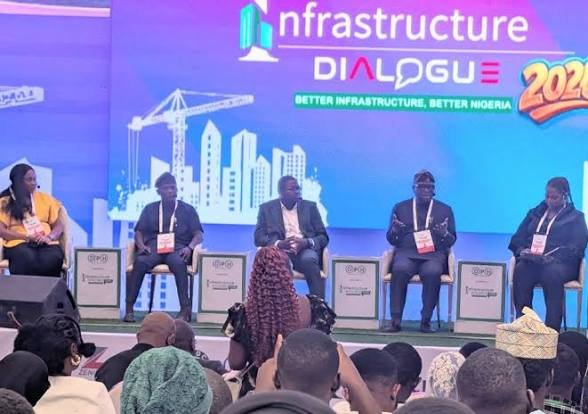

STAKEHOLDERS in the infrastructure and financial sectors have called on the Federal Government to urgently transition from traditional procurement models to private capital mobilisation to bridge Nigeria’s 2.3 trillion dollars infrastructure deficit.
The consensus was reached at the opening of the 2026 Infrastructure Dialogue held in Abuja.
In his opening remarks, the President of the Abuja Chamber of Commerce and Industry, ACCI, Emeka Obegolu, said that modern and resilient infrastructure had become a matter of national urgency.
Obegolu emphasised that the greater challenge facing the nation was not identifying gaps, but mobilising long-term and sustainable capital.
”Infrastructure remains the foundation of every thriving economy. Whether in transportation, energy, or digital connectivity, it directly influences productivity and the quality of life.
”Improving infrastructure financing is not solely the responsibility of government; it requires shared commitment and collaboration across both public and private sectors,” he said.
In a goodwill message, Dr Jobson Ewalefoh, Director-General of the Infrastructure Concession Regulatory Commission (ICRC), revealed that Nigeria required an annual investment of 100 billion dollars to address needs across transport, ICT, and aviation.
Ewalefoh, who was represented by Mr Amanze Okere, Director Support Services ICRC, said that with public spending covering less than 30 per cent of this requirement, private capital was an “absolute necessity.”
He disclosed that the Commission was set to present a model Public-Private Partnership (PPP) agreement by June 2026 to accelerate commercial and financial closures for projects.
”To bridge this substantial financing gap, Nigeria has strategically embraced PPPs. They are not merely financing tools; they are powerful catalysts for infrastructure renewal and poverty alleviation,” Ewalefoh said.
The Convener of the event and Managing Partner of Deutsche Partners Holding (DPH), Dr Onuoha Nnachi, said the initiative had already unlocked over 600 million dollars into the Nigerian economy between 2025 and 2026.
Nnachi, however, identified “trust deficit” as a major barrier to international funding, urging the government to be more intentional in its backing of regional projects.
”The problem is not the rural areas; it is the system and the mindset of leaders. If the leaders are willing, it can be solved.
”I don’t support government borrowing for social infrastructure like schools. We should seek funds for economic infrastructure, railways and airports that can pay for themselves,” Nnachi said.
Also speaking, the Founder of Silverbird Group, Sen. Ben Murray-Bruce, shared his journey in the entertainment and media sectors, urging entrepreneurs to maintain a “can-do spirit” in spite of systemic difficulties.
Murray-Bruce recounted his experiences negotiating with international figures, stressing that the key to success was the “ability to dream.”
On her part, Ms Olubunmi Obasanjo-Williams of Afreximbank, lamented that intra-African trade accounted for only 15 per cent of the continent’s trade, compared to 70 per cent in Europe.
She urged Nigerian businesses to leverage the African Continental Free Trade Area (AfCFTA) to transform the nation from an oil-dependent economy to a non-oil export hub.
The dialogue, themed “Building Nigeria’s Future: The Strategic Role of DFIs and Capital Markets in Infrastructure Financing and Economic Development,” continues on Thursday.(NAN)
A.I
May 14, 2026
Tags: Amanze Okere