
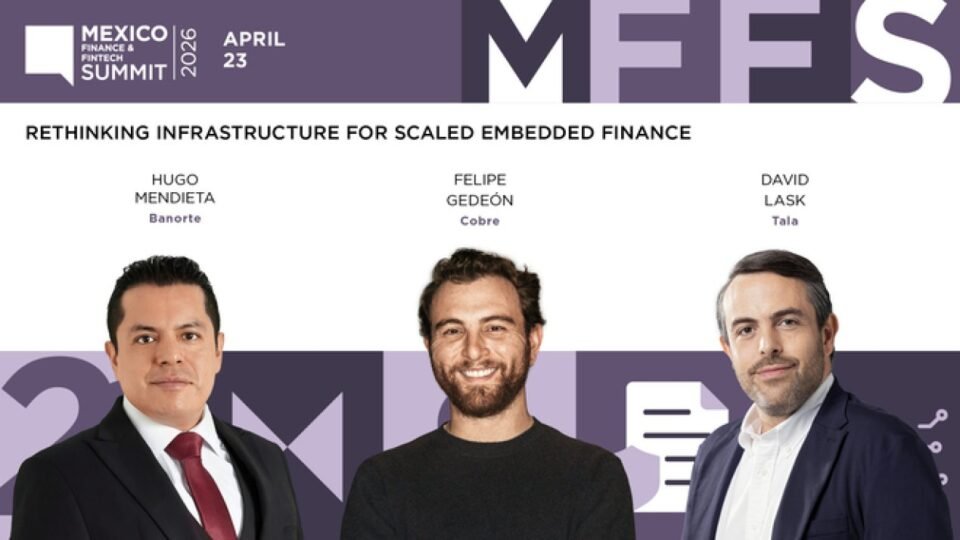
Industry executives said embedded finance in Latin America has moved beyond experimentation but still faces structural challenges related to infrastructure, governance, and data access, according to speakers at the panel “Rethinking Infrastructure for Scaled Embedded Finance.” Participants discussed how financial services integrated into digital ecosystems are expanding across the region while requiring coordinated regulatory frameworks and technology modernization to support long-term growth.
David Lask, Managing Director for Mexico and Latin America, Tala, said embedded finance should no longer be viewed as a temporary trend. “Embedded finance is not something that will decline; it is already a reality,” Lask said. He noted that financial services increasingly operate as components of broader digital ecosystems, though questions remain around integration limits, data accessibility, and governance structures. According to industry studies cited during the discussion, embedded finance is expected to grow at an annual rate of 24%.
Lask compared the evolution of embedded finance to the development of the Internet of Things, explaining that adoption occurs gradually across industries rather than through a single universal model. “There is no single model; it advances case by case,” he said. He added that embedded financial services have existed operationally for decades, but broader normalization still requires infrastructure improvements and regulatory clarity.
Felipe Gedeón, Co-Founder, Cobre, said Latin America implemented embedded finance long before the term gained global recognition. “In the region, people have been making payments in stores or supermarkets outside traditional banking channels for decades,” he said. He explained that embedded finance expands access by integrating financial tools into everyday platforms rather than requiring customers to interact directly with banks.
Gedeón said sustaining embedded finance depends on continuous protocol updates and technological innovation. He highlighted Mexico’s real-time payment system SPEI as an example of infrastructure that enables integration across multiple services. “The answer is embedding through durable protocols and building what becomes possible as systems evolve,” he said, emphasizing the need to connect financial rails with new digital services.
Hugo Mendieta, Deputy Director of Digital Banking, Banorte, said existing banking infrastructure remains a key limitation. “Much of the infrastructure was not designed for this ecosystem,” he said, explaining that legacy core banking systems restrict scalability when multiple participants enter the market. He said modular and scalable architectures are necessary to support growth while preserving core banking functionality.
Mendieta described an emerging approach in which banks isolate legacy core systems while building external service layers capable of handling data flows and product development. “You maintain internal banking functionality while creating external layers that are more resilient and scalable,” he said. He added that governance frameworks are essential to balance rapid innovation with operational risk management.
Speakers agreed that governance represents a central requirement for embedded finance deployment. Lask said sectors that are already advancing technologically demonstrate that governance enables innovation rather than limiting it. “For embedded finance to work, governance must exist,” he said, stressing that clear participation rules and defined data access policies support collaboration among institutions.
Gedeón outlined three technical processes underlying embedded finance: authentication, transaction activity, and data generation. “Every embedded financial product depends on authentication, the action itself, and the data produced,” he said. He pointed to portable identity models as a major opportunity, enabling users to interact across multiple financial systems without repeated onboarding processes.
He also noted that artificial intelligence is influencing how companies design financial infrastructure. “Companies are no longer committing to a single model; they test one approach and then another,” he said. According to Gedeón, financial design is becoming more standardized through simplified data structures and traceability rules, enabling faster integration between institutional systems.
Regulatory design across Latin America presents additional complexity. Mendieta explained that Mexico follows a regulation-driven model supported by the 2018 Fintech Law, which defines obligations for data providers and applicants. However, he said user experience varies widely across institutions. “Sector governance with shared standards would allow the ecosystem to function more efficiently,” he said.
He contrasted Mexico’s framework with Brazil’s hybrid system, where government regulation coexists with industry governance, and with Colombia and Argentina, where fintech associations play a leading coordination role. “When no clear coordinating authority exists, operational challenges begin to appear,” he said, emphasizing the importance of balanced oversight.
Panelists also addressed accessibility and consumer participation as drivers of governance quality. Gedeón said regulatory clarity enables companies to innovate while maintaining compliance. “Good governance and anti-money laundering practices improve when consumers and companies demand accountability,” he said. He introduced the concept of federated identity, where a centralized digital identity enables interactions across multiple financial accounts and services.
Mendieta said federated identity models could help address inclusion challenges, particularly for vulnerable populations. He cited cases involving minors, individuals without guardianship structures, and people with disabilities who cannot physically access banking services. “Embedded finance must solve these barriers so more people can participate,” he said.
Lask concluded that infrastructure modernization and governance evolution remain essential to expanding access to financial services. He explained that Tala has restructured operations to integrate credit services directly into digital platforms where users need financing. “The objective is to prepare ourselves to reach customers in the most effective way and build services around their needs,” he said.
Gedeón added that companies must maintain disciplined adoption strategies as innovation accelerates. “Technology moves at one speed and organizations at another; our task is to bring financial products to more people while building responsibly,” he said. Mendieta closed the discussion by emphasizing customer focus as the guiding principle. “Regulation and governance should not be seen as restrictions but as proof that the ecosystem functions efficiently,” he said.