
Baird’s vision for Bayonne, with its picturesquely rusty refineries, has the kind of improvisatory Mad Max charm familiar from many postapocalyptic cinematic landscapes. “Our road was paved with this idea of erase and do over, but, at last, materials have become so valuable”—in terms of both their carbon footprint and financial cost—“that we don’t tear everything out and start from scratch,” he said, and added that we can design new structures with their future deconstruction and reconstruction in mind. “Instead of saying something has to be so strong it can withstand any hurricane or earthquake, a structure can be made to be easily evacuated, and its bones can be made to withstand anything, but certain elements can be made intentionally fragile, to be blown off, broken, recovered, repurposed.”
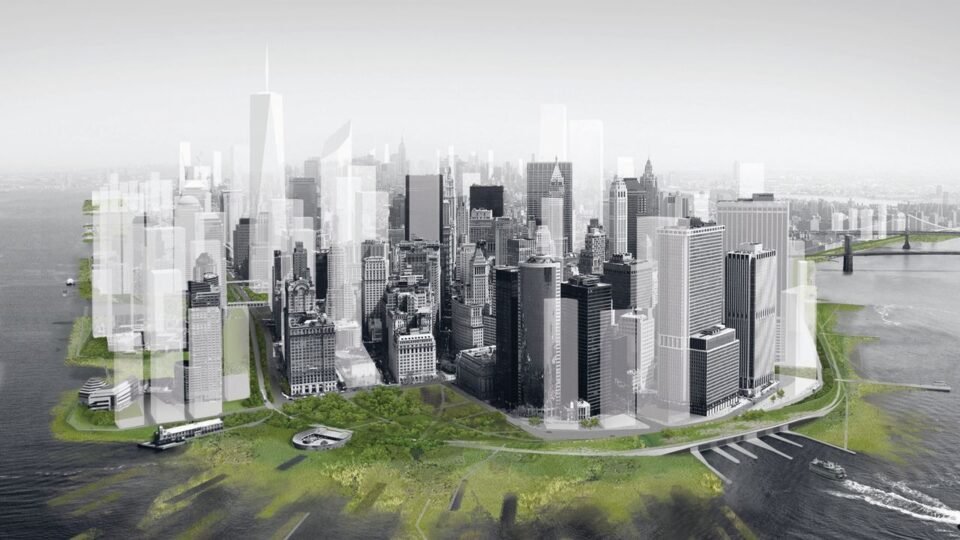
That same subjectivity to change was built into the scheme developed for “Rising Currents” by the firm Lewis Tsurumaki Lewis (L.T.L.), which redesigned the low-lying landfill and shallows around the Statue of Liberty and Ellis Island. “We had a site that originally didn’t exist,” said the L.T.L. partner Marc Tsurumaki, “which was then brought into existence with nineteenth-century technology, and then looks into a future in which it again wouldn’t exist.” The goal, he said, “wasn’t that it wouldn’t flood but that the idea of its flooding would be built into the design of the site, so it would be flooded in a considered, even meaningful way.” This idea had some counterintuitive consequences, such as introducing a series of intricately repeating narrow peninsulas and inlets that would, said Tsurumaki, “deliberately lengthen the coastline by a factor of ten, from four and half miles to forty-five miles.” While that would seem to increase the vulnerability of land to sea, “the increased surface area of that interface better absorbs and diffuses the energy of weather events and maximizes the intertidal zone, which not only has the richest ecological condition but presents shifting spatial conditions for architecture.” Alter a single variable, said Tsurumaki, “and you see the impact on all the other systems. New York City is a charged field in this way. The density of variables and contingencies mean that one thing can really change everything else.”
The reverse is also true: everything else can really change one thing. Eric Bunge, whose firm, nArchitects, redesigned Sunset Park, Bay Ridge, and Staten Island for “Rising Currents,” kept working through the blackout thanks to an office generator. But, he clarified, “our server crashed because we plugged in a space heater. Everything is linked to some further system. Even if you think you’re not affected, you’re affected.” For the waterfront just north of the Verrazano-Narrows Bridge, nArchitects conceived a settlement they called New Aqueous City, situated behind a new archipelago of islets connected by expandable storm-surge barriers (ingeniously expanded by the very water that they subsequently deflect). Post-Sandy, conceded Bunge, “we underestimated the force of the water, how much water there would actually suddenly be; it requires an adjusted mindset.”
“We imagine that the city will and should get wet,” said Bunge, “and that designing for a dry city is maybe madness. As a city, we choose not to run for the hills. If you index population growth to sea-level rise in New York, you have something like two hundred thousand more people for every inch of rising water between now and about 2030. The question is, where do you put all these people? It can’t be just the familiar post-industrial approach to the waterfront, with parks and leisure programs.” For their waterfront settlement, nArchitects wrote an intricate zoning code that literally and figuratively inverted aspects of traditional zoning—such as establishing a continuous roof plane (that allows, among other things, airborne evacuation) from which buildings of varying heights would descend, suspended over the flowing water and floating streets below. Bunge evoked the lesson of the Oosterscheldekering, a miles-long seawall and sluice built by the Dutch following catastrophic floods in the nineteen-fifties. “It was built over such a long time that by the time they finished it [in 1986] they finally realized it would have been an ecological disaster if they had completely sealed off the sea,” Bunge said. “So they decided to leave it ten per cent open.”
“There are design solutions,” said Bunge, that “transcend our current obsessive discourse of efficiency and defense.” That transcendent resiliency derives from changeability and permeability, and thus from a kind of dynamic equilibrium between natural and artificial elements. New York’s harbor, “as it exists at the present time,” another engineer and landscape architect has said, embodies “the changes created by man, and by nature in her struggles with his innovations.” That was Viele, writing in 1855 to the New Jersey State Legislature’s Joint Committee on the Encroachments upon the Bay and Harbor of New York. He concluded, “with regard to rivers, nature acts by certain fixed laws, from which she never deviates; in accordance with these laws, their beds are established and their channels excavated. Man cannot change them; all his efforts to do so, have but produced modifications; the evil he attempts to remove, reappears with greater force at another point.”
Photographs courtesy of MOMA.