
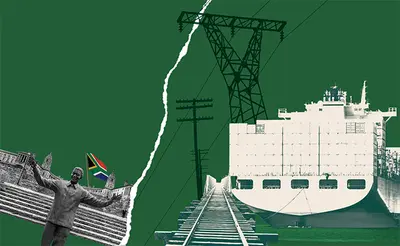
At the end of August, Eskom presented a picture that would have seemed improbable only a few years ago. The load shedding had disappeared, the utility had returned to profitability, and the immediate sense of crisis surrounding the electricity system had eased.
However, the system emerging from that crisis will not simply restore the Eskom that existed before it. Private generation is expanding, transmission is being separated from generation, and access to the grid is becoming increasingly important to how the electricity market works. Eskom is recovering inside a system that is being reorganised around a different institutional model.
Eskom’s example reveals a larger transformation in the way South Africa is organising economic infrastructure. Functions once concentrated inside public institutions are being separated, with strategic infrastructure remaining publicly owned while private companies increasingly provide investment and operation. The result is not simply a shift from public to private provision. As capital and expertise are drawn from elsewhere, greater significance attaches to the institutions that determine who may use infrastructure, on what terms, and at what price.
The familiar argument about privatisation captures only part of this change. An electricity grid can remain publicly owned while connections and transmission capacity determine which producers can participate; a railway can remain public-owned while access to train paths determines which companies can move goods. Public ownership remains important, but it no longer concentrates all economically important decisions in the same institution.
For much of the democratic period, these functions were more concentrated within the public system. Eskom generated and transmitted electricity, while Transnet controlled rail infrastructure and dominated freight operations. Importantly, the machinery required to operate these networks resided within public institutions.
Drawing on external expertise
As these institutions struggled to finance infrastructure, retain expertise, and operate complex networks, successive governments responded with turnaround strategies, financial support, and greater oversight. The response now emerging is different, with private generation expanding as transmission is separated from Eskom’s generation business, rail opening to private operators and private investment entering parts of the port system. Rather than reconstructing every function internally, reform increasingly draws investment and expertise from elsewhere.
These reforms have economic arguments independent of the failures that accelerated them. Competition, private investment, and specialisation might have been desirable even under stronger public institutions. South Africa’s recent history changes the starting point because this transition follows years of deteriorating performance within important parts of the public system.
The separation between public responsibility and actual provision is already visible elsewhere. Private security operates alongside a police service that retains responsibility for public safety, while widespread water interruptions expose a similar gap between formal responsibility and reliable provision. Electricity and freight represent a different development because outside capital and operations are increasingly being incorporated into the institutional architecture of the public systems themselves.
That distinction matters because unbundling changes what public institutions must be able to do. They no longer need to perform every function but must be able to govern relationships among electricity producers, rail operators, investors, regulators, and public institutions with different interests. Contracts must be credible, pricing rules defensible, and scarce infrastructure allocated in ways that preserve both investment and public purpose.
Handing over real control
This is where unbundling becomes a question of political economy. If access determines participation in a market, the rules governing it acquire economic value. Grid connections, rail slots, tariffs, licences, and contractual terms determine which investments become viable, which firms can enter, and where returns accumulate. Economic power consequently acquires a new location around the points at which entry is granted, priced, or refused.
This architecture will eventually shape where knowledge accumulates because organisations retain competence by exercising it. As private companies deepen their experience of financing and operating infrastructure, public institutions may become increasingly specialised in regulation and coordination. That division can produce a stronger public system if specialisation improves both operation and regulation. It becomes precarious when those writing the rules understand the systems less intimately than the firms whose behaviour those rules are intended to govern.
For three decades, debates over the country’s political economy have understandably placed enormous weight on control over strategic assets. The infrastructure economy now taking shape adds another dimension as power increasingly lies in determining access, setting its price, allocating risk and writing the rules when public obligations collide with private returns.
South Africa’s predicament is that this journey can continue for a long time without producing an obvious crisis. Electricity can improve, freight can recover and investment can rise even as public institutions grow more dependent on capabilities they may struggle to evaluate or replace.
Each success can make the next transfer of responsibility easier to justify, until dependence becomes architecture rather than emergency. Dependence itself is not the problem as governments routinely rely on capabilities that do not reside within public institutions. The challenge emerges if that dependence becomes asymmetric, with public institutions increasingly reliant on outside expertise, capital and operational capacity while they lose the knowledge to evaluate, discipline, or replace.
Prof Joseph Sekhampu is the Chief Director of the NWU Business School.