
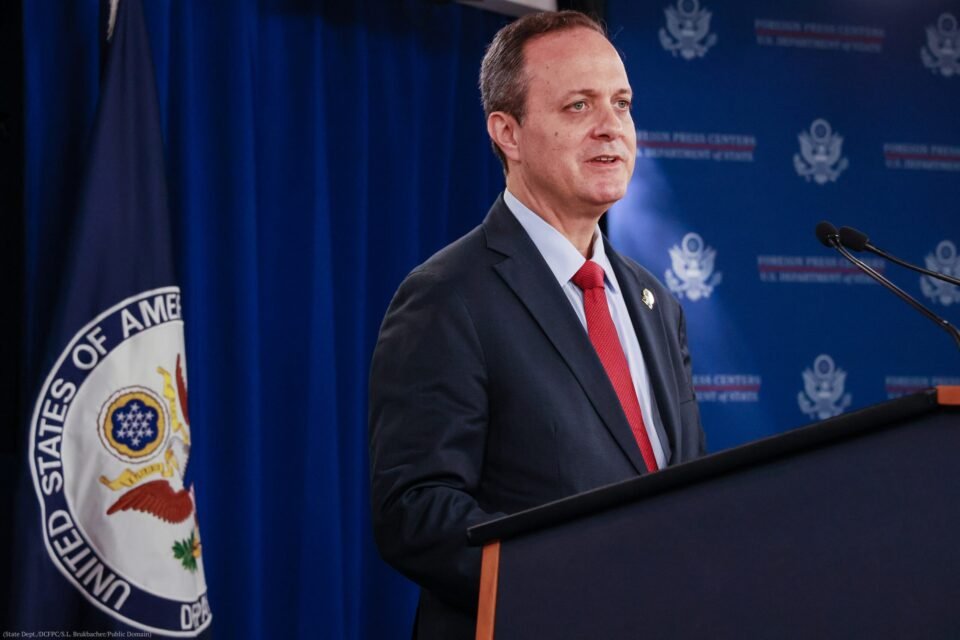
Downloadable photos and video of this briefing for use in reporting can be found here:
Photos: https://www.flickr.com/photos/foreignpressctr/albums/72177720333972440
Video: https://vimeo.com/1197478992/dc9d390b9e
THE WASHINGTON FOREIGN PRESS CENTER, WASHINGTON, D.C.
MODERATOR: Okay. Well, good afternoon, everybody, and welcome back to the Washington Foreign Press Center. We’re so glad to have you with us today. My name is Leah Knobel and I will be the moderator for today’s briefing.
It’s my pleasure today to introduce Michael Rutherford, Assistant Secretary of the Office of Multimodal Freight Infrastructure and Policy at the U.S. Department of Transportation. Assistant Secretary Rutherford has over two decades of private sector experience in railroad and consumer good companies. He spent several years working in Europe, and received his master’s degree from SDA Bocconi in Milan.
Today Assistant Secretary Rutherford will brief on the 2026 National Freight Strategic Plan, a multi-year strategy to modernize the United States’ nearly 7-million-mile freight network. A reminder that our briefing today is on the record and the transcript will be posted to our website, fpc.state.gov, later today.
With that, I will turn it over to our briefer for his opening remarks.
ASSISTANT SECRETARY RUTHERFORD: Thank you. Good afternoon, everyone. And to our distinguished guests representing news organizations from Europe, Africa, Asia, and across the Americas, welcome. It is a privilege to address the foreign press corps. Your presence underscores the foundational reality that we intimately understand. The global economy does not move in silos, nor does it stand still. As in the past, so now, global trade is undergoing significant change, and that is newsworthy.
America in particular stands at a historic convergence point. As our country approaches its 250th birthday next month, we cannot help but to reflect on how far we have come as we work to build an even better future for the next 250 years. For those of us concerned with transportation, it is equally fitting to reflect on the physical systems that have carried our nation since its inception. Reflecting on the lessons from our past, many of us have been particularly drawn to the multi-century legacy of what long ago was dubbed the American system as we ponder what its modern execution entails for us today.
Alexander Hamilton seeded the early principles of this idea in his report on the subject of manufacturers. Still in our republic’s earliest days, he dedicated an entire section to, quote, “the facilitating of the transportation of commodities.” What some of you will observe on your upcoming tour at the Port of Savannah is evidence of an American supply chain renaissance, a solid foundation for a long-term strategy not unlike the one described by Hamilton that places the real economy, supported by modernized freight supply chains, exactly where it belongs – back as a central pillar of our national transportation policy.
For too long macroeconomic frameworks treated logistics as an afterthought, but that mindset has fundamentally changed. As Treasury Secretary Scott Bessent noted in his latest Financial Stability Oversight Council annual report, we’ve expanded our paradigm to explicitly include economic security and sustainable long-term growth. Stability is not just about financial markets. It requires that the whole of the American system reliably provide the resources necessary to enable the real economy, to support domestic production capacity, our standard of living, and our core national values. The real economy is back in the driver’s seat.
Our 2026 National Freight Strategic Plan serves as the foundational document for this shift as it relates to transportation in particular. The 2026 plan outlines key priorities like safety, security, and efficiency, among others. These are standard terms in transportation. Their combination, however, signals a deeper transformation underway. We are moving past the days of viewing freight strictly as a matter of concrete and steel. Instead, we are defining it as the comprehensive operating system of the United States for which information is infrastructure alongside roads, bridges, and ports, making a more dynamic network, fueling our energy sectors, bolstering our agricultural industries, powering our manufacturing base, sustaining our defense readiness, and securing a more prosperous future for this generation and generations yet to come.
Historically, transportation policy has suffered from a siloed approach, whether divided by modes or by fiercely defended jurisdictions, yet anyone in logistics knows that modern supply chains require a greater degree of collaboration at the intersection of the public and private sectors across all levels of government, and with an increasingly holistic and multimodal approach to the supply chains themselves. Responding to these complexities of modern freight transportation is precisely why the United States Congress created the Freight Office almost five years ago, building on the foundation laid out in our first National Freight Strategic Plan. Our updated strategic plan mirrors this ground truth, emphasizing a comprehensive approach that restores American industrial competitiveness and reinforces our role as an anchor of global economic stability.
Nowhere is this clearer than in our manufacturing sector. The National Freight Strategic Plan underscores the importance of manufacturing, focusing on growth in new facility construction and operational efficiencies. We are forecasting a 67 percent increase in the total value of manufacturing freight flows between 2025 and 2050. Yet many often underestimate the full implications of the reshoring of manufacturing in particular. In the context of advanced manufacturing, this often entails a surge in both inbound and outbound freight traffic across multiple points spanning a domestic production ecosystem, moving everything from raw materials to intermediate and finished products.
Consequently, freight corridors crisscrossing America’s heartland and connecting to maritime gateways along both coasts are benefitting from a renewed focus. Today’s discussions now more often turn to those internal improvements about which Hamilton spoke so long ago.
To respond to these complex simultaneous changes, we are taking a more comprehensive approach to how we discuss and manage strategic freight bottlenecks. We no longer view bottlenecks as a static point on a map. Instead, the Freight Office now incorporates new manufacturing announcements in our analysis of these freight bottlenecks. This is a simple recognition that demands on localized freight networks are likely to increase as a result of new industrial capacity coming online in the not-so-distant future.
We are also undertaking work together with the Bureau of Transportation Statistics to explore ways to better incorporate dynamic modeling and scenario planning into our analysis of these same freight flows. In this way, the Department of Transportation can better assist states in evaluating eventual changes in freight flows and their impacts; can anticipate how today’s changes in domestic and offshore production alike will stress the freight network tomorrow, ensuring that we are making the most of our limited transportation dollars by investing for the future and not the past.
Of course, the true test of our 2026 strategy lies in its implementation. Pinpointing a weak link on a map is the easy part. The real work is rallying the funding, cutting through the red tape, and orchestrating modernization across various levels of government and private enterprise.
Under the leadership of Secretary Duffy, that is exactly what we are doing. His vision is about more than just streamlining the permitting process, though those initiatives remain incredibly important to keeping projects moving forward on time and on budget. For example, the Freight Office now provides input into crafting the notice of funding opportunities to ensure that every discretionary grant and funding decision adheres to our stated national freight priorities, as appropriate, aligning federal investment directly with our execution-focused agenda. The recently updated State Freight Plan guidance similarly helps states to better understand the interdependence and opportunities from aligning their investments with national priorities in the broader context of a changing macroeconomic environment.
For the same reason, we are in the process of finalizing the federal designations for the National Multimodal Freight Network, or NMFN, after which states will have an opportunity to incorporate additional segments of local significance. The purpose of the NMFN is precisely to drive this sort of alignment in terms of priorities and investments across all levels of government.
The trends of reshoring and near-shoring are driving structural shift, creating a broader regionalization of manufacturing in North America. This suggests that the future of U.S. freight growth will transition from predominantly east-west routes to a more balanced system as – with manufacturing across the Sun Belt corridor from Texas to Carolinas, and along the Auto Alley from the Great Lakes to the Gulf of America, which includes more than just automotive these days.
While there are many other corridors with similar growth, I mention these two today for a reason. This dynamic ecosystem is exactly what some of you will catch a glimpse of in Savannah tomorrow. The Southeastern United States features prominently in this American supply chain renaissance. The Port of Savannah stands as a vital trade gateway that feeds directly into these corridors, which serve many of the fastest growing populations in our country, like my home state of Florida.
Georgia has invested heavily in key freight mobility projects around Savannah to support this increased efficiency. Likewise, the private sector has also supported significant investments over the years, especially in multimodal connectivity such as intermodal container transfer facilities to better coordinate freight handoffs between the port and our eastern railroads.
The combined result of these sustained investments on multiple fronts has been incredible growth. Because this growth in volume places heavy demands on localized infrastructure, we are constantly working with state and local authorities to mitigate the impacts on the local communities while supporting the safe and efficient movement of the freight itself.
Top of mind for the Freight Office is multimodal connectivity. We place a premium on linking our transport modes seamlessly. We recognize that the highest yield upgrades don’t always require pouring more concrete. Frequently, the biggest gains arise from utilizing existing infrastructure more efficiently. That means synchronizing the handoffs of assets between carriers, terminals, and third parties alike. In some cases, we are even moving beyond simply adding standard highway lanes by utilizing managed and dedicated express routes that separate heavy truck freight traffic from passenger traffic.
For instance, the state of Georgia is working on similar plans for a truck-only express lane that will expedite freight along the I-75 Northbound corridor towards Atlanta, effectively speeding the freight from port to inland final destinations. Then there’s V2X or Vehicle-to-Everything connectivity. Deployed on a more local level, we are investing in V2X communications, allowing commercial vehicles to interact with surrounding infrastructure and traffic signals in real time to optimize their routing reliability and reduce secondary incidents. This soft infrastructure solution, just like a hard infrastructure example of truck-only express lanes, helps to move freight more safely and efficiently.
Which brings me to the fluidity-safety-efficiency nexus. Multiple studies have long illustrated how unlocking free-flow traffic helps reduce harmful incidents to people and property alike. As a bonus, we also know that it saves valuable time and money. Stop-and-go traffic wastes an estimated 6.4 billion gallons of diesel fuel annually, costing the trucking industry over $32 billion.
And finally, there’s a need for a holistic approach. We cannot look at individual transportation components in isolation. We must approach the freight network as a network. This means elevating the way we consider frequently underestimated ancillary components that often function as the linchpins to keep the system together. Think of warehouses, chassis providers, and truck parking. For example, truck parking is critical to keeping freight moving swiftly and safely. It provides safe, legal spaces for drivers to pre-stage so they can efficiently coordinate precise pickup and delivery windows at ports and distribution centers while ensuring that they have a secure environment to get the rest they need to operate safely on the nation’s roadways.
That is why the Department of Transportation recently launched many pro-trucker initiatives, including the delivery of over $275 million in grant funding last year to expand truck parking nationwide. And let me also be clear that human capital is not a secondary concern in this transportation modernization plan. If technology is a force multiplier, then the real force behind our innovation agenda is our workforce. People are what bring the infrastructure and technology together to make an impact. More basic applications like one-stop-shop permitting with automated route identification for oversized, overweight loads creates ease of doing business by helping planners quickly traverse the patchwork of state-level regulations.
More sophisticated applications like digital twins enable decision makers to simulate and optimize flow of goods through expanded manufacturing corridors before the first shovel of dirt is even turned, ensuring that we again make the most of every dollar invested. And network capacity isn’t just about containers or highway lanes. Technology, though essential to locking latent capacity, is just a tool that creates new capabilities. True innovation, the identifying of real-world solutions at the intersection of both hard and soft infrastructure, remains firmly in the domain of people with the courage to imagine a better way of doing things – the same sort of people who have contributed to our country’s unparalleled prosperity over the past 250 years.
Consequently, today we recommit to navigating the dynamics between technology and labor, ensuring that innovation improves operations and makes the workplace safer and more productive rather than merely displaces jobs. You simply cannot manage what you do not know, however, and government and private entities cannot address congestion issues, they cannot see the root causes, alternate routes, or systemic vulnerabilities. Our national strategy embraces the technological revolution already sweeping the logistics industry. We are transitioning away from rigid, static blueprints for dynamic, network-aware responsiveness informed by predictive analytics. To tie these modal handoffs together, the United States is continuing to develop end-to-end supply chain visibility through our Fleet Logistics Optimization Works, or FLOW Initiative. FLOW is a public-private data-sharing clearinghouse hosted by the Department of Transportation that provides participants, like the Port of Georgia, with a secure dashboard matching near-term cargo demand with real-world asset supply, providing a forward-looking demand visibility weeks in advance. For international transportation professionals, more fluid operations mean foreign ocean carriers and global logistics firms can optimize their operations to more efficiently turn their assets more quickly at the ports and deep into the America heartland, saving valuable time and capital.
FLOW’s success stems in part from the fact that it operates securely and neutrally as a protected market clearinghouse backed by clear anti-trust protections, enabling companies to safely optimize logistics data without sacrificing privacy or business confidential information. In a sense, FLOW serves as an information enabler across a full spectrum of supply chain participants, much like a lighthouse for better end-to-end visibility. Now, obviously a planning document alone won’t pave over a bottleneck or automatically digitize the supply chain. What the 2025 – 2026 National Freight Strategic Plan does is provide an actionable, comprehensive framework. In the future of global trade, successful nations will be the ones that understand how to embrace both hard and soft infrastructure to forge a viable path forward toward greater economic sovereignty and enduring prosperity. They’ll be the ones with innovators who understand how best to synchronize infrastructure, assets, and digital platforms into one highly coherent logistics engine, simultaneously improving safety, increasing asset utilization, and decreasing wasteful costs to bolster long-term prosperity.
As some of you prepare to travel to Savannah tomorrow, I urge you to look past the physical scale of the steel trains and concrete berms. Look also at the digital systems that start the moment a truck reaches the gate, the multimodal connectivity around a port, and learn about the growing industrial LIFA systems generating the inbound and outbound freight moving across a port and throughout the region. What you will see is the United States is building again, building a multimodal system geared towards serving the real economy and embracing a premier standard for the future of commerce. As Secretary Duffy recently noted in his forward to our 2026 National Freight Strategic Plan, by investing in a safe, efficient, and reliable 21st century framework and freight network, America will lead in global commerce, reinforce its economic independence, and create opportunity for generations to come. The United States has always moved forward by building – by connecting people, goods, and perhaps most importantly, ideas at scale. The American system is fully active and it is driving a renaissance in the American supply chain.
So I thank you very much again for being here, and I’ll pass it back for questions.
MODERATOR: Thank you so much for those remarks. We’ll now take some questions. For those in the room, please raise your hand and introduce yourselves. And those of us joining on Zoom, there’s several of you; please make sure your screen name includes your name, outlet, and country. If you’d like to ask a question, we do ask that you turn your camera on if possible and use the raised hand feature.
We’ll start in the room first. Please, go ahead.
QUESTION: Yumi Lee with Yonhap News Agency of South Korea. Thank you for having this briefing today. And as you know, South Korean companies have made significant investments in U.S. manufacturing, so are there specific areas where the DOT would like to expand cooperation with Korean companies?
And my second question is: How does the National Freight Strategic Plan support foreign investors like those from South Korea? Thank you.
ASSISTANT SECRETARY RUTHERFORD: So in terms of where we would like to collaborate with you, I could say everywhere. Clearly, there are some industries where I think South Korea has a particular strength, and so understanding where they are also in the United States and certain systems and the supply chains necessary to support them, I think is relevant.
In terms of how the plan can assist you, however, I think there are a couple different things I would look at. Number one are some of the dynamics that we are tracking and understanding these ecosystems. I gave you two of the corridors. We identify a number of others by specific industry sectors that I would – I would recommend that you go and take a look at. And there’s also the National Multimodal Freight Network, which again, as I shared in my prepared remarks, is one way we’re looking to make certain that the investments we make at the federal level are complemented by the investments that are being made at the state level, and knowing where the U.S. federal government and U.S. states are going to be investing in supply chains I think could also be very worthwhile for anyone looking to better understand how best to position themselves in the United States market. But thank you for your question.
MODERATOR: There are questions in the room. Go ahead, please.
QUESTION: Hi. My name is Sang Eun Lee from another South Korean media outlet, the Korea Economic Daily newspaper. And everything sounds very promising, but I am curious how the United State Government assessing the impact of rising labor cost and also material cost at construction sites. And do you have any projections of the increase in the future?
ASSISTANT SECRETARY RUTHERFORD: So I’ll keep my remarks specific to transportation, and I think you look at – this is another example of the reason why we have got to look at both hard and soft infrastructure. You cannot just build your way out of things, and we’ve had some experience with this even after COVID. If you look at some of the ports that saw significant congestion during the COVID pandemic, they were able to drive significant improvements in their throughput capacity just by revisiting the processes, right?
So if you look at – and that’s the type of innovation I’m talking about. If you now combine that with some of these new capabilities that technology is constantly introducing into the logistics base, I think that’s a great opportunity for us to not only help ensure that this is sustainable from an economic standpoint but will continue to generate jobs for Americans – good jobs for Americans – for many years still to come.
MODERATOR: Yes, go ahead.
QUESTION: Dmitry Kirsanov of TASS. Good afternoon, Mr. Secretary, and thank you so much for doing the briefing and thanks a lot to the FPC for arranging this. This is a bit of a shot in the dark: Do you have any update on the U.S. and Russia potentially resuming direct air travel, be it the cargo flights, passenger travel, which I’m guessing is not your bailiwick strictly speaking, but anything on that?
ASSISTANT SECRETARY RUTHERFORD: Yeah, I would not have any updates for you today, but I’m certain that we can get someone to provide you with any relevant updates that might be available.
MODERATOR: Great. We’re going to move to Zoom. Eva Schweitzer, please unmute yourself and ask your question.
QUESTION: Hi. It’s not exactly the same topic, but it’s also about – Eva Schweitzer from Austrian newspaper Kleine Zeitung. It’s not exactly the same topic, but it has also to do with transportation. So I have heard of problems getting packages shipped to America from Austria and Germany, I assume other European countries, because the carriers don’t know what kind of tariffs to charge and what kind of fees to charge, so that has pretty much come to a halt. Is the administration aware of the problem and is something to be done about this?
ASSISTANT SECRETARY RUTHERFORD: A bit —
QUESTION: So you can’t ship any stuff from Europe to America at this point – no small packages. Maybe they do big stuff.
ASSISTANT SECRETARY RUTHERFORD: Yeah, we do look at air cargo as well in the Freight Office. It is certainly a priority for us as well, and I actually had a number of meetings with different representatives from our air cargo industry just last week. From a Department of Transportation standpoint, however, the angle at which we’re approaching this is more around the existing infrastructure and ensuring that we have the intermodal connectivity so that we can move that freight in and out of our airports more efficiently as well as looking at what the needs are in terms of improving the operations of how the freight gets handled once it’s on the ground.
With regards to your question in relation to tariffs, I’d really have to refer you to my colleagues at Department of Commerce, and I’m certain we can put you in contact with someone for a follow-up on that aspect of your question.
MODERATOR: Thank you. Again, if you have a question on Zoom, please raise your hand and we’ll call on you. In the meantime, we’ll move to a pre-submitted question from a journalist: “How does the 2026 National Freight Strategic Plan address capacity constraints at major container ports that handle international cargo?” So not too far off from our prior question.
ASSISTANT SECRETARY RUTHERFORD: No. I’ll say the first thing that I would highlight – and you can even see this with some of the projects that we’ve broken ground on since I’ve been here in the administration – and that is you can’t really stop at just the port. When we talk about congestion, if you’re a beneficial cargo owner – and I used to work for multinationals – one American, one German – in Europe. You’re not – it’s not really about the port; that’s not what you care about. What you care about is getting your goods to their final destination, and the port is just one component of that. You also need to have that inland connectivity. And it’s equally important for the ocean carriers that those assets be able to move as swiftly and efficiently as possible, because more quickly their containers move back and forth, the fewer containers they need to invest in.
So I would say, number one, we are looking at shifts, for example, and I alluded to this. You do see continued strength in imports coming from Asia, but we also are seeing increases in freight that is coming from deeper into Southeast Asia, if you will. And the moment you start moving deeper and deeper into Southeast Asia, the more likely you are to come to the U.S. east coast direct. Keep in mind that about two-thirds of the U.S. population lives east of the Mississippi. If you were to then throw in what in the east we would call the watershed markets of kind of the eastern Dakotas down to eastern Texas and across to the Gulf of America, you’re now dealing with closer to 80 percent of the total U.S. population. So that helps explain how shifts in offshore production are naturally going to affect the way – the way freight ultimately gets routed to the United States.
With regards to the highway infrastructure specifically, we did define within the plan the specific ways in which we’re looking to assess those freight bottlenecks: truck delay per mile and travel time reliability. Truck delay per mile means you’re already seeing a breakdown in the system. Travel time reliability, you’re starting to see some deterioration of service levels. And we’ve overlaid that, as I suggested in my prepared remarks, with all of these new announcements that this administration keeps making about new investments in new manufacturing in the United States, because we know that in two, three, five years, that new investment is going to generate even more traffic.
So when you pull all of that together, you’ve got a much better picture of what the future demand is going to be on your freight network, and that really allows you to be more proactive about how you invest your otherwise limited transportation dollars.
MODERATOR: Thank you. We have another question on Zoom. Yeonsook Kim, please go ahead and ask your question. Unmute yourself.
QUESTION: Hi, my name is Yeonsook Kim from Yonhap News Agency, Korea. So since South Korean companies like Hyundai have invested heavily in Georgia, so how will the infrastructure upgrade at the Port of Savannah particularly reduce logistics times or costs for these Korean investors? Can you have some specific numbers or something? Thank you.
ASSISTANT SECRETARY RUTHERFORD: I will let my colleagues in the state of Georgia speak to the specific numbers, but I would again draw your attention to things like the investments they’re making along the I-75 corridor northbound, which is really about expediting that freight into those major population centers, beginning with Atlanta but extending up into Tennessee and parts of the Midwest.
So certainly that is very important. And some of the things that I think folks will see when – those of you who are going to the Port of Savannah, a lot of the multimodal connectivity, the investments, the technology that they have invested in over time, which not only makes the shipments more efficient to move but also makes those movements more secure, which is equally important especially when you’re dealing with advanced manufacturing like in the case of Hyundai. Thank you.
MODERATOR: All right. Thank you so much. Seeing no other questions, this concludes today’s briefing. I want to thank Assistant Secretary Rutherford for sharing his time with us today and to our journalists for their participation. Thank you so much.