
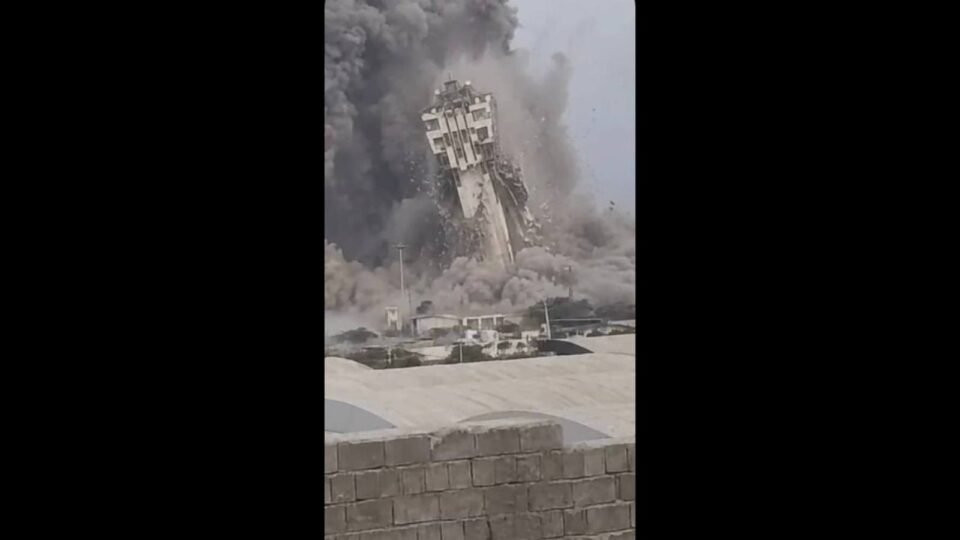
The United States military bombed bridges, a railway station, an airport and the control tower of Iran’s only deep-water ocean port on Friday, the seventh consecutive day of strikes, extending its assault from military targets to the infrastructure of civilian life.
Iranian state media reported strikes on at least five bridges in the southern province of Hormozgan, killing seven people in the port city of Bandar Khamir and hitting its railway station. Explosions were reported in Sirik, Ahvaz and Yazd after a new wave of strikes began at 3 p.m. Eastern time.
Iran’s energy ministry asked citizens Friday to use less electricity and air conditioning, as American strikes on the power system strained the grid in extreme heat. Since the fighting resumed, the strikes have killed at least 38 people and wounded more than 400, Iran’s Health Ministry said Friday.
Attacks on civilian infrastructure are war crimes. The Rome Statute of the International Criminal Court defines “intentionally directing attacks against civilian objects, that is, objects which are not military objectives” as a war crime, and customary international law—binding on Washington and Tehran alike, though neither ratified the treaties—specifically protects “drinking water installations and supplies.”
A spokesman for UN Secretary-General António Guterres said Friday that Guterres is “particularly concerned about attacks on civilian infrastructure in Iran and across the region,” adding, “Such attacks are unacceptable.”
Defense Secretary Pete Hegseth celebrated the destruction on social media. He posted a photograph Friday of the maritime surveillance tower at Chabahar collapsing in smoke, above the caption, “Iran does not control the SoH”—the Strait of Hormuz, 350 miles away.
Iranian officials said the tower, which fell after a third strike, guided merchant shipping and rescues of fishermen at sea. Ryan Costello, policy director of the National Iranian American Council, called the post “disgusting online revelry in the bombardment of Iran and its infrastructure.”
The memorandum of understanding signed June 17 stopped the American attacks, reopened Iran’s ports and paused oil sanctions in return for 60 days of free passage through the strait.
US President Donald Trump pronounced the agreement dead on July 8, notified Congress on July 10 that “military action” had resumed, and the first of seven consecutive nights of bombing followed on July 11. By Tuesday afternoon the naval blockade was back in force.
The Trump administration is actively discussing a ground invasion. The Wall Street Journal reported Wednesday that Trump is leaning toward expanded operations, including sending troops to seize Kharg Island, Iran’s main oil export terminal, and other territory along the strait, after a White House Situation Room meeting Tuesday. Reuters reported the same day that officials describe the current strikes as “shaping operations.”
On Friday, the Journal reported that the US was shifting jet fighters back from Europe and that the 11th Marine Expeditionary Unit, more than 2,000 strong, is operating in the region.
Trump has refused to rule out a ground assault. “Sometimes you need a ground campaign, but we have other people that will do the ground campaign for us,” he said on Fox News Tuesday, calling a seizure of Kharg Island unlikely, but adding, “If we degrade them far enough and deep enough back, I would do that.”
The bridge campaign itself executes a threat he made days earlier: “We’re going to knock out all their power plants. We’re going to knock out all their bridges unless they get to the table and negotiate.”
Iran answered with missile and drone attacks on US bases and other targets across Kuwait, Bahrain, Qatar, Jordan and Oman. On Friday, it damaged a Kuwaiti power and desalination plant—the country draws about 90 percent of its drinking water from desalination—forcing Kuwait to ration electricity in the July heat.
No member of the Democratic congressional leadership has publicly responded to the Journal’s report that the White House is actively discussing sending ground troops into Iran. On Wednesday, House Minority Leader Hakeem Jeffries voted to protect $3.3 billion in military aid to Israel against an amendment striking it.
When Trump signed the agreement with Iran in June, the party’s leaders denounced it as a capitulation. “This is not the art of the deal. This is the art of surrender,” Senate Minority Leader Chuck Schumer said on June 19, declaring that Trump “gave away the store” and that “the Iranians took him to the cleaners.”
Democratic Representative Seth Moulton of Massachusetts called the deal “basically a surrender document from Donald Trump to the supreme leader of Iran.” Their criticism was, in effect, a demand that the war be fought through to victory.
The war is overwhelmingly unpopular. In an Economist/YouGov poll conducted July 10-13, 57 percent called the decision to go to war wrong and 65 percent said Washington should strike a deal to end it as soon as possible. A Washington Post-Ipsos poll released Thursday put Trump’s approval rating at 37 percent, with 61 percent disapproving.
The economic toll is mounting. Brent crude settled Friday at $88.10 a barrel, up 4.6 percent on the day and more than 10 percent across the week, its sharpest five-day rise since April.
Gasoline has reached $3.94 a gallon nationally, up from $3.79 on July 7, according to AAA, and war-risk insurance for ships in the region has climbed from 0.25 percent of a vessel’s value before the war to as much as 10 percent.
The bombing of Iran is part of a broader war. In Gaza, the Health Ministry counted 73,250 dead as of this week, and Israel has sharply escalated its strikes—more than 40 in June, the most of any month since the ceasefire that took effect in October 2025.
On Friday a drone strike on a funeral procession outside a mosque in the Nuseirat refugee camp killed eight people, Al Jazeera reported. The Times of Israel wrote Thursday that the Israeli military “ramped up its strikes” in Gaza after the first round of the war against Iran wound down in April.