
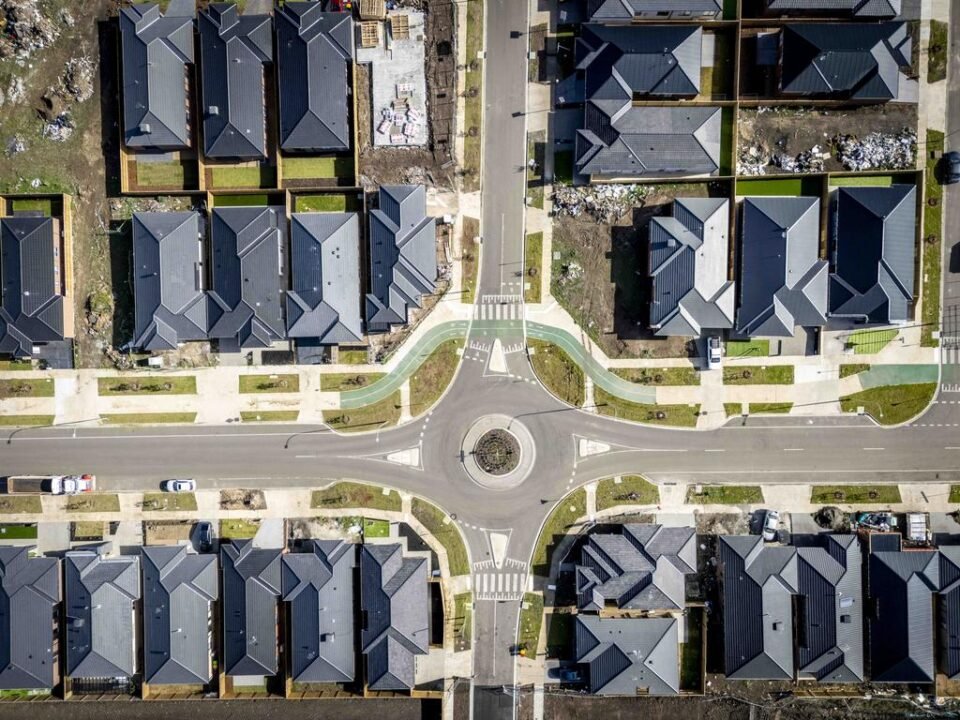

More than 23% of all residential building approvals are being funnled into growth areas already under mortgage stress
More than 23 per cent of all residential building approvals in Australia are being funnelled into growth corridors where over half of households are already facing severe mortgage stress.
Research platform OurTop10 looked at 51 major councils nationally where new dwellings were approved over the past 12 months, with 38 of those experiencing mortgage stress above 50 per cent.
These high-stress corridors absorbed 46,557 of the 205,249 total homes approved nationwide in the year to June 2026—effectively concentrating new housing debt in communities with minimal financial shock absorbers.
“Governments keep talking about building up, but the approvals show we’re still building out,” OurTop10 head of research Mansour Soltani said.
“Three in four homes approved in these high mortgage-stress councils were detached houses, concentrating even more development in communities where existing mortgage holders are already under significant financial pressure.
“Increasing supply doesn’t do much to ease the pressure on people who already have a mortgage.
“Their repayments don’t change because a new estate is approved down the road.
“So we end up with two groups in the same postcode: households who are already stretched, and new buyers arriving with small deposits who are the most likely to end up in the same position.”
Source: OurTop10 Pressure Corridors
The research revealed Australia approved 205,249 dwellings in the 12 months to June 2026 despite a Housing Accord target of 240,000 a year.
“That is a shortfall of 34,751 homes,” the OurTop10 Pressure Corridors report said.
“One in every seven homes that should have been approved was not. Every month of the year came in under the required pace.
“Over the same 12 months, the number of mortgage-holding households modelled as under financial strain across the postcodes in this analysis rose 17.8 per cent.”
The analysis looked at ABS dwelling approvals and mortgage-stress modelling from Digital Finance Analytics (DFA) and found that the same names turn up on both lists: Logan and Ipswich in Greater Brisbane, Casey, Hume and Whittlesea on Melbourne’s fringe, Wanneroo north of Perth, Camden and Campbelltown in south-west Sydney, and Playford north of Adelaide.
The price has been reduced on this Deebing Heights home in the Ipswich region despite a DHA lease being in place
Logan in Greater Brisbane had the largest number of homes approved of the top 10 council areas over the past 12 months.
But the analysis revealed the postcodes mapped also revealed a 70 per cent mortgage stress rate.
MORE: 30pc of Aussies now use Bank of Mum & Dad to afford a home
Qld sellers slash prices by up to six figures amid discounting frenzy
Aussie sellers slash asking prices by six figures
The vendor has reduced the price on this Yarrabilba house in teh Logan region
There were 4017 approvals in Wanneroo in Western Australia, but the stress rate was measured at 89 per cent.
Ipswich has 3522 approvals and a stress rate of 67 per cent.
The areas with the highest mortgage stress were all located in NSW – Blacktown (100%), Liverpool (98%) and Camden (92%).
There were 2415, 2163 and 1759 approvals respectively.
Three Victorian council areas also made the list – Casey (55%), Hume (51%) and Whittlesea (62%), with 3516, 3053 and 2783 approvals each.
Playford in South Australia also made the list, with 2241 approvals and a mortgage stress rate of 70 per cent, according to the research.
Mr Soltani said that despite governments repeatedly calling for more high-density housing, new supply in mortgage-stressed growth corridors remained heavily weighted towards detached homes.
“New housing is essential, but these figures show much of it is landing in communities with very little financial shock absorber left,” he said.
Many of the growth corridors are also magnets for first home buyers using government grants and housing schemes such as the Federal Government’s 5 per cent Deposit Scheme to get into the market.
Mr Soltani said the problem for those newer buyers now was the real risk of plunging into negative equity.
“Negative equity is one issue but the real concern in the medium to long term is that you could create these economic slums with financial pressures, high divorce and unemployment rates,” he said.
“And adding even more supply will only put more downward pressure of median values.
“Anyone moving into these areas need to take the long game approach to see any future positive uplift.”
Mr Soltani added that he believed investors would also be reluctant to purchase new builds in growth corridors without strong infrastructure and government investment.
The Federal Government made sweeping changes to property tax incentives during the May Budget.
Federal treasurer Jim Chalmers announced the reforms
Key changes included limiting negative gearing to new residential builds and replacing the 50 per cent capital gains tax (CGT) discount with inflation indexation and a 30 per cent minimum tax rate, effective from July 1 next year.
Investment properties purchased prior to Federal Budget night were grandfathered, meaning existing investors keep the incentives.
Since then, home prices have been collapsing.
ABS figures showed the value of the residential housing market shrank by $34.1 billion over the June quarter, dragging the total value of the market down to $12.68 trillion.
Analysis by research group FoundIt of more than 760,000 rental property listings also showed a stock shortfall was emerging, with only 61 new rentals coming to market for every 100 rentals sold since budget night.
About 10,100 rented homes were sold in the first seven weeks since the budget – the latest period with available data – but just 6140 new rentals were purchased and listed up for lease over the same period.