
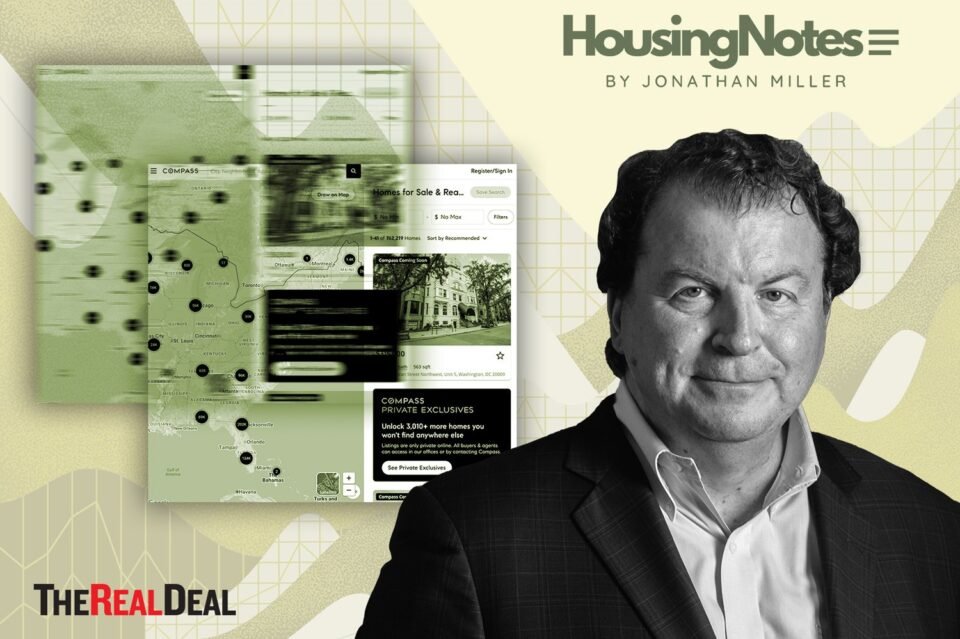
We are excited to announce that Jonathan Miller, who has long authored the most authoritative report on the residential real estate market, is partnering with The Real Deal. Below, you’ll find his Housing Notes column, which will now run on our site several times a week. In addition, Miller’s quarterly report for New York City, which he published through Douglas Elliman for more than three decades, will now be “The Real Deal report, prepared by Jonathan Miller.” Miller’s data venture, Streetmatrix, which provides hyperlocal data, will provide statistics to TRD Data subscribers.
— TRD editors
MLS industry is under siege
When I consult for MLS (Multiple Listing Service), I tend to think of them as a private database with a series of rules, administered by a board focused on its own self-interest. Nothing more. Nothing less. Those rules form a cooperative system in which competing brokers agree to share their property listings, making the process of buying and selling homes more efficient (and transparent) for consumers. There are currently about 500 MLS systems in the U.S.
In Manhattan, where I am based, we’ve never had a traditional MLS system. When StreetEasy was purchased by Zillow, we got a lot closer (the central database part), but our data is still filthy compared to a traditional MLS.
Compass appears to have aspirations to become a national MLS through its private listings effort, so it can effectively double-end many more deals despite repeated, logic-defying denials. However, just because I find this whole private listing thing unethical and damaging to price discovery for both buyers and sellers, doesn’t mean that I love the way Zillow or many MLS systems do business.
Litigation primer
MLSs and the broader real estate industry have faced intense scrutiny from the Department of Justice and multiple class-action lawsuits alleging that commission structures violate antitrust laws. This tends to happen with monopolies, something that Compass now seems to be heading towards with private listings. The central issue is whether the traditional cooperative compensation system, where home sellers pay commissions to both their listing agent and the buyer’s agent, constitutes illegal price-fixing that inflates costs for consumers.
The most prominent case, Sitzer/Burnett (originally filed in 2019), resulted in a federal jury finding in October 2023 that the National Association of Realtors (NAR) and major brokerages violated the Sherman Antitrust Act by conspiring to force home sellers to pay inflated commissions (because they also paid the buyer side commission too). Plaintiffs alleged that requiring sellers to make blanket offers of compensation to buyers’ brokers as a condition of listing homes on MLSs artificially inflated transaction costs and deprived buyers of the ability to negotiate their agents’ fees. NAR ultimately settled for $418 million and agreed to eliminate the cooperative compensation rule that required seller’s agents to offer compensation to buyer’s agents on MLS listings. Many other national brokerage firms also settled.
The reality is that there hasn’t been a meaningful shift in who actually pays buyer agent commissions. Sellers continue to pay buyer-side commissions in the vast majority of transactions. In fact, one could argue that buyer-side commissions actually rose after the NAR settlement, from 2.38 percent in 2024 to 2.43 percent in 2025. What has changed is the transparency and negotiation process, not the fundamental economics.
Legal intentions versus market forces
I believe the DOJ was trying to align the person paying for the service with the person using the service. But despite this supposed clarification, it basically made the class-action attorneys a lot of money while the industry has largely maintained the status quo and spent millions to settle its exposure. In other words, if a seller doesn’t see the value of paying the buyer’s agent commission, buyer’s agents are not incentivized to show the property. More importantly, the amount of the commission dollars saved by the seller would result in a lower achievable purchase price. It looks like the class action plaintiffs didn’t understand this key point of economics. For example, if a buyer had to pay a $50,000 commission to the buyer’s agent to make an offer, they would offer $50,000 less to the seller. And for financed purchases, the $50,000 commission would not be rolled into the buyer’s mortgage. In other words, no one is saving any money here.
If this had the market impact originally feared, and all buyers were paying their portion of the commission out of pocket, sales prices would likely fall by ±2.5 percent to reflect the lower purchase price.
The pre-marketing FOMO
There is a terrific series at Real Estate News about what some MLS systems are doing about private listings: The MLS dilemma: Resist — or join — the pre-marketing movement. MLSs are split between resisting and embracing Compass-style private listing strategies, even as their own trade group, Council of Multiple Listing Services (CMLS), a nonprofit industry trade group made up of more than 200 MLSs across the United States and Canada, publicly condemns selective marketing and “shadow” inventory.
By insisting that any listing partner must stop “monetizing” listing data and avoid “altering” it with tools like AVMs, days on market or risk overlays, Compass is effectively demanding that MLSs and portals abandon core parts of their business and value proposition. When those entities inevitably decline, Compass can say “we tried to share, they chose money over homeowners,” turning a self‑imposed restriction into an indictment of everyone else. Why do they want to stop monetizing listing data if individual transactions are not shared publicly? Inquiring minds want to know.
Some MLSs are now trying to work with Compass on private listings because they see more upside in channeling and shaping this behavior inside their systems than in fighting it from the outside, and they are under pressure from both brokers and portals to support “seller choice” even though they are “screwing the buyer (and seller)” at the same time. Within these efforts, MLS usually retains the full listing record, history and compliance oversight, even if the public sees a sanitized, phased version of that story (for example, no public DOM during a preview period). This information allows the MLSs that are breaking from the industry position to argue that they are preserving the underlying information.
Besides the business strategy, private listings are a recruiting tool. If a company has a lion’s share of the listings, and an agent is in the transaction business, it is only natural that they will go where the listings originate. On a national scale, that’s not a free-market characteristic that will generate fairness for consumers, and eventually the monopoly will go after agent splits. The agents who think that private listings will help them generate more income will probably be disappointed as their splits decline.
“We co‑broke with everyone” is misleading
Compass makes a point of inviting “all agents” to access Coming Soon and Private Exclusive books, presenting those as transparent, inclusive channels open to the whole industry. But these channels are still Compass‑controlled funnels: they live on Compass.com, in Compass‑produced digital/physical books, or in curated sharing arrangements, not in the neutral, standardized ecosystem where most agents search every day.
The practical effect of starting every listing inside a Compass‑only environment is to increase the odds of a Compass‑to‑Compass deal and keep more commission in‑house, even if outside agents can technically request access. The marketing statement “we co‑broke with everyone” obscures the model’s incentive (steering deal flow through Compass first) and presents a constrained, brand‑centric distribution system as if it were equivalent to full MLS cooperation. It’s not.
Compass’ “we co‑broke with everyone” line is also misleading because it conflates theoretical willingness to cooperate with the practical reality of how and when other agents can see, use and rely on its private inventory. The headline message suggests open cooperation, yet the fine print excludes the dominant distribution channels that make listings broadly visible, which means the average non‑Compass buyer’s agent is still less likely to reliably see and be able to act on these listings at the earliest stages. The chronic lack of listing inventory in many regions of the U.S. means that Compass will likely sell most of these listings and benefit from double-ending.
Sadly for consumers, the anticipated year-long federal regulatory scrutiny of the Compass-Anywhere deal was dropped because their attorney had a friend in the White House. As a result, this will be litigated at the state level due to its anticompetitive nature. If this is such a great deal for the consumer, why are states beginning to ban private listings? Crazy, right?
The MLS will no longer be considered the entire market
Consumers and real estate agents will no longer be able to see the market as a whole, and that is already happening. The analogy here is my ability to watch the New York Yankees televised games. I need to subscribe to eight services à la carte as an in-market fan. It’s become unnecessarily complicated for a consumer who wants to see every game. I used to have the Yankees games on every day they played because it was on one channel — a game was always on in the background. After countless times not being able to watch a game because I don’t have the right subscription, I’m losing interest. Now imagine trying to see every home listing in your market as a consumer?
New York Yankees
- Gotham Sports app (YES Network direct‑to‑consumer)
- ESPN app (for ESPN/ABC games, often via an authenticated subscription)
- Fox Sports / Fox Now or equivalent (Fox and FS1 national games)
- Peacock app (NBC/Peacock games)
- TBS via Max/HBO Max app (TBS games now accessed through Max)
- Amazon Prime Video app (21 Yankees games in your region)
- Apple TV app (Apple TV+ Friday night games)
- Netflix app (MLB games placed there)
New York Knicks
- Gotham Sports (MSG+ for Knicks regional games)
- NBA League Pass (for out‑of‑market games when the Knicks are the road team elsewhere, plus NBA TV access)
- ESPN app (for ESPN/ABC national games, authenticated via some base TV/streaming access)
- Peacock app (for those exclusive Monday games)
- Amazon Prime Video app (for the Amazon exclusives)
Final thoughts
MLSs, already under antitrust and structural pressure, are now being hollowed out from the inside by private‑listing strategies, which concentrate inventory, limit price discovery and turn “we co‑broke with everyone” into a marketing fig leaf for keeping more deals in‑house while consumers lose the ability to see the whole market. It also implies, without saying outright, that private listings function as a national recruiting moat, attracting agents to whoever hoards inventory and shifting long‑term bargaining power away from agents toward the dominant brokerage that will later squeeze their fee splits.
By demanding that partners stop monetizing and even lightly enhancing listing data (for example, prohibiting AVMs and presenting DOM), Compass is directly attacking the business models of portals and MLSs to force them into a weaker, utility‑like role within a Compass‑controlled ecosystem. That was likely the plan all along.
The actual final thought — It is a tough line to walk. And my first — cat video!
Read more Housing Notes columns and sign up for email newsletters here.
Read more

New York latest state to consider law on private listings

Google’s listings experiment adds pressure to fractured MLS landscape

Housing Notes: A fed paper shows just how private listings screw over the elderly