
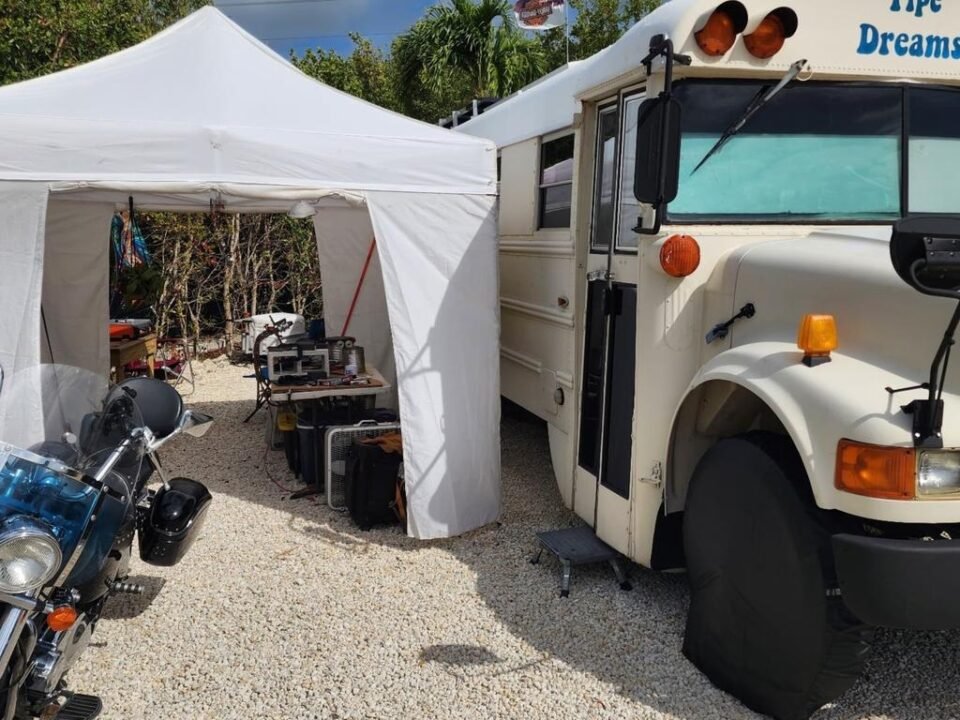

Allen Schaub lives full-time by the water in his converted school bus. Picture: Facebook
With prices continuing to rise, the idea of owning a home is out of reach for many let alone owning one by the water
But for select savvy others, the secret to living steps from the ocean is to do so temporarily – actually renting by the night in campgrounds right on the water.
In the US that place is Bahia Honda State Park, the country’s most in-demand camping site that can book 11 to 12 months in advance.
That’s how Allen Schaub, 47, makes it work on Sugarloaf Key, a small island just a 30-minute drive from Key West.
He’d already been living in his converted school bus, or skoolie, with his wife for seven years when he got the call while living in Ohio.
A good friend kept persuading him to come south and finally, he decided it was time.
A laid-back lifestyle means living simply
Schaub, a certified diesel technician and GM electrical specialist, drove his skoolie down to the Keys with his wife and settled on Sugarloaf early on.
The area is home to two campgrounds: the Sugarloaf/Key West KOA Resort and the Sugarloaf Key RV Resort and Cottages. The first has rates starting at $134 (AUD $187) a night, or approximately $4020 (AUD $5630) a month. The second has rates starting at $142 (AUD $198) a night, or approximately $4260 (AUD $5966) a month.
Allen Schaub lives full-time by the water in his converted school bus. Picture: Facebook
“There are no monthly discounts; that would be too easy,” jokes Schaub.
Fortunately, Schaub quickly found work, and his employer helps pay for his nightly campground rental.
But even still, that price may feel steep, considering that it covers a small plot of land, utilities, and facilities — but no roof or rooms. By comparison, the median rent in nearby Miami is $2,254 (AUD $3156). That’s nearly double.
Then again, that doesn’t get you beachside living.
A busload of comfort comes at a cost
Schaub and his wife invested three and a half months and $40,000 (AUD $56,000) into building their skoolie. They didn’t skimp on materials, choosing butcher-block counters, a 15,000 BTU ACU unit and real, milled lumber for the ceiling.
They built not only for comfort and luxury in mind, but for the elements that come with living in a hurricane prone area.
“If we do come into a tropical storm, all the RVs will tip over. They’re plastic, fibreglass, and pressed wood,” he says. “This bus is 22,000 pounds of steel. It’s not going anywhere!”
The threat of tropical storms doesn’t faze Schaub, but it did worry his insurance companies. For his skoolie, as well as his pick-up truck and a motorcycle, Schaub pays $700 (AUD $980) a month in insurance.
But, for him, those costs are worth it, as his main reason to be in the Keys is to take advantage of 120 miles (193Kkm) of islands to explore. His favourite thing to do is to travel by boat, fishing throughout the mangroves and flats of the Keys.
He’s grateful for the return to boating. When he and his wife were enjoying nomadic life, the one thing they missed was boating — a hobby they enjoyed back when they still lived in a “sticks and bricks” home in Ohio.

Schaub runs a glassblowing business on the side of his normal job. Picture: Facebook
Now, they have the best of both — although with gas costs still rising, it has made the dream of living on “a slice of paradise” a bit more challenging.
He typically works two jobs five or six days a week, and his wife works in customer service and as owner of The Erratic Nomadics Visual Arts LLC glassblowing shop, so they have steady income.
He’s seeing the cost increase with his grocery bill. The couple had been living in Ocala, FL, prior to heading further south. There, he says they spent $800 (AUD $1120) a month on groceries. In the Keys, that number is $1,100 (AUD $1540) – and that’s not including the 30-minute drive time to get to the store.
Despite the increased costs, he feels like he’s living the dream. “It’s as close to paradise as you can get without a passport,” he said.
Long term, he’s unsure what he and his wife will choose next. He likes the idea of a cooler climate. Somewhere he could raise cattle and other animals.
For now, no decision has to be made. When the time comes, getting a change of scenery couldn’t be easier.
“I can just flip the key and go anywhere I want.”
Could you do it in Australia?
As more and more Aussies take up caravan-style living in a bid to escape exorbitant rental and mortgage costs, the idea of permanent residency by the beach at a caravan park might be appealing.
The good news is that what Schaub has achieved in the US is possible in Australia as well if you know where to look.
Not all caravan parks in Australia offer full-time residency, with regulations restricting stays to 180 days per year under tourism zoning laws.
While some parks do offer full-time residency, there can be long waitlists to access limited spots.
Like Schaub discovered, insurance costs are also a factor in Australia – full-time caravan living at a park requires specialised insurance outside the standard recreational insurance.