
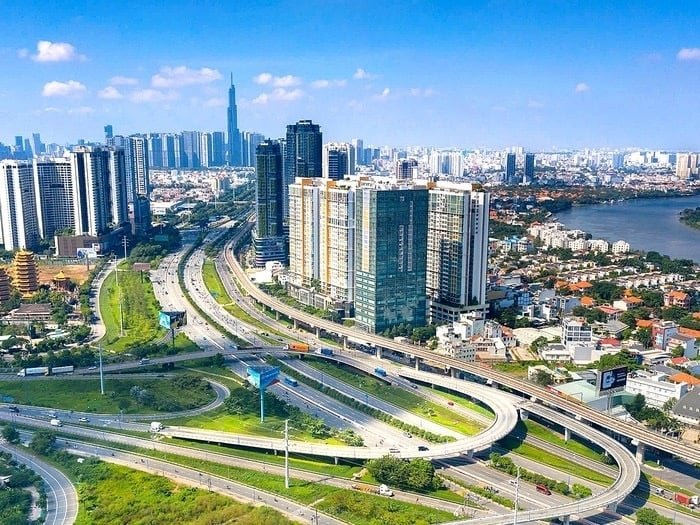
According to the Vietnam Investment Guide 2026, recently published by Knight Frank Vietnam, office tenants and homebuyers currently hold a negotiating advantage. However, the surge in new apartment launches could make 2027 a challenging period for developers.
 |
|
The surge in new apartment launches could make 2027 a challenging period for developers. |
Many growth drivers, but trading volume is not commensurate.
Alex Crane, Managing Director of Knight Frank Vietnam, noted that Vietnam has made significant progress in 2026, from upgrading its stock market and improving its national credit rating to merging provinces and cities and implementing large-scale infrastructure investment programs.
“Vietnam has made significant progress this year. The upgrade of the stock market, the improvement of the national credit rating to investment grade, the merger of provinces and cities, and the implementation of an unprecedented infrastructure investment program all demonstrate a consistent development direction. However, real estate transactions have not kept pace with these positive changes, and that gap is creating investment opportunities,” Alex Crane assessed.
According to Knight Frank, Vietnam’s GDP is projected to grow by 9.95% in the third quarter of 2026, placing it among the highest-growth countries in ASEAN. On September 21, 2026, FTSE Russell upgraded Vietnam’s stock market to a secondary emerging market, while Japan ‘s R&I credit rating agency upgraded the country’s credit rating to investment grade.
However, data from MSCI shows that the total value of commercial real estate transactions in 2025 will only reach approximately $0.5 billion, which is not commensurate with the positive developments in the economy .
According to Alex Crane, tenants and property buyers can now negotiate favorable terms before major infrastructure projects such as Long Thanh Airport, new metro lines, and the international financial center become operational.
Investors who proactively conduct early due diligence on legal and commercial matters can gain an advantage when the market enters its next growth cycle.
For the office segment, the common lease size has decreased from 1,000-3,000 m² in 2024-2025 to 300-1,200 m² in Q3/2026. This is mainly due to multinational corporations being more cautious about expanding their leased space, while building owners are offering more flexible lease terms.
The average asking rent for Grade A office space in Ho Chi Minh City reached US$58.6/m²/month, with an occupancy rate of 83%. In Hanoi , the corresponding rent was US$34.3/m²/month, with an occupancy rate of 72%.
2027: A test for the apartment market.
In the apartment segment, the average primary selling price in Hanoi reached US$4,349/m², higher than the US$4,210/m² in Ho Chi Minh City, based on the administrative boundaries before the merger.
Between 2022 and 2025, apartment prices in Hanoi increased by 122.8%, while in Ho Chi Minh City they increased by 23%. According to Knight Frank, this difference partly reflects the product structure of projects launched in each period.
To stimulate demand, some projects are implementing financial support programs with loan-to-value ratios of up to 85% of the property value and a maximum principal repayment grace period of 5 years.
However, Knight Frank predicts that 2027 could be a test for the apartment market as new supply increases while buyers’ financial capabilities remain under pressure.
Without significant improvements in demand or additional supportive policies, the market may face a more challenging period. Data from previous cycles shows that supply and transaction volumes typically fluctuate before prices adjust.
For foreign buyers, as of October 2026, 6,188 apartments had been purchased by foreigners in Vietnam. Of these, South Korean buyers accounted for 48% and mainland Chinese buyers accounted for 31%.
In the six Southeast Asian markets surveyed, Vietnam ranked fourth in terms of ease of access to real estate for foreigners, after Thailand, Malaysia, and Singapore, but ahead of Cambodia and Indonesia.
The main obstacles lie in regulations regarding ownership rights, including a 50-year ownership term and a limit on the percentage of foreign ownership not exceeding 30% of the apartments in a condominium building.
 |
|
Some projects are implementing financial support programs with loan-to-value ratios of up to 85% of the property value and a maximum principal repayment grace period of 5 years. |
Opportunities from industrial real estate and emerging segments
Besides residential and office properties, industrial real estate continues to show positive signs.
The occupancy rate of ready-built factory space in the Greater Ho Chi Minh City area reached 93.6%, higher than the 82.8% in the Greater Hanoi area. The total supply of ready-built factory and warehouse space nationwide reached 17.6 million m².
Meanwhile, total registered foreign direct investment (FDI) reached US$50.3 billion in the first nine months of 2026, providing further impetus to demand for real estate serving manufacturing and logistics.
Knight Frank also pointed out investment opportunities in emerging segments. Data center capacity in Vietnam is projected to reach 950 MW by 2030. The number of ultra-high net worth individuals (UHNWIs) is expected to increase by 59% between 2026 and 2031.
In the social housing segment, supply remains limited. The expanded Ho Chi Minh City area currently has approximately 41,000 social housing units, equivalent to about 10% of the total commercial apartment supply.
Mr. Son Hoang, Deputy Director of Market Research at Knight Frank Vietnam, said that previous real estate cycles have shown that supply and absorption rates often change before prices do. These will be important indicators to monitor throughout 2027.
“The next real estate cycle will not only be determined by the overall market growth rate, but also depend on areas and segments where structural demand, infrastructure development, and investment capital flows converge. This requires investors to take a cautious, disciplined approach and clearly assess legal risks as well as project implementation feasibility,” Mr. Son Hoang emphasized.