
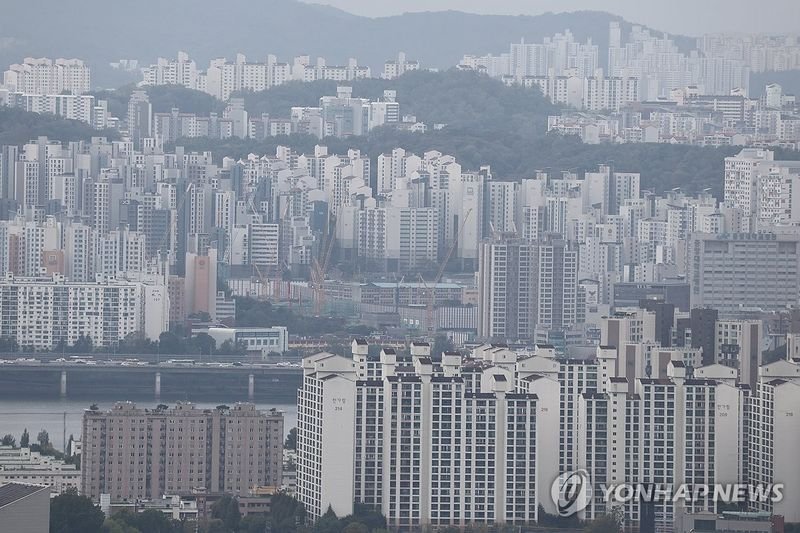
[Financial News] Real-estate sentiment among people in their 20s and 30s is showing signs of shifting away from the ruling camp. The Democratic Party of Korea leads the People Power Party in the average party support ratings across three recent major polls, but the order is reversed when it comes to trust in real estate policy. The People Power Party leads the Democratic Party by 34 percentage points among people in their 30s in particular. As weak support for the ruling camp among young people coincides with distrust of its real estate policy, housing has emerged as a major political issue.
On the 19th, this newspaper calculated a simple, equally weighted average of party support ratings from the National Barometer Survey (NBS), Gallup Korea and Realmeter for the second week of November. The Democratic Party of Korea came in at 36.2%, and the People Power Party at 31.3%.
The results were different, however, on real estate policy. In the NBS survey released on the 12th, 34% of respondents chose the People Power Party as the party most likely to pursue real estate policy effectively, compared with 29% for the Democratic Party. The Democratic Party had led by 8 percentage points in November last year, meaning the relative gap between the two parties shifted by 13 percentage points in a year.
The difference was even larger among people in their 30s. The share choosing the People Power Party reached 48%, while the Democratic Party came in at just 14%. Compared with the 5-percentage-point gap among all respondents, assessments of real estate policy were clearly divided among people in their 30s.
Party support among young people is also noteworthy. In Gallup Korea’s survey for the second week of November, the Democratic Party had 24% support among those aged 18 to 29 and the People Power Party 28%; among people in their 30s, the figures were 29% and 25%, respectively. By contrast, Realmeter found support for the People Power Party and the Democratic Party at 50.9% and 28.4%, respectively, among those aged 18 to 29, and at 49.0% and 28.4% among people in their 30s. The parties’ leads and the size of the gaps differed by pollster, but both surveys put the Democratic Party’s support among young people in the 20% range.
Notably, in Gallup Korea’s survey, 42% of people in their 20s and 39% of those in their 30s said they did not support any party. This helps explain why weak support for the ruling camp among young people cannot be taken to mean firm support for the People Power Party.
Another notable point is that assessments of real estate policy differed from those of other policies. In the NBS survey, the Democratic Party led the People Power Party on welfare policy, 45% to 21%; on employment, 37% to 25%; and on foreign affairs and trade, 40% to 28%.
Differences also emerged within the ruling camp over the direction of real estate policy. As controversy continued over the Democratic Party’s proposal to expand the basic deduction for the comprehensive real estate holding tax, the party’s leader, Kim Min-seok, said on the 12th, “It is best to consistently uphold the fundamentals of the real estate policy being pursued by the party and government,” signaling support for maintaining the policy’s direction.
The People Power Party made this a line of attack. Its floor leader, Jeong Jeom-sig, criticized the Democratic Party’s debate over the comprehensive real estate holding tax as a “rebellion show” and called for measures to address the jeonse and monthly-rent crunch in the Seoul metropolitan area.
Negative assessments of real estate policy were also reflected in evaluations of the president’s job performance. In Gallup Korea’s survey for the second week of November, real estate policy was the most frequently cited reason for a negative assessment of the president’s performance, at 17%.[email protected] Kim Gyeong-min Reporter