
AI is opening up new vistas in Australian real estate marketing; the problem is, they’re not always based on reality.
Even premium rental apartments with Sydney Harbour views are not immune to a little creative touch-up.

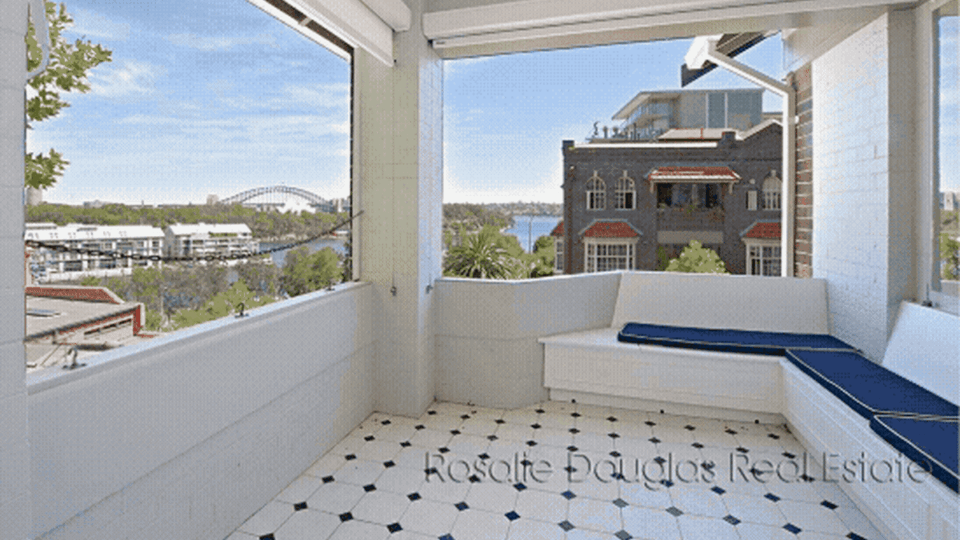
Photos from a real estate advertisement for a unit in Potts Point were digitally altered to enhance the view. Realestate.com.au
In advertising photos of a two-bedroom unit in Potts Point, listed in June for $1248 a week, AI appears to have manufactured an even more stunning view for the property.
A quick comparison to a previous photo of the same balcony from 2024 reveals trees have been lowered and buildings shrunk to increase the visibility of the blue harbour.
The structure of the balcony wall has also been altered by AI, to allow for the digital addition of more sumptuous cushioned seating.
When run through a SynthID detector, the updated balcony image returned a positive result for OpenAI’s invisible watermark.
Rosalie Douglas is the principal at Rosalie Douglas Real Estate, the agency which managed the listing.
Douglas said she was unaware of the use of AI in the image until she was asked about it by nine.com.au.
After speaking with the person who edited the images, Douglas said they “did not ask Chat[GPT] to enhance the view”.
“AI was only asked to generate the furnishings.”
Douglas said a disclaimer regarding the use of AI to style the property with furnishings was present when the property was advertised for rent.
In response to the now-rife use of AI in real estate marketing, the Minns government passed legislation last month designed to stop misleading AI rental ads.
From early 2027, landlords and agents will be required to disclose when property images in rental advertisements have been digitally altered or AI-generated.

Photos from a real estate advertisement of a property in Rosebud, Victoria, show the addition of digital furniture. Realestate.com.au
In Queensland, real estate agents are also required to label any AI-generated image and disclose any difference between the image and actual home.
Queensland’s Office of Fair Trading can issue fines of up to $90,000 in cases of so-called “house fishing”.
In June, the office released a best practice guide to avoid misrepresentations in the industry.
It gave the example of a case where an online property listing prominently featured a photo of a sparkling blue pool.
However, when prospective buyers visited the property, they found the pool in a neglected state – green, murky, and covered by a torn shade sail.
On a federal level, it is an offence under Australian Consumer Law to engage in misleading and deceptive conduct, however, specific laws on the use of AI vary state-by-state.
Nine.com.au has viewed real estate advertisements from across the country and found varying levels of AI enhancement.
The use of AI to add stylish furniture to photos of an empty home appears to be commonplace and is generally considered standard practice by real estate agents.
Bernie Crawford, principal of Queensland’s MB Real Estate, said adding furniture to photos with AI was “no different from putting stock furniture in the house for the sale”.
“But if you put a swimming pool in the backyard that doesn’t exist, that’s definitely misleading,” he said.
Douglas said an added benefit of using AI to digitally furnish a house was that a current tenant’s privacy could be protected.
“We just (advertised a property) where we artificially furnished a house so that the tenant’s furniture wasn’t on display,” she said.
However, many real estate advertisements are now going beyond simply adding furniture, with some AI photos also showing theoretical renovations.
White some of the theoretical renovations are labelled as AI on the photos themselves, other listings simply make mention of the fact that AI was used as a conceptual aid in the written body of the advertisement.
One listing of a property in Geraldton, Western Australia, attracted attention earlier this year, after it used AI photos to completely landscape the front yard and re-paint the property.

Photos advertising a property in Geraldton, WA, included the conceptual renovation of the properties front yard, as well as the home’s exterior. Realestate.com.au
“Please note some photos are AI generated to give an indication of potential renovations,” the advertisement notes.
While the ad was slammed online, Dave Rawlingson, the agent who made the AI alterations, told the Australian Financial Review locals and everyone visiting the property knew it needed a full renovation.
Rawlingson said he used AI in the same way that developers use artist’s impressions to show a property’s potential and not what it actually looks like, something that was obvious to locals.
However, many renters and buyers say they are growing increasingly fed up with wasting their time viewing properties which look nothing like they are advertised.
Some point out that it is not always clear how much a home’s interiors have been touched up by AI at the same time as adding digital furniture.
Last month, renter Caitlin Stanbury started an online Change.org petition after her search for a rental property in Sydney was derailed by misleading, AI-infused ads.
Stanbury is now calling for genuine property photographs to be used “as the standard” for all Australian real estate ads.
“The primary photographs used to advertise a property should be genuine photographs of the property as it currently exists,” she writes in the petition, which has attracted more than 8000 signatures.
“AI-generated or digitally staged furniture, decorations, landscaping or other alterations should only be permitted where they are clearly labelled as virtually staged and an unedited photograph of the actual space is also provided.”
Commenting on the petition, frustrated renter Angela agreed, saying that during her recent house hunting expeditions she wasn’t even sure she was at the right property sometimes because they bore so little resemblance to what was advertised.
“AI was used to completely change the condition and state of nearly all the properties we visited,” Angela wrote.
“We viewed properties that were beautifully described and presented in the advert and images but on arriving, the properties were completely worn down, not maintained and had holes in the walls, paint damage, mould and trash everywhere.
“If they want to include AI enhanced photos it should be mandatory that the advertisement also include the original unedited images to reflect the true state of the property!!”