

Global PE funds are bottom-fishing healthcare assets.
Data from Bain Capital shows that in 2025, the disclosed transaction value of the healthcare PE market reached $191 billion, breaking the historical peak in 2021; the value of exit transactions during the same period was $156 billion. Since 2026, buyout and control investments have shown an accelerating growth trend.
The domestic market is no exception, with a continuous stream of significant buyout and control investment transactions. Recently, Beijing Jingguanguan Yizhuang Kangqiao Healthcare M&A Investment Fund acquired a majority stake in You’er Pharmaceutical, a leading pediatric company; in February 2026, Hillhouse Capital acquired a stake in Bristol Myers Squibb; in November 2025, Sequoia China acquired the business and assets related to moxifloxacin, an antibiotic drug under Bayer.
There have also been classic successful cases in terms of exits. At the 2025 performance communication meeting of Beauty Farm, it was mentioned that CPE Yuanfeng no longer constituted a major shareholder after selling its shares in 2025. CPE had a 12-year controlling investment in Beauty Farm and exited in stages, achieving excess returns and becoming a classic successful case of PE buyout and control. In 2026, Everest Medicines planned to acquire Healtheon Singapore for $250 million, and Kangqiao Capital completed its exit.
In the mature European and American markets, the ratio of buyout and control investments (PE) to growth & venture capital investments (VC) in the healthcare industry is 7:3. However, in the domestic market, this ratio is the opposite of that in the European and American markets, and VC investment is the mainstream. The balance is tilting towards the PE side, and the proportion of buyout and control investments in the domestic healthcare market is gradually increasing. More top institutions are starting to pay attention to buyout and control investments with stable returns.
Why are PE funds making more moves?
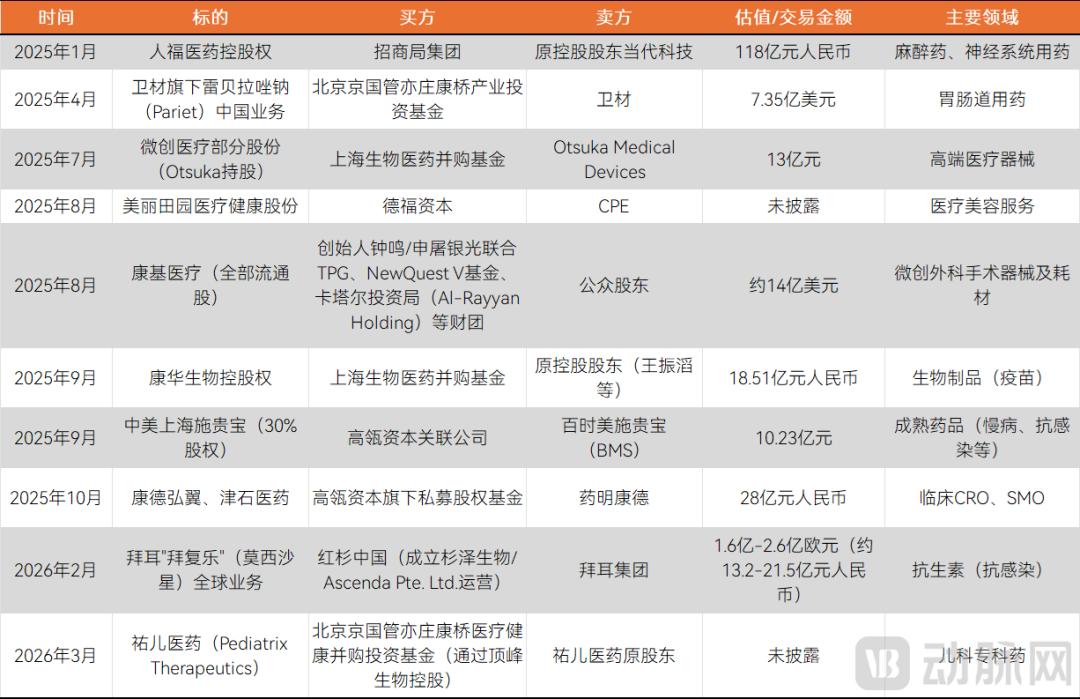
From a statistical perspective, domestic PE funds are making frequent moves, with many transactions exceeding 2 billion yuan in scale. Some industry insiders said that in addition to established PE funds such as Kangqiao Capital and Hillhouse Capital, some funds that used to focus on growth investments have also started to expand their M&A business.
One of the driving forces behind this shift comes from the change in institutional perception. When talking about healthcare PE investments in Asia, global alternative asset management giant TPG said: “More and more private equity institutions are realizing that building high-quality healthcare companies requires a long incubation period. More institutions are starting to deeply participate in company operations to improve efficiency and create industry leaders through industry integration. Private equity investments in the healthcare field are evolving from the past transactional, light-intervention model to a more long-term and transformation-oriented investment approach.”
From the perspective of the capital side, PE investments are facing a more favorable market environment. From the supply side, it is becoming increasingly difficult to capture high-growth projects in the healthcare field. The IPO exit channel is volatile, and the track dividend is gradually fading, making it much more difficult for the VC model to obtain excess returns through the high-speed growth of enterprises. However, there are more and more high-quality control transaction opportunities. Factors such as the divestiture of mature assets by multinational enterprises, the entry of valuations into the low range, and the debt dilemmas of shareholders have brought a large number of opportunities for PE funds to buy out and control healthcare assets.
Against the backdrop of the warming global healthcare PE investment, which fields do PE funds favor?
Judging from the completed transactions, different global markets show different investment preferences.
In the biopharmaceutical field, Bain Capital pointed out that global investors continue to focus on sub – sectors with strong anti – policy – risk capabilities, such as contract development and manufacturing organizations (CDMO), generic drugs, consumer health, and animal health. These fields are relatively less affected by payer pressure and policy uncertainty.
In the medical device field, global PE funds are keen on acquiring assets divested by giants. Both the number and scale of spin – off and M&A transactions in the medical device field have increased. For example, Blackstone and TPG privatized and acquired Hologic for $18.3 billion. The Carlyle Group acquired the kidney care business divested by Baxter International and renamed it Vantive.
Behind this upsurge, PE institutions have developed a replicable value – creation methodology: through the triple engines of “increasing revenue, thickening profits, and raising valuations”, they have achieved value – added in multiple medical device M&A projects. Many of the divested assets in the medical device field have a solid foundation. After spin – off, greater decision – making autonomy and more targeted investments can enable the assets to play greater potential.
In the domestic market, PE funds prefer the mature drug assets divested by multinational pharmaceutical companies. Multinational corporations (MNCs) have multiple motivations for divesting mature assets. On the one hand, multinational enterprises are more focused on their core high – growth businesses in the Chinese market; on the other hand, the rise of local enterprises and the intensification of competition due to the centralized procurement policy have brought systematic opportunities for the divestiture of assets by multinational pharmaceutical companies.
The mature drugs divested by multinational pharmaceutical companies have mature brand assets and stable cash flows for PE funds. In the past, they were not valued due to MNC strategic adjustments. They have a mature operating system and room for transformation and appreciation. After PE funds acquire the mature assets of MNCs, by formulating customized development strategies, re – allocating targeted development resources, introducing the best management teams in the industry, and providing targeted incentive mechanisms, these businesses can be revitalized.
Although domestic and foreign PE funds have different preferences for projects, what is the same is the enthusiasm and confidence of global PE funds in healthcare industry assets.
How can PE funds do better than founders?
VC investments earn money from the high – speed growth of enterprises, relying on track dividends and IPO exits, which tests the investor’s ability to judge the track and the enterprise. However, PE funds’ buyout and control of healthcare assets earn money from value reshaping, which tests the operational ability. Value – added empowerment is the core ability of PE funds. How can PE funds do better than founders?
Looking back at the history of PE funds’ buyout of healthcare assets, successful value – added often depends on three pillars.
The first pillar is a higher strategic vision and in – depth industry understanding. PE funds need to find targets with long – term stable growth and be familiar with industry operations, and be the first to detect hidden opportunities in the industry. Only with in – depth industry understanding can the most appropriate strategic decisions be made.
For example, after CPE Yuanfeng took control of Beauty Farm in 2013, it was the first to discover that the medical beauty market had more growth prospects than the traditional beauty market. It helped Beauty Farm introduce medical beauty management talents and build a medical beauty team, enabling Beauty Farm to transform from traditional beauty to a dual – engine model of traditional beauty + medical beauty, seizing the golden period of medical beauty development.
The second pillar is M&A integration. PE funds usually use M&A to build platform – based enterprises. This strategy is suitable for tracks that have been verified but are still in a fragmented state, and industry leaders can be built through M&A integration.
For example, CPE Yuanfeng built Beauty Farm into the Danaher in the medical beauty field. In 2013, when CPE Yuanfeng took control of Beauty Farm, it was the third in the industry. CPE Yuanfeng realized that acquiring mature stores was more cost – effective than opening new stores. After establishing this strategy, CPE assisted Beauty Farm in building an M&A team. Since then, Beauty Farm has completed more than 30 M&A transactions and counter – attacked to acquire Siyanni, the first in the industry in 2013, and Nairuil, the second.
The third pillar is to layout more growth fields and introduce innovative products. Introducing transformative new products and creating synergies with mature products is the core of expanding growth.
For example, in 2019, EQT acquired the skin health department divested by Nestle and established Galderma. Previously, this department had slow growth. After EQT took over, it continuously introduced transformative new products, including the IL – 31 receptor inhibitor Nemluvio (nemolizumab) for the treatment of atopic dermatitis and prurigo nodularis, and the new liquid type A botulinum toxin Relfydess. After these products were launched, they sold well and drove rapid performance growth. After Galderma’s IPO, its stock price tripled, and EQT earned 180 billion yuan from this investment, becoming the most profitable investment in history.
Some domestic PE funds have also begun to explore this model. After Sequoia China acquired the global assets of moxifloxacin under Bayer, it established Shanze Biotech and revealed that its business model would be “dual – engine driven by mature products and innovative products”, aiming to build a leading biopharmaceutical platform focusing on the fields of anti – infection, respiratory, and critical care.
With more PE funds participating in the buyout and control investment of healthcare assets, how can they exit?
Overseas, IPOs and inter – fund transactions are the main exit channels. However, in the domestic market, the IPO exit channel is volatile, and capable buyers are more scarce. It is necessary to explore and accumulate diversified exit channels.
Although the buyout and control investment in the domestic healthcare field started later than in overseas markets, it has witnessed a key turning point in recent years. With the in – depth development of the industry, the supply of high – quality projects and the professional talent echelon are becoming increasingly mature, and the wave of industry integration is accelerating. PE funds are deeply transforming from financial investors to industrial operators, actively participating in the buyout and control of healthcare assets to empower enterprises to reshape their value with full – cycle value – creation capabilities. This trend indicates that more existing assets are expected to break through the value bottleneck and achieve value leap.
Reference materials:
KPMG’s 2026 Healthcare and Life Sciences Investment Outlook
The Future of Healthcare Investing in Asia: Perspectives from TPG Leaders Across the Region | TPG
Hu Tenghe of CPE Yuanfeng: Controlling investment is a compulsory course for entrepreneurship
CBC Viewpoint | What is the difference between M&A investment and venture capital investment?
This article is from the WeChat public account “Arterial Network” (ID: vcbeat), author: Yang Xue, published by 36Kr with authorization.