
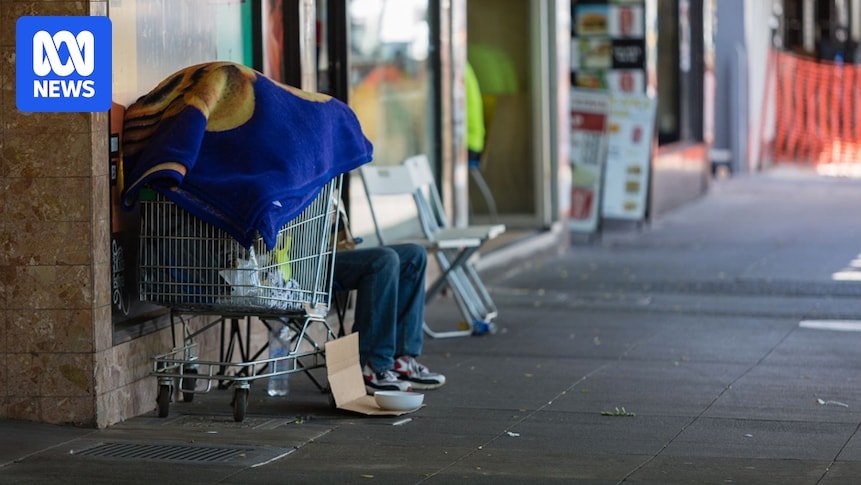
The City of Port Phillip will be able to impound a homeless person’s personal possessions, including bedding, in response to “anti-social behaviour” under amendments to the local law.
Five councillors for the area, which takes in suburbs including St Kilda, South Melbourne, Balaclava and Port Melbourne, voted in favour of the changes at Wednesday night’s meeting despite strong opposition from members of the community.
Three councillors voted against the motion.
Port Phillip council’s own survey of 708 residents found that 76 per cent of residents said they did not support the proposal.
Mayor Alex Makin said while homelessness was a complex issue that required sustained investment, the measures were a “last resort” that would help address reported antisocial behaviour.
City of Port Phillip mayor Alex Makin. (ABC News: Kate Ashton)
“We are not saying this amendment is a solution to homelessness,”
he said.
“What this amendment does do is provide one more tool to help us manage encampments where behaviours are raising safety and amenity concerns.”
The council said it had around 25 people sleeping rough each night with many more in cars, couch surfing or in crisis accommodation.
The amendment was put forward in a bid to address the rates of crime and improve community safety and council maintained it had a “welfare first” response.
Some St Kilda residents argue rough sleepers make the area unsafe. (ABC News: Patrick Rocca)
Crime rates for Port Phillip are higher than the state average, with almost 11,000 criminal incidents recorded in the year to June 2025 compared to 6,814 Victoria-wide.
But on Wednesday night, residents and some councillors raised concerns that removing personal belongings could be a breach of human rights and would do little to de-escalate a situation.
Under the amendment, items could be removed from a person at an encampment in response to “anti-social behaviour” if the person does not comply with a council officer.
The items would be stored for as long as required and could be collected within the business day at no charge, according to council.
Council to Homeless Persons CEO Deborah Di Natale said policies like that adopted in Port Phillip “dehumanise people sleeping rough”.
“The true anti-social behaviour is policy responses that blame people forced to live on the streets rather than offer them the support they desperately need,” she said.
Deborah Di Natale says the way councils around Australia are treating people experiencing homelessness is “alarming”. (ABC News: Terry McDonald)
“If we’re serious about protecting everyone in the community’s safety then we should be providing assertive outreach and housing support, not punishing already traumatised people.
“Don’t forget, people sleeping rough are far more likely to be victims of crime than perpetrators.“
A community divided
During Wednesday night’s meeting, a statement was read on behalf of a person experiencing homelessness in St Kilda who said being able to camp with others improved their safety and made their experience less isolating.
“This proposal makes homeless an even more depressing and lonely experience,” the statement said.
“I’ll be forever be looking over my shoulder and feeling like im doing something wrong.
“It feels like the council would rather I just died so that they don’t have to deal with me.“
Another resident, who also works as a social worker in Port Phillip, spoke about the trauma that could be caused to a person experiencing homelessness by removing their belongings.
“I’ve seen how having belongings taken away from someone, everything they own, can be one of the most distressing and traumatic events a person can go through,” she said.
“People have lost their birth certificates, their only forms of identity, the only photos they have of deceased parents and loved ones, and their shelter for the night — their home.
“People don’t choose to live on the streets. It’s due to systematic failures and the housing crisis.”
It was also highlighted that council’s report did not outline the impact the amendment could have on First Nations people.
Council’s proposal was met with strong community opposition. (ABC News: Danielle Bonica)
Other residents spoke in favour of the proposal including one man from St Kilda who alleged he had experienced vehicle break ins and assaults after confronting people trespassing on his property.
“What I have experienced in the last few years is beyond what any resident should endure,” he said.
“I feel the systems and assistance provided in this municipality only aids … and attracts poor and or criminal behaviour.
“There seems to be no effective deterrence or rehabilitation to change poor behavioural patterns.“
A Middle Park resident said whilst encampments were not a concern in his suburb, he supported the amendment for neighbouring suburbs.
“Our community is not safe … people still want to feel safe and be safe,” he said.
“The proposing encampment laws do not seek to criminalise homelessness and they are only to be enforced as a last resort when behaviours make people feel unsafe.”
According to council’s report, Victoria Police also supported the proposal and would work with council and social service providers to deliver coordinated responses.
This would involve connecting people to housing, mental health, and drug and alcohol support, it said.
Cr Makin thanked residents for making submissions.
“The heartfelt debate and public submissions in the council chamber last night showed there are diverse views on this issue,” he said.
“The common ground is that everyone wants improved safety in our public spaces, including for those who are sleeping rough.“
Ms Di Natale from the Council to Homeless Persons said Port Phillip’s measures were “part of an alarming trend in the way people experiencing homelessness are being treated by councils across Australia”.
The City of Moreton Bay in Queensland last year made homeless camping illegal on public land.
It led to a Supreme Court case which found the local council violated the human rights of homeless campers when it evicted them from public parks and that several “errors of law” were made, including disposing of homeless tents and other possessions without consent.