
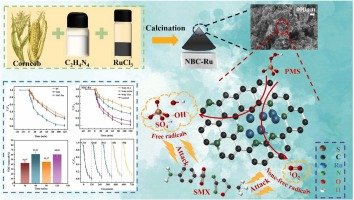
The discharge of pollutants from sulfonamide antibiotics poses a serious threat to water ecology and has become a crucial environmental issue. Persulfate advanced oxidation technology can effectively remove them and has broad application prospects. Herein, a Ru-N co-doped biochar (NBC-Ru) was synthesized via one-pot method. Characterization revealed the presence of Ru-N coordination and enhanced surface area (77.34 m2·g−1) in NBC-Ru. SMX was removed 98 % within 120 min (k = 0.03308 min−1) at the NBC-Ru dosage of 0.1 g·L−1. By quenching experiments and EPR tests, it was determined that 1O2 played a major role. Through EIS, the introduction of Ru reduced the electronic resistance from 2000 Ω to 10 Ω. The catalyst maintained 89 % efficiency accompanied by a maximum Ru ion leaching of 1.71 % after five cycles. HPLC-MS identified four degradation pathways: hydroxylation, sulfonamide cleavage, ring opening, and coupling reactions. TOC tests showed that NBC-Ru mineralized 60.85 % of SMX. ECOSAR modeling showed a decrease in the acute and chronic toxicity of the intermediates as compared to SMX. DFT calculations confirmed that the introduction of Ru improved the adsorption energy of NBC-Ru for PMS (−4.8 eV). This study provides a sustainable strategy for converting agricultural wastes into high-performance persulfate activators that remove emerging contaminants.