
Thank you for opening your Chartbook email.
Anna Airy, A Shell Forge at a National Projectile Factory, Hackney Marshes, London, 1918

Bond breakout – John Authers
Across the developed markets, bond markets are staging a slow-motion car wreck.
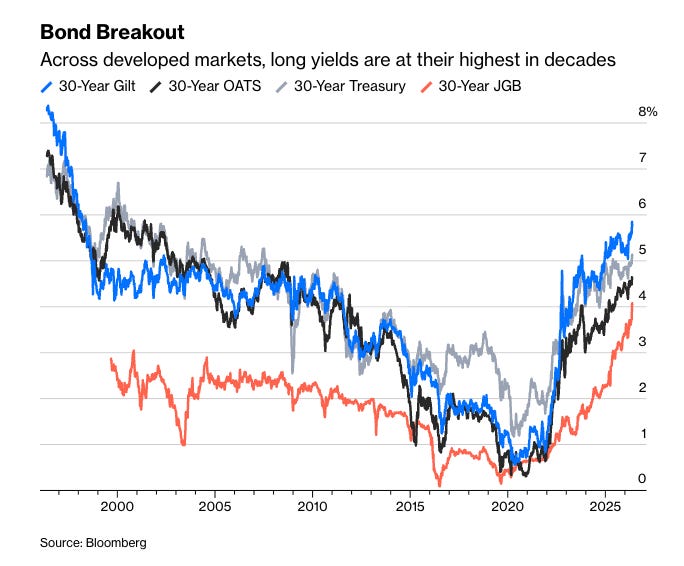
Looking at the drastic moves in the US, Japan, the UK and France, Barclays’ Ajay Rajadhyaksha commented: “Last week, long bonds broke. Not in one country. In all of them. Simultaneously. Four countries. Four different political systems. Four different central banks. But the same trade — “get me out of duration!”” Each country has its own contributing political problems, but the uniformity of the shift out of long-term bonds with high duration makes clear that something broader is afoot. For Rajadhyaksha, it is “simple and uncomfortable.” The developed world “has too much debt, too little fiscal discipline, and no political appetite for fixing either.” If there’s a trigger, it has been the Iran war and the resulting shock to oil supply.
Source: Bloomberg
G7 countries are now borrowing at rates that were enjoyed by EM in the early 2020s
Trade between China and Russia has grown in recent years
Big effects of bad data
A decade ago nearly nine in ten Americans, when approached, agreed to fill out the Current Population Survey, which is administered to about 60,000 households each month and asks about, among other things, employment. Fewer than seven in ten do so now (see chart 1). For the Consumer Expenditure Survey, which tries to capture 3,700 households monthly, the response rate is down from 68% to 40%. … When the information becomes less reliable, investment decisions get more difficult to make. Some may be delayed, creating a potential drag on the economy.
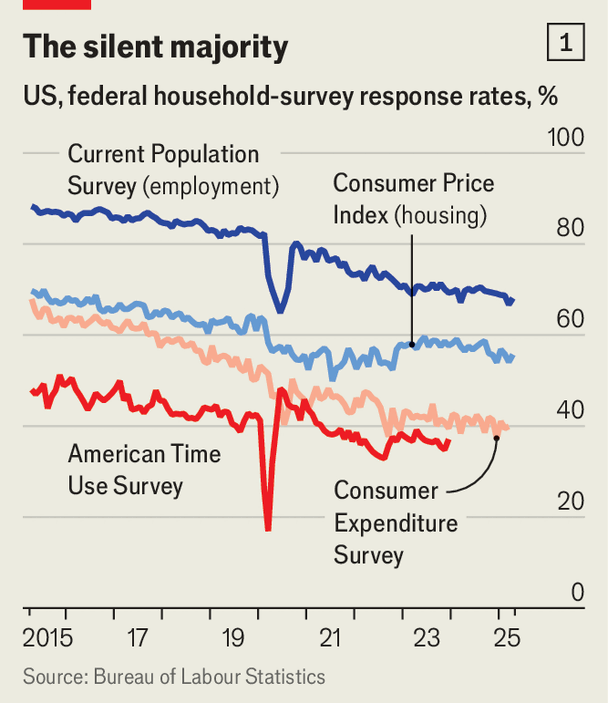
A new working paper by Nicholas Bloom of Stanford University, Erica Groshen, former head of the Bureau of Labour Statistics (BLS) now at Cornell University, and Duncan Hobbs and Michael Strain of the American Enterprise Institute, a think-tank, hazards an estimate. Preserving trust in “the integrity and quality of official statistics”, the authors claim, generates economic benefits of about $25 for every $1 spent on the BLS, the agency with an annual budget of $700m that is responsible for many of these data. To arrive at their conclusion the quartet analysed an ignoble episode in the BLS’s recent history. On August 1st 2025 Donald Trump sacked Erika McEntarfer, appointed as the agency’s commissioner by his predecessor, Joe Biden. The president alleged, without evidence, that the BLS’s steep downward revision to recent jobs numbers had been “RIGGED in order to make the Republicans, and ME, look bad”.
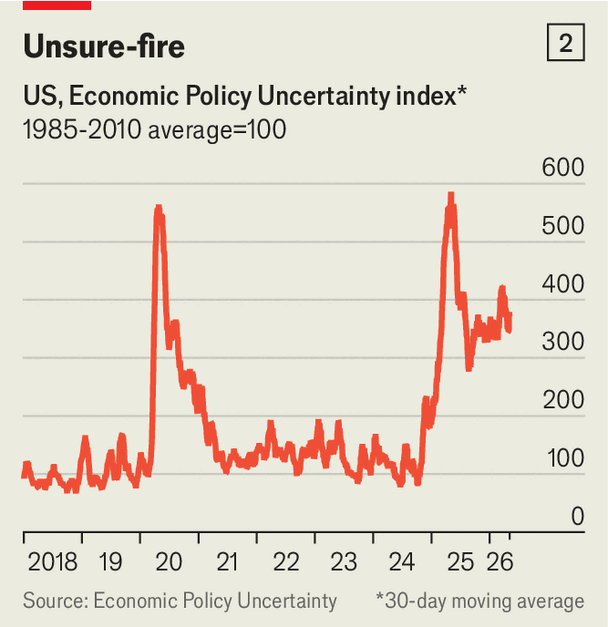
In fact, it was the wanton dismissal that looked bad in the eyes of many observers. In the following seven days there was a 50% leap, relative to the week before, in the average value of the index of Economic Policy Uncertainty (EPU), which tracks the number of articles mentioning such uncertainty that are published daily in American newspapers. This was a discernible jump even when compared to the chaos caused by Mr Trump’s trade war in April 2025 and his real one in Iran in the past two months (see chart 2). Based on Mr Bloom’s earlier study with other colleagues of the EPU’s impact on business investment, industrial production and employment, the authors estimate that the jump reduced American GDP by over $100bn (0.3%) and non-farm payrolls by 168,000 (0.1%).
Source: The Economist
Immigration and thermostatic politics (Sarah O’Connor in the FT)
A strange thing happened a year and a half ago. No sooner had Americans elected Donald Trump as president on an explicitly anti-immigration platform than US public opinion began to swing much more favourably towards immigration.
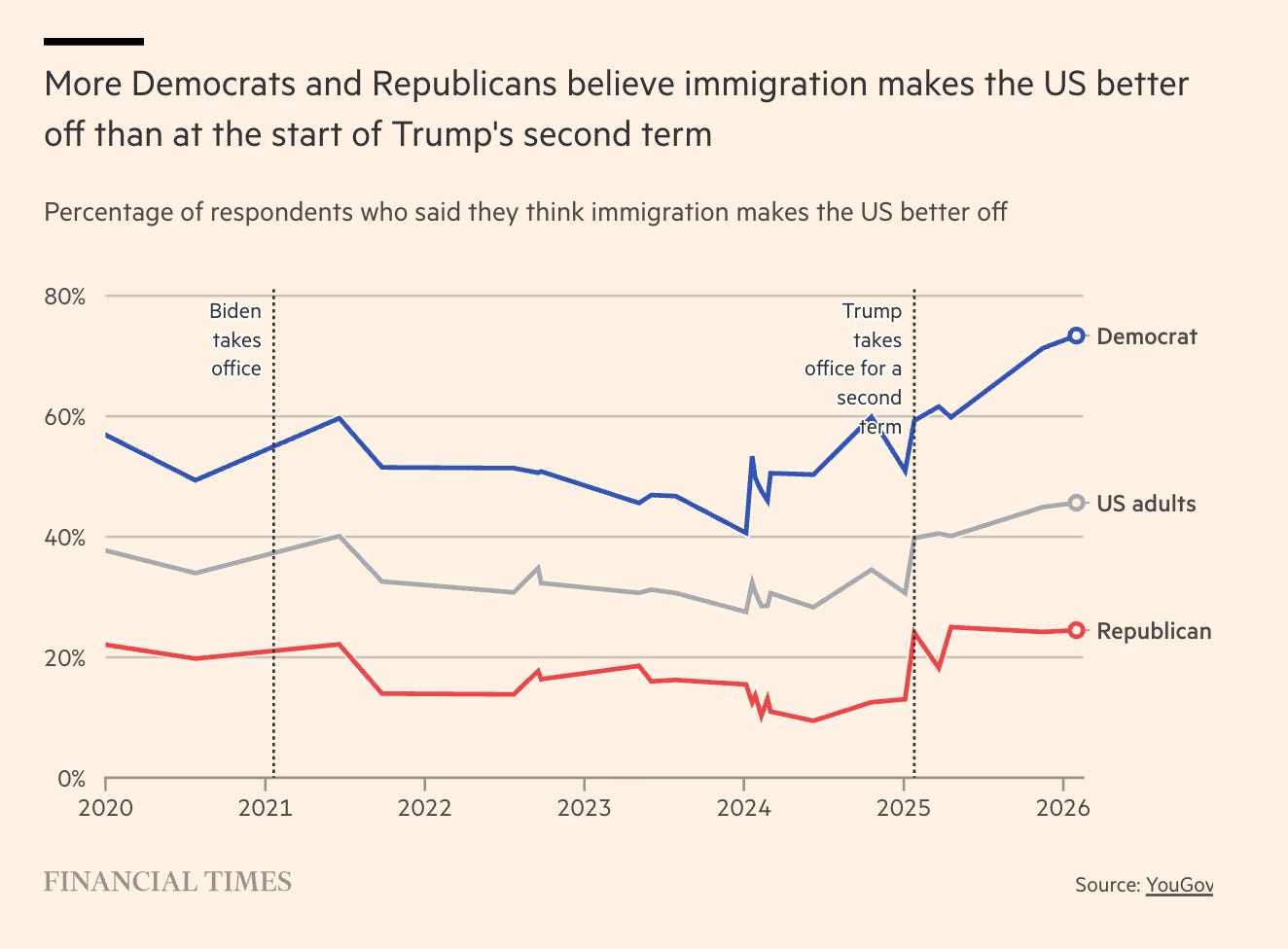
… to political scientists who study “thermostatic” politics, this development is no surprise at all. Public opinion often moves against the prevailing party, especially if they are perceived to have gone “too far” in one direction. The phenomenon was first explored in the 1990s with reference to fiscal policy, but in recent years it has been particularly evident in the realm of immigration policy. While these swings in opinion polls can make it seem as if people don’t know their own minds, they can be a useful democratic check on governments by sending bright flashing warning lights when policies stray too far from the public’s comfort zone.
The problem comes when politicians misinterpret those signals. When people tell pollsters they want less immigration, or think it is bad for the country overall (or the converse), they are often expressing an opinion about how things appear to be going in that moment relative to their preferences, rather than a deep shift in their underlying views. According to Alexander Kustov, a political scientist, most Americans’ views are quite stable and moderate: they support immigration that is controlled and in the national interest, and oppose flows that are disorderly or under-enforced. In the US, he argues the Trump administration over-interpreted dissatisfaction with high immigration under Joe Biden, and implemented policies that went too far for many voters. “People don’t necessarily change their idea about their ideal immigration policy, but they can react to what the government is currently doing,” he told me. “A lot of people are not happy with what the Trump administration are doing — right now we’re not talking about border enforcement, we’re talking about people not just getting harassed, but killed.” But similarly, he added, pro-immigration advocates would be making a mistake to interpret the recent, more favourable swing towards immigration as a deep-seated ideological shift in attitudes.
The recent history of UK immigration policy offers another cautionary tale. After the 2016 Brexit referendum, public concern about immigration fell. This was partly because net migration statistics declined, but also because people felt a sense of catharsis and control, says Sunder Katwala, director of British Future, a think-tank. By 2019, the public ranked immigration as only the ninth biggest issue of concern, according to Ipsos polling. But when the Conservative government liberalised visa routes for students and care workers between 2019 and 2022, that helped net migration to surge. And so, too, did public concern. Today’s Labour government has implemented another sharply restrictive turn in immigration policy. As Kustov and researcher Caitlyn Yates argue, thermostatic public opinion should be a useful check on politicians. Instead it seems to have helped to magnify the pendulum swing in the UK. The government over-interprets and overreacts to a change in public opinion, which reacts in turn, prompting a sudden swing the other way.
Source: Financial Times
HEY READERS,
THANK YOU for opening the Chartbook email. I hope it brightens your day.
I enjoy putting out the newsletter, but tbh, what keeps this flow going is the generosity of those readers who clicked the subscription button.

If you are persuaded to click, please consider the annual subscription of $50. It is both better value for you and a much better deal for me, as it involves only one credit card charge. Why feed the payments companies if we don’t have to.
Anna Airy, Shop for Machining 15-Inch Shells: Singer Manufacturing Company, Clydebank, Glasgow, 1918

Racing for a vaccine … we have been here before!
The deadly Ebola outbreak in two African countries driven by a virus species with no vaccine has triggered an urgent search for a potential jab, in a test of troubled global efforts to avert threats posed by emerging diseases. A World Health Organization advisory group is due to would meet on Tuesday to recommend candidate jabs to prioritise for clinical trials, the global health body said. It will assess data including an analysis by the Coalition for Epidemic Preparedness Innovations (Cepi), which was set up after failures in the international response to a previous Ebola crisis. The latest Ebola outbreak in Democratic Republic of Congo and Uganda has infected hundreds of people and killed more than 80, health authorities say. Cepi’s reaction will be a crucial indicator of its progress towards its wider goal of producing vaccines for pandemic threats in just 100 days, despite steep cuts to international health funding.
“If there was ever a time that we could show the world why Cepi is needed and show the world why the 100-day mission is needed, it’s now,” Nicole Lurie, the organisation’s executive director for preparedness and response, told the FT. “We’re happy to accept that responsibility, but obviously we need help from partners — particularly financial help in the long run.” DR Congo and Uganda would make the final decision on whether to press ahead with any vaccine candidates endorsed for clinical trials by the WHO experts, the global health body said. “Other ethical and community acceptability issues will be considered,” said the WHO, which declared the latest outbreak a public health emergency of international concern on Sunday. “This will be important to make sure that the trial, if it happens, will be adequately communicated to the population.” Lurie said Cepi had provided information from a survey of research teams and companies working on drugs that might be effective against the Bundibugyo virus behind the outbreak. The organisation hoped soon to announce partners in the quest for a jab, she added, although she declined to give a timescale for when one might be developed.
Cepi’s Nicole Laurie said global health bodies were ‘getting some live-fire drills’ with hantavirus and the latest Ebola outbreak. The hunt for a vaccine should be helped by scientific advances including the use of artificial intelligence to find drugs active against viruses, Lurie said. Existing jabs against the Zaire Ebola virus responsible for many previous outbreaks might provide a basis for tackling the Bundibugyo species, she added. “We’ll see how far and how fast we can get,” Lurie said, adding that Cepi had done preliminary work recently on a possible jab for the rat-borne hantavirus responsible for a recent fatal outbreak on a cruise ship. “Both with hantavirus and now with Ebola, [we] are getting some live-fire drills.”
Source: Michael Peel in the Financial Times
Dad-chat is coming for dad-books. (By Pamela Paul and Jeffrey A. Trachtenberg in the WSJ)
They were the go-to gifts for Father’s Day: a book about some little-known chapter of World War II, the sweeping narrative of a shipwreck, perhaps the latest presidential biography. These days, dad books are a dying breed. Nonfiction book sales have been in decline for the past four years, and are now the most challenged segment of the print book market. Publishers say certain types of books still fare well—including celebrity memoirs and religious titles. But in recent years, print sales in such categories as biography, current affairs and business and economics—what publishers refer to as “serious nonfiction” and which tend to resonate especially with men—have fallen considerably. Sales of nonfiction print titles were down nearly 8% through May 9 this year, and sales of books about politics and current affairs were down 19%, according to book tracker Circana BookScan. Publishing has long been subject to cyclical changes, with trends in format and genre taking over bookshelves in grand sweeps. (Remember the adult coloring-book craze? Or the stratospheric rise of romantasy?) But many in publishing believe the decline in serious nonfiction is more existential.
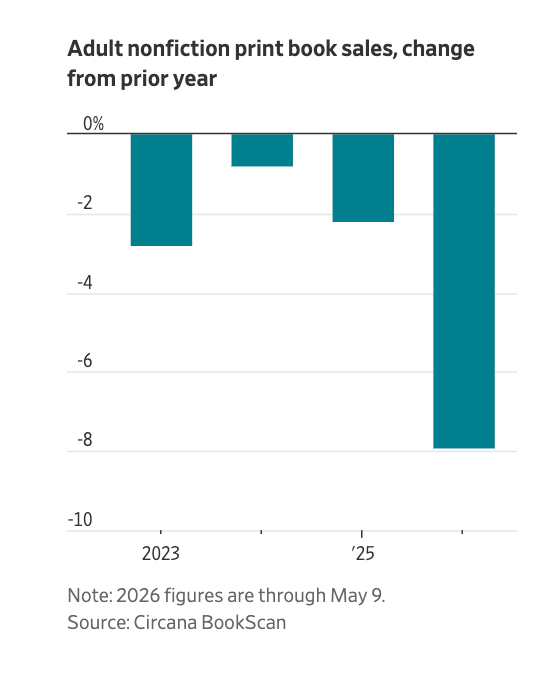
“The trend couldn’t be clearer,” said Jonathan Karp, the former chief executive of Simon & Schuster and publisher of the new Simon Six imprint. “This is a sea change and people should wake up and realize we’re living in a new world.” One culprit for the shift: a new media diet for fans of more serious nonfiction. … Sixty-two percent of men and 54% of women consumed a podcast in the prior month, according to a recent survey by Edison Research at SSRS, up from 46% and 39%, respectively, in 2023. “When we have internal meetings to talk about this problem, it always comes around to podcasts,” said Jonathan Burnham, president and publisher of the Harper Group at HarperCollins Publishers. “The man who wants to read American history is now tuning into one of the many good podcasts about history that lends the quiet attention to a serious subject he’s looking for. It makes the idea of sitting down with a 700-page Ron Chernow book less appealing. You’ve scratched that itch.”
Source: Wall Street Journal
Remarkable report by Novara from the nationalist rally in London in mid May.
Anna Airy, Leopard Moth and Plums, 1915