
Southern Vietnam’s industrial real estate market is entering a more mature phase as foreign direct investment (FDI) pivots toward high-tech and green industries, putting greater emphasis on logistics infrastructure, operational capacity and ESG standards over land availability.

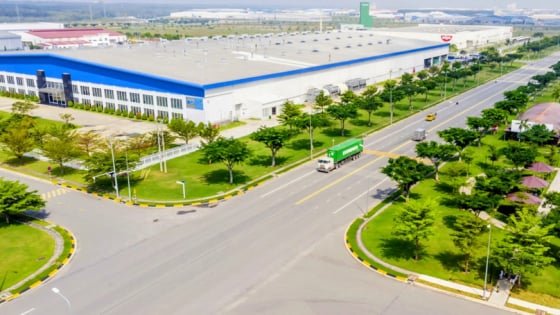
A view of the Vietnam-Singapore Industrial Park (VSIP) in the former Binh Duong province, now part of Ho Chi Minh City. Photo courtesy of VSIP.
Data from first-quarter industry reports show the market is no longer in the rapid supply expansion phase seen in 2021-2024, but is instead moving into a cycle of absorption, restructuring and more selective capital allocation.
“The Southern Key Economic Region is entering a new stage of maturity, where supply is being absorbed and demand is increasingly shaped by high-value industries and shifting FDI priorities,” said Chuong Doan, deputy director of industrial and office leasing at Cushman & Wakefield Vietnam.
She said accelerated inter-regional infrastructure development, combined with more selective tenant requirements, is pushing the market toward a new equilibrium between stability and transformation, reinforcing the region’s role as a manufacturing, logistics and advanced industry hub.
The current slowdown does not indicate weakening demand, but rather reflects a more mature market following years of rapid expansion.
Total industrial land supply in the Southern Key Economic Region remains at about 36,400 hectares, with no new projects recorded in the first quarter, Doan said. Occupancy stood at roughly 74.8%, slightly higher quarter-on-quarter but lower year-on-year.
Although net absorption rose 182% quarter-on-quarter, the market has yet to return to the “land-hungry” conditions of previous cycles, reflecting greater caution among FDI manufacturers in expansion decisions.
Global headwinds, including elevated interest rates, geopolitical tensions, rising logistics costs and growing trade protectionism, are also driving multinational firms to scale expansion more selectively rather than pursue broad-based capacity growth.
In other words, while FDI inflows into Vietnam remain resilient, investor priorities have shifted.
John Campbell, director of industrial services at Savills Vietnam, said Vietnam is entering a “large-scale industrial phase,” in which FDI is moving away from mass production expansion toward higher-value segments such as electronics, technology equipment and semiconductors.
He said this shift is pushing the market from a cost-led model to one increasingly driven by infrastructure quality, logistics efficiency and operational standards.
Ho Chi Minh City remains the region’s largest manufacturing and logistics hub, supported by strong demand from high-tech and value-added industries. However, limited land availability and rising costs are gradually redirecting investment toward neighboring provinces, including Dong Nai and Tay Ninh.
Tay Ninh is emerging as a new low-cost industrial rental hub in the South, with significant development potential fueled by comparatively competitive land pricing. Meanwhile, Dong Nai continues to benefit from infrastructure upgrades, including the Long Thanh International Airport, Bien Hoa-Vung Tau Expressway and seaports linked to the Cai Mep–Thi Vai complex.
Analysts say transport infrastructure is becoming the key variable reshaping southern Vietnam’s industrial property map, with major projects such as Long Thanh airport, ring roads, interprovincial expressways and logistics corridors opening new development zones for both industrial real estate and supply chains.
Shift toward logistics, ESG and high-quality factories
A key structural change in the market is the rising dominance of ready-built factories and modern logistics facilities.
Ready-built factory (RBF) supply in the South reached about 6.8 million square meters in the first quarter, with nearly 192,000 square metres added. Several industrial clusters in Binh Duong and Dong Nai reported near-full occupancy, with Dong Nai leading at about 95% and Tay Ninh over 93%.
The trend reflects a clear shift in FDI strategy. Rather than building facilities from scratch – a capital-intensive and time-consuming process, manufacturers are increasingly opting for ready-built factories to accelerate production timelines, reduce upfront investment and improve operational flexibility.
The trend is particularly pronounced in electronics, precision engineering, supporting industries, and high-tech manufacturing.

The Amata City Long Thanh High-tech Park in Dong Nai province, southern Vietnam. Photo courtesy of Amata.
Demand is also increasingly concentrated on assets with higher operational standards, automation capabilities and ESG (environmental, social, and governance) compliance. Green requirements are evolving from optional features into baseline expectations for international tenants. Eco-industrial park models are no longer experimental but are becoming a competitive necessity.
This is intensifying competition among industrial park developers. Land availability alone is no longer sufficient to attract tenants; developers are now required to build integrated ecosystems combining manufacturing, logistics and supporting services.
Industrial zones lacking logistics connectivity, infrastructure depth or sustainability standards are increasingly under pressure, even when offering lower rental costs.
Alongside ready-built factories, demand for ready-built warehouses is also expanding, driven by e-commerce and logistics growth. Warehouse occupancy in southern Vietnam reached 91.7% in the latest quarter despite no new supply. Ho Chi Minh City was nearly fully occupied at about 99%.
The trend is driving spillover demand into satellite provinces with larger land banks and lower operating costs. Over the medium term, logistics assets linked to ports, airports and ring roads are expected to be the most attractive segment of the market.
Some analysts say Vietnam’s industrial real estate sector still has room for growth, supported by global supply chain diversification and the “China +1” strategy. However, the phase of easy expansion is over.
The market is no longer driven by land banking and speculative appreciation. Instead, competitiveness is increasingly defined by infrastructure execution, logistics capability, ability to attract high-tech tenants and ESG compliance.
Provinces with strong infrastructure, clean land supply, logistics connectivity and transparent investment frameworks are expected to outperform. By contrast, projects relying on outdated development models risk lagging, even if they retain land advantages.
Registered FDI capital in Vietnam reached $15.2 billion in Q1/2026, up 42.9% from a year earlier. The figure had plunged by 40.6% year-on-year in January and dropped 12.6% in February, before a surge in March, according to the National Statistics Office.
The country recorded $5.41 billion in disbursed FDI capital for the period, up 9.1% year-on-year and marking the highest level for the quarter in five years.