
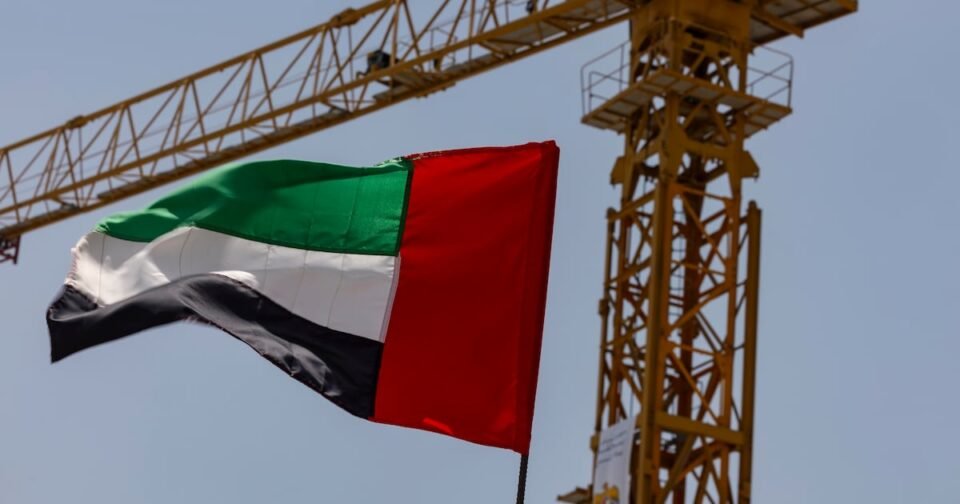
The UAE’s construction sector is moving away from a focus on property towards infrastructure following the outbreak of the Iran war, amid a flood of project announcements by the government, an industry executive has said.
While the property sector has undergone some adjustment since the start of the war on February 28, there have been no cancellations to any of contractor Innovo Group’s projects, its chief executive Bishoy Azmy said.
The company operates in a number of emirates and “we have maybe more than 30 running projects”, he told The National. “I can tell you that none of these projects stopped.”
While the usual phrase in construction is BUA (built-up-area), the term in vogue in the market now is BAU (business as usual), he said.
The company, which has a project backlog of about Dh30 billion ($8.2 billion), is still witnessing a change in its future pipeline.
The shift appears to reflect more than merely a reaction to global geopolitical uncertainty. Government-backed infrastructure spending is also acting as a confidence anchor at a time when developers, lenders and buyers are becoming more selective, while also supporting the UAE’s longer-term needs in transport, energy, water, logistics, data centres and urban development.
“I see the construction industry changing in terms of not being as overwhelmingly linked only to real estate, and I think that’s a positive change – so, being a more diversified industry,” Mr Azmy said.
“Real estate is a big part of our client base, real estate still continues, but with more caution and more standard projects that are in more definite locations where the infrastructure is already there, and it’s easier to convince people that these communities are genuine now, not futuristic.”
The property market in the UAE has not recorded any immediate major fallout from the war.
“We saw a pivot away from maybe some of the more residential projects, some of the more hospitality projects, some of the more fancy projects, some of the more tertiary and secondary location projects, and a retreat to the core,” Mr Azmy said.
“The core” refers to contractors and developers managing projects in prime or proven locations, backed by stronger sponsors, existing roads and utilities, clearer demand and simpler execution risks.
In Dubai, in the first quarter, transaction volumes rose 21 per cent and 3.8 per cent annually in January and February, respectively, a report by consultancy Cavendish Maxwell found. However, in March, volumes fell by 9.6 per cent, with the ready segment falling sharply by 33.4 per cent, the report found.
“While the March slowdown may initially appear to be driven by geopolitical developments, seasonal factors, including the timing of Ramadan, were also at play,” the report said. “The coming months are expected to provide a clearer indication of underlying demand once seasonal and timing effects normalise.”
Infrastructure in focus
The UAE has announced several key infrastructure projects in recent months across energy, water, transport, roads, urban development and economic sectors.
Last month, Abu Dhabi launched Dh55 billion of public-private partnership projects to boost major development in the transport and infrastructure sectors. The pipeline, which comprises 24 projects set to be brought to market this year and next, was launched jointly by Abu Dhabi Investment Office and Abu Dhabi Projects and Infrastructure Centre.
Meanwhile, the Ministry of Energy and Infrastructure has launched a programme to reduce energy and water consumption in government buildings, with investment of Dh120 million in the first phase, state news agency Wam reported last month. That is set to expand to 360 buildings at a cost of Dh1 billion by phase two.
The Dubai government last month revealed plans for the Dh34 billion Dubai Metro Gold Line.
Dubai is also investing heavily to upgrade sewerage and stormwater drain networks. It has awarded five contracts under the Tasreef programme, with a total value of Dh2.5 billion, covering 30 key areas, Wam said.
The emirate also announced expansion projects in Dubai Silicon Oasis worth Dh12.8 billion, as well as the expansion of Dubai International Financial Centre valued at Dh100 billion.
In Sharjah, work has started on a new Dh500 million exhibition and conference project to host the Sharjah International Book Fair in 2027, Wam said.
“We have seen the government [federal and local] spend a lot and accelerate … a lot of infrastructure projects, and even embark on new infrastructure projects across all sectors”, including social projects, airport work, underground infrastructure, rail, ports storage, oil facilities, refineries and data centres, Mr Azmy said.
“So for us as a national player in this space, we are seeing a positive pivot away from one good sector into multiple other better sectors.”
A construction industry “should have a diversified balance of multiple sectors that have different cyclicality, different needs, different cash flow projections, different demand-supply dynamics, that need different skill sets, different subcontractor bases”, he said.
Now the sector is going to be “more aligned with global trends”, he added.