
More than 20 years ago, the lure of Tasmania’s affordable bush blocks in picturesque landscapes attracted a rush of mainland buyers.
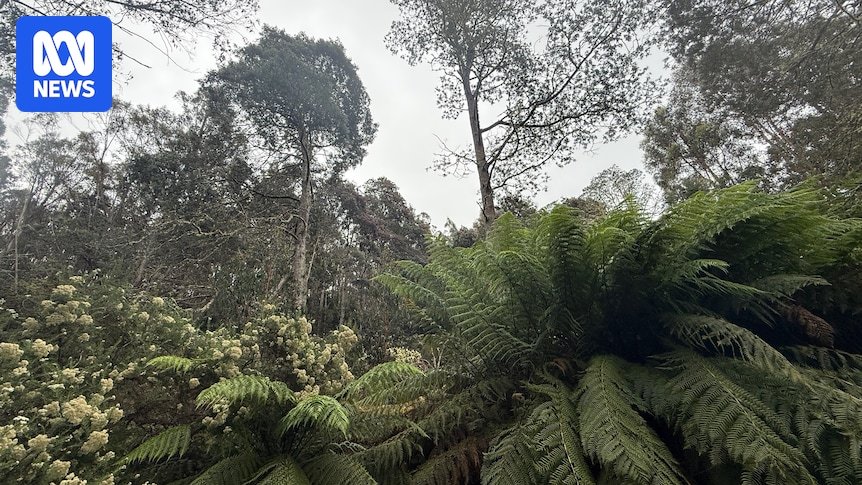
Among them was Marianne Lovelock from Canberra, who was particularly taken by a five-hectare block at Collinsvale at the foot of Kunanyi/Mt Wellington near Hobart.
The Myrtle Forest Creek flows through the middle, providing a home for platypus, while the damp ferny woodland is a haven for birdlife and gives shelter to pademelons.
Despite being a haven for wildlife, the property began to be used as a dumping ground. (Supplied: Sarah Wilcox)
After purchasing it, building on the land proved too challenging, so a boom gate was installed, and Landcare volunteers helped out where they could.
But then it started to be used as a dumping site.
“They were even throwing tyres into the waterways. I tried to ring the council for help and tell them that the boom gate had been ripped down and all this garbage dumped,” Ms Lovelock said.
“I just thought it needs someone to take care of it and to let it sit there and be forest, as opposed to putting on a holiday house.“
The Wellington Park Management Trust and Glenorchy Council were unable to take it on.
In the aftermath of the Voice to Parliament referendum, Ms Lovelock had an idea: she would attempt to hand it to the Aboriginal Land Council of Tasmania (ALCT).
“I felt there were a lot of First Nations people really hurting, on both sides of the debate,” she said.
“It would demonstrate in some ways to the Palawa people that people do care, lots of people care.”
The process was not easy, and it couldn’t be gifted for free due to legislative requirements — the ALCT would need to purchase it at the minimum fee.
With limited resources, the ALCT needed to launch a crowdfunding campaign.
Marianne Lovelock had the idea to hand the property to the Aboriginal Land Council of Tasmania following the Voice to Parliament referendum. (Supplied: Sarah Wilcox)
Donations flow in, and rehabilitation starts
The campaign was noticed by Tasmanian illustrator Josh Pringle, known for the Keep Tassie Wild stickers.
The business donates half of its profits to environmental causes, and last year donated $10,000 to the ALCT for the Collinsvale block, its largest donation in its 10 years.
Josh Pringle says he wanted to find a special cause for when Keep Tassie Wild ticked over $100,000 in donations, and the ALCT donation fit. (ABC News: Selina Ross)
“It felt like a special one for us, to give money that would result in a tactile and important project,” Mr Pringle said.
“The idea that people can have a place to go, to manage it, to be in charge of it, to practice and experience that deep and proper connection is incredibly exciting.“
The ALCT finalised the acquisition late last year, and its Pakana Ranger program has already set to work on rehabilitating the land.
Loading…
They removed more than 30 dumped tyres and are eradicating invasive foxglove and California thistles while developing a water-monitoring program.
ALCT general manager Sarah Wilcox said it was an important piece of land for the Aboriginal community because of the creek and its connection to the mountain.
Aboriginal Land Council of Tasmania general manager Sarah Wilcox and executive officer Brooke Bourke. (Supplied: Jillian Mundy)
It will be used to train the next generation of rangers.
“The junior rangers have such pride and joy on their faces knowing they are now fulfilling what our ancestors did,” Ms Wilcox said.
“They’re walking that country, they’re caring for that country, and they’re learning from that country.“
The property in Collinsvale will be used to train the next generation of rangers in land management. (Supplied: Sarah Wilcox)
Loongana, Mathinna land was also handed back
It was one of three private blocks that had recently been provided to the ALCT by their owners.
Another is at Loongana in the state’s north-west, set in deep forest with the Leven River running through, home to freshwater crayfish, masked owls and other birdlife.
The land at Loongana is covered in dense forest. (Supplied: Aboriginal Land Council of Tasmania)
Ms Wilcox said rangers would also manage it.
“It’s a place that a lot of citizen science occurs — there’s also kayakers and fishers, so those activities can still continue,” she said.
“We’re not here to take away experiences for people, we just want to make sure that the land is managed in the right way.”
The third piece of land is a small residential block at Mathinna, in the north-east.
“It can become an interpretation site with a native garden,” Ms Wilcox said.
“Mathinna has so much to offer; there are a lot of walks and waterfalls, they get quite a lot of visitors, and our site will be in the middle of town.
“People will be able to take a moment and reflect.“
The Leven River winds through the land at Loongana. (Supplied: Aboriginal Land Council of Tasmania)
Land hand backs a challenging process
The ALCT has had to turn to private land hand-backs due to a long-term impasse with the Tasmanian government.
There have been no large-scale land returns in Tasmania since 2005, when Truwana/Cape Barren Island and Lungtalanana/Clarke Island were returned to the ALCT.
Truwana/Cape Barren Island was returned to Aboriginal ownership in 2005. (ABC News: Morgan Timms)
Since then, there have been sporadic leases and other management arrangements.
An attempt to hand back Larapuna/Eddystone Point was voted down in the Legislative Council in 2012, and the process has been mired in political uncertainty and division.
In 2017, the Hodgman Liberal government started a review of the model for returning land, but it was halted, the laws have not changed, and no land returns have occurred.
A treaty and truth-telling report, prepared for the government in 2021, found that the ALCT was not receiving sufficient resources.
A view of Preminghana on Tasmania’s north-west coast, one of the first lands to be returned to Aboriginal ownership over three decades ago. (ABC Northern Tasmania: Rick Eaves)
Ms Wilcox said it could be addressed as part of ongoing treaty and truth-telling discussions.
“I think that there is support across the parliament for land return,” she said.
“There’s a fear about giving land back, and people think that we’re after their backyards, but we’re not after their backyards.
“It’s about cultural landscapes that have significance that connects us to our ancestors, to our country.“