
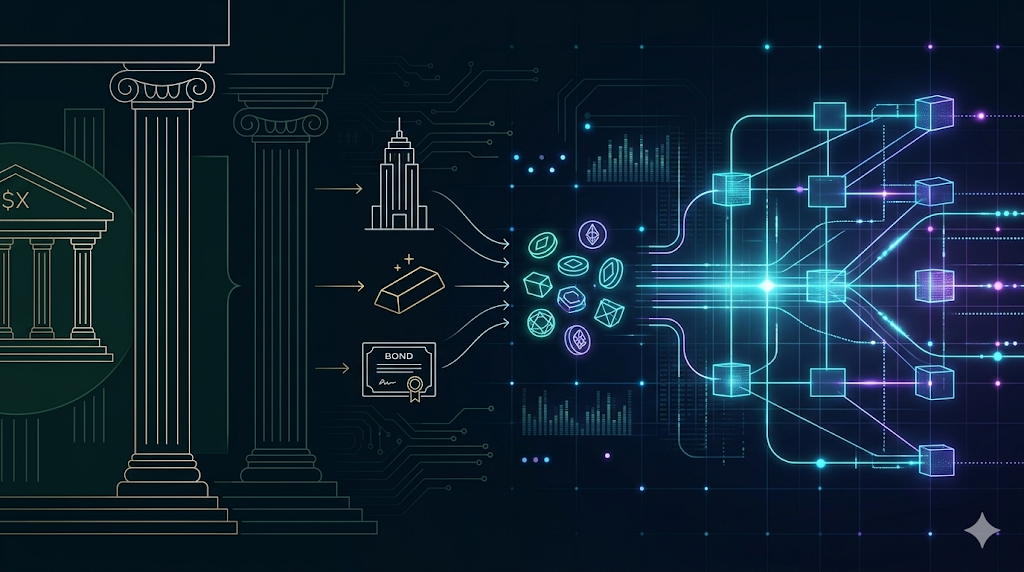
Once fierce adversaries, traditional Wall Street institutions and digital asset networks are forging an unprecedented convergence through regulated Real-World Asset (RWA) tokenization. This shifting balance of power indicates that banks no longer view digital assets as a threat to their survival; instead, they recognize distributed ledger technology (DLT) as a core infrastructure for modern financial market efficiency.
This strategic evolution marks the beginning of a multi-year migration, paving the way for trillions of dollars in legacy capital to transition onto blockchain networks.
The Massive Influx of Institutional Capital in 2026
BlackRock and Tokenized Treasuries
Tokenized United States Treasuries currently dominate the institutional blockchain sector because they offer absolute security combined with seamless on-chain yield. By mid-2026, the BlackRock USD Institutional Digital Liquidity Fund, known as BUIDL, surged past 2.4 billion dollars in total assets. This massive accumulation proves that Wall Street is moving beyond speculative cryptocurrencies into highly stable, government-backed digital instruments.
This specific fund operates seamlessly across multiple networks, paying daily rewards directly into holder wallets. Because traditional institutions require flawless liquidity and regulatory compliance, the success of BUIDL serves as a fundamental blueprint for future asset tokenization.
Franklin Templeton’s BENJI Fund
Franklin Templeton pioneered the institutional tokenization movement long before its massive Wall Street competitors entered digital space. Their BENJI fund initially launched in 2021 and steadily expanded. This foundational product validated the radical concept that traditional money market funds could operate entirely on public blockchain infrastructure.
The early success of BENJI forced other massive asset managers to rapidly develop their own proprietary tokenization strategies to remain competitive. By expanding across multiple blockchains like Polygon, Solana, and Aptos, Franklin Templeton ensured their institutional products remain highly accessible to modern decentralized applications.
Expanding Beyond Standard ETFs
Wall Street is rapidly expanding its digital asset focus far beyond the highly successful spot Bitcoin exchange-traded funds launched in previous years. While those initial funds captured billions in retail and institutional capital, they simply repackaged cryptocurrency into a traditional financial wrapper. Today, the focus is entirely on migrating legacy financial instruments directly onto decentralized, native blockchain networks.
This shift indicates that institutions now value the underlying technology itself, rather than just the speculative price movements of digital currencies. Asset managers are aggressively building the necessary infrastructure to tokenize corporate bonds, private equity, and complex commodity derivatives globally.
Integrating with Decentralized Exchanges
Institutional capital is officially abandoning restrictive over-the-counter desks in favor of deep liquidity pools located on decentralized cryptocurrency exchanges. In early 2026, BlackRock made a landmark strategic move by allowing its BUIDL fund to be traded directly on the Uniswap decentralized exchange. This integration marks the very first time a major Wall Street asset has embraced permissionless, peer-to-peer digital trading.
Allowing institutional assets to trade continuously on decentralized exchanges dramatically reduces settlement friction and enhances transparent price discovery. Eligible investors can now instantly swap multi-million dollar tokenized treasury positions for digital stablecoins at any hour of the day or night.
Solving Traditional Wall Street Inefficiencies
Atomic Settlement and Counterparty Risk
Blockchain technology instantly solves the massive settlement delays that traditionally plague legacy banking systems and international clearinghouses. Traditional financial trades frequently require up to two business days to completely clear, exposing participating institutions to severe counterparty risks. By utilizing smart contracts, tokenized asset trades settle in absolute real-time simultaneously with the transfer of the underlying digital payment.
This atomic settlement eliminates the dangerous time gap where a counterparty could potentially default on their financial obligations. Massive investment banks are highly motivated to migrate their operations on-chain specifically to reduce their mandatory capital reserve requirements.
Eradicating Financial Intermediaries
Tokenizing traditional assets eradicates the expensive, highly bureaucratic intermediaries that heavily tax global financial transactions. Legacy systems rely entirely on transfer agents, clearing banks, and centralized depositories to manually verify and record asset ownership changes. Decentralized ledgers automatically perform all these vital administrative functions using immutable cryptographic code for a fraction of a cent.
Removing these middlemen drastically lowers the operational overhead for massive asset managers and boutique investment firms alike. These extreme cost savings are the primary financial catalyst convincing skeptical Wall Street executives to fully embrace the decentralized Web3 digital infrastructure.
Unlocking 24/7 Global Trading
Decentralized networks unlock uninterrupted, twenty-four-hour global trading capabilities that traditional stock exchanges simply cannot replicate. Legacy markets stubbornly operate on antiquated schedules, frequently closing for weekends and national holidays, which traps investor capital during global macroeconomic crises. Blockchain infrastructure operates continuously, allowing institutions to react instantly to sudden geopolitical events regardless of their local time zone.
This continuous operation is absolutely vital for managing risk in a hyper-connected global economy where financial news breaks constantly. Wall Street firms utilizing tokenized assets gain a massive competitive advantage by adjusting their portfolios while traditional competitors remain locked out of the market.
Fractionalizing Illiquid Assets
Blockchain architecture effortlessly fractionalizes highly illiquid assets, allowing institutions to distribute complex private equity and commercial real estate globally. Traditionally, investing in a massive private credit fund required millions of dollars in upfront capital, severely limiting market participation. By issuing digital tokens representing fractional ownership, institutions can drastically lower these financial barriers and attract a massive new pool of global investors.
This fractionalization unlocks billions of dollars in previously trapped liquidity, revitalizing stagnant private markets. According to early 2026 market data, tokenized private credit has rapidly expanded into a multi-billion dollar industry driven strictly by this new technological accessibility.
Regulatory Clarity Driving Institutional Adoption
The European MiCA Framework
The full implementation of the European MiCA framework in 2026 successfully provided the exact regulatory clarity institutions require to deploy massive capital. This comprehensive legislation definitively categorizes different digital assets, establishing clear, uniform rules for cryptocurrency exchanges and stablecoin issuers across the entire continent. Because institutions naturally abhor legal uncertainty, this robust framework directly triggered a massive surge in European digital asset adoption.
Banks operating under MiCA can confidently build tokenization infrastructure without fearing sudden, arbitrary regulatory crackdowns from hostile government agencies. Consequently, European financial markets are currently leading the global race to integrate tokenized real-world assets into everyday corporate banking.
Shifting United States Policy in 2026
Shifting regulatory policies in the United States during 2026 aggressively accelerated the integration of Wall Street and digital tokens. Following years of extreme hostility from federal agencies, legislation like the proposed CLARITY Act aims to establish a legitimate framework for digital commodities. This dramatic political pivot rapidly unblocked trillions of dollars in sidelined institutional capital waiting for legal permission to enter the digital space.
The United States is desperately rushing to establish clear rules to prevent highly lucrative tokenization projects from fleeing to more friendly international jurisdictions. When American banks receive official regulatory guidance, the resulting capital influx will permanently solidify blockchain as the foundation of global finance.
Programmable Compliance on Blockchains
Standardizing compliance directly within the blockchain code allows institutions to easily satisfy international anti-money laundering laws without compromising network efficiency. Modern smart contracts utilize specialized permissioned layers that actively verify the legal identity and accreditation status of a user before allowing a token transfer. If a receiving wallet fails this mandatory regulatory check, the transaction is instantly and mathematically rejected by the underlying protocol.
This programmable complianc solves the massive tension between decentralized anonymity and strict corporate banking regulations. Wall Street can finally utilize public blockchains because these advanced token standards guarantee that restricted assets never fall into the hands of sanctioned individuals.
The Convergence of DeFi and Legacy Banking
Tokenized Treasuries as DeFi Collateral
Utilizing highly stable tokenized treasuries as premium collateral is currently revolutionizing the entire decentralized finance lending ecosystem. Historically, decentralized lending markets relied entirely on highly volatile cryptocurrencies, which frequently caused catastrophic liquidations during sudden market crashes. By accepting tokenized government debt, decentralized protocols can offer massive loans secured by the safest, most reliable financial instruments on the planet.
This integration fundamentally bridges the massive divide between traditional finance yields and decentralized algorithmic trading strategies. Institutional traders can now generate reliable, government-backed interest on their base capital while simultaneously utilizing that exact capital to execute complex trades on-chain.
Next-Generation Institutional Stablecoins
The integration of tokenized treasury funds directly into stablecoin issuance platforms redefines the safety of digital fiat currencies. Several prominent stablecoin issuers now utilize tokenized US Treasuries as the primary reserve asset backing their digital dollars. This structural change means that institutional stablecoins are directly backed by highly liquid, yield-bearing government securities operating entirely on the blockchain.
Robust collateralization eradicates the existential fears surrounding stablecoin insolvencies that historically plagued the cryptocurrency industry. Wall Street institutions are significantly more willing to process multi-million dollar digital payments when they know the underlying stablecoin is backed by verifiable on-chain treasury funds.
Modernizing Digital Asset Custody
Massive banks are rapidly adapting by launching their own specialized digital asset custody solutions to protect institutional private keys. These legacy institutions recognize that if they fail to secure digital tokens, they will lose their relevance in the modern financial system.
The convergence requires banks to hire elite blockchain security engineers to build highly resilient, multi-signature cold storage vaults. This massive infrastructure shift proves that traditional banks are entirely transforming into digital technology companies to survive the Web3 revolution.
Expanding Private Credit Markets
Private credit markets are aggressively moving on-chain to capitalize on the immense speed and transparency offered by decentralized financial protocols. Traditional private lending is notoriously opaque, relying heavily on manual spreadsheets and expensive legal teams to enforce complex loan covenants. Smart contracts automate these exact loan terms, immediately executing interest payments and instantly seizing digital collateral if a corporate borrower defaults.
Automation drastically lowers the operational risk for institutional lenders, making private credit significantly more profitable. As a result, Wall Street private equity firms are increasingly utilizing blockchain networks to source capital and manage their massive global loan portfolios efficiently.
Macroeconomic Forces Behind the Pivot
Inflation and the Search for Yield
Persistent global inflation heavily forces institutional investors to aggressively seek out highly efficient, yield-generating digital assets to protect client purchasing power. Traditional savings accounts and legacy bonds frequently fail to outpace rising consumer prices, leading to a slow destruction of institutional wealth. Tokenized assets eliminate the expensive management fees of traditional funds, mathematically allowing a much higher percentage of the yield to return directly to the investor.
This structural efficiency makes on-chain treasury funds vastly superior to traditional money market accounts during periods of elevated macroeconomic inflation. Consequently, corporate treasurers are actively shifting massive portions of their idle fiat reserves directly into tokenized digital assets.
Geopolitical Instability and Asset Portability
Rising geopolitical tensions globally actively drive institutional capital away from vulnerable legacy banking networks toward highly resilient, decentralized blockchain ledgers. When international conflicts threaten traditional cross-border payment systems, multinational corporations face severe operational disruptions and frozen assets. Decentralized digital tokens operate completely independent of national borders, guaranteeing that corporate capital can flow freely regardless of sudden political sanctions.
This geopolitical uncertainty highlights the absolute necessity of maintaining a truly neutral, un-censorable global financial infrastructure. Wall Street institutions are aggressively adopting digital assets explicitly to hedge against the increasing fragility of the traditional international monetary system.
Demographic Shifts in Wealth Management
The massive shift in demographic wealth distribution heavily pressures traditional banks to adopt digital tokens to attract the next generation of wealthy investors. Millennials and Generation Z heavily prefer interacting with decentralized digital applications rather than visiting traditional, antiquated banking branches. If Wall Street firms fail to offer comprehensive cryptocurrency and tokenized asset portfolios, they will permanently lose this massive upcoming wave of inheritances.
To survive this demographic transition, legacy institutions must modernize their consumer interfaces and product offerings to reflect a Web3-native reality. Embracing digital tokens is no longer an experimental luxury for banks; it is an absolute requirement for long-term corporate survival.
| Macroeconomic Driver | Traditional Market Impact | Blockchain Integration Benefit |
| High Inflation | Destroys real purchasing power | Maximizes yield by cutting middleman fees |
| Geopolitical Instability | Threatens traditional global clearing | Ensures neutral, borderless asset transfers |
| Generational Wealth Transfer | Capital flees legacy bank branches | Attracts digitally native retail investors |
How to Access Tokenized Markets on KuCoin
Conclusion
The spectacular convergence of Wall Street and the cryptocurrency sector represents the most significant financial evolution of the modern decade. The successful launch of massive institutional products like the BlackRock BUIDL fund proved that banks no longer view blockchain as a speculative threat. Instead, traditional finance strictly recognizes decentralized ledgers as the ultimate, highly efficient infrastructure required to eliminate counterparty risk and expensive administrative intermediaries. This pivotal conversion is setting the stage for trillions of dollars in legacy capital to eventually migrate away from antiquated legacy systems and onto transparent, immutable smart contracts.
This historic shift from rivals to powerful allies heavily relies on the establishment of clear global regulatory frameworks and the invention of programmable compliance standards. As tokenized real-world assets surpass 30 billion dollars in total value, the integration of traditional yields into decentralized finance applications creates a deeply resilient digital economy. Macroeconomic pressures, including persistent inflation and severe geopolitical instability, mathematically guarantee that this institutional migration will aggressively accelerate.
FAQs
What exactly is a tokenized real-world asset?
A tokenized real-world asset is a digital cryptocurrency token that legally and mathematically represents fractional ownership of a traditional financial instrument or physical property. Blockchain protocols digitize assets like government treasury bonds, commercial real estate, or private credit to ensure instant global transferability. This decentralized technology eliminates the expensive middlemen and slow settlement times inherently present in traditional legacy finance systems.
Why did Wall Street change its stance on cryptocurrency?
Wall Street radically changed its stance on cryptocurrency because institutions realized that blockchain infrastructure provides vastly superior operational efficiency compared to legacy banking software. By tokenizing traditional assets, banks can instantly settle complex trades, eliminate severe counterparty risks, and operate continuously twenty-four hours a day. The financial cost savings generated by replacing manual administrators with automated smart contracts simply became too massive for corporate executives to ignore.
What is the BlackRock BUIDL fund?
The BlackRock BUIDL fund is a massive institutional money market product that operates entirely on public blockchain networks rather than traditional financial rails. It holds strictly US Treasury bills and bank cash, generating a reliable daily yield that is distributed directly to the digital wallets of its investors. By mid-2026, it accumulated over 2.4 billion dollars in assets, becoming a dominant force in the tokenized digital securities market.
How does tokenization solve traditional settlement delays?
Tokenization solves traditional settlement delays by utilizing smart contracts to execute atomic swaps, where the transfer of an asset and its payment occur simultaneously. In traditional markets, clearinghouses often require up to two days to manually verify funds and update ownership ledgers, exposing banks to severe default risks. Blockchain technology automates this verification process cryptographically, allowing multi-million dollar trades to settle flawlessly in absolute real-time.
Are tokenized institutional assets available to retail investors?
Many direct tokenized institutional assets currently restrict access strictly to qualified, highly accredited investors due to complex international securities laws. However, retail investors can easily gain massive indirect exposure to this booming sector by trading the native governance tokens of protocols facilitating these transactions. Advanced cryptocurrency platforms perfectly provide everyday traders seamless access to decentralized networks actively building this new Wall Street infrastructure.
Disclaimer:This content is for informational purposes only and does not constitute investment advice. Cryptocurrency investments carry risk. Please do your own research (DYOR).