
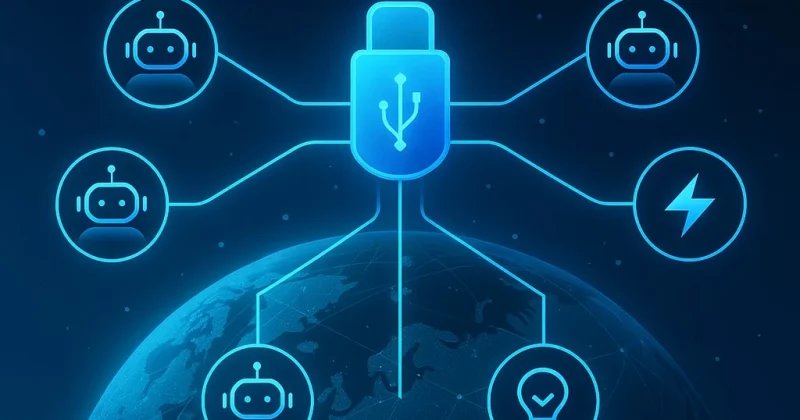
Fetch.ai has been quietly assembling something ambitious: a full-stack infrastructure where AI agents don’t just respond to prompts, they actually do things. Book flights, compare prices, negotiate deals, and pay each other, all without a human hovering over the keyboard.
The two pillars of this push are ASI:One, branded as “Your Personal AI,” and Agentverse, a marketplace where these agents live, collaborate, and transact.
What ASI:One and Agentverse actually do
ASI:One, launched in November 2025, is a customizable personal agentic large language model. In English: it’s a personal AI that learns your preferences over time and can autonomously coordinate tasks by tapping into a broader network of other agents.
That broader network is Agentverse. Think of it as an app store, but instead of apps, you’re browsing AI agents built by developers, brands, and businesses. These agents span sectors like travel, retail, and finance. By mid-2026, Agentverse reportedly hosts up to 2.7 million agents.
Your personal AI agent doesn’t just search for information. It can interact with verified brand agents on Agentverse to complete multi-step tasks. Need to plan a trip? Your agent could negotiate with a hotel agent, a flight agent, and a car rental agent simultaneously, comparing options and executing bookings.
AI agents that pay each other
In December 2025, Fetch.ai rolled out what it called the first AI-to-AI payments for real-world transactions. Agents can now settle payments using on-chain assets like USDC and FET.
Then in May 2026, Fetch.ai introduced the Agent Launch platform on BNB Chain. This allows AI agents to autonomously create and trade their own tokens.
The bigger picture: Fetch.ai’s long game
Fetch.ai was founded in 2017 by Humayun Sheikh, who is also notable as an early investor in DeepMind.
In 2024, Fetch.ai merged with SingularityNET and Ocean Protocol to form the Artificial Superintelligence Alliance. The merger consolidated three projects that were each tackling different pieces of decentralized AI: agent coordination (Fetch.ai), AI marketplace and reasoning (SingularityNET), and data sharing (Ocean Protocol).
What this means for investors
The 2.7 million agents reportedly on Agentverse by mid-2026 is a metric worth watching closely, but with caveats. Agent count alone doesn’t tell you much about quality or genuine economic activity. The more revealing metric will be transaction volume flowing through AI-to-AI payments. If agents are actually settling real transactions using USDC and FET, that creates organic demand for the token beyond speculation.
FET’s utility case is now more concrete than most AI-adjacent tokens. It serves as a payment rail within the agent ecosystem, a staking mechanism, and potentially a base pair for agent-issued tokens. Investors should be tracking Agentverse transaction volumes, the number of verified brand agents onboarding to the platform, and the growth trajectory of Agent Launch activity on BNB Chain as the key indicators of whether Fetch.ai’s agent economy is generating real economic gravity.