
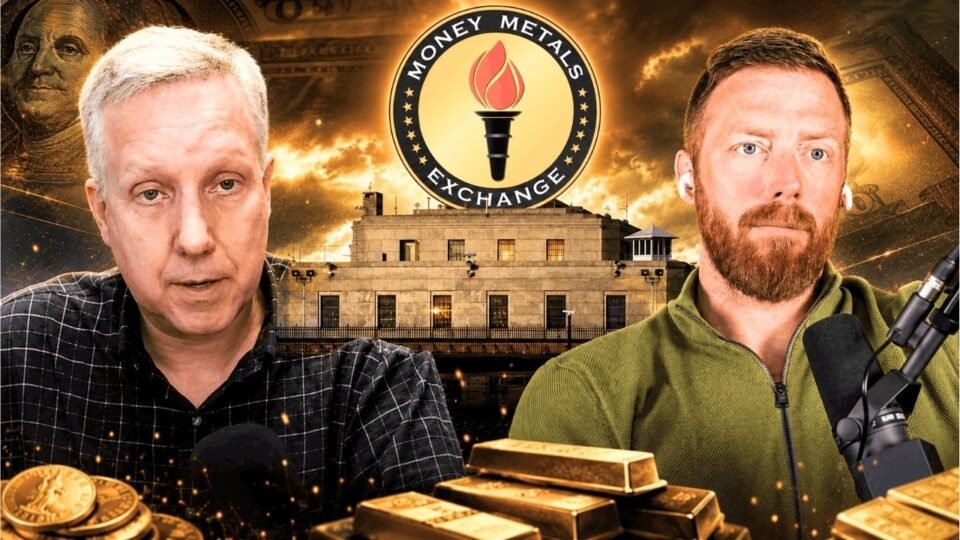
In a recent interview on the Pinnacle Digest Podcast, host Aaron Hoddinott sat down with Money Metals President and CEO Stefan Gleason to discuss central bank gold buying, Federal Reserve policy, the future of the U.S. dollar, and the growing debate surrounding America’s gold reserves.
Gleason argued that the global monetary system is undergoing a major shift as countries increasingly turn to gold to reduce their dependence on the U.S. dollar.
Why Central Banks Are Buying Gold Instead of U.S. Dollars
According to Gleason, the freezing of Russian assets following the 2022 invasion of Ukraine accelerated the global push toward de-dollarization. Nations around the world took notice that access to the dollar-based financial system could be restricted, increasing the appeal of gold as a reserve asset that cannot be frozen or sanctioned by foreign governments.
He believes central bank demand has been a primary driver behind gold’s rise from roughly $2,000 per ounce to successive record highs. Gleason also noted that gold recently surpassed sovereign bonds as the world’s leading reserve asset among central banks, signaling a significant shift in reserve management strategies.
Federal Reserve Policy, Interest Rates, and Gold Prices
The conversation then turned to Federal Reserve Chair Kevin Warsh and whether his recent hawkish comments pose a threat to gold prices.
Gleason argued that investors often misunderstand the relationship between interest rates and gold. Historically, gold has frequently performed well during periods of rising rates when inflation remains above interest rates, resulting in negative real returns for investors holding cash and bonds.
He also questioned how much flexibility the Federal Reserve truly has. With federal debt levels at historic highs and annual interest costs exceeding $1 trillion, Gleason believes policymakers will struggle to maintain restrictive monetary policy for long. In his view, inflation and liquidity injections remain more likely than sustained monetary tightening.
Will the U.S. Face Another Financial Crisis?
When asked whether America could experience another crisis similar to 2008, Gleason acknowledged growing risks in commercial real estate, private credit, technology, and artificial intelligence-related investments. However, he said policymakers are far better prepared to intervene today than they were during the Global Financial Crisis.
Drawing on past conversations with former Federal Reserve Governor Kevin Warsh and economist Mohamed El-Erian, Gleason argued that central banks have developed extensive tools for stabilizing markets. While volatility and asset losses remain possible, he expects authorities to respond aggressively with liquidity measures before allowing a systemic collapse.
As a result, Gleason sees inflation and currency debasement as more likely outcomes than a prolonged deflationary downturn.
Physical Gold and Silver Markets Show Growing Stress
Gleason also provided insight into current conditions in the physical precious metals market. Money Metals has been a net buyer over the last two to three months as investors take profits following strong gains in gold and silver prices.
He noted that local coin shops across North America are seeing heavy selling activity, particularly in silver. The influx of material has overwhelmed portions of the refining industry and exposed significant infrastructure challenges.
According to Gleason, North America lacks sufficient silver refining capacity, leading to major backlogs and forcing some material to be shipped overseas for processing. Despite the selling pressure in the West, he said demand remains extremely strong throughout Asia, where investors continue accumulating precious metals at elevated levels.
Why Physical Silver Trades at a Premium in Asia
The discussion also explored the growing gap between paper silver prices in Western futures markets and physical silver premiums in Asia.
Gleason explained that Western markets rely heavily on leveraged futures trading and hedging activity from miners, refiners, and dealers. This creates significant paper-market selling pressure that can weigh on prices.
Asian markets, by contrast, are driven more by physical ownership and less by leverage. Combined with stronger cultural demand and economic growth, these factors have created persistent premiums for physical silver in countries such as India and across Southeast Asia.
He cited examples of silver flowing from London to New York and eventually to Asia as traders pursued arbitrage opportunities created by regional price differences and shortages of physical metal.
The SILVER Act and U.S. Precious Metals Infrastructure
Fresh from meetings in Washington, D.C., Gleason discussed the bipartisan SILVER Act, or System Integrity Through Licensed Vault Expansion and Resilience Act.
Introduced by Senator Catherine Cortez Masto of Nevada and Senator Jim Risch of Idaho, the legislation seeks to reduce concentration risk within U.S. precious metals markets. Gleason argued that the majority of gold and silver backing major futures contracts remains concentrated in New York-area vaults, creating a potential single point of failure.
The legislation would allow qualified depositories in other regions of the country to participate more fully in exchange infrastructure, increasing resilience, competition, and market access.
Fort Knox Audit Questions Continue to Grow
One of the most controversial topics discussed was the status of America’s gold reserves at Fort Knox.
Gleason argued that the United States has not conducted a truly comprehensive audit of its gold reserves in decades. While various reviews have occurred over the years, he contends that many fail to meet modern auditing standards that require physical verification, chain-of-custody controls, and detailed inventory procedures.
He supports the Gold Reserves Transparency Act, which would mandate a comprehensive audit of U.S. gold holdings and determine whether any of the reserves have been leased, swapped, pledged, or otherwise encumbered.
The 83% U.S. Gold Reserve Purity Problem
According to Gleason, one of the least understood issues surrounding America’s gold reserves is purity.
He claims that approximately 83% of U.S. gold reserves consist of older “coin melt bars” containing between 90% and 93% gold. These bars were produced decades ago from melted U.S. gold coins and do not meet today’s international good-delivery standard of 99.99% purity.
Because modern bullion markets require higher purity levels, Gleason argues that much of the nation’s gold would need to be refined before it could be readily traded or used in a financial intervention. Estimates cited during the interview suggest that refining roughly 7,000 tons of non-pure gold reserves could take decades under current industry capacity constraints.
China’s Gold Reserves Could Change the Global Monetary System
The interview concluded with a discussion of China’s gold holdings and their potential implications for the global economy.
China officially reports reserves of roughly 2,000 tons, but Gleason believes the true figure may be significantly higher. Based on import data and other indicators, he suggested China’s actual holdings could eventually prove to be closer to 8,000 to 10,000 tons.
If Beijing were to reveal substantially larger reserves, the announcement could reshape perceptions of global monetary power and potentially accelerate the transition toward a more multipolar financial system.
Whether through continued central bank accumulation, growing questions about sovereign gold reserves, or evolving monetary policies, Gleason believes gold will remain at the center of some of the most important economic debates in the years ahead.
To learn more, visit Pinnacle Digest to stay connected with Aaron and his team, Money Metals for precious metals investing, storage, and lending services, and the Sound Money Defense League for updates on state and federal sound money legislation and precious metals policy initiatives. Together, these organizations continue to contribute to the ongoing conversation surrounding gold, silver, monetary policy, and the future of the global financial system.
Originally Published on Money Metals.