
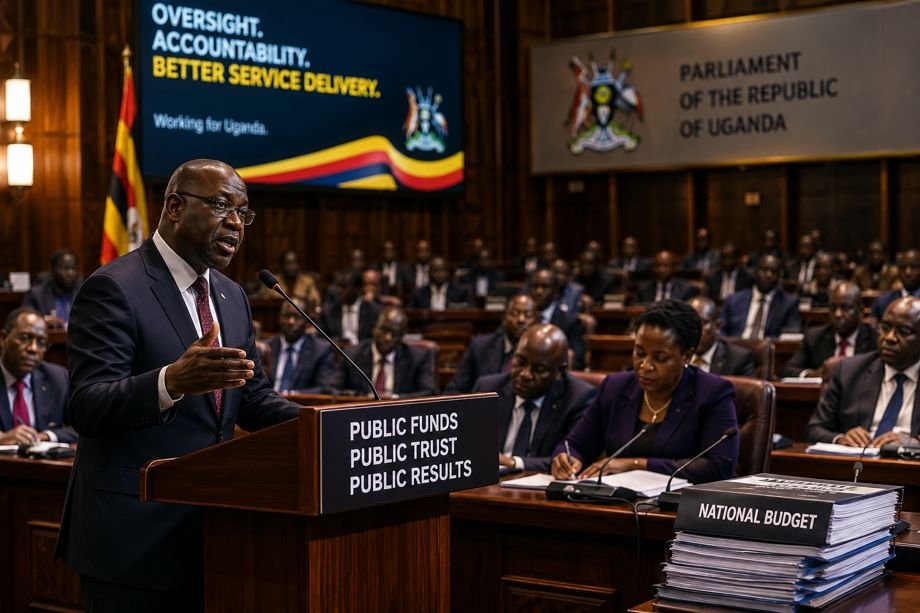
Uganda’s latest call for stronger parliamentary oversight signals that the government is shifting attention from how much money is allocated to how effectively public money is spent. Finance Minister Henry Musasizi’s appeal to Members of Parliament (MPs) to actively monitor government-funded projects reflects growing recognition that budget approval alone cannot guarantee better public services. As Uganda pursues ambitious programmes such as the Parish Development Model (PDM) and Uganda Vision 2040, stronger oversight is emerging as a critical pillar for improving governance, fiscal discipline and public confidence.
From Budget Approval to Results on the Ground
The minister’s message broadens Parliament’s traditional role beyond debating and approving the national budget. By encouraging MPs to inspect schools, health centres, roads and community projects, engage district officials and directly interact with PDM beneficiaries, the government is seeking to establish a culture of results-based oversight.
This approach acknowledges a longstanding challenge in many developing economies: resources are often allocated for development projects, but implementation gaps, administrative inefficiencies and weak accountability can prevent communities from receiving the intended benefits. Direct engagement by MPs could help identify delays, incomplete projects or misuse of public funds earlier, allowing corrective action before problems become systemic.
The announcement that supplementary budgets will be limited to unforeseen and unavoidable circumstances under the Public Finance Management Act further reinforces the government’s intention to strengthen fiscal discipline. If implemented consistently, this could make Uganda’s budgeting process more predictable and transparent while reducing unplanned government spending.
Parliament Faces Greater Responsibility in Delivering Vision 2040
The discussions also underline Parliament’s growing importance in Uganda’s long-term development agenda. National Planning Authority Chairperson Prof. Pamela Mbabazi reminded lawmakers that achieving Uganda Vision 2040, which aims to expand the economy to US$500 billion by 2040—requires more than approving expenditure. Parliament must ensure that legislation, public investment and oversight work together to support sustained economic transformation.
The concerns raised by legislators themselves demonstrate that institutional reforms remain necessary. Complaints over delays in receiving budget documents indicate that effective oversight begins before funds are approved. Without sufficient time to scrutinise spending proposals, Parliament’s ability to identify risks or improve budget quality is constrained.
Similarly, calls to address double taxation and improve infrastructure for industrial parks show that lawmakers are increasingly linking fiscal policy with investment, industrialisation and economic competitiveness. These issues suggest that parliamentary oversight is evolving into a broader discussion about the efficiency of public spending rather than simply the size of government expenditure.
How Will This Affect Uganda, Policymakers and Stakeholders?
For Uganda, stronger parliamentary oversight could improve the effectiveness of government spending by ensuring projects are completed as planned and public resources reach intended beneficiaries. Better monitoring may strengthen public trust in state institutions while improving delivery of education, healthcare, agricultural support and local infrastructure. If accountability improves, Uganda could also enhance confidence among development partners and investors seeking predictable and transparent public financial management.
For policymakers, the minister’s remarks increase expectations for better planning, reporting and implementation. Ministries and government agencies may face greater scrutiny over procurement, project execution and budget utilisation. Restricting supplementary budgets will encourage ministries to prepare more realistic spending plans while improving compliance with fiscal rules. However, policymakers will also need to ensure that tighter expenditure controls do not reduce flexibility during emergencies or unforeseen economic shocks.
For local governments, district administrations and Chief Administrative Officers are likely to experience closer engagement with MPs, requiring stronger coordination, timely reporting and improved administrative capacity. More active oversight could encourage higher standards of financial management but may also expose weaknesses in staffing, project monitoring and implementation systems that require institutional strengthening.
For businesses and private investors, parliamentary attention to issues such as double taxation and industrial park infrastructure could contribute to a more predictable investment environment if followed by policy reforms. Improved infrastructure and stronger fiscal governance may reduce business uncertainty and support Uganda’s industrialisation strategy over the longer term.
For development partners and civil society, stronger parliamentary oversight aligns with broader governance objectives centred on transparency, accountability and efficient use of public resources. More rigorous monitoring of programmes such as the Parish Development Model could improve evidence-based policy adjustments while enhancing confidence that externally supported projects are delivering intended outcomes.
The Success Will Depend on Implementation, Not Intentions
While the government’s message reflects a positive shift toward accountability, the effectiveness of these reforms will ultimately depend on execution. MPs will require timely access to financial information, technical capacity to assess increasingly complex programmes and constructive cooperation from implementing agencies. Oversight must remain evidence-based rather than becoming politicised or duplicating the work of existing audit institutions.
At the same time, improving accountability requires reforms throughout the budget cycle. Delays in submitting budget documents, concerns about taxation and the need for better infrastructure planning all suggest that stronger monitoring alone cannot resolve structural weaknesses in public financial management. Meaningful progress will depend on integrating transparent budgeting, efficient implementation and continuous evaluation into Uganda’s governance framework.
The coming months will therefore be an important test of whether Parliament embraces its expanded oversight role and whether government institutions respond with greater transparency and improved project delivery. If these efforts are sustained, Uganda could strengthen fiscal discipline, improve service delivery and move closer to achieving the long-term objectives outlined in Vision 2040. However, if oversight remains inconsistent or institutional bottlenecks persist, the gap between approved budgets and development outcomes may continue to challenge the country’s broader economic ambitions.