
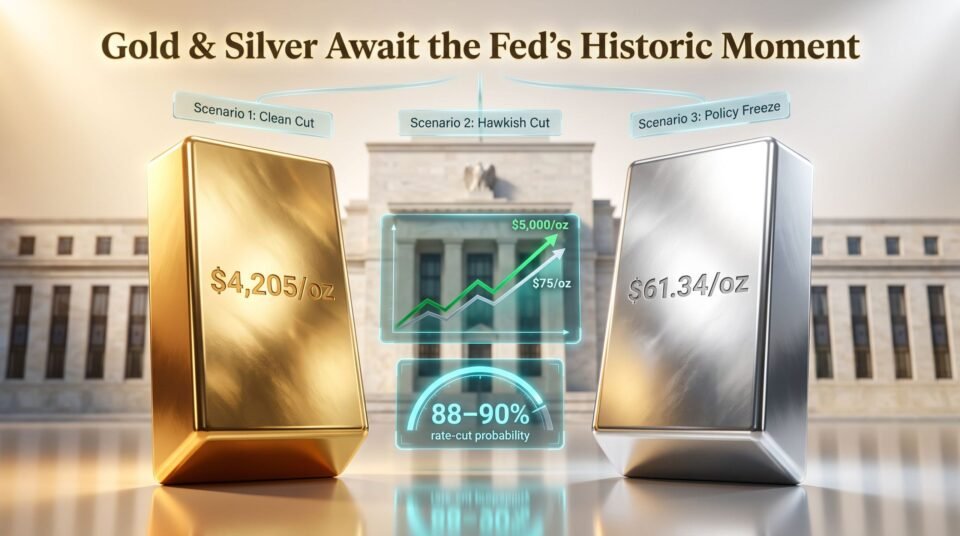
Precious metals markets have a well-documented tendency to enter periods of unusual stillness before major monetary policy inflection points. This is not indecision. It is the market absorbing enormous uncertainty and compressing directional energy into a tight range, waiting for a catalyst to release it. What makes the current environment particularly significant is not just the rate decision itself, but the extraordinary collision of forces surrounding it. Geopolitical disruption, renewed inflationary pressure, political tension over monetary independence, and a multi-decade shift in how central banks are treating gold as a reserve asset have all converged simultaneously. Gold and silver await the Fed’s historic moment in exactly this kind of charged atmosphere, and the resolution of that waiting period carries implications that extend well beyond a single trading session.
When big ASX news breaks, our subscribers know first
Why This Federal Reserve Decision Carries Unusual Weight
The Convergence of Forces That Makes This Moment Different
Most Federal Reserve meetings are consequential in a technical sense, but the current meeting sits at a genuine crossroads. The original trajectory for 2026 monetary policy had been pointing toward rate reductions, with market consensus solidly behind easing. That trajectory was disrupted by conflict in the Middle East, specifically the Iran war, which sent energy prices sharply higher and injected renewed inflationary pressure into a global economy that had not fully contained the previous inflation cycle.
The inflation transmission mechanism from geopolitical energy shocks is well understood in theory but difficult to navigate in practice. Higher energy costs feed directly into transportation, manufacturing, and food production costs. These increases filter through to consumer prices over a period of weeks to months, showing up in CPI data and complicating the Fed’s calculus. When this inflationary impulse arrived just as rate-cut momentum was building, it created a policy environment with no clean precedent.
The Federal Reserve’s dual mandate, which requires it to simultaneously pursue price stability and maximum employment, is under genuine strain. Cutting rates stimulates economic activity but risks re-accelerating inflation. Holding rates steady or raising them protects price stability but risks tipping a slowing economy into contraction. This is not a theoretical tension. It is playing out in real time, and the resolution of that tension is what gold and silver markets are pricing with such careful attention.
Furthermore, the gold safe-haven appeal of the metal has been amplified by the broader question of Fed credibility. A decision that appears politically motivated rather than data-driven could undermine confidence in the dollar and amplify gold’s role as a credibility hedge against monetary policy error.
What Gold and Silver Are Doing Right Now
Reading the Price Action in Context
Gold has been trading in the $4,201 to $4,205 per ounce range, reflecting modest consolidation of roughly 0.1% to 0.2% from recent levels. Silver has broken above the psychologically significant $60 per ounce level, reaching an intraday high of $61.61 before consolidating near $61.34. These are not trend-reversal signals. They are textbook pre-announcement positioning moves driven by institutional profit-taking ahead of binary policy outcomes.
The behavioural pattern here is well established. Large institutional holders systematically reduce exposure before major announcements to protect gains, then re-enter once the directional signal is confirmed. Retail investors frequently misread this as bearish momentum when it is actually a structural feature of how sophisticated money manages risk around high-uncertainty events.
| Metal | January 2026 Peak | Current Range | Analyst Medium-Term Target |
|---|---|---|---|
| Gold | $4,600/oz | $4,201–$4,205/oz | $5,000/oz |
| Silver | $85–$86/oz | $61.34–$61.61/oz | $75/oz |
According to recent market commentary from Reuters, silver powering to fresh records above $60 reflects the compounding effect of both monetary and industrial demand forces, making the pre-announcement consolidation all the more notable. Options market positioning also plays a role in pre-decision price suppression. As futures expiry approaches and options dealers hedge their books, the net effect can be to dampen volatility artificially in the days immediately before the announcement.
Decoding the 88–90% Rate Cut Probability
Why a Consensus Cut Can Still Surprise Markets
Fed funds futures are currently assigning an 88% to 90% probability to a 25-basis-point rate reduction at this meeting. That is a very high conviction reading, but it does not mean the announcement will pass without market movement. The “surprise within consensus” dynamic is a recurring feature of monetary policy markets. What matters is not just whether the cut happens, but the language that surrounds it, the tone of Chair Powell’s press conference, and critically, the updated dot plot projections for 2026 and beyond.
If this meeting delivers a third consecutive rate reduction, the cumulative effect on non-yielding assets like gold and silver becomes compounded. Each successive cut progressively reduces the opportunity cost of holding metals, and the market typically prices that trajectory rather than each individual decision in isolation. The historical record shows that gold’s strongest rallies during easing cycles tend to occur not at the first cut but during the third and subsequent reductions, when the directional signal is unmistakable.
The inverse relationship between real interest rates and gold prices is one of the most reliable correlations in financial history. In the current environment, where inflation remains elevated even as nominal rates are being cut, real yields could decline sharply. Consequently, this is precisely the condition under which gold and bonds dynamics become critically important to understand, as the gold and bond dynamics interplay reveals how gold has historically outperformed most other asset classes when real yields fall.
Three Strategic Scenarios for Gold and Silver
Scenario 1: A Clean Cut With Dovish Forward Guidance
This represents the highest probability outcome based on current market pricing. A 25-basis-point cut accompanied by language suggesting additional reductions in 2026 would likely trigger a reversal of pre-announcement profit-taking. Gold could push toward $4,400 to $4,500 per ounce in the near term, while silver’s momentum above $60 would likely accelerate, with the medium-term trajectory toward $75 per ounce remaining intact.
The key accelerant in this scenario would be dovish revisions to the dot plot, which would signal that policymakers see further easing ahead. That kind of forward guidance carries more long-term pricing power for precious metals than the basis-point decision itself.
Scenario 2: A Hawkish Cut With Inflation Warning Language
A 25-basis-point reduction paired with explicit warnings about inflation risks would create a contradictory signal that markets would need time to digest. The initial response in gold might be a brief spike followed by consolidation as traders weigh the mixed message. Silver, with its dual exposure to monetary and industrial demand, would likely experience heightened volatility.
Paradoxically, this scenario could be bullish for gold on a 3 to 6 month horizon. If the Fed signals it is approaching the end of its easing cycle prematurely while inflation remains elevated, gold benefits from its role as an inflation hedge rather than just a rate-cut beneficiary.
Scenario 3: A Policy Freeze With Inflation Cited as Justification
This is the lowest probability outcome but cannot be dismissed given the geopolitical inflation dynamics in play. An unexpected pause would likely trigger a sharp short-term selloff in both metals. However, history shows that gold tends to recover strongly after unexpected Fed pauses, particularly in environments where the underlying reasons for the pause involve inflationary instability rather than economic strength.
“The most important variable for precious metals investors is not the rate decision itself, but the language surrounding future policy direction. The Fed’s dot plot projections for 2026 and 2027 will carry more long-term pricing power for gold and silver than whatever number is announced at 2:00 p.m. ET.”
Silver’s Structural Supply Deficit as an Amplifying Force
Why Silver Responds More Violently to Monetary Easing Than Gold
Silver’s price sensitivity to Fed policy changes is structurally amplified by factors that have nothing to do with monetary conditions. Ongoing silver supply deficits have been placing a rising floor under prices independent of whatever the Fed decides. This structural tightness means that when monetary easing adds demand-side pressure to an already constrained market, the price response tends to be larger and faster than in a balanced supply environment.
The industrial demand layer compounds this dynamic. Electric vehicle manufacturing requires silver for electrical contacts and battery management systems. Solar panel production is one of the fastest-growing sources of silver demand globally, with photovoltaic applications consuming an estimated 140 to 150 million ounces per year and rising. Semiconductor manufacturing also relies on silver’s unmatched electrical conductivity. These are secular demand drivers that do not reverse with interest rate cycles, which means rate-cut tailwinds are genuinely additive to an already constructive supply-demand backdrop.
| Demand Category | Silver’s Exposure | Gold’s Exposure | Market Implication |
|---|---|---|---|
| Monetary / Safe Haven | High | Very High | Both benefit from rate cuts |
| Industrial / Technology | Very High | Minimal | Silver has additional upside catalyst |
| Supply Constraints | Severe | Moderate | Silver more price-sensitive to demand shocks |
| Central Bank Accumulation | Limited | Significant | Gold has a stronger institutional price floor |
Furthermore, a thorough gold-silver ratio analysis reveals that the current ratio remains well above its long-run average. This historically signals that silver is undervalued relative to gold and tends to outperform during the next leg of a bull market, suggesting substantial catch-up potential if monetary conditions become the catalyst for the next acceleration phase.
The next major ASX story will hit our subscribers first
The Historical Performance Pattern Around Confirmed Easing Cycles
A genuine Fed pivot, defined as a confirmed shift from a tightening or neutral stance to an active easing cycle, has historically been one of the most reliable catalysts for sustained precious metals bull markets. The 2019 to 2020 cycle provides the most recent clear example. Gold moved from approximately $1,280 per ounce in mid-2019 to over $2,000 per ounce by mid-2020 as the Fed reversed course and ultimately engaged in unprecedented quantitative easing. Silver followed a similar trajectory with even larger percentage gains during the acceleration phase.
Silver has a documented tendency to underperform gold during the early stages of a precious metals bull market and then dramatically outperform during the later acceleration phase. This pattern reflects the sequential way institutional capital flows into the sector: large funds typically build gold positions first due to liquidity considerations, then rotate into silver once the bull market thesis is confirmed.
The Case for $5,000 Gold and $75 Silver
The structural factors supporting these targets extend well beyond rate cut expectations. Sovereign debt levels across major economies have reached levels that historically correlate with currency debasement concerns. In addition, central bank gold buying has been running at generational highs, with collective purchases exceeding 1,000 tonnes in each of 2022 and 2023. This represents a generational shift in how reserve managers are treating gold as a strategic asset.
De-dollarisation trends, while gradual, are creating alternative reserve frameworks that feature gold more prominently than in previous decades. For the $5,000 gold target to fail, several conditions would need to materialise simultaneously: a dramatic reversal of central bank buying trends, a significant strengthening of the US dollar’s reserve currency status, a rapid resolution of geopolitical tensions removing the safe-haven premium, and a return to meaningfully positive real interest rates.
How to Position Around the Fed’s Announcement
Practical Frameworks for Different Investor Profiles
The pre-announcement dip in gold and silver prices can represent a tactical accumulation window for investors with a medium to long-term perspective, particularly for those focused on physical holdings. The profit-taking that creates this temporary softness is driven by short-term institutional positioning considerations that are structurally unrelated to the underlying bull market thesis.
- Physical metal holders benefit from the pre-announcement dip as an accumulation opportunity without exposure to announcement-day volatility in paper markets.
- ETF investors should note that gold and silver ETFs can experience tracking differences during high-volatility windows, particularly in the minutes immediately following the 2:00 p.m. ET announcement and the subsequent Powell press conference at 2:30 p.m. ET.
- Mining equity investors need to account for the leverage effect: major producers typically amplify metal price moves by a factor of two to three times in either direction, which creates both opportunity and risk around binary announcements.
- Options traders can use straddle or strangle structures to capture volatility regardless of directional outcome, though premium costs tend to be elevated ahead of known catalysts.
As CNBC has reported, gold near record highs on rate cut expectations and silver cracking key resistance levels illustrates precisely how swiftly markets reprice once policy direction is confirmed. A critical and often overlooked point is that the Powell press conference at 2:30 p.m. ET typically matters more for precious metals pricing than the rate decision itself.
Gold’s Role in the Evolving Monetary Architecture
Beyond the Fed: The Structural Forces That Transcend Any Single Decision
The current Federal Reserve decision is a near-term catalyst embedded within structural forces that operate on a much longer timeline. Central bank gold accumulation, now running at generational highs, reflects a deliberate diversification away from dollar-denominated assets by sovereign reserve managers. This institutional buying provides a price floor that operates independently of retail sentiment or short-term trading dynamics.
The de-dollarisation trend is gradual and nonlinear, but its direction is not seriously contested by informed observers. As alternative reserve frameworks develop, gold’s role as a neutral, non-sovereign store of value becomes more rather than less important. Silver’s industrial renaissance, driven by the green energy transition and semiconductor demand growth, means its long-term supply-demand trajectory is structurally bullish regardless of monetary conditions.
Gold and silver await the Fed’s historic moment as the near-term trigger for a move that structural forces have been building toward for years. The compression phase that has characterised recent price action is not a ceiling. It is a coiled spring. The directional energy accumulating beneath the surface of these markets has rarely been greater, and the resolution of the current policy uncertainty is unlikely to disappoint those positioned for what comes next.
Disclaimer: This article is intended for informational and educational purposes only and does not constitute financial advice. Precious metals prices are subject to significant volatility and past performance is not indicative of future results. Price targets and scenario projections referenced in this article represent analyst estimates and market commentary, not guaranteed outcomes. Investors should conduct their own due diligence and consult with qualified financial advisors before making investment decisions.
Want to Capitalise on the Next Major Mineral Discovery Before the Broader Market Does?
While precious metals markets brace for the Fed’s pivotal decision, Discovery Alert’s proprietary Discovery IQ model scans ASX announcements in real time, instantly identifying significant mineral discoveries across gold, silver, and 30+ other commodities — turning complex data into actionable investment insights for both traders and long-term investors. Explore how historic discoveries have generated extraordinary returns on Discovery Alert’s dedicated discoveries page, and begin your 14-day free trial today to position yourself ahead of the market.