
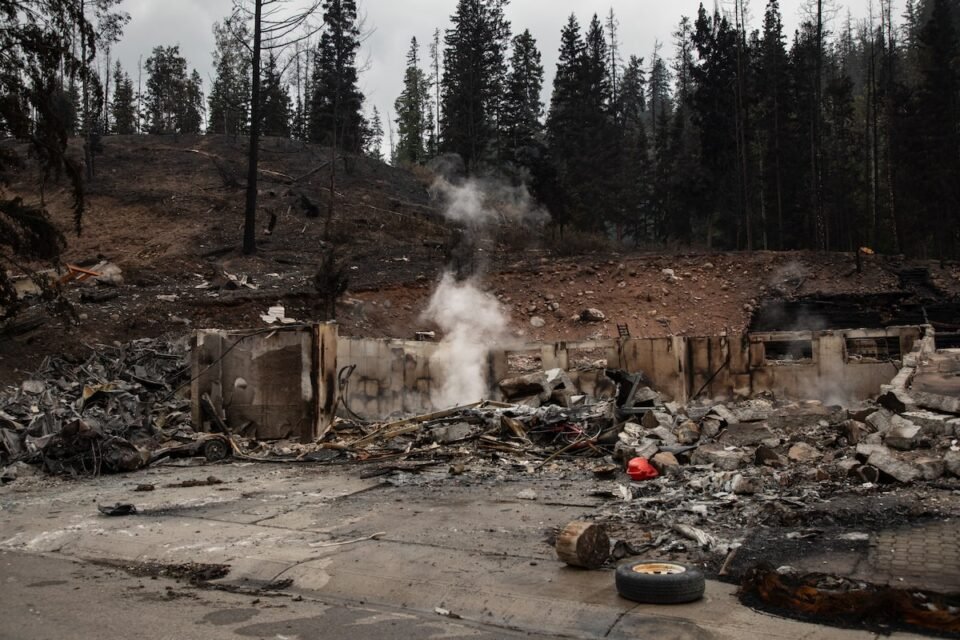
The remains of a home smoulder in Jasper, Alta., in July, 2024.AMBER BRACKEN/The Canadian Press
Danny Parys is a strategy and governance consultant, and a fellow at Social Capital Partners.
When disaster strikes, who do you call?
Today, the answer is increasingly: Private equity. Or, more accurately, a company owned by private equity.
That’s because over the past two decades, many local, independent firms operating in the disaster economy, companies that provide services to us when we are most vulnerable – such as disaster restoration firms, medevacs, surgical centres and funeral homes – have been quietly and comprehensively bought up by asset managers.
This massive consolidation has meant that, precisely when consumers are least willing or able to shop around, the cost of support has risen while the quality of service has declined.
And as emergencies that affect our property, and our loved ones, are set to increase, the impact of this consolidation is likely to worsen.
Opinion: Air conditioning may kill you: The drawbacks of overadapting to a burning world
Climate change-related natural disasters, such as floods or wildfires, are surging in both frequency and magnitude. According to data from the Insurance Bureau of Canada, in 2024 alone weather-related losses amounted to $8.5-billion – the highest on record.
And as Canadians continue to age, trips to the emergency room, emergency medical care and funerals will also contribute to the growth of the disaster economy. Aging alone will add $93-billion to health care costs in the next 10 years, according to research by the Conference Board of Canada.
For Canadians this is cause for concern.
For private equity firms, it’s an economic opportunity. Natural disasters and personal emergencies represent a recession-proof growth industry, where consumers have few alternatives.
Consider the disaster restoration industry. Twenty years ago, this sector was dominated by local, family-owned businesses. Vibrant competition in this ecosystem ensured that the cost of repair was mostly aligned with inflation.
But in 2007, Canadian private equity firm, TorQuest Partners, began rolling up disaster restoration companies across Canada, and since 2018 private equity has deployed more than US$6-billion into the disaster restoration industry.
This rapid consolidation has meant that large private equity-backed companies with reduced competition and close ties to insurance companies have been able to control pricing dynamics.
And because private equity firms tend to rely on acquisition strategies that saddle companies with debt, relying on their own cash flow to repay loans, even in markets where competition still exists, consumers are unlikely to avoid rising costs.
Servicing these heavy debt loads means price increases are inevitable and cost cutting is widespread, often manifesting in diminished safety protocols and reduced wages.
The result? Higher insurance costs for Canadians. Over the past decade, home insurance costs have risen by 90 per cent in Alberta and by 84 per cent in Ontario.
Opinion: Canada needs to invest in nature as infrastructure
Despite rampant consolidation, much of this activity has remained hidden to the general public.
Private equity firms tend to not advertise their acquisitions and most formerly independent firms retain their names and brand identity even while sitting underneath a much wider corporate umbrella, obfuscating who really owns and controls the company.
Moreover, in many cases the customer doesn’t pay directly as firms operating in these sectors often bill insurance providers, not individuals.
Though the customer might not pay directly, and remain unaware of price increases, over time higher costs are absorbed in the form of pricier insurance, or in instances where government foots the bill, an increased tax burden.
But disaster restoration is far from the only sector affected by this type of consolidation.
Private equity companies are now heavily invested in Canada’s medevac infrastructure, increasingly controlling the market for rapid emergency transportation. A worrying trend, as analysis by the Brookings Institution done in the U.S. suggests that private equity-backed medevac firms charged more, and increased prices more aggressively, than their non-private equity counterparts.
And once transported, it is increasingly likely that a private equity firm will also control the clinic or surgical centre the patient arrives at, as acquisition activity in Canada’s health care sector has been heating up. For example, just one private equity firm, Kensington Capital Partners through its subsidiary Clearpoint Health Network, now controls 53 for-profit surgical centres across six provinces.
Funeral homes, too, have fallen prey to private equity. In 2024, Canada’s largest funeral home was purchased by a private equity firm, Birch Hill Equity Partners Management Inc., through its affiliate Viridian Acquisition Inc., punctuating a continuing trend of acquisitions.
When disaster happens, whether it be related to property or a loved one, so much consolidation means that there is increasingly little option but to call a private equity-backed firm.
Traditionally, an ecosystem of local, independent businesses operating in a competitive environment meant that market forces could protect people at their most vulnerable.
Now, as private equity firms continue to consolidate in the ever-growing disaster economy, Canadians’ collective vulnerability has become a key asset used to unlock economic value.