
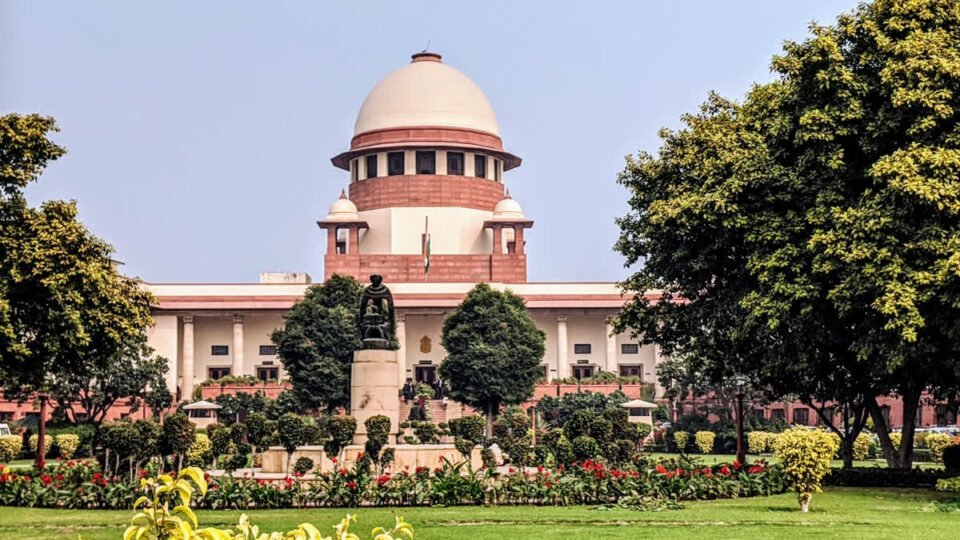
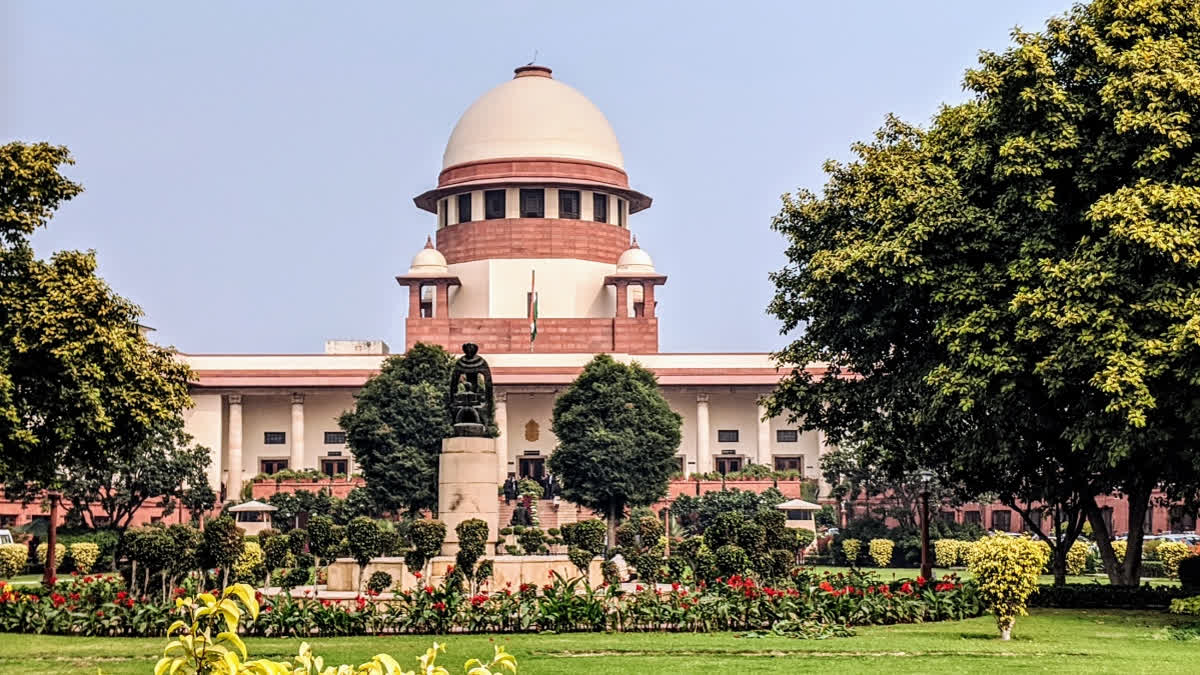
File photo of Supreme Court (Getty Images)
New Delhi: The Supreme Court on Wednesday said that the personal private properties of a titular ruler would pass to his successors in accordance with Hindu or Muslim personal law instead of the customary law of primogeniture, where the eldest male lineal descendant inherited all properties.
The judgment was delivered by a bench comprising Justices Pankaj Mithal and S V N Bhatti. The apex court delivered its verdict on a civil dispute between Brigadier Sukhjit Singh, the government-recognised titular ‘Maharaja’ of Kapurthala, and his estranged wife Gita Devi and their children.
The bench said that while the rule of primogeniture could apply to the symbolic throne (gaddi) and titles, it does not extend to personal private properties declared during the merger of princely states.
“In view of the above discussion that the properties declared to be the private properties of the Maharaja would devolve according to Hindu Law/ Law of Succession and not by the rule of primogeniture, the judgment and order of the learned single judge as well as of the division bench of the high court which holds that the rule of primogeniture would prevail in the succession of properties is illegal and is unsustainable in law,” said the bench.
The bench said that the properties/estate did not constitute the ruler’s estate, as the merger covenant guaranteed such custom only for the gaddi (throne), not for private property.
It said that as the private properties of an ordinary citizen, they were required to devolve according to the ordinary personal law then in force, namely, the Hindu Mitakshara Law.
The bench said the estate/the private properties declared by the ruler devolved upon the single heir, Maharaja Paramjit Singh, on 19.06.1949 immediately after the merger agreement.
“At that time, the Hindu Succession Act was not in force. The said Act was enforced with effect from 17.06.1956, and by that time, the properties had already acquired the status of private property of the then ruler, Maharaja Paramjit Singh, in his capacity as an ordinary citizen, due to the signing of the merger agreement,” it added.
The bench said accordingly, the Hindu Succession Act or Section 5(ii) of the Act, which exempts estates descending to a single heir under a covenant, is not applicable here.
Singh claimed that as the eldest male lineal descendant, he was the sole owner of all family properties under customary law and that the Hindu Succession Act did not apply to his impartible estate.
The bench said that the issue before it was how the properties of the ruler, declared to be the private personal properties and distinct from the public properties, would devolve upon the heirs and successors.
“Upon the signing of the merger covenant, Maharaja Jagatjit Singh ceased to be an absolute sovereign and assumed the status of an ordinary citizen of India,” it said.
The bench said that the recognition of the Maharaja as the ruler by the President of India under Article 366 (22) of the Constitution was a political or an executive act for ceremonial purposes entitling the Maharaja to receive privy purse and other connected privileges, but it was not an indicium of ownership of property.
The bench said after signing the merger agreement and notification of certain properties as the personal private properties of the Maharaja, only the perceived throne devolved according to the rule of primogeniture, but not the personal private properties of the ruler.
It said the personal private properties declared by the ruler would devolve upon his successors in accordance with the Muslim/Hindu personal law, or in the present case, in accordance with the Hindu Succession Act and not by the rule of primogeniture.
The bench said that of the disputed four immovable properties, three are in the joint names of the family members, and so they are liable to division between the joint holders.
“An inventory of private properties was declared by the then Maharaja Jagatjit Singh. Therefore, the properties so declared by him as per the inventory became his private personal properties, over which he had full ownership and right of use and enjoyment. The covenant nowhere provided that such private and personal properties declared by the Maharaja would be governed by the rule of primogeniture,” it added.
The bench said the Maharaja had not only declared some of his properties as private and personal properties but has also expressed his intention that they would devolve upon his heirs and successors in the normal way, rather than under the rule of primogeniture.
Read More