
When economists discuss infrastructure, the conversation usually centres on roads, ports, railways, power and other physical assets that support economic activity. Far less attention is paid to security, even though it underpins them all. Where lives and property cannot be protected with reasonable certainty, investment falters, businesses face higher operating costs, supply chains are disrupted and economic activity suffers.
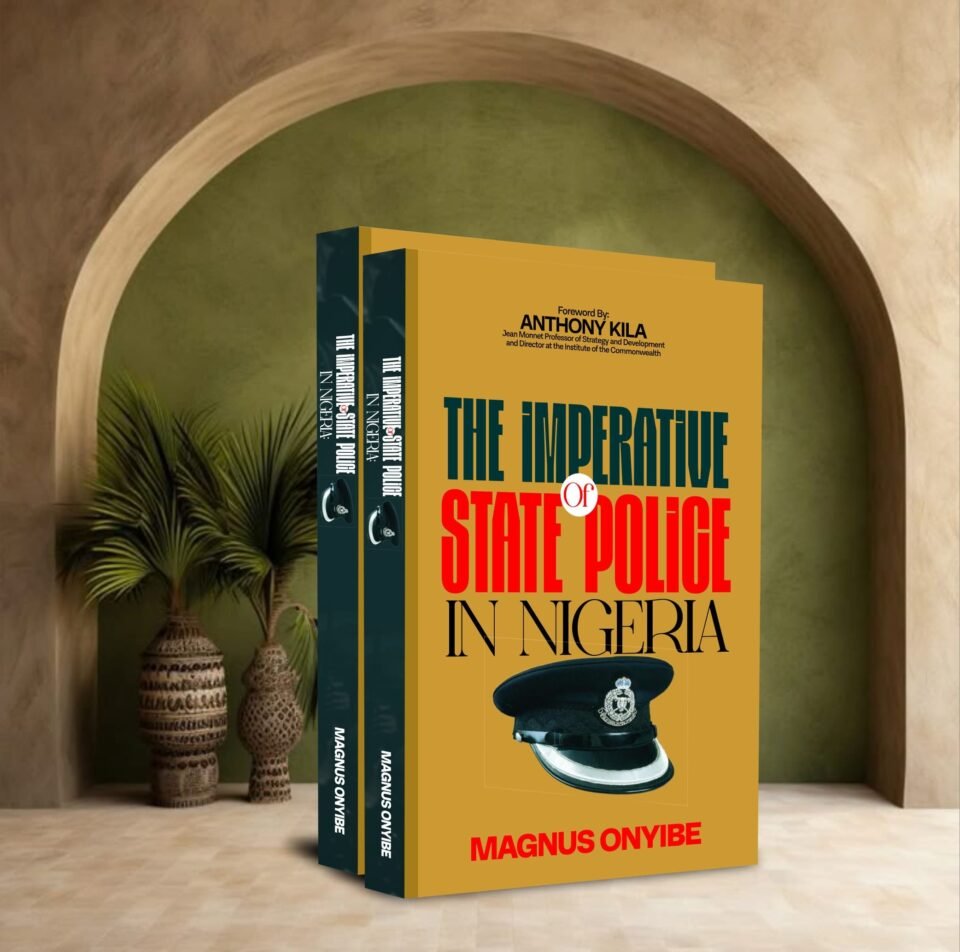
It is from this broader perspective that Magnus Onyibe approaches the question of state policing in The Imperative of State Police in Nigeria. Although the book examines constitutional and institutional reform, its central argument is that no economy can fulfil its potential without a security system capable of maintaining public order and inspiring confidence.
The book is published at a time when questions of security have become inseparable from those of economic survival. Nigeria continues to grapple with terrorism, banditry, kidnapping, communal violence, oil theft, piracy and organised crime, all of which exact a heavy economic toll alongside their human cost. Farmers abandon productive land, manufacturers contend with rising logistics and insurance costs, mining operations are disrupted and investors increasingly factor security risks into investment decisions. Governments, meanwhile, devote growing portions of limited public resources to emergency responses instead of long-term development.
Against this backdrop, Onyibe poses a fundamental question: does Nigeria’s worsening security situation stem simply from inadequate policing resources, or does the problem lie deeper, in the structure of the country’s policing system itself?
Onyibe’s answer is clear. He argues that Nigeria’s highly centralised policing system, inherited from the military era, is no longer suited to the demands of governing a federal republic of more than 220 million people. Concentrating operational control at the centre, he contends, has slowed decision-making, weakened local intelligence gathering and reduced the capacity of the police to respond effectively to the different security challenges confronting various parts of the country.
Whether readers agree entirely with this conclusion or not, the argument deserves careful consideration because it shifts attention from symptoms to systems. Much public discussion of insecurity revolves around operational issues—recruiting more personnel, acquiring better equipment or increasing funding. Onyibe does not dismiss these measures. Rather, he argues that they can achieve only so much if the institutional framework within which they operate is no longer fit for purpose.
The book, however, avoids romanticising the past. Onyibe acknowledges that any move towards state policing must reflect present-day realities rather than attempt to recreate arrangements from another era. His proposal is anchored in a constitutional framework designed to combine greater operational flexibility at the state level with effective national coordination. Recruitment standards, professional training, accountability, judicial oversight, intelligence-sharing and sustainable funding receive sustained attention. These, he argues, are not secondary considerations but the foundations of any successful decentralised policing system.
That emphasis on institutional capacity broadens the discussion beyond policing itself. Investors increasingly assess not only macroeconomic indicators but also the quality of a country’s institutions. The predictability of regulation, the effectiveness of the justice system and the state’s ability to guarantee public safety all shape investment decisions. Seen from this perspective, Onyibe’s argument speaks directly to Nigeria’s economic competitiveness.
Another strength of the book is its recognition that effective policing in the 21st century depends as much on technology as on constitutional reform. Onyibe argues that changes to the legal framework will accomplish little unless they are matched by investment in surveillance systems, integrated command-and-control centres, digital intelligence platforms, data-driven crime analysis and community reporting mechanisms.
He illustrates this argument with practical examples. Governor Peter Mbah’s technology-driven security initiatives in Enugu State demonstrate how innovation can strengthen intelligence gathering and improve operational response. The Lagos State Security Trust Fund, meanwhile, offers an example of how collaboration between government and the private sector can reinforce security while preserving institutional accountability.
Taken together, these examples suggest that effective security can no longer be regarded as the exclusive responsibility of the government. Businesses, financial institutions, technology firms and local communities all have important roles to play in creating a safer environment. Onyibe argues that a decentralised policing system should encourage such partnerships by bringing decision-making closer to the communities where security challenges arise.
The book ranges across political history, constitutional law, public administration, comparative governance and practical policing experience. Although it draws together nineteen newspaper articles written over more than two decades, it reads as a coherent study, tracing both the deterioration of Nigeria’s security environment and the evolution of the author’s thinking on state policing. Professor Anthony Kila’s foreword provides an intellectual frame, while the afterword by retired Assistant Inspector-General of Police Tunji Alapini grounds the discussion in operational experience.
The Imperative of State Police in Nigeria will be presented on September 10, 2026, at the Abuja Continental Hotel under the theme, “Explaining the Grey Areas of State Policing: The Case, the Strategy, the Operations, and the Framework.” Organised by Inspire Media Services Limited, the event is expected to bring together policymakers, legislators, security professionals, governors, constitutional scholars and private-sector leaders, reflecting the broad range of interests the issue now commands.
The book is unlikely to settle the debate over state police. Questions about political interference, the varying fiscal capacities of the states, constitutional safeguards and coordination between federal and state police forces remain. Onyibe acknowledges these concerns and argues that they should be addressed through institutional design rather than used as reasons to preserve the status quo.
His larger point is that security should be viewed as economic infrastructure. Roads, power stations and ports cannot deliver their full value where insecurity keeps farmers off their land, disrupts supply chains, raises the cost of doing business and discourages investment. Seen in that light, policing reform is not simply a constitutional question but an economic one.
Whether or not readers accept Onyibe’s case for state police, the book succeeds in shifting the discussion beyond politics to the relationship between security, investment and national development. At a time when Nigeria is searching for new engines of economic growth, it is a perspective that deserves serious attention.


