
As US Treasury yields rise to the highest in decades, are bonds becoming a better investment for portfolios? “Clearly bonds look more attractive on first look,” says Christian Mueller-Glissmann, head of Asset Allocation within Goldman Sachs Research. “The challenge, of course, is it depends a lot on your investment horizon.”
In the near term, longer-duration bonds may make portfolios riskier and may not provide a reliable hedge when investors shun risk. However, increasing bond allocations may make more sense for investors with longer time horizons, according to Goldman Sachs Research.
-
Higher Treasury yields make bonds look more appealing for portfolios, but whether investors should increase their bond allocations depends on their time horizons.
-
Equities still look more attractive than bonds over the next few months, according to Goldman Sachs Research. Strong earnings growth may provide a buffer against rising bond yields.
-
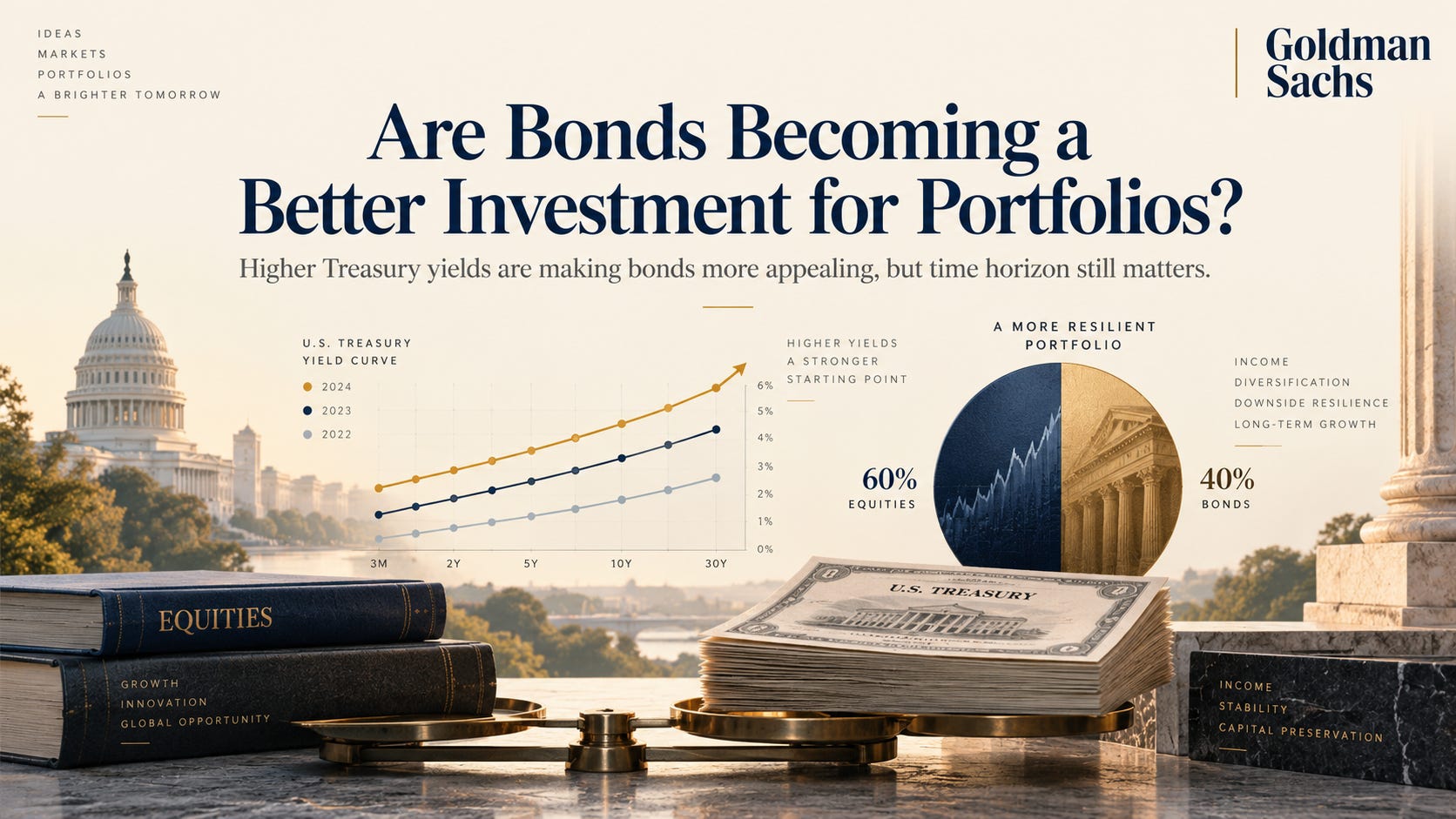
A 60/40 portfolio of 60% stocks and 40% bonds may offer a better risk-reward over longer time horizons, although investors should still consider diversifying those portfolios with, for example, alternative assets.
As US Treasury yields rise to the highest in decades, are bonds becoming a better investment for portfolios? “Clearly bonds look more attractive on first look,” says Christian Mueller-Glissmann, head of Asset Allocation within Goldman Sachs Research. “The challenge, of course, is it depends a lot on your investment horizon.”
In the near term, longer-duration bonds may make portfolios riskier and may not provide a reliable hedge when investors shun risk. However, increasing bond allocations may make more sense for investors with longer time horizons, according to Goldman Sachs Research.
Mueller-Glissmann points to four key factors to consider when allocating assets to a portfolio: the assets’ relative return, their relative risk, their correlation benefit, and their return versus cash.
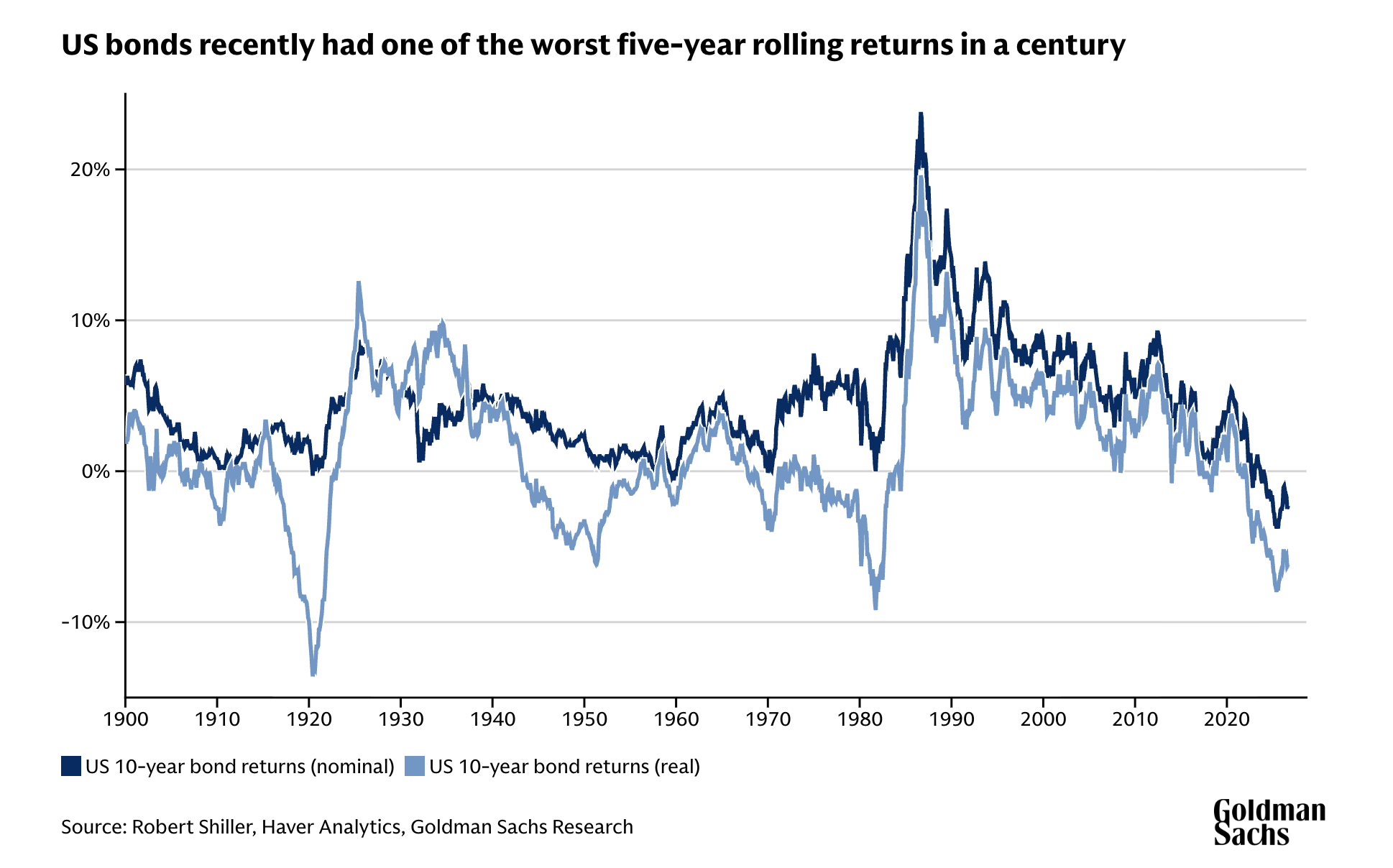
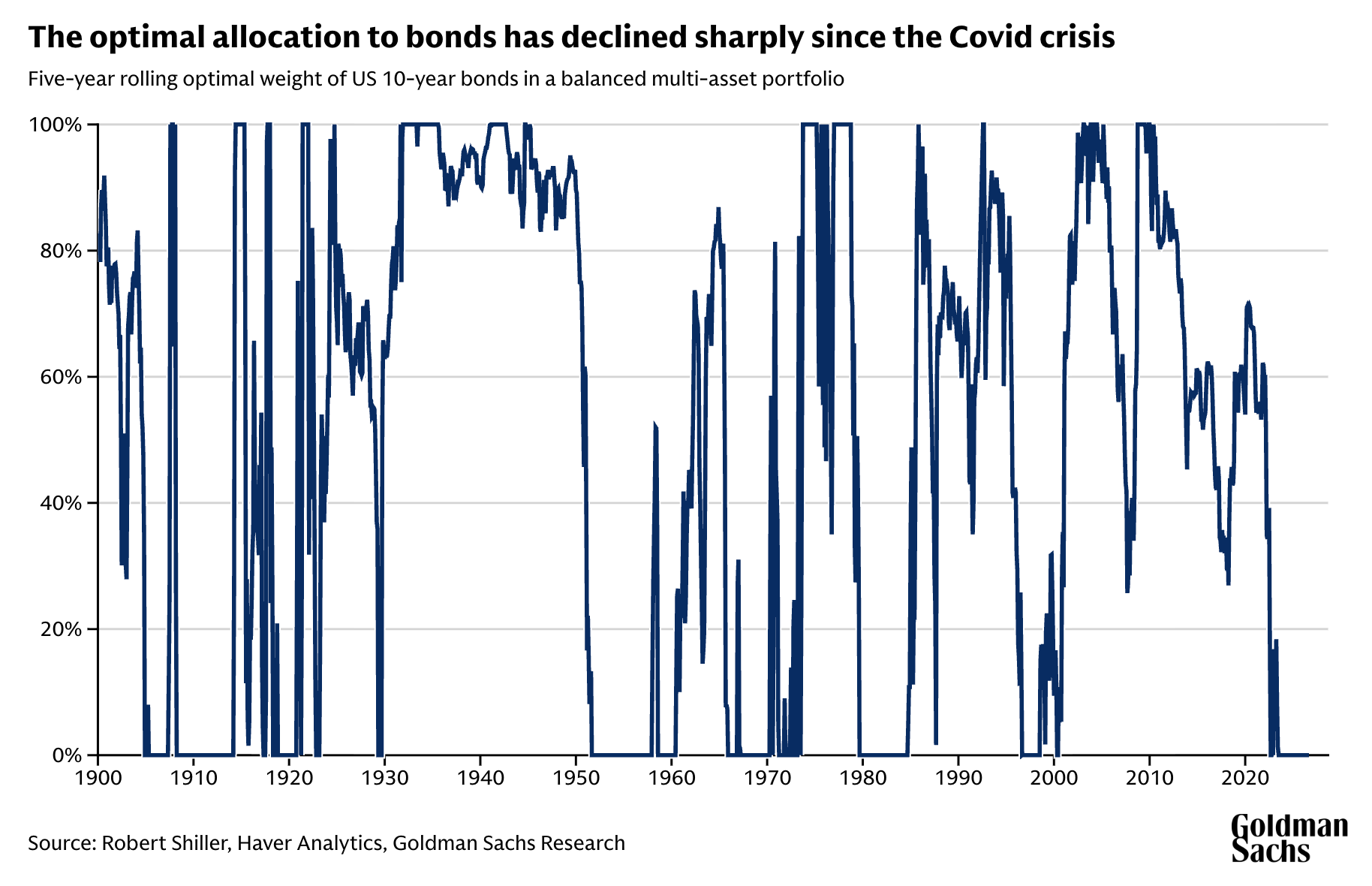
The relative return of bonds versus other assets is becoming more complex as there is scope for interest rates to climb higher, he says. Goldman Sachs Research’s baseline, meanwhile, is that equities’ relative return in the next few months will be boosted by earnings growth. The optimal allocation to bonds over the last five years was close to 0%, as those securities posted one of their worst five-year rolling returns in a century while equities performed strongly.
“Equities can in a lot of places still cushion higher bond yields because of very strong earnings growth,” Mueller-Glissmann says. “That strong earnings growth is a bit like a buffer for higher bond yields.”
Companies are reporting third-quarter earnings starting this month, and stocks have the potential to surprise to the upside. “The tech sector and artificial intelligence theme are still delivering some very strong earnings momentum, and we expect that to continue,” he says.
As technology companies launch new products and services using AI, that creates potential for new revenue and monetization, Mueller-Glissmann says. At the same time, a decline in bond yields would likely be a boost to stocks as well as bond investments.
“Putting it all together, the relative return to us looks better in equities,” he says.
To some extent, the relative risk for bonds has improved because higher yields offer more carry, which can help cushion a portfolio against declines. But even so, the relative risk for bonds is still elevated amid Middle East tensions and uncertainty about inflation and monetary policy. Some sovereign bond issuers in Europe are also coming under pressure, as French and Italian government bond yields rise relative to those of Germany.
“It’s creating a more risky profile for bonds, with some of that volatility coming via the currencies,” he says. The volatility in European fixed-income securities and foreign exchange can be a “double whammy” for investors. That can also create demand for relative safe havens like US Treasuries, German bunds, and UK gilts, as those securities may benefit from rising concerns about some European government bonds.
The recent correlation between bonds and stocks has not favored fixed-income assets, Mueller-Glissmann says. He notes that equity-bond correlations have been positive, with both assets in many cases rising or falling in tandem. Volatility in energy prices and hawkish central bank policy are pushing yields higher while weighing on stocks. Equity returns have been relatively flat in many markets, but Mueller-Glissmann notes that the interest-rate-sensitive parts of the stock market—such as smaller firms, and real estate and infrastructure companies—could benefit from rates relief, especially if growth concerns increase.
“Over the medium term, if you have continued inflation normalization, we could see equity-bond correlations start to turn more negative,” he says. “Near-term it is more complex due to the Middle East tensions, hawkish central banks, and the AI capex boom. However, excessive tightening in financial conditions could eventually weigh on growth sentiment, potentially slowing the bond sell-off and leading to more negative equity-bond correlations.”
The expected return for bonds versus cash is not necessarily attractive, according to Goldman Sachs Research. There is likely more value in shorter- to medium-term government debt because central bank policy is unlikely to drive those interest rates substantially higher, and those securities yield nearly as much as longer-term bonds, Mueller-Glissmann says.
The situation could be much different over the longer term, however. “The longer your investment horizon gets, the more you need to think about a more normal allocation to bonds,” Mueller-Glissmann says.
In the longer run, bonds’ relative return, relative risk, correlation benefit, and return versus cash may be substantially better than in the near term. Goldman Sachs Research uses a long-term scenario framework to predict the optimal bond allocation for the next five to 10 years based on varying macroeconomic outcomes for GDP growth, inflation, and corporate profitability.
“When you look over the very long run since World War II, on average, the optimal bond allocation was actually 40%,” Mueller-Glissmann says. That aligns with a typical balanced 60/40 portfolio of 60% stocks and 40% bonds.
He notes that the 10-year US Treasury yield of 5.3% is higher than the average of 4.7% over the last 250 years. “From that perspective, we are not at a bad starting point for long-run investing in bonds,” Mueller-Glissmann says. While concerns about many countries’ fiscal outlooks have risen and inflation volatility has increased, “longer-duration bond yields are reflecting that risk already a bit,” he says.
Even though the outlook for the 60/40 portfolio has improved for longer-term investors, Mueller-Glissmann says he is skeptical that conditions will again be as favorable for the traditional balanced portfolio as they were before the Covid pandemic. “You need to work a bit harder within the asset classes,” he says. These portfolios may benefit from allocations to alternative assets such as real assets, hedge funds, and private equity as well as from factor investing.
“Our core mantra for building a portfolio for the next decade is you need to have exposure to innovation, protection from inflation, and better risk mitigation,” Mueller-Glissmann says.
Within equities, that points to favoring technology stocks and real assets, he says. In bonds, there’s a stronger case for inflation-linked bonds such as Treasury Inflation-Protected Securities (TIPS), with the large increase in real yields this year. Factor investing, such as low-volatility and selective high-dividend-yield stocks, can help reduce risk, because those tend to be negatively correlated with technology stocks. Commodity trading advisors (CTAs), meanwhile, have historically offered inflation protection and some protection in a crisis.