
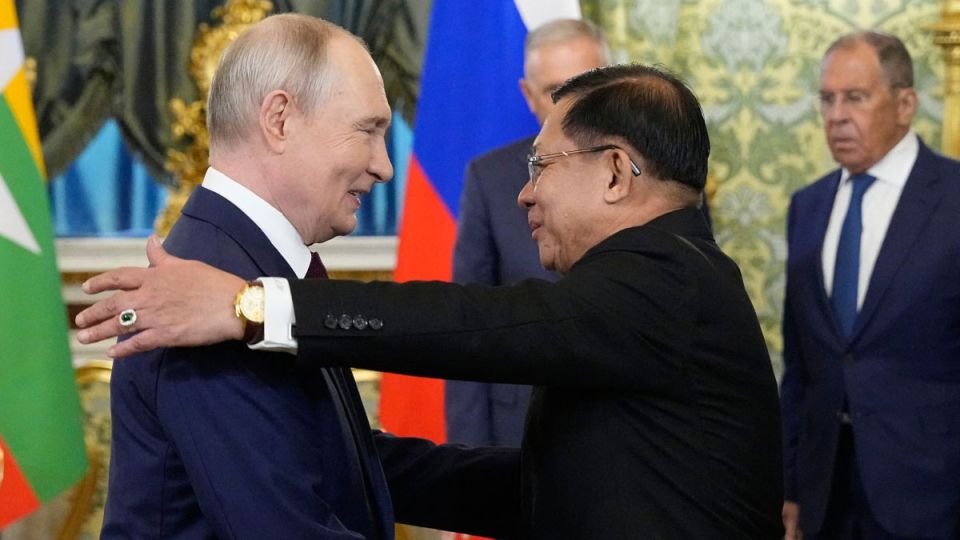
Russian President Vladmir Putin said Russia is willing to cooperate with Myanmar in natural resource exploration and oil and gas extraction, including offshore projects, as the two countries signed 12 memorandums of understanding during Myanmar President Min Aung Hlaing’s visit to Moscow.
Putin made the remarks during the joint meeting with media on August 18, alongside Min Aung Hlaing, describing the energy sector as an important area of bilateral cooperation.
“Russia is willing to cooperate in natural resource exploration and oil and gas extraction in Myanmar, including offshore areas. There is considerable potential for Russia to export LNG to Myanmar. The LNG could be used domestically and also exported to other countries,” Putin said.
He noted that coal-fired power plant and oil refinery projects are already underway in Myanmar, and said the two countries signed an agreement last year to build a nuclear power plant, calling it a key project for both countries.
Putin said Russia-Myanmar relations are built on long-standing friendship, fairness, mutual respect, and mutual benefit, recalling that Soviet Union provided substantial assistance to Myanmar in the social, economic, and defense sectors during 1950s and 1960s.
Read More: Myanmar’s Min Aung Hlaing Heads to Moscow in First Visit Since Becoming President
He noted that Soviet-era infrastructure, including hospitals and universities, continues to benefit the Myanmar people today.
“Russia-Myanmar relations continue to develop and strengthen. There are many points of contact between the governments of the two countries. The foreign ministers of both countries maintain systematic communication and relations,” he said, adding that consultations are also held continuously between security councils, parliaments and political parties.
Putin pointed to a broader portfolio of joint projects, including a steel plant and fertilizer plant under construction in Myanmar, along with discussions on a deep-sea port in southern Myanmar and cooperation in high-tech fields such as digital sector and cybersecurity.
Under a visa-free arrangement, scientists, young people, tourists, and athletes have been travelling between the two countries, and a Myanmar consulate is set to open in Vladivostok, adding to existing Myanmar cultural and religious centers in Russia’s Altai and Kaluga regions and in Moscow.
Read More: Russia–ASEAN Summit 2026: What Is at Stake for Southeast Asia?
Putin also said the approval had been granted to build a Russian Orthodox church in Yangon, and noted growing interest in the Russian language, with Russian now taught at universities in Yangon and Mandalay as well as at Myanmar’s military academy.
He said 400 Myanmar students are currently studying at Russian universities, with 17,000 having graduated from Russian institutions to date.
On military front, Putin said bilateral military-technical cooperation was developing well, with the two countries frequently conducting exercises in Myanmar’s waters and Russian naval vessels making regular visits.
He added that Russia and Myanmar hold closely aligned views on international affairs, with both countries opposing interference in the internal affairs of states and international organizations.
With 12 MoUs signed during Min Aung Hlaing’s visit, Putin said he was confident the trip would prove successful and the agreements would provide significant support for the countries’ broader partnership.
